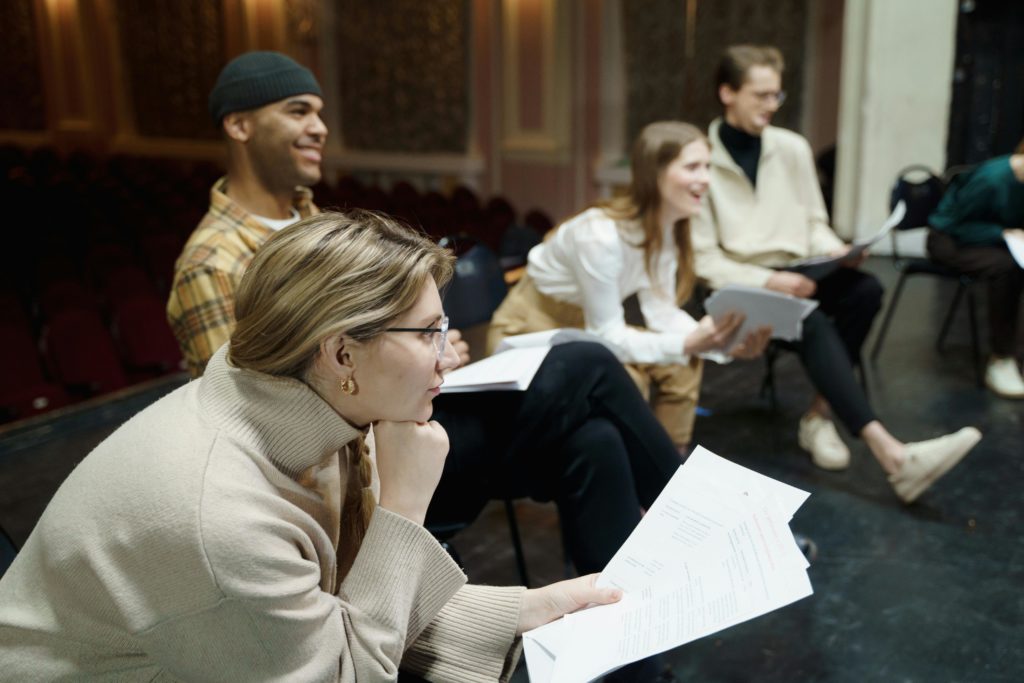
{"id":829,"date":"2024-01-25T10:00:00","date_gmt":"2024-01-25T10:00:00","guid":{"rendered":"https:\/\/blogs.sussex.ac.uk\/librarycollections\/?p=829"},"modified":"2024-05-09T10:55:21","modified_gmt":"2024-05-09T09:55:21","slug":"theatre-and-academia-series-how-the-library-enhances-your-performing-arts-education","status":"publish","type":"post","link":"https:\/\/blogs.sussex.ac.uk\/librarycollections\/2024\/01\/25\/theatre-and-academia-series-how-the-library-enhances-your-performing-arts-education\/","title":{"rendered":"Theatre and Academia Series: How the Library Enhances Your Performing Arts Education"},"content":{"rendered":"\n<p>by Helena MacCormack<\/p>\n\n\n\n<p>As someone who has studied performing arts for years, I understand the unique journey that drama students embark upon. Theatre is a vibrant, living art form where practice and creativity take centre stage. However, there is a misconception that theatre students exist in opposition to academia due to the practical nature of their degrees. While practical work is at the core of theatre studies, academic research plays a crucial role in shaping your perspective as a theatre practitioner. This post marks the first of a series which will detail 5 ways in which the Library&#8217;s resources can provide academic grounding to your theatre studies, with plenty of recommendations.<\/p>\n\n\n\n<div class=\"wp-block-image\"><figure class=\"aligncenter size-large\"><img loading=\"lazy\" width=\"550\" height=\"367\" src=\"https:\/\/i2.wp.com\/blogs.sussex.ac.uk\/librarycollections\/files\/2024\/01\/AdobeStock_95665646-1024x683.jpeg?resize=550%2C367&#038;ssl=1\" alt=\"People sitting in a theatre. The image is taken from behind, facing the stage.\" class=\"wp-image-902\" srcset=\"https:\/\/i1.wp.com\/blogs.sussex.ac.uk\/librarycollections\/files\/2024\/01\/AdobeStock_95665646-scaled.jpeg?resize=1024%2C683&amp;ssl=1 1024w, https:\/\/i1.wp.com\/blogs.sussex.ac.uk\/librarycollections\/files\/2024\/01\/AdobeStock_95665646-scaled.jpeg?resize=300%2C200&amp;ssl=1 300w, https:\/\/i1.wp.com\/blogs.sussex.ac.uk\/librarycollections\/files\/2024\/01\/AdobeStock_95665646-scaled.jpeg?resize=768%2C512&amp;ssl=1 768w, https:\/\/i1.wp.com\/blogs.sussex.ac.uk\/librarycollections\/files\/2024\/01\/AdobeStock_95665646-scaled.jpeg?resize=1536%2C1024&amp;ssl=1 1536w, https:\/\/i1.wp.com\/blogs.sussex.ac.uk\/librarycollections\/files\/2024\/01\/AdobeStock_95665646-scaled.jpeg?resize=2048%2C1365&amp;ssl=1 2048w, https:\/\/i1.wp.com\/blogs.sussex.ac.uk\/librarycollections\/files\/2024\/01\/AdobeStock_95665646-scaled.jpeg?resize=100%2C67&amp;ssl=1 100w, https:\/\/i1.wp.com\/blogs.sussex.ac.uk\/librarycollections\/files\/2024\/01\/AdobeStock_95665646-scaled.jpeg?resize=150%2C100&amp;ssl=1 150w, https:\/\/i1.wp.com\/blogs.sussex.ac.uk\/librarycollections\/files\/2024\/01\/AdobeStock_95665646-scaled.jpeg?resize=200%2C133&amp;ssl=1 200w, https:\/\/i1.wp.com\/blogs.sussex.ac.uk\/librarycollections\/files\/2024\/01\/AdobeStock_95665646-scaled.jpeg?resize=450%2C300&amp;ssl=1 450w, https:\/\/i1.wp.com\/blogs.sussex.ac.uk\/librarycollections\/files\/2024\/01\/AdobeStock_95665646-scaled.jpeg?resize=600%2C400&amp;ssl=1 600w, https:\/\/i1.wp.com\/blogs.sussex.ac.uk\/librarycollections\/files\/2024\/01\/AdobeStock_95665646-scaled.jpeg?resize=900%2C600&amp;ssl=1 900w, https:\/\/i1.wp.com\/blogs.sussex.ac.uk\/librarycollections\/files\/2024\/01\/AdobeStock_95665646-scaled.jpeg?w=1100 1100w, https:\/\/i1.wp.com\/blogs.sussex.ac.uk\/librarycollections\/files\/2024\/01\/AdobeStock_95665646-scaled.jpeg?w=1650 1650w\" sizes=\"(max-width: 550px) 100vw, 550px\" data-recalc-dims=\"1\" \/><figcaption>Photo by <a href=\"https:\/\/stock.adobe.com\/uk\/contributor\/201855263\/aerogondo?load_type=author&amp;prev_url=detail\" data-type=\"URL\" data-id=\"https:\/\/stock.adobe.com\/uk\/contributor\/201855263\/aerogondo?load_type=author&amp;prev_url=detail\">aerogondo<\/a> on <a href=\"https:\/\/stock.adobe.com\/uk\/images\/audience-watching-theater-play\/95665646\" data-type=\"URL\" data-id=\"https:\/\/stock.adobe.com\/uk\/images\/audience-watching-theater-play\/95665646\">Adobe Stock<\/a><\/figcaption><\/figure><\/div>\n\n\n\n<h2>1. Technique: The Craftsmanship of Theatre<\/h2>\n\n\n\n<p>Honing your craft is essential. Whether you&#8217;re an aspiring actor, director, or designer, the Library offers a plethora of resources to enhance your technical skills. Peruse the PN section of the Library to discover how tried and tested methods can elevate your artistry. Here are some of my top recommendations.<\/p>\n\n\n\n<p><strong>For those who perform:<\/strong><\/p>\n\n\n\n<p><em>Freeing the natural voice: imagery and art in the practice of voice and language<\/em> by Kristin Linklater (2006)<br>Library shelfmark: PN 4162 LIN<\/p>\n\n\n\n<p>Originally published in 1976, Linklater&#8217;s manual on vocal technique was revolutionary in its unification of theory and practice. It draws heavily upon the almost meditative use of imagery and imagination, extolling both psychological and physiological wisdom in order to best support the voice. Linklater&#8217;s techniques continue to be studied today by a variety of performing artists wanting to connect with their voice. The exercises are best completed with oral instruction &#8211; working with a voice teacher if possible, even better in a group where discussion can take place &#8211; but are also effective when used in solo study.<\/p>\n\n\n\n<div class=\"wp-block-jetpack-markdown\"><p><em>The Actor Training Reader<\/em>, ed. by Mark Evans (2015)<br>\nLibrary shelfmark: PN 2061 ACT<\/p>\n<\/div>\n\n\n\n<p>This reader provides an overview of foundational ideologies in actor training, collecting writings from some key 20th-century theatre practitioners including Konstantin Stanislavski, Bertolt Brecht, and Michael Chekhov.<\/p>\n\n\n\n<p><em>The Six Questions: Acting Technique For Dance Performance<\/em> by Daniel Nagrin (1997) <br><a href=\"https:\/\/www-jstor-org.sussex.idm.oclc.org\/stable\/j.ctt5vkgfq\">Online access via JSTOR<\/a><\/p>\n\n\n\n<p>Nagrin borrows from Stanislavskian acting techniques in order to explore &#8216;the internal life of a dance performance&#8217;, which he argues is as important as the physical. Split into two parts, &#8216;The Theory&#8217; and &#8216;The Workbook&#8217;, <em>Six Questions<\/em> is a thorough yet succinct text for dancers wanting to strengthen their outward performance through inward enquiry.<\/p>\n\n\n\n<figure class=\"wp-block-image size-large\"><img loading=\"lazy\" width=\"550\" height=\"367\" src=\"https:\/\/i1.wp.com\/blogs.sussex.ac.uk\/librarycollections\/files\/2024\/01\/240123-HMBlogPost-2-1024x683.jpg?resize=550%2C367&#038;ssl=1\" alt=\"Three silhouettes in poses behind a red theatre curtain. \" class=\"wp-image-903\" srcset=\"https:\/\/i0.wp.com\/blogs.sussex.ac.uk\/librarycollections\/files\/2024\/01\/240123-HMBlogPost-2-scaled.jpg?resize=1024%2C683&amp;ssl=1 1024w, https:\/\/i0.wp.com\/blogs.sussex.ac.uk\/librarycollections\/files\/2024\/01\/240123-HMBlogPost-2-scaled.jpg?resize=300%2C200&amp;ssl=1 300w, https:\/\/i0.wp.com\/blogs.sussex.ac.uk\/librarycollections\/files\/2024\/01\/240123-HMBlogPost-2-scaled.jpg?resize=768%2C512&amp;ssl=1 768w, https:\/\/i0.wp.com\/blogs.sussex.ac.uk\/librarycollections\/files\/2024\/01\/240123-HMBlogPost-2-scaled.jpg?resize=1536%2C1024&amp;ssl=1 1536w, https:\/\/i0.wp.com\/blogs.sussex.ac.uk\/librarycollections\/files\/2024\/01\/240123-HMBlogPost-2-scaled.jpg?resize=2048%2C1365&amp;ssl=1 2048w, https:\/\/i0.wp.com\/blogs.sussex.ac.uk\/librarycollections\/files\/2024\/01\/240123-HMBlogPost-2-scaled.jpg?resize=100%2C67&amp;ssl=1 100w, https:\/\/i0.wp.com\/blogs.sussex.ac.uk\/librarycollections\/files\/2024\/01\/240123-HMBlogPost-2-scaled.jpg?resize=150%2C100&amp;ssl=1 150w, https:\/\/i0.wp.com\/blogs.sussex.ac.uk\/librarycollections\/files\/2024\/01\/240123-HMBlogPost-2-scaled.jpg?resize=200%2C133&amp;ssl=1 200w, https:\/\/i0.wp.com\/blogs.sussex.ac.uk\/librarycollections\/files\/2024\/01\/240123-HMBlogPost-2-scaled.jpg?resize=450%2C300&amp;ssl=1 450w, https:\/\/i0.wp.com\/blogs.sussex.ac.uk\/librarycollections\/files\/2024\/01\/240123-HMBlogPost-2-scaled.jpg?resize=600%2C400&amp;ssl=1 600w, https:\/\/i0.wp.com\/blogs.sussex.ac.uk\/librarycollections\/files\/2024\/01\/240123-HMBlogPost-2-scaled.jpg?resize=900%2C600&amp;ssl=1 900w, https:\/\/i0.wp.com\/blogs.sussex.ac.uk\/librarycollections\/files\/2024\/01\/240123-HMBlogPost-2-scaled.jpg?w=1100 1100w, https:\/\/i0.wp.com\/blogs.sussex.ac.uk\/librarycollections\/files\/2024\/01\/240123-HMBlogPost-2-scaled.jpg?w=1650 1650w\" sizes=\"(max-width: 550px) 100vw, 550px\" data-recalc-dims=\"1\" \/><figcaption>Photo by <a href=\"https:\/\/unsplash.com\/@kyleunderscorehead?utm_content=creditCopyText&amp;utm_medium=referral&amp;utm_source=unsplash\">Kyle Head<\/a> on <a href=\"https:\/\/unsplash.com\/photos\/silhouette-of-three-performers-on-stage-p6rNTdAPbuk?utm_content=creditCopyText&amp;utm_medium=referral&amp;utm_source=unsplash\">Unsplash<\/a><\/figcaption><\/figure>\n\n\n\n<p><strong>For those who create:<\/strong><\/p>\n\n\n\n<p><em>The Playwright&#8217;s Guidebook: An insightful primer on the art of dramatic writing<\/em> by Stuart Spencer (2002)<br>Library shelfmark: PN 1661 SPE<\/p>\n\n\n\n<p>Whether it&#8217;s your first try or your fiftieth try, it&#8217;s always good to go back to basics. This book covers the foundational aspects of writing a play, starting right at the beginning with the matter of structure. With participatory exercises and gems of advice scattered through, this makes for an extensive yet approachable read for those wanting to write like the greats.<\/p>\n\n\n\n<p><em>Devising Theatre: A Practical and Theoretical Handbook<\/em> by Alison Oddey (1994)<br>Library shelfmark: PN 2071.I5 ODD<\/p>\n\n\n\n<p>If you&#8217;re less interested in &#8216;writing a play&#8217; and more keen on &#8216;devising a piece of theatre from scratch&#8217; &#8211; or you&#8217;re uncertain of the difference and curious to find out &#8211; this book is a brilliant starting point. Although it may appear wordy at first for a book about devising, it&#8217;s surprisingly succinct, articulately fusing theory with practical advice. The final chapter, &#8216;Learning to Devise: Practical ideas and suggestions&#8217;, provides a useful array of creative prompts for the rehearsal room.<\/p>\n\n\n\n<figure class=\"wp-block-image size-large\"><img loading=\"lazy\" width=\"550\" height=\"367\" src=\"https:\/\/i1.wp.com\/blogs.sussex.ac.uk\/librarycollections\/files\/2024\/01\/240123-HMBlogPost-3-1024x683.jpg?resize=550%2C367&#038;ssl=1\" alt=\"The Richard Rogers marquee, showing advertising for the musical Hamilton\" class=\"wp-image-904\" srcset=\"https:\/\/i2.wp.com\/blogs.sussex.ac.uk\/librarycollections\/files\/2024\/01\/240123-HMBlogPost-3-scaled.jpg?resize=1024%2C683&amp;ssl=1 1024w, https:\/\/i2.wp.com\/blogs.sussex.ac.uk\/librarycollections\/files\/2024\/01\/240123-HMBlogPost-3-scaled.jpg?resize=300%2C200&amp;ssl=1 300w, https:\/\/i2.wp.com\/blogs.sussex.ac.uk\/librarycollections\/files\/2024\/01\/240123-HMBlogPost-3-scaled.jpg?resize=768%2C512&amp;ssl=1 768w, https:\/\/i2.wp.com\/blogs.sussex.ac.uk\/librarycollections\/files\/2024\/01\/240123-HMBlogPost-3-scaled.jpg?resize=1536%2C1024&amp;ssl=1 1536w, https:\/\/i2.wp.com\/blogs.sussex.ac.uk\/librarycollections\/files\/2024\/01\/240123-HMBlogPost-3-scaled.jpg?resize=2048%2C1365&amp;ssl=1 2048w, https:\/\/i2.wp.com\/blogs.sussex.ac.uk\/librarycollections\/files\/2024\/01\/240123-HMBlogPost-3-scaled.jpg?resize=100%2C67&amp;ssl=1 100w, https:\/\/i2.wp.com\/blogs.sussex.ac.uk\/librarycollections\/files\/2024\/01\/240123-HMBlogPost-3-scaled.jpg?resize=150%2C100&amp;ssl=1 150w, https:\/\/i2.wp.com\/blogs.sussex.ac.uk\/librarycollections\/files\/2024\/01\/240123-HMBlogPost-3-scaled.jpg?resize=200%2C133&amp;ssl=1 200w, https:\/\/i2.wp.com\/blogs.sussex.ac.uk\/librarycollections\/files\/2024\/01\/240123-HMBlogPost-3-scaled.jpg?resize=450%2C300&amp;ssl=1 450w, https:\/\/i2.wp.com\/blogs.sussex.ac.uk\/librarycollections\/files\/2024\/01\/240123-HMBlogPost-3-scaled.jpg?resize=600%2C400&amp;ssl=1 600w, https:\/\/i2.wp.com\/blogs.sussex.ac.uk\/librarycollections\/files\/2024\/01\/240123-HMBlogPost-3-scaled.jpg?resize=900%2C600&amp;ssl=1 900w, https:\/\/i2.wp.com\/blogs.sussex.ac.uk\/librarycollections\/files\/2024\/01\/240123-HMBlogPost-3-scaled.jpg?w=1100 1100w, https:\/\/i2.wp.com\/blogs.sussex.ac.uk\/librarycollections\/files\/2024\/01\/240123-HMBlogPost-3-scaled.jpg?w=1650 1650w\" sizes=\"(max-width: 550px) 100vw, 550px\" data-recalc-dims=\"1\" \/><figcaption>Photo by <a href=\"https:\/\/unsplash.com\/@sdoy1995?utm_content=creditCopyText&amp;utm_medium=referral&amp;utm_source=unsplash\">Sudan Ouyang<\/a> on <a href=\"https:\/\/unsplash.com\/photos\/hamilton-richard-rodgers-signage-UQuka_ruWxQ?utm_content=creditCopyText&amp;utm_medium=referral&amp;utm_source=unsplash\">Unsplash<\/a><\/figcaption><\/figure>\n\n\n\n<p><strong>For those who shape:<\/strong><\/p>\n\n\n\n<p><em>The Director&#8217;s Craft: A Handbook for the Theatre<\/em> by Katie Mitchell (2009)<br>Library shelfmark: PN 2053 MIT<\/p>\n\n\n\n<p>Author Katie Mitchell is one of Britain&#8217;s most influential directors, having directed at some of the UK&#8217;s most recognised institutions including the Royal Shakespeare Company, The Royal National Theatre, The Royal Court, The Young Vic, and The Donmar Warehouse. (Sussex&#8217;s own Ben Fowler has written <a href=\"https:\/\/www-taylorfrancis-com.sussex.idm.oclc.org\/books\/mono\/10.4324\/9781315112572\/katie-mitchell-benjamin-fowler\">a book about her work<\/a>.) In this text, Mitchell shares the key elements of her approach &#8211; a gem for anyone interested in directing.<\/p>\n\n\n\n<p><em>How to Read A Play<\/em> by Ronald Hayman (1977)<br>Library shelfmark: PN 1701 HAY<\/p>\n\n\n\n<p>This text does exactly what it says it will do &#8211; advises the reader on how to effectively visualise a play in order to lift it off the page. Directors and performers may find this useful when contemplating how to best interpret the text at hand.<\/p>\n\n\n\n<p><em>Dramaturgy and performance<\/em> by Cathy Turner and Synne K. Behrndt (2007)<br>Library shelfmark: PN 1661 TUR<\/p>\n\n\n\n<p>If you&#8217;re interested in dramaturgy &#8211; or curious to learn about what it even is in the first place &#8211; this book is a great place to start. From the history and development of dramaturgy as a practice to the various types of dramaturgy in the modern day, Turner and Behrndt provide an introduction to a transmutable role in 21st-century theatre.<\/p>\n\n\n\n<figure class=\"wp-block-image size-large\"><img loading=\"lazy\" width=\"550\" height=\"367\" src=\"https:\/\/i0.wp.com\/blogs.sussex.ac.uk\/librarycollections\/files\/2024\/01\/240123-HMBlogPost-4-1024x683.jpg?resize=550%2C367&#038;ssl=1\" alt=\"A group of people sitting on chairs in a loose line, holding scripts. They are watching something off to the right of the frame.\" class=\"wp-image-905\" srcset=\"https:\/\/i0.wp.com\/blogs.sussex.ac.uk\/librarycollections\/files\/2024\/01\/240123-HMBlogPost-4-scaled.jpg?resize=1024%2C683&amp;ssl=1 1024w, https:\/\/i0.wp.com\/blogs.sussex.ac.uk\/librarycollections\/files\/2024\/01\/240123-HMBlogPost-4-scaled.jpg?resize=300%2C200&amp;ssl=1 300w, https:\/\/i0.wp.com\/blogs.sussex.ac.uk\/librarycollections\/files\/2024\/01\/240123-HMBlogPost-4-scaled.jpg?resize=768%2C512&amp;ssl=1 768w, https:\/\/i0.wp.com\/blogs.sussex.ac.uk\/librarycollections\/files\/2024\/01\/240123-HMBlogPost-4-scaled.jpg?resize=1536%2C1024&amp;ssl=1 1536w, https:\/\/i0.wp.com\/blogs.sussex.ac.uk\/librarycollections\/files\/2024\/01\/240123-HMBlogPost-4-scaled.jpg?resize=2048%2C1365&amp;ssl=1 2048w, https:\/\/i0.wp.com\/blogs.sussex.ac.uk\/librarycollections\/files\/2024\/01\/240123-HMBlogPost-4-scaled.jpg?resize=100%2C67&amp;ssl=1 100w, https:\/\/i0.wp.com\/blogs.sussex.ac.uk\/librarycollections\/files\/2024\/01\/240123-HMBlogPost-4-scaled.jpg?resize=150%2C100&amp;ssl=1 150w, https:\/\/i0.wp.com\/blogs.sussex.ac.uk\/librarycollections\/files\/2024\/01\/240123-HMBlogPost-4-scaled.jpg?resize=200%2C133&amp;ssl=1 200w, https:\/\/i0.wp.com\/blogs.sussex.ac.uk\/librarycollections\/files\/2024\/01\/240123-HMBlogPost-4-scaled.jpg?resize=450%2C300&amp;ssl=1 450w, https:\/\/i0.wp.com\/blogs.sussex.ac.uk\/librarycollections\/files\/2024\/01\/240123-HMBlogPost-4-scaled.jpg?resize=600%2C400&amp;ssl=1 600w, https:\/\/i0.wp.com\/blogs.sussex.ac.uk\/librarycollections\/files\/2024\/01\/240123-HMBlogPost-4-scaled.jpg?resize=900%2C600&amp;ssl=1 900w, https:\/\/i0.wp.com\/blogs.sussex.ac.uk\/librarycollections\/files\/2024\/01\/240123-HMBlogPost-4-scaled.jpg?w=1100 1100w, https:\/\/i0.wp.com\/blogs.sussex.ac.uk\/librarycollections\/files\/2024\/01\/240123-HMBlogPost-4-scaled.jpg?w=1650 1650w\" sizes=\"(max-width: 550px) 100vw, 550px\" data-recalc-dims=\"1\" \/><figcaption>Photo by cottonbro studio on Pexels<\/figcaption><\/figure>\n\n\n\n<p><strong>For those who design:<\/strong><\/p>\n\n\n\n<p><em>Costume<\/em> by Ali MacLaurin &amp; Aoife Monks (2015)<br>Library shelfmark: PN 2067 MAC<\/p>\n\n\n\n<p>Combining theoretical writing with practitioner interviews, this book explores the role and effect of costume in theatre.<\/p>\n\n\n\n<p><em>The Handbook of Set Design<\/em> by Colin Winslow (2006)<br>Library shelfmark: PN 2091.28 WIN<\/p>\n\n\n\n<p>Combining historical context, practical advice, and visual examples, this book is an excellent overview of the art of set design. The section on &#8216;computer techniques&#8217; is a little outdated, but this is still overall a well-rounded text.<\/p>\n\n\n\n<p><em>Creative and successful set designs: how to make imaginative stage sets with limited Resources<\/em> by Todd Muffatti (2018)<br><a href=\"https:\/\/ebookcentral.proquest.com\/lib\/suss\/reader.action?docID=5719352\">Online access via ProQuest<\/a><\/p>\n\n\n\n<p>A basic, instructional text which places focus on getting the job done creatively when working with restrictions. It is directed towards high school teachers staging productions with students (hence &#8216;limited resources&#8217;) but the advice holds strong for any student of set design. My favourite quote: &#8216;Remember that plays have been staged in far worse circumstances than yours and survived.&#8217;<\/p>\n\n\n\n<figure class=\"wp-block-image size-large\"><img loading=\"lazy\" width=\"550\" height=\"310\" src=\"https:\/\/i0.wp.com\/blogs.sussex.ac.uk\/librarycollections\/files\/2024\/01\/240123-HMBlogPost-5.jpg?resize=550%2C310&#038;ssl=1\" alt=\"The cast of the musical Rent posing on tables\" class=\"wp-image-906\" srcset=\"https:\/\/i0.wp.com\/blogs.sussex.ac.uk\/librarycollections\/files\/2024\/01\/240123-HMBlogPost-5.jpg?w=970&amp;ssl=1 970w, https:\/\/i0.wp.com\/blogs.sussex.ac.uk\/librarycollections\/files\/2024\/01\/240123-HMBlogPost-5.jpg?resize=300%2C169&amp;ssl=1 300w, https:\/\/i0.wp.com\/blogs.sussex.ac.uk\/librarycollections\/files\/2024\/01\/240123-HMBlogPost-5.jpg?resize=768%2C432&amp;ssl=1 768w, https:\/\/i0.wp.com\/blogs.sussex.ac.uk\/librarycollections\/files\/2024\/01\/240123-HMBlogPost-5.jpg?resize=100%2C56&amp;ssl=1 100w, https:\/\/i0.wp.com\/blogs.sussex.ac.uk\/librarycollections\/files\/2024\/01\/240123-HMBlogPost-5.jpg?resize=150%2C84&amp;ssl=1 150w, https:\/\/i0.wp.com\/blogs.sussex.ac.uk\/librarycollections\/files\/2024\/01\/240123-HMBlogPost-5.jpg?resize=200%2C113&amp;ssl=1 200w, https:\/\/i0.wp.com\/blogs.sussex.ac.uk\/librarycollections\/files\/2024\/01\/240123-HMBlogPost-5.jpg?resize=450%2C253&amp;ssl=1 450w, https:\/\/i0.wp.com\/blogs.sussex.ac.uk\/librarycollections\/files\/2024\/01\/240123-HMBlogPost-5.jpg?resize=600%2C338&amp;ssl=1 600w, https:\/\/i0.wp.com\/blogs.sussex.ac.uk\/librarycollections\/files\/2024\/01\/240123-HMBlogPost-5.jpg?resize=900%2C507&amp;ssl=1 900w\" sizes=\"(max-width: 550px) 100vw, 550px\" data-recalc-dims=\"1\" \/><figcaption>Joan Marcus, CC BY-SA 4.0, via Wikimedia Commons<\/figcaption><\/figure>\n\n\n\n<p><strong>For those who operate:<\/strong><\/p>\n\n\n\n<p><em>Stage Lighting Design: A Practical Guide<\/em> by Neil Fraser, 2nd edn (2018)<br>Library shelfmark: PN 2091.E4 FRA<\/p>\n\n\n\n<p>Fraser&#8217;s guide covers equipment, technique, and methods, including lots of examples and exercises for the reader to explore. With a foreword from Richard Attenborough, after whom the campus&#8217; Attenborough Centre for the Creative Arts is named, this is a comprehensive guide for anyone wanting to learn all about the craft of theatre lighting.<\/p>\n\n\n\n<p><em>Sound and Music for the Theatre: The Art and Technique of Design<\/em> by Deena Kaye and James LeBrecht, 4th edn (2015)<br><a href=\"https:\/\/ebookcentral.proquest.com\/lib\/suss\/detail.action?docID=4542706\">Online access via ProQuest<\/a><\/p>\n\n\n\n<p>A foundational and in-depth handbook to sound design in theatre. Once you get past all the prefaces and introductions, Kaye and LeBrecht walk the reader through the evolution and foundations of sound design, the process of researching, developing, and executing a concept, and the collaborative art of working as one part of a production team. Towards the end, attention is also paid to the breadth of possible roles in sound and the diversity of experiences of industry professionals.<\/p>\n\n\n\n<figure class=\"wp-block-image size-large\"><img loading=\"lazy\" width=\"550\" height=\"331\" src=\"https:\/\/i2.wp.com\/blogs.sussex.ac.uk\/librarycollections\/files\/2024\/01\/240123-HMBlogPost-6-1024x616.jpg?resize=550%2C331&#038;ssl=1\" alt=\"Spotlights shining from the back of the stage\" class=\"wp-image-907\" srcset=\"https:\/\/i0.wp.com\/blogs.sussex.ac.uk\/librarycollections\/files\/2024\/01\/240123-HMBlogPost-6-scaled.jpg?resize=1024%2C616&amp;ssl=1 1024w, https:\/\/i0.wp.com\/blogs.sussex.ac.uk\/librarycollections\/files\/2024\/01\/240123-HMBlogPost-6-scaled.jpg?resize=300%2C180&amp;ssl=1 300w, https:\/\/i0.wp.com\/blogs.sussex.ac.uk\/librarycollections\/files\/2024\/01\/240123-HMBlogPost-6-scaled.jpg?resize=768%2C462&amp;ssl=1 768w, https:\/\/i0.wp.com\/blogs.sussex.ac.uk\/librarycollections\/files\/2024\/01\/240123-HMBlogPost-6-scaled.jpg?resize=1536%2C924&amp;ssl=1 1536w, https:\/\/i0.wp.com\/blogs.sussex.ac.uk\/librarycollections\/files\/2024\/01\/240123-HMBlogPost-6-scaled.jpg?resize=2048%2C1232&amp;ssl=1 2048w, https:\/\/i0.wp.com\/blogs.sussex.ac.uk\/librarycollections\/files\/2024\/01\/240123-HMBlogPost-6-scaled.jpg?resize=100%2C60&amp;ssl=1 100w, https:\/\/i0.wp.com\/blogs.sussex.ac.uk\/librarycollections\/files\/2024\/01\/240123-HMBlogPost-6-scaled.jpg?resize=150%2C90&amp;ssl=1 150w, https:\/\/i0.wp.com\/blogs.sussex.ac.uk\/librarycollections\/files\/2024\/01\/240123-HMBlogPost-6-scaled.jpg?resize=200%2C120&amp;ssl=1 200w, https:\/\/i0.wp.com\/blogs.sussex.ac.uk\/librarycollections\/files\/2024\/01\/240123-HMBlogPost-6-scaled.jpg?resize=450%2C271&amp;ssl=1 450w, https:\/\/i0.wp.com\/blogs.sussex.ac.uk\/librarycollections\/files\/2024\/01\/240123-HMBlogPost-6-scaled.jpg?resize=600%2C361&amp;ssl=1 600w, https:\/\/i0.wp.com\/blogs.sussex.ac.uk\/librarycollections\/files\/2024\/01\/240123-HMBlogPost-6-scaled.jpg?resize=900%2C541&amp;ssl=1 900w, https:\/\/i0.wp.com\/blogs.sussex.ac.uk\/librarycollections\/files\/2024\/01\/240123-HMBlogPost-6-scaled.jpg?w=1100 1100w, https:\/\/i0.wp.com\/blogs.sussex.ac.uk\/librarycollections\/files\/2024\/01\/240123-HMBlogPost-6-scaled.jpg?w=1650 1650w\" sizes=\"(max-width: 550px) 100vw, 550px\" data-recalc-dims=\"1\" \/><figcaption>Photo by <a href=\"https:\/\/unsplash.com\/@wesleypribadi?utm_content=creditCopyText&amp;utm_medium=referral&amp;utm_source=unsplash\">Wesley Pribadi<\/a> on <a href=\"https:\/\/unsplash.com\/photos\/red-and-yellow-light-on-a-dark-room-dyJq7vzPeU8?utm_content=creditCopyText&amp;utm_medium=referral&amp;utm_source=unsplash\">Unsplash<\/a><\/figcaption><\/figure>\n\n\n\n<p>One of the best ways to hone your craft as a theatre practitioner is to consume a variety of creative works by other practitioners. The next post in this series will focus on the Library&#8217;s access to a wealth of material by classic and contemporary theatremakers.<\/p>\n","protected":false},"excerpt":{"rendered":"<p>by Helena MacCormack<\/p>\n<p>As someone who has studied performing arts for years, I understand the unique journey that drama students embark upon. Theatre is a vibrant, living art form where practice and creativity take centre stage. However, there is a misconception that theatre students exist in opposition to academia due to the practical nature of their degrees. While practical work is at the core of theatre studies, academic research plays a crucial role in shaping your perspective as a theatre practitioner. This post marks the first of a series which will detail 5 ways in which the Library&#8217;s resources can provide academic grounding to your theatre studies, with plenty of recommendations.<\/p>\n<div class=\"read-more\"><a href=\"https:\/\/blogs.sussex.ac.uk\/librarycollections\/2024\/01\/25\/theatre-and-academia-series-how-the-library-enhances-your-performing-arts-education\/\">Read more &#8250;<\/a><\/div>\n<p><!-- end of .read-more --><\/p>\n","protected":false},"author":412,"featured_media":902,"comment_status":"open","ping_status":"open","sticky":true,"template":"","format":"standard","meta":{"spay_email":""},"categories":[4491],"tags":[151045,202485],"jetpack_featured_media_url":"https:\/\/i1.wp.com\/blogs.sussex.ac.uk\/librarycollections\/files\/2024\/01\/AdobeStock_95665646-scaled.jpeg?fit=2560%2C1707&ssl=1","jetpack-related-posts":[{"id":1003,"url":"https:\/\/blogs.sussex.ac.uk\/librarycollections\/2024\/05\/09\/theatre-and-academia-how-the-library-enhances-your-performing-arts-education\/","url_meta":{"origin":829,"position":0},"title":"Theatre and Academia: How the Library Enhances Your Performing Arts Education","date":"9 May 2024","format":false,"excerpt":"The heart of theatre lies in storytelling, and our Library is a treasure trove of playtexts waiting to be explored. From timeless classics to contemporary works, the Library facilitates access to an extensive collection that spans genres, eras, and cultures. These scripts not only serve as material for productions but\u2026","rel":"","context":"In &quot;The Library&quot;","img":{"alt_text":"A woman standing, reading from a script and holding her hand aloft.","src":"https:\/\/i2.wp.com\/blogs.sussex.ac.uk\/librarycollections\/files\/2024\/05\/Adobe-Lightfield-Studios-scaled.jpeg?fit=1200%2C801&ssl=1&resize=350%2C200","width":350,"height":200},"classes":[]},{"id":67,"url":"https:\/\/blogs.sussex.ac.uk\/librarycollections\/2020\/09\/08\/like-a-child-in-a-candy-store-a-historian-of-20th-century-west-africa-delves-into-the-blds-legacy-collection\/","url_meta":{"origin":829,"position":1},"title":"\u2018Like a child in a candy store\u2019 Gerardo Serra delves into the BLDS Legacy Collection","date":"8 September 2020","format":false,"excerpt":"Before the spleen of writing, editing (and re-writing and re-editing) sets in, there is a fleeting moment in which the historian is like a child in a candy store, starry-eyed and gleefully lost. I experienced such a moment when, in 2016, I walked into the basement of what was then\u2026","rel":"","context":"In &quot;BLDS (British Library for Development Studies)&quot;","img":{"alt_text":"Front cover of the pamphlet Somali women in socialist construction, showing statue of woman on a plinth","src":"https:\/\/i1.wp.com\/blogs.sussex.ac.uk\/librarycollections\/files\/2020\/12\/Somali-women-socialist-construction-scaled-e1606920568654.jpg?resize=350%2C200&ssl=1","width":350,"height":200},"classes":[]},{"id":237,"url":"https:\/\/blogs.sussex.ac.uk\/librarycollections\/2020\/12\/11\/silk-society-and-scandal-the-archive-of-jeremy-hutchinson-qc\/","url_meta":{"origin":829,"position":2},"title":"Silk, society and scandal: the archive of Jeremy Hutchinson QC","date":"11 December 2020","format":false,"excerpt":"By Richard Wragg - University of Sussex Library Collections Manager We are pleased to announce that the archive of Jeremy Hutchinson, Baron Hutchinson of Lullington QC (1915 - 2017), was allocated to the University of Sussex earlier this year through the Acceptance in Lieu Scheme. The Scheme provides a mechanism\u2026","rel":"","context":"In &quot;Special Collections&quot;","img":{"alt_text":"Image shows a collection of black and white photos from the Hutchinson archive","src":"https:\/\/i1.wp.com\/blogs.sussex.ac.uk\/librarycollections\/files\/2020\/12\/Hutchinson-archive.jpg?resize=350%2C200&ssl=1","width":350,"height":200},"classes":[]},{"id":793,"url":"https:\/\/blogs.sussex.ac.uk\/librarycollections\/2023\/11\/06\/unboxing-and-mapping-black-history-in-sussex-library-legacy-collections\/","url_meta":{"origin":829,"position":3},"title":"Unboxing and Mapping Black History in Sussex Library Legacy Collections","date":"6 November 2023","format":false,"excerpt":"Reposted from Decolonial Maps blog\u00a0by\u00a0Alice Corble. This summer the Library was blessed to host its first\u00a0Junior Research Associate (JRA): Myisha Box (History and International Relations BA student, now in her final year). The project was supervised by Gavin Mensah Coker and Anne-Marie Angelo, with a support team in the library\u2026","rel":"","context":"In &quot;Black History Month&quot;","img":{"alt_text":"JRA Myisha Box with her poster: Mapping Sussex University Library\u2019s Black History Archives","src":"https:\/\/i1.wp.com\/blogs.sussex.ac.uk\/librarycollections\/files\/2023\/11\/231106-JRAblog-MyishaBox-1.jpg?fit=1024%2C1024&ssl=1&resize=350%2C200","width":350,"height":200},"classes":[]},{"id":1095,"url":"https:\/\/blogs.sussex.ac.uk\/librarycollections\/2024\/07\/04\/ai-at-sussex-library-conference-workshop\/","url_meta":{"origin":829,"position":4},"title":"AI at Sussex: Library Conference Workshop","date":"4 July 2024","format":false,"excerpt":"By Sean Goddard and Daisy Phipps This was a well-paced and interesting led workshop. Using a mixture of presentation styles, including small table group work and discussions, PowerPoint presentations, and longer q and a\u2019s with the workshop leads (George Robinson and Sam Hemsley). Something for everybody. The workshop started with\u2026","rel":"","context":"In &quot;The Library&quot;","img":{"alt_text":"Students sitting in front of the Library on Library square","src":"https:\/\/i2.wp.com\/blogs.sussex.ac.uk\/librarycollections\/files\/2024\/07\/141124_LibraryUsers_StudentsSitting-scaled.jpg?fit=915%2C1200&ssl=1&resize=350%2C200","width":350,"height":200},"classes":[]},{"id":1015,"url":"https:\/\/blogs.sussex.ac.uk\/librarycollections\/2024\/06\/05\/exploring-different-approaches-to-using-tricontinental-and-mujeres-in-your-research-from-a-library-perspective\/","url_meta":{"origin":829,"position":5},"title":"Exploring different approaches to using Tricontinental and Mujeres in your research from a library perspective","date":"5 June 2024","format":false,"excerpt":"Reposted from the BLDS Legacy Collection Blog By Danny Millum A little belatedly we wanted to write up the details of the \u2018Exploring different approaches to using\u00a0Tricontinental\u00a0and\u00a0Mujeres\u00a0in your research from a library perspective\u2019 workshop, which took place on Monday 22 April in the Global Studies Resource Centre. It was organised\u2026","rel":"","context":"In &quot;Uncategorised&quot;","img":{"alt_text":"A slide from a presentation at the workshop","src":"https:\/\/i2.wp.com\/blogs.sussex.ac.uk\/librarycollections\/files\/2024\/05\/20240422_111846-scaled.jpg?fit=1200%2C900&ssl=1&resize=350%2C200","width":350,"height":200},"classes":[]}],"_links":{"self":[{"href":"https:\/\/blogs.sussex.ac.uk\/librarycollections\/wp-json\/wp\/v2\/posts\/829"}],"collection":[{"href":"https:\/\/blogs.sussex.ac.uk\/librarycollections\/wp-json\/wp\/v2\/posts"}],"about":[{"href":"https:\/\/blogs.sussex.ac.uk\/librarycollections\/wp-json\/wp\/v2\/types\/post"}],"author":[{"embeddable":true,"href":"https:\/\/blogs.sussex.ac.uk\/librarycollections\/wp-json\/wp\/v2\/users\/412"}],"replies":[{"embeddable":true,"href":"https:\/\/blogs.sussex.ac.uk\/librarycollections\/wp-json\/wp\/v2\/comments?post=829"}],"version-history":[{"count":5,"href":"https:\/\/blogs.sussex.ac.uk\/librarycollections\/wp-json\/wp\/v2\/posts\/829\/revisions"}],"predecessor-version":[{"id":911,"href":"https:\/\/blogs.sussex.ac.uk\/librarycollections\/wp-json\/wp\/v2\/posts\/829\/revisions\/911"}],"wp:featuredmedia":[{"embeddable":true,"href":"https:\/\/blogs.sussex.ac.uk\/librarycollections\/wp-json\/wp\/v2\/media\/902"}],"wp:attachment":[{"href":"https:\/\/blogs.sussex.ac.uk\/librarycollections\/wp-json\/wp\/v2\/media?parent=829"}],"wp:term":[{"taxonomy":"category","embeddable":true,"href":"https:\/\/blogs.sussex.ac.uk\/librarycollections\/wp-json\/wp\/v2\/categories?post=829"},{"taxonomy":"post_tag","embeddable":true,"href":"https:\/\/blogs.sussex.ac.uk\/librarycollections\/wp-json\/wp\/v2\/tags?post=829"}],"curies":[{"name":"wp","href":"https:\/\/api.w.org\/{rel}","templated":true}]}}