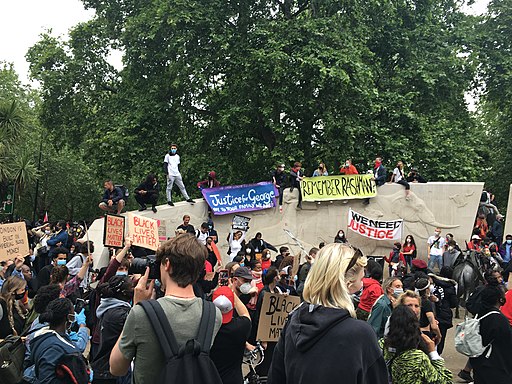
{"id":1026,"date":"2020-06-15T11:09:37","date_gmt":"2020-06-15T11:09:37","guid":{"rendered":"http:\/\/blogs.sussex.ac.uk\/psychology\/?p=1026"},"modified":"2020-06-15T11:09:39","modified_gmt":"2020-06-15T11:09:39","slug":"why-does-civil-unrest-spread-between-cities","status":"publish","type":"post","link":"https:\/\/blogs.sussex.ac.uk\/psychology\/2020\/06\/15\/why-does-civil-unrest-spread-between-cities\/","title":{"rendered":"Why does civil unrest spread between cities?"},"content":{"rendered":"\n<p>By Prof John Drury<\/p>\n\n\n\n<p>Protests and riots that began in Minneapolis after police killed an unarmed African American have now spread to over 23 states. I recently led a large-scale programme of research on the wave of riots in England in 2011 to address the question of how such events spread. The UK and US waves were different in important ways \u2013 most obviously, in the US many of the collective events have been peaceful protests, whereas in England only the initial protest was peaceful. Yet there are some striking similarities between them, as well as with other waves of riots. This similarity suggests that some of the same processes are operating.<\/p>\n\n\n\n<div class=\"wp-block-image\"><figure class=\"aligncenter size-large\"><img data-attachment-id=\"1027\" data-permalink=\"https:\/\/blogs.sussex.ac.uk\/psychology\/2020\/06\/15\/why-does-civil-unrest-spread-between-cities\/black_lives_matter_hyde_park_london_protest_3-6-24\/\" data-orig-file=\"https:\/\/i0.wp.com\/blogs.sussex.ac.uk\/psychology\/files\/2020\/06\/Black_Lives_Matter_Hyde_Park_London_protest_3.6.24.jpg?fit=512%2C384&amp;ssl=1\" data-orig-size=\"512,384\" data-comments-opened=\"1\" data-image-meta=\"{&quot;aperture&quot;:&quot;0&quot;,&quot;credit&quot;:&quot;&quot;,&quot;camera&quot;:&quot;&quot;,&quot;caption&quot;:&quot;&quot;,&quot;created_timestamp&quot;:&quot;0&quot;,&quot;copyright&quot;:&quot;&quot;,&quot;focal_length&quot;:&quot;0&quot;,&quot;iso&quot;:&quot;0&quot;,&quot;shutter_speed&quot;:&quot;0&quot;,&quot;title&quot;:&quot;&quot;,&quot;orientation&quot;:&quot;0&quot;}\" data-image-title=\"Black_Lives_Matter_Hyde_Park_London_protest_3.6.24\" data-image-description=\"\" data-image-caption=\"\" data-medium-file=\"https:\/\/i0.wp.com\/blogs.sussex.ac.uk\/psychology\/files\/2020\/06\/Black_Lives_Matter_Hyde_Park_London_protest_3.6.24.jpg?fit=300%2C225&amp;ssl=1\" data-large-file=\"https:\/\/i0.wp.com\/blogs.sussex.ac.uk\/psychology\/files\/2020\/06\/Black_Lives_Matter_Hyde_Park_London_protest_3.6.24.jpg?fit=512%2C384&amp;ssl=1\" loading=\"lazy\" width=\"512\" height=\"384\" src=\"https:\/\/i0.wp.com\/blogs.sussex.ac.uk\/psychology\/files\/2020\/06\/Black_Lives_Matter_Hyde_Park_London_protest_3.6.24.jpg?resize=512%2C384&#038;ssl=1\" alt=\"London Black Lives Matter peaceful protest in June 2020\" class=\"wp-image-1027\" srcset=\"https:\/\/i0.wp.com\/blogs.sussex.ac.uk\/psychology\/files\/2020\/06\/Black_Lives_Matter_Hyde_Park_London_protest_3.6.24.jpg?w=512&amp;ssl=1 512w, https:\/\/i0.wp.com\/blogs.sussex.ac.uk\/psychology\/files\/2020\/06\/Black_Lives_Matter_Hyde_Park_London_protest_3.6.24.jpg?resize=300%2C225&amp;ssl=1 300w, https:\/\/i0.wp.com\/blogs.sussex.ac.uk\/psychology\/files\/2020\/06\/Black_Lives_Matter_Hyde_Park_London_protest_3.6.24.jpg?resize=100%2C75&amp;ssl=1 100w, https:\/\/i0.wp.com\/blogs.sussex.ac.uk\/psychology\/files\/2020\/06\/Black_Lives_Matter_Hyde_Park_London_protest_3.6.24.jpg?resize=150%2C113&amp;ssl=1 150w, https:\/\/i0.wp.com\/blogs.sussex.ac.uk\/psychology\/files\/2020\/06\/Black_Lives_Matter_Hyde_Park_London_protest_3.6.24.jpg?resize=200%2C150&amp;ssl=1 200w, https:\/\/i0.wp.com\/blogs.sussex.ac.uk\/psychology\/files\/2020\/06\/Black_Lives_Matter_Hyde_Park_London_protest_3.6.24.jpg?resize=450%2C338&amp;ssl=1 450w\" sizes=\"(max-width: 512px) 100vw, 512px\" data-recalc-dims=\"1\" \/><figcaption>Black Lives Matter peaceful protest on 3.6.20 end of March from Hyde Park to Trafalgar Square by Katie Crampton (WMUK) \/ <a href=\"http:\/\/(https:\/\/creativecommons.org\/licenses\/by-sa\/4.0)\">CC BY-SA<\/a> <\/figcaption><\/figure><\/div>\n\n\n\n<p>It&#8217;s necessary to begin by examining the meaning of the precipitating incident and the social categories involved. What did \u2018they\u2019 do, and who are \u2018we\u2019?<\/p>\n\n\n\n<p>In Minneapolis 2020, as in <a href=\"https:\/\/academic.oup.com\/bjc\/article-abstract\/57\/4\/964\/2623988\">Tottenham in 2011<\/a> (and as in Watts 1965, Brixton 1981 and many others), actions by police officers against an individual encapsulated the <em>whole relationship<\/em> between a wider group and an institution. In each case, the violence inflicted was seen as embodying the history of relations between police and Black \/ African-American people, where police harassment, assault, and collective humiliation were a daily experience.<\/p>\n\n\n\n<p><a href=\"https:\/\/www.sussex.ac.uk\/webteam\/gateway\/file.php?name=beyond-contagion-report-for-the-guardian-january-2019.pdf&amp;site=557\">Our research<\/a> found that a local history of police harassment was key predictor of which districts rioted in London in 2011. Other predictors were local deprivation and negative attitudes to the police. Research in the US has found that race is another predictor of where riots occur. These factors correlate, of course: African-Americans are more likely to live in deprived districts and to be subject to police harassment and killing.<\/p>\n\n\n\n<p>But these factors are relatively constant. They help explain which cities riot, but they don\u2019t tell us when and how protest or rioting in one city influences people in other cities to join a wave.<\/p>\n\n\n\n<p>We found three types of social-psychological processes that helped explain how a wave occurs.<\/p>\n\n\n\n<p>First, there is <a href=\"https:\/\/onlinelibrary.wiley.com\/doi\/abs\/10.1002\/ejsp.2650\">spread via a shared identity<\/a> with those in other cities. This is where people in different locations each define themselves in terms of a similar shared history of injustice at racist policing and resistance to that injustice. Our interviewees said of the police killing of Mark Duggan in 2011, \u2018that could have been me\u2019 and \u2018that could have been my friends\u2019. This shared identity with those rioting in response to the killing provided a normative motivation to do the same in their own district: the police needed to be shown that they cannot get away with murder. In the case of the George Floyd events, African American identity, defined in terms of a history of police violence, is clearly a key factor leading people in many cities to feel the same sense of injustice and anger as those in Minneapolis. For these people, and for others who feel solidarity with African Americans, action to express that sense of injustice \u2013 including punishing the police \u2013 is an enactment of common identity.<\/p>\n\n\n\n<p>Second, there is a process that social movement researchers call capacity to mobilize and protest researchers call collective efficacy. In our research, we use the term <em>empowerment<\/em>. This captures the experience of one\u2019s social relations becoming transformed as power shifts from the police to the crowd. In the English riots, some participants didn\u2019t necessarily identify with the original rioters. But they could see that a common outgroup &#8212; the police \u2013 were becoming weakened. This empowered them to participate in their own area, including going beyond the initial issue to enact <a href=\"%20Towards%20an%20elaborated%20social%20identity%20explanation%20The%20question%20of%20how%20normative%20form%20changes%20during%20a%20riot,%20and%20thus%20how%20collective%20behaviour%20spreads%20to%20different%20targets%20and%20locations,%20has%20been%20neglected%20in%20previous%20research,%20despite%20its%20theoreti...%20onlinelibrary.wiley.com\">long-standing grievances and desires<\/a>.<\/p>\n\n\n\n<p>People\u2019s perceptions of the identity and empowerment of others was crucial. They came onto the streets when they not only identified with the other location or were empowered by police weakness but also believed that others locally felt the same way. This in turn was the basis of expectations of support for ingroup normative actions \u2013 in this case against the police and some properties.<\/p>\n\n\n\n<p>The third process that helps explain riot spread concerns <a href=\"https:\/\/www.researchgate.net\/publication\/341205406_How_crowd_violence_arises_and_how_it_spreads_A_critical_review_of_theory_and_evidence\">police perceptions<\/a>. We found that previous rioting led to a heightened level of organizational vigilance in the police. This state of expectancy can lead to pre-emptive forms of police intervention &#8212; such as violent dispersal of a non-violent crowd. Where people in the crowd experience these police actions as illegitimate and indiscriminate, there are significant unintended consequences. Such actions by police serve to unite the crowd \u2013 both those who did not originally intend to fight and those who did &#8212; around a new norm of fighting back against the police.<\/p>\n\n\n\n<p>Some of the coverage of the current wave of US riots has tried to suggest that powerful agitators are involved, with the implication that the crowd is easily swayed. Like the \u2018contagion\u2019 metaphor that is so frequently employed in these contexts, it suggests an unthinking crowd and therefore detracts from the meaningfulness of crowd action. Notions of mindless influence do not explain who joins in (and who doesn\u2019t). Nor do they explain the widespread selectivity of targets. Such notions also let the authorities off the hook. As our research has shown, and the events across the US illustrate, the spread of riots is a complex social phenomenon grounded in collective definitions of identity, injustice, and changing power relations between groups.<\/p>\n\n\n\n<p><em>John Drury is professor of <a href=\"http:\/\/www.sussex.ac.uk\/psychology\/research\/socialandappliedpsychology\">social psychology<\/a> at the University of Sussex. The <a href=\"http:\/\/www.sussex.ac.uk\/beyondcontagion\/\">Beyond Contagion<\/a> project was funded by the Economic and Social Research Council, and carried out by John Drury, Roger Ball, Clifford Stott, Stephen Reicher and Fergus Neville<\/em><\/p>\n","protected":false},"excerpt":{"rendered":"<p>By Prof John Drury Protests and riots that began in Minneapolis after police killed an unarmed African American have now spread to over 23 states. I recently led a large-scale programme of research on the wave of riots in England<span class=\"ellipsis\">&hellip;<\/span><\/p>\n<div class=\"read-more\"><a href=\"https:\/\/blogs.sussex.ac.uk\/psychology\/2020\/06\/15\/why-does-civil-unrest-spread-between-cities\/\">Read more &#8250;<\/a><\/div>\n<p><!-- end of .read-more --><\/p>\n","protected":false},"author":156,"featured_media":0,"comment_status":"open","ping_status":"open","sticky":false,"template":"","format":"standard","meta":{"spay_email":"","jetpack_publicize_message":"","jetpack_is_tweetstorm":false},"categories":[98529],"tags":[98571,176767,98552],"jetpack_featured_media_url":"","jetpack_publicize_connections":[],"jetpack_sharing_enabled":true,"jetpack_shortlink":"https:\/\/wp.me\/pafdEV-gy","jetpack-related-posts":[{"id":216,"url":"https:\/\/blogs.sussex.ac.uk\/psychology\/2016\/06\/06\/explaining-involuntary-influence-beyond-contagion\/","url_meta":{"origin":1026,"position":0},"title":"Explaining involuntary influence: Beyond contagion","date":"June 6, 2016","format":false,"excerpt":"By John Drury A recent article on the Brexit debate suggested that there is a fear among Governments that Brexit would lead to\u00a0\u2018referendum contagion\u2019. The term \u2018contagion\u2019 here denotes not only the idea of behaviour spreading rapidly, but also that this spread is uncontainable and undesirable in some way. It\u2026","rel":"","context":"With 1 comment","img":{"alt_text":"","src":"https:\/\/i1.wp.com\/blogs.sussex.ac.uk\/psychology\/files\/2016\/06\/Roger-1-300x229.jpg?resize=350%2C200","width":350,"height":200},"classes":[]},{"id":460,"url":"https:\/\/blogs.sussex.ac.uk\/psychology\/2017\/10\/07\/why-do-bystanders-justify-the-use-of-violence-by-protesters\/","url_meta":{"origin":1026,"position":1},"title":"Why do bystanders justify the use of violence by protesters?","date":"October 7, 2017","format":false,"excerpt":"By Patricio Saavedra Morales Recently, the UN Human Rights Office published an\u00a0extensive report\u00a0about human rights violations and abuses during protests occurring in Venezuela from 1st\u00a0of April to 31st\u00a0July 2017.\u00a0 In the document, UN officers accused the Venezuelan police force of excessive use of force during protests and illegal detentions of\u2026","rel":"","context":"In &quot;PhD research&quot;","img":{"alt_text":"","src":"","width":0,"height":0},"classes":[]},{"id":275,"url":"https:\/\/blogs.sussex.ac.uk\/psychology\/2016\/10\/18\/what-is-the-role-of-shared-identities-in-the-aftermath-of-floods\/","url_meta":{"origin":1026,"position":2},"title":"What is the role of shared identities in the aftermath of floods?","date":"October 18, 2016","format":false,"excerpt":"By Evangelos Ntontis As a PhD student at the School of Psychology of Sussex University, I recently had the honour of winning the 2016 PhD poster conference. Of course winning is accompanied with writing a blog for the School\u2019s website, so I\u2019ll take this short space to briefly write about\u2026","rel":"","context":"In \"Academic Writing\"","img":{"alt_text":"","src":"https:\/\/i1.wp.com\/blogs.sussex.ac.uk\/psychology\/files\/2016\/10\/CtiS-_dWEAANpNI-225x300.jpg?resize=350%2C200","width":350,"height":200},"classes":[]},{"id":806,"url":"https:\/\/blogs.sussex.ac.uk\/psychology\/2019\/07\/03\/there-are-no-rioters-in-hong-kong\/","url_meta":{"origin":1026,"position":3},"title":"There are no rioters in Hong Kong","date":"July 3, 2019","format":false,"excerpt":"By Patricio Saavedra Morales In June this year, thousands of Hongkongers hit the streets to protest against a controversial extradition bill promoted by the Chief Executive of the former British colony, Carrie Lam. During those days, Hongkongers, as well as people worldwide, cried out in fury after seeing how riot\u2026","rel":"","context":"In &quot;PhD research&quot;","img":{"alt_text":"","src":"","width":0,"height":0},"classes":[]},{"id":1166,"url":"https:\/\/blogs.sussex.ac.uk\/psychology\/2020\/12\/15\/understanding-collective-fear-responses-to-perceived-terrorist-threats\/","url_meta":{"origin":1026,"position":4},"title":"Understanding collective fear responses to perceived terrorist threats","date":"December 15, 2020","format":false,"excerpt":"By Dr Dermot Barr The UK national threat level was raised to \u2018Severe\u2019, the second highest level, on the 3rd November 2020 after a series of terrorist attacks in France and Austria. This level means an attack is thought to be \u2018highly likely\u2019. This blogpost discusses the psychology around this\u2026","rel":"","context":"In &quot;Research staff&quot;","img":{"alt_text":"","src":"https:\/\/i1.wp.com\/blogs.sussex.ac.uk\/psychology\/files\/2020\/12\/Dermots-blog-Graph-1-Evacuations-due-to-false-alarm-incidents.jpg?resize=350%2C200&ssl=1","width":350,"height":200},"classes":[]},{"id":1297,"url":"https:\/\/blogs.sussex.ac.uk\/psychology\/2021\/06\/02\/who-helps-the-helpers-8-tips-for-voluntary-groups\/","url_meta":{"origin":1026,"position":5},"title":"Who helps the helpers? 8 tips for voluntary groups","date":"June 2, 2021","format":false,"excerpt":"Local voluntary mutual aid groups have been critically important for many people during Covid. But keeping the momentum going is difficult even when the need for the kind of help these groups provide is still high. Groups & COVID: Community, Support and Mutual Aid, a project led by\u00a0Prof John Drury,\u2026","rel":"","context":"In &quot;Faculty research&quot;","img":{"alt_text":"","src":"https:\/\/i1.wp.com\/blogs.sussex.ac.uk\/psychology\/files\/2021\/06\/Volunteers.jpg?resize=350%2C200&ssl=1","width":350,"height":200},"classes":[]}],"_links":{"self":[{"href":"https:\/\/blogs.sussex.ac.uk\/psychology\/wp-json\/wp\/v2\/posts\/1026"}],"collection":[{"href":"https:\/\/blogs.sussex.ac.uk\/psychology\/wp-json\/wp\/v2\/posts"}],"about":[{"href":"https:\/\/blogs.sussex.ac.uk\/psychology\/wp-json\/wp\/v2\/types\/post"}],"author":[{"embeddable":true,"href":"https:\/\/blogs.sussex.ac.uk\/psychology\/wp-json\/wp\/v2\/users\/156"}],"replies":[{"embeddable":true,"href":"https:\/\/blogs.sussex.ac.uk\/psychology\/wp-json\/wp\/v2\/comments?post=1026"}],"version-history":[{"count":3,"href":"https:\/\/blogs.sussex.ac.uk\/psychology\/wp-json\/wp\/v2\/posts\/1026\/revisions"}],"predecessor-version":[{"id":1030,"href":"https:\/\/blogs.sussex.ac.uk\/psychology\/wp-json\/wp\/v2\/posts\/1026\/revisions\/1030"}],"wp:attachment":[{"href":"https:\/\/blogs.sussex.ac.uk\/psychology\/wp-json\/wp\/v2\/media?parent=1026"}],"wp:term":[{"taxonomy":"category","embeddable":true,"href":"https:\/\/blogs.sussex.ac.uk\/psychology\/wp-json\/wp\/v2\/categories?post=1026"},{"taxonomy":"post_tag","embeddable":true,"href":"https:\/\/blogs.sussex.ac.uk\/psychology\/wp-json\/wp\/v2\/tags?post=1026"}],"curies":[{"name":"wp","href":"https:\/\/api.w.org\/{rel}","templated":true}]}}