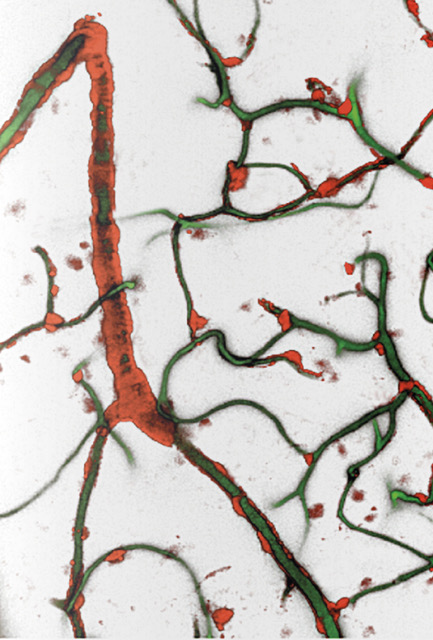
{"id":1066,"date":"2020-11-09T08:55:00","date_gmt":"2020-11-09T08:55:00","guid":{"rendered":"http:\/\/blogs.sussex.ac.uk\/psychology\/?p=1066"},"modified":"2020-11-04T09:30:10","modified_gmt":"2020-11-04T09:30:10","slug":"do-bad-blood-vessels-trigger-dementia","status":"publish","type":"post","link":"https:\/\/blogs.sussex.ac.uk\/psychology\/2020\/11\/09\/do-bad-blood-vessels-trigger-dementia\/","title":{"rendered":"Do bad blood vessels trigger dementia?"},"content":{"rendered":"\n<p>By Dr Catherine Hall<\/p>\n\n\n\n<p>Dementia affects increasing numbers of people as they age (one in 14 people over the age of 65 suffer from dementia).&nbsp;It changes how the brain functions, gradually stopping brain cells and brain connections from working so that people progressively struggle with remembering things, thinking and speaking. Alzheimer\u2019s disease is the most common form of dementia and is characterised by the build-up in the brain of two proteins, beta-amyloid and tau, which are thought to damage cells and cause them to die. Up to now, most drugs have targeted these proteins, but have not been successful and there is still no cure for Alzheimer\u2019s disease.<\/p>\n\n\n\n<p>However, changes happen in the brain years before people start reporting problems with memory and thinking. It is therefore likely that the most effective treatments will act early in the disease process to interfere with its progression before brain cells become damaged making it important to understand what happens to cause the onset of Alzheimer\u2019s disease.&nbsp;Increasing evidence suggests that damage to blood vessels feeding the brain might first trigger the disease. Firstly, risk factors for dementia are the same as risk factors for cardiovascular disease (e.g. obesity, lack of exercise, high blood pressure, and the main genetic risk factor for Alzheimer\u2019s disease, <em>APOE4<\/em>), suggesting that unhealthy blood vessels could cause both diseases. Secondly, brain blood vessels show the first signs of dysfunction in Alzheimer\u2019s disease, as brain blood flow is disrupted before the build-up of beta-amyloid and tau, and before neurons are damaged and memory is impaired.&nbsp;<\/p>\n\n\n\n<div class=\"wp-block-image\"><figure class=\"aligncenter size-large\"><img data-attachment-id=\"1133\" data-permalink=\"https:\/\/blogs.sussex.ac.uk\/psychology\/2020\/11\/09\/do-bad-blood-vessels-trigger-dementia\/unknown-4\/\" data-orig-file=\"https:\/\/i1.wp.com\/blogs.sussex.ac.uk\/psychology\/files\/2020\/11\/Unknown.jpeg?fit=433%2C640&amp;ssl=1\" data-orig-size=\"433,640\" data-comments-opened=\"1\" data-image-meta=\"{&quot;aperture&quot;:&quot;0&quot;,&quot;credit&quot;:&quot;&quot;,&quot;camera&quot;:&quot;&quot;,&quot;caption&quot;:&quot;&quot;,&quot;created_timestamp&quot;:&quot;0&quot;,&quot;copyright&quot;:&quot;&quot;,&quot;focal_length&quot;:&quot;0&quot;,&quot;iso&quot;:&quot;0&quot;,&quot;shutter_speed&quot;:&quot;0&quot;,&quot;title&quot;:&quot;&quot;,&quot;orientation&quot;:&quot;0&quot;}\" data-image-title=\"Unknown\" data-image-description=\"\" data-image-caption=\"\" data-medium-file=\"https:\/\/i1.wp.com\/blogs.sussex.ac.uk\/psychology\/files\/2020\/11\/Unknown.jpeg?fit=203%2C300&amp;ssl=1\" data-large-file=\"https:\/\/i1.wp.com\/blogs.sussex.ac.uk\/psychology\/files\/2020\/11\/Unknown.jpeg?fit=433%2C640&amp;ssl=1\" loading=\"lazy\" width=\"433\" height=\"640\" src=\"https:\/\/i1.wp.com\/blogs.sussex.ac.uk\/psychology\/files\/2020\/11\/Unknown.jpeg?resize=433%2C640&#038;ssl=1\" alt=\"\" class=\"wp-image-1133\" srcset=\"https:\/\/i1.wp.com\/blogs.sussex.ac.uk\/psychology\/files\/2020\/11\/Unknown.jpeg?w=433&amp;ssl=1 433w, https:\/\/i1.wp.com\/blogs.sussex.ac.uk\/psychology\/files\/2020\/11\/Unknown.jpeg?resize=203%2C300&amp;ssl=1 203w, https:\/\/i1.wp.com\/blogs.sussex.ac.uk\/psychology\/files\/2020\/11\/Unknown.jpeg?resize=100%2C148&amp;ssl=1 100w, https:\/\/i1.wp.com\/blogs.sussex.ac.uk\/psychology\/files\/2020\/11\/Unknown.jpeg?resize=150%2C222&amp;ssl=1 150w, https:\/\/i1.wp.com\/blogs.sussex.ac.uk\/psychology\/files\/2020\/11\/Unknown.jpeg?resize=200%2C296&amp;ssl=1 200w, https:\/\/i1.wp.com\/blogs.sussex.ac.uk\/psychology\/files\/2020\/11\/Unknown.jpeg?resize=300%2C443&amp;ssl=1 300w\" sizes=\"(max-width: 433px) 100vw, 433px\" data-recalc-dims=\"1\" \/><figcaption>Pericytes and smooth muscle cells (red) regulate blood vessel diameter (in green). This process may go wrong early in Alzheimer\u2019s disease<\/figcaption><\/figure><\/div>\n\n\n\n<p>In a project funded by the <a href=\"https:\/\/mrc.ukri.org\/\">Medical Research Council<\/a>, <a href=\"http:\/\/www.brainenergylab.com\/\" data-type=\"URL\" data-id=\"http:\/\/www.brainenergylab.com\/\">my lab<\/a> is trying to understand how changes in blood vessels in the brain are linked to the onset of Alzheimer\u2019s disease. Brain cells need a constant supply of energy in the form of oxygen and glucose provided in the blood, and previous research has shown that if they have only low levels of oxygen, brain cells accumulate more beta-amyloid. We are creating new genetically modified mice that allow us to investigate whether the critical trigger for Alzheimer\u2019s disease is if blood vessels in the brain stop working properly, producing a decrease in brain oxygen levels which causes the build-up of beta-amyloid.<\/p>\n\n\n\n<p>Our previous work, funded by the <a href=\"https:\/\/acmedsci.ac.uk\/\" data-type=\"URL\" data-id=\"https:\/\/acmedsci.ac.uk\/\">Academy of Medical Sciences<\/a> and the <a href=\"https:\/\/wellcome.org\/\" data-type=\"URL\" data-id=\"https:\/\/wellcome.org\/\">Wellcome Trust<\/a>, shows that the main genetic risk factor for Alzheimer\u2019s disease (APOE4) causes some blood vessels to become dysfunctional even in young mice. However normal mice cannot make beta-amyloid, so we have not yet been able to study how this damage to blood vessels affects beta-amyloid production.&nbsp;Our new genetically modified mice can produce beta-amyloid but in a controllable way (by changing the amount of a drug we feed the mice), and also carry the APOE4 gene. This allows us to first identify which blood vessels are not working correctly, and then turn on beta-amyloid production. We can then study whether beta-amyloid accumulates near the dysfunctional vessels and in areas with low oxygen levels. Because beta-amyloid itself can stop blood vessels from working well, we expect that affected vessels will gradually become even more dysfunctional, accelerating beta-amyloid accumulation until nearby brain cells are damaged.<\/p>\n\n\n\n<p>These experiments will reveal how changes in blood flow lead to the build-up of beta-amyloid and damage to brain cells. The new mice will allow us to test the effect of drugs and lifestyle interventions such as exercise on this process, identifying new approaches for treatments targeting the very early stages of Alzheimer\u2019s disease.&nbsp; &nbsp;<\/p>\n\n\n\n<p><\/p>\n\n\n\n<p><em><a href=\"https:\/\/profiles.sussex.ac.uk\/p348374-catherine-hall\">Dr Catherine Hall<\/a> is a senior lecturer at the School of Psychology and the director of <a href=\"http:\/\/www.brainenergylab.com\/\">the Brain Energy Lab<\/a>. <\/em><\/p>\n\n\n\n<p><em>Find out more about our research on <a href=\"http:\/\/www.sussex.ac.uk\/psychology\/research\/behaviouralclinicalneuroscience\">Behavioural and Clinical Neuroscience<\/a>.<\/em><\/p>\n","protected":false},"excerpt":{"rendered":"<p>By Dr Catherine Hall Dementia affects increasing numbers of people as they age (one in 14 people over the age of 65 suffer from dementia).&nbsp;It changes how the brain functions, gradually stopping brain cells and brain connections from working so<span class=\"ellipsis\">&hellip;<\/span><\/p>\n<div class=\"read-more\"><a href=\"https:\/\/blogs.sussex.ac.uk\/psychology\/2020\/11\/09\/do-bad-blood-vessels-trigger-dementia\/\">Read more &#8250;<\/a><\/div>\n<p><!-- end of .read-more --><\/p>\n","protected":false},"author":156,"featured_media":0,"comment_status":"open","ping_status":"open","sticky":false,"template":"","format":"standard","meta":{"spay_email":"","jetpack_publicize_message":"","jetpack_is_tweetstorm":false},"categories":[98529],"tags":[98526,168172,90890,97095],"jetpack_featured_media_url":"","jetpack_publicize_connections":[],"jetpack_sharing_enabled":true,"jetpack_shortlink":"https:\/\/wp.me\/pafdEV-hc","jetpack-related-posts":[{"id":1082,"url":"https:\/\/blogs.sussex.ac.uk\/psychology\/2020\/11\/30\/reducing-patterns-of-brain-hyperactivity-in-individuals-at-genetic-risk-of-alzheimers-disease-an-important-avenue-for-early-life-risk-reduction\/","url_meta":{"origin":1066,"position":0},"title":"Reducing patterns of brain hyperactivity in individuals at genetic risk of Alzheimer\u2019s disease: an important avenue for early-life risk reduction?","date":"November 30, 2020","format":false,"excerpt":"By Dr Claire Lancaster Fifty million people live with dementia worldwide, the most common cause of which is Alzheimer\u2019s \u2013 a progressive, neurodegenerative disease. Although the past 12-months have seen Aducanumab expediated for FDA approval \u2013 the first new drug with the potential to reduce cognitive symptoms in over 15\u2026","rel":"","context":"In &quot;Faculty research&quot;","img":{"alt_text":"","src":"https:\/\/i0.wp.com\/blogs.sussex.ac.uk\/psychology\/files\/2020\/10\/brain-activity-in-Alzheimers-Disease.png?resize=350%2C200&ssl=1","width":350,"height":200},"classes":[]},{"id":1143,"url":"https:\/\/blogs.sussex.ac.uk\/psychology\/2020\/11\/23\/alzheimer-type-dementia\/","url_meta":{"origin":1066,"position":1},"title":"Alzheimer type dementia","date":"November 23, 2020","format":false,"excerpt":"by Prof Jennifer Rusted Age is not synonymous with poor health, but Alzheimer type dementia (AD) is a disease of the brain for which age is the biggest risk factor \u2013 the older you are, the greater your risk of developing the disease.\u00a0 But it certainly is not inevitable, and\u2026","rel":"","context":"In &quot;Faculty research&quot;","img":{"alt_text":"","src":"https:\/\/i0.wp.com\/blogs.sussex.ac.uk\/psychology\/files\/2020\/11\/Old-lady-1.png?resize=350%2C200&ssl=1","width":350,"height":200},"classes":[]},{"id":1137,"url":"https:\/\/blogs.sussex.ac.uk\/psychology\/2020\/11\/16\/do-changes-in-emotion-regulation-affect-decision-making-in-people-with-alzheimers-disease\/","url_meta":{"origin":1066,"position":2},"title":"Do Changes in Emotion Regulation Affect Decision-Making in People with Alzheimer\u2019s Disease?","date":"November 16, 2020","format":false,"excerpt":"by Dr Rotem Perach, Prof Jennifer Rusted, Prof Pete Harris, Dr Eleanor Miles Ever felt so excited that you found yourself telling your life story to a stranger? Or so anxious about something that you could think about little else? We know that our emotions often affect our decisions, for\u2026","rel":"","context":"In &quot;Faculty research&quot;","img":{"alt_text":"","src":"","width":0,"height":0},"classes":[]},{"id":1712,"url":"https:\/\/blogs.sussex.ac.uk\/psychology\/2022\/10\/06\/whats-in-a-word-using-speech-marker-to-diagnose-alzheimers-early\/","url_meta":{"origin":1066,"position":3},"title":"What\u2019s in a word? Using speech marker to diagnose Alzheimer\u2019s early","date":"October 6, 2022","format":false,"excerpt":"By Alice Stanton September was World Alzheimer\u2019s Month, an international event run by Alzheimer\u2019s Disease International to spread awareness and challenge the stigmas that surround Alzheimer\u2019s and other forms of dementia. Alzheimer's is a degenerative neurological condition that is currently affecting more than 944,000 people in the UK and Alzheimer\u2019s\u2026","rel":"","context":"Similar post","img":{"alt_text":"","src":"https:\/\/i1.wp.com\/blogs.sussex.ac.uk\/psychology\/files\/2022\/10\/dementia-595638_1920.jpg?resize=350%2C200&ssl=1","width":350,"height":200},"classes":[]},{"id":289,"url":"https:\/\/blogs.sussex.ac.uk\/psychology\/2016\/11\/14\/jra-memories\/","url_meta":{"origin":1066,"position":4},"title":"JRA Memories","date":"November 14, 2016","format":false,"excerpt":"By George Britton Once I found out that I got the JRA award, I found myself explaining what the scheme is, and what I was going to do, to countless people.\u00a0 The reality of the project is only sinking in as I carry it out. In the process I have\u2026","rel":"","context":"In \"Academic Writing\"","img":{"alt_text":"","src":"https:\/\/i0.wp.com\/blogs.sussex.ac.uk\/psychology\/files\/2016\/10\/DSCF5238-300x225.jpg?resize=350%2C200","width":350,"height":200},"classes":[]},{"id":1902,"url":"https:\/\/blogs.sussex.ac.uk\/psychology\/2023\/03\/17\/the-brain-energy-lab-connecting-and-collaborating-is-fundamental-to-everything-we-do\/","url_meta":{"origin":1066,"position":5},"title":"The Brain Energy Lab: connecting and collaborating is fundamental to everything we do","date":"March 17, 2023","format":false,"excerpt":"By Catherine Hall The theme for this year's British Science Week is connections and we thought it would be a good opportunity to ask one of our psychology lecturers, Dr Catherine Hall to tell us some of the reasons why connections and collaborations are so important to research success. Since\u2026","rel":"","context":"Similar post","img":{"alt_text":"","src":"https:\/\/i1.wp.com\/blogs.sussex.ac.uk\/psychology\/files\/2023\/03\/BSW-logo.jpg?resize=350%2C200&ssl=1","width":350,"height":200},"classes":[]}],"_links":{"self":[{"href":"https:\/\/blogs.sussex.ac.uk\/psychology\/wp-json\/wp\/v2\/posts\/1066"}],"collection":[{"href":"https:\/\/blogs.sussex.ac.uk\/psychology\/wp-json\/wp\/v2\/posts"}],"about":[{"href":"https:\/\/blogs.sussex.ac.uk\/psychology\/wp-json\/wp\/v2\/types\/post"}],"author":[{"embeddable":true,"href":"https:\/\/blogs.sussex.ac.uk\/psychology\/wp-json\/wp\/v2\/users\/156"}],"replies":[{"embeddable":true,"href":"https:\/\/blogs.sussex.ac.uk\/psychology\/wp-json\/wp\/v2\/comments?post=1066"}],"version-history":[{"count":7,"href":"https:\/\/blogs.sussex.ac.uk\/psychology\/wp-json\/wp\/v2\/posts\/1066\/revisions"}],"predecessor-version":[{"id":1134,"href":"https:\/\/blogs.sussex.ac.uk\/psychology\/wp-json\/wp\/v2\/posts\/1066\/revisions\/1134"}],"wp:attachment":[{"href":"https:\/\/blogs.sussex.ac.uk\/psychology\/wp-json\/wp\/v2\/media?parent=1066"}],"wp:term":[{"taxonomy":"category","embeddable":true,"href":"https:\/\/blogs.sussex.ac.uk\/psychology\/wp-json\/wp\/v2\/categories?post=1066"},{"taxonomy":"post_tag","embeddable":true,"href":"https:\/\/blogs.sussex.ac.uk\/psychology\/wp-json\/wp\/v2\/tags?post=1066"}],"curies":[{"name":"wp","href":"https:\/\/api.w.org\/{rel}","templated":true}]}}