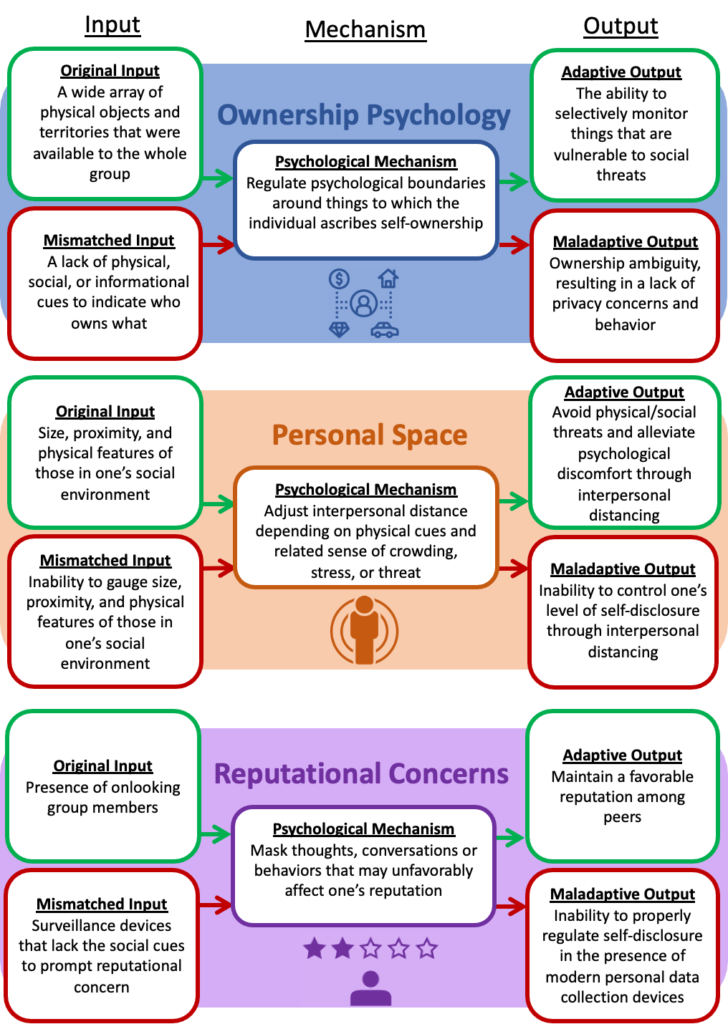
{"id":1180,"date":"2021-01-11T09:05:00","date_gmt":"2021-01-11T09:05:00","guid":{"rendered":"http:\/\/blogs.sussex.ac.uk\/psychology\/?p=1180"},"modified":"2020-12-16T14:00:04","modified_gmt":"2020-12-16T14:00:04","slug":"the-privacy-mismatch-evolved-intuitions-in-a-digital-world","status":"publish","type":"post","link":"https:\/\/blogs.sussex.ac.uk\/psychology\/2021\/01\/11\/the-privacy-mismatch-evolved-intuitions-in-a-digital-world\/","title":{"rendered":"The Privacy Mismatch: Evolved Intuitions in a Digital World"},"content":{"rendered":"\n<p>By Joe Green<\/p>\n\n\n\n<p>Imagine you\u2019re on a busy train texting a friend when you notice a stranger sneakily reading your texts from over your shoulder. Your natural response would probably be to recoil as you realise your privacy is being invaded. So why is it that when we\u2019re online and under the watchful eye of data-hungry corporations, most of us wouldn\u2019t think twice about readily sharing that same information?<\/p>\n\n\n\n<h2>Privacy Paradox<\/h2>\n\n\n\n<p>When asked directly, most people report valuing their personal privacy and being intent on protecting it, but research shows that those same people will often forgo it in exchange for more convenient ways to work and socialise. This is known as the \u2018Privacy Paradox\u2019; people claim to care about their personal data but then do very little to protect it online.<\/p>\n\n\n\n<p>Some theories have explained this contradiction by claiming that users are simply making reasoned cost-benefit privacy calculations, while others suggest that we are falling victim to a range of cognitive biases. However, in a <a href=\"https:\/\/www.researchgate.net\/publication\/346049634_The_Privacy_Mismatch_Evolved_Intuitions_in_a_Digital_World\">recent paper<\/a> Azim Shariff, William Jettinghoff and I argue that a more complete understanding of this phenomenon requires looking back to our evolutionary roots.<\/p>\n\n\n\n<h2>The Evolution of Privacy<\/h2>\n\n\n\n<p>Broadly speaking, privacy functions to selectively control access to oneself or one\u2019s group. We suggest that within our ancestral past, the role of privacy has been to help protect our body, territory, and reputation while around others. Consequently, millions of years of face-to-face interaction have seen us develop a toolkit of privacy-based intuitions which help to manage both our physical and psychological boundaries. Yet these evolved intuitions are often ill-equipped to deal with the emerging challenges of the digital environment.<\/p>\n\n\n\n<p>An \u2018evolutionary mismatch\u2019 describes the negative consequence that occurs when a trait that evolved within one environment enters another. A classic mismatch example is our fondness for high-calorie foods \u2013 this was an adaptive trait within the ancestral environment where such foods were nourishing yet sparse. But today, when there\u2019s a McDonald\u2019s on every high street, this same trait can lead to obesity and diabetes. And so it is with privacy traits, too. Below we describe three related mismatches:<\/p>\n\n\n\n<figure class=\"wp-block-image size-large\"><img data-attachment-id=\"1181\" data-permalink=\"https:\/\/blogs.sussex.ac.uk\/psychology\/2021\/01\/11\/the-privacy-mismatch-evolved-intuitions-in-a-digital-world\/privacy-mismatch\/\" data-orig-file=\"https:\/\/i0.wp.com\/blogs.sussex.ac.uk\/psychology\/files\/2020\/12\/Privacy-Mismatch.png?fit=1016%2C1430&amp;ssl=1\" data-orig-size=\"1016,1430\" data-comments-opened=\"1\" data-image-meta=\"{&quot;aperture&quot;:&quot;0&quot;,&quot;credit&quot;:&quot;&quot;,&quot;camera&quot;:&quot;&quot;,&quot;caption&quot;:&quot;&quot;,&quot;created_timestamp&quot;:&quot;0&quot;,&quot;copyright&quot;:&quot;&quot;,&quot;focal_length&quot;:&quot;0&quot;,&quot;iso&quot;:&quot;0&quot;,&quot;shutter_speed&quot;:&quot;0&quot;,&quot;title&quot;:&quot;&quot;,&quot;orientation&quot;:&quot;0&quot;}\" data-image-title=\"Privacy-Mismatch\" data-image-description=\"\" data-image-caption=\"\" data-medium-file=\"https:\/\/i0.wp.com\/blogs.sussex.ac.uk\/psychology\/files\/2020\/12\/Privacy-Mismatch.png?fit=213%2C300&amp;ssl=1\" data-large-file=\"https:\/\/i0.wp.com\/blogs.sussex.ac.uk\/psychology\/files\/2020\/12\/Privacy-Mismatch.png?fit=550%2C774&amp;ssl=1\" loading=\"lazy\" width=\"550\" height=\"774\" src=\"https:\/\/i0.wp.com\/blogs.sussex.ac.uk\/psychology\/files\/2020\/12\/Privacy-Mismatch-728x1024.png?resize=550%2C774&#038;ssl=1\" alt=\"Input-output mismatches showing the psychological mechanisms impacting ownership psychology, personal space and reputational concerns.\" class=\"wp-image-1181\" srcset=\"https:\/\/i0.wp.com\/blogs.sussex.ac.uk\/psychology\/files\/2020\/12\/Privacy-Mismatch.png?resize=728%2C1024&amp;ssl=1 728w, https:\/\/i0.wp.com\/blogs.sussex.ac.uk\/psychology\/files\/2020\/12\/Privacy-Mismatch.png?resize=213%2C300&amp;ssl=1 213w, https:\/\/i0.wp.com\/blogs.sussex.ac.uk\/psychology\/files\/2020\/12\/Privacy-Mismatch.png?resize=768%2C1081&amp;ssl=1 768w, https:\/\/i0.wp.com\/blogs.sussex.ac.uk\/psychology\/files\/2020\/12\/Privacy-Mismatch.png?resize=100%2C141&amp;ssl=1 100w, https:\/\/i0.wp.com\/blogs.sussex.ac.uk\/psychology\/files\/2020\/12\/Privacy-Mismatch.png?resize=150%2C211&amp;ssl=1 150w, https:\/\/i0.wp.com\/blogs.sussex.ac.uk\/psychology\/files\/2020\/12\/Privacy-Mismatch.png?resize=200%2C281&amp;ssl=1 200w, https:\/\/i0.wp.com\/blogs.sussex.ac.uk\/psychology\/files\/2020\/12\/Privacy-Mismatch.png?resize=300%2C422&amp;ssl=1 300w, https:\/\/i0.wp.com\/blogs.sussex.ac.uk\/psychology\/files\/2020\/12\/Privacy-Mismatch.png?resize=450%2C633&amp;ssl=1 450w, https:\/\/i0.wp.com\/blogs.sussex.ac.uk\/psychology\/files\/2020\/12\/Privacy-Mismatch.png?resize=600%2C844&amp;ssl=1 600w, https:\/\/i0.wp.com\/blogs.sussex.ac.uk\/psychology\/files\/2020\/12\/Privacy-Mismatch.png?resize=900%2C1267&amp;ssl=1 900w, https:\/\/i0.wp.com\/blogs.sussex.ac.uk\/psychology\/files\/2020\/12\/Privacy-Mismatch.png?w=1016&amp;ssl=1 1016w\" sizes=\"(max-width: 550px) 100vw, 550px\" data-recalc-dims=\"1\" \/><\/figure>\n\n\n\n<h2>Ownership Psychology<\/h2>\n\n\n\n<p>Working out who owns what can be a tricky business, however, humans have developed a set of ownership conventions to guide this process. Important cues like \u2018who first possessed an object\u2019 help to intuitively discern ownership within the interpersonal environment, but these cues often gets blurred online. For example, who is the first possessor of a Facebook user\u2019s data, Facebook or the user? This ownership ambiguity often leaves us unsure about what is ours and whether we ought to then protect it.<\/p>\n\n\n\n<h2>Personal Space<\/h2>\n\n\n\n<p>Physical privacy enables us to navigate social space without becoming overstimulated. But within an online space, social cues relating to size, nature, and proximity of onlooking crowds tend to disappear. As a result, we\u2019re often worse at managing self-disclosure: sending that regrettable late-night tweet to your 200 followers is a lot easier than announcing it to an in-person crowd of 200.<\/p>\n\n\n\n<h2>Reputational Concern<\/h2>\n\n\n\n<p>Giving off a good or bad impression comes with social rewards and repercussions. As such, we instinctively modify what we say or do around others. For instance, if you had an Amazon employee sat in your living room recording your every utterance \u2013 unlikely, I know \u2013 you\u2019d be wary about what you were saying. But when Amazon\u2019s smart speaker Alexa is doing just that silently in the background, chances are that you talk freely and without a filter.<\/p>\n\n\n\n<p>Many modern technological surveillance devices lack the anthropomorphic cues necessary to trigger our instinctive reputational concern and downstream privacy behaviour.<\/p>\n\n\n\n<h2>A Future<\/h2>\n\n\n\n<p>E.O. Wilson once described us as having, \u201cStone Age emotions, medieval institutions, and godlike technology\u201d. Indeed, expecting Stone Age brains to self-manage personal data in the ever-changing digital environment is both unreliable and unrealistic. Reading the privacy policy for every website you visit in a year alone would take roughly one month! Instead, online culture and expectations need to change \u00ad\u2013 we as consumers must demand more top-down privacy protection from these godlike technologies. Afterall, none of us want someone looking over our shoulder.<\/p>\n\n\n\n<p><em><a href=\"https:\/\/profiles.sussex.ac.uk\/p334094-joe-green\/about\">Joe Green<\/a> is a PhD student under the supervision of <a href=\"https:\/\/profiles.sussex.ac.uk\/p173988-matthew-easterbrook\" data-type=\"URL\" data-id=\"https:\/\/profiles.sussex.ac.uk\/p173988-matthew-easterbrook\">Dr Matt Easterbrook.<\/a> Joe&#8217;s research studies how moral intuitions affect our attitudes towards modern issues like Universal Basic Income, automation, and online privacy.<\/em>\u00a0<\/p>\n\n\n\n<p>Find out more about our\u00a0<a href=\"http:\/\/www.sussex.ac.uk\/psychology\/research\/socialandappliedpsychology\">research on Social and Applied Psychology<\/a>.<\/p>\n","protected":false},"excerpt":{"rendered":"<p>By Joe Green Imagine you\u2019re on a busy train texting a friend when you notice a stranger sneakily reading your texts from over your shoulder. Your natural response would probably be to recoil as you realise your privacy is being<span class=\"ellipsis\">&hellip;<\/span><\/p>\n<div class=\"read-more\"><a href=\"https:\/\/blogs.sussex.ac.uk\/psychology\/2021\/01\/11\/the-privacy-mismatch-evolved-intuitions-in-a-digital-world\/\">Read more &#8250;<\/a><\/div>\n<p><!-- end of .read-more --><\/p>\n","protected":false},"author":156,"featured_media":0,"comment_status":"open","ping_status":"open","sticky":false,"template":"","format":"standard","meta":{"spay_email":"","jetpack_publicize_message":"","jetpack_is_tweetstorm":false},"categories":[98528],"tags":[168182,97941,98552],"jetpack_featured_media_url":"","jetpack_publicize_connections":[],"jetpack_sharing_enabled":true,"jetpack_shortlink":"https:\/\/wp.me\/pafdEV-j2","jetpack-related-posts":[{"id":1116,"url":"https:\/\/blogs.sussex.ac.uk\/psychology\/2020\/11\/04\/they-dont-know-weve-got-legs-meeting-online-and-in-person\/","url_meta":{"origin":1180,"position":0},"title":"\u201cThey don\u2019t know we\u2019ve got legs\u201d: meeting online and in-person","date":"November 4, 2020","format":false,"excerpt":"By Prof Nicola Yuill Covid-19 restrictions haven\u2019t just stopped us meeting in person \u2013 instead, they have nudged us into new ways of connecting. Humans are the ultimate social species: evolutionary biologists regard the human tendency towards cooperation as having created the complex coordination we manage in politics, the arts,\u2026","rel":"","context":"In &quot;Faculty research&quot;","img":{"alt_text":"","src":"https:\/\/i0.wp.com\/blogs.sussex.ac.uk\/psychology\/files\/2020\/11\/Screen-Shot-2020-11-03-at-14.50.27.png?resize=350%2C200&ssl=1","width":350,"height":200},"classes":[]},{"id":225,"url":"https:\/\/blogs.sussex.ac.uk\/psychology\/2016\/06\/14\/reflections-of-a-first-year-phd-student\/","url_meta":{"origin":1180,"position":1},"title":"Reflections of a first year PhD student","date":"June 14, 2016","format":false,"excerpt":"By Mateo Legan\u00e9s Fonteneau Doing a PhD was never my lifetime objective. When I finished college I started studying an engineering degree, but I realised quite soon that it wasn\u2019t what I\u2019d expected. I then went on to study Social Work, hoping to help drug addicts when I finished. As\u2026","rel":"","context":"In \"First Year\"","img":{"alt_text":"Mateo with his colleagues, about to win a race","src":"https:\/\/i2.wp.com\/blogs.sussex.ac.uk\/psychology\/files\/2016\/06\/Unknown-300x169.jpeg?resize=350%2C200","width":350,"height":200},"classes":[]},{"id":339,"url":"https:\/\/blogs.sussex.ac.uk\/psychology\/2017\/02\/13\/life-as-a-postdoc-10-things-to-consider\/","url_meta":{"origin":1180,"position":2},"title":"Life as a postdoc \u2013 10 things to consider","date":"February 13, 2017","format":false,"excerpt":"By Dr Christiane Oedekoven \u00a0 I am currently working as a postdoc in Chris Bird\u2019s Episodic Memory Lab after doing my first postdoc in Tuebingen, in a more clinical setting. Of course, every lab is different, and obviously not everyone has the same experience, but the issues we discussed in\u2026","rel":"","context":"In \"Academia\"","img":{"alt_text":"","src":"https:\/\/i1.wp.com\/blogs.sussex.ac.uk\/psychology\/files\/2017\/02\/Photo-credit-Phlebotomy-Tech_Medium-300x200.jpg?resize=350%2C200","width":350,"height":200},"classes":[]},{"id":1080,"url":"https:\/\/blogs.sussex.ac.uk\/psychology\/2020\/10\/30\/do-you-know-what-im-thinking-a-journey-from-mozambique-to-sussex\/","url_meta":{"origin":1180,"position":3},"title":"Do you know what I'm thinking? - a Journey from Mozambique to Sussex","date":"October 30, 2020","format":false,"excerpt":"Paloma Manguele is a PhD student in the Attention Lab. She studies mind wandering, a concept she is cautious to translate into her first language, Portuguese. \u201cI guess the word could be \u2018divaga\u00e7ao\u2019 \u2013 digression \u2013 but not exactly,\u201d she explains. There are not many studies about mind wandering in\u2026","rel":"","context":"In &quot;PhD research&quot;","img":{"alt_text":"","src":"https:\/\/i0.wp.com\/blogs.sussex.ac.uk\/psychology\/files\/2020\/10\/Paloma-Manguele-EEG-2.jpg?resize=350%2C200&ssl=1","width":350,"height":200},"classes":[]},{"id":429,"url":"https:\/\/blogs.sussex.ac.uk\/psychology\/2017\/08\/14\/my-time-on-work-experience-in-the-school-of-psychology-at-the-university-of-sussex\/","url_meta":{"origin":1180,"position":4},"title":"My Time on Work Experience in the School of Psychology at the University of Sussex","date":"August 14, 2017","format":false,"excerpt":"By Toby Killeen Hi! I am Toby and I\u2019m a 15 year old schoolboy doing work experience in the School of Psychology at the University of Sussex. During the week I have worked all around the School. Here is a short summary of what I did. On Monday I started\u2026","rel":"","context":"In \"Animal behaviour\"","img":{"alt_text":"","src":"","width":0,"height":0},"classes":[]},{"id":201,"url":"https:\/\/blogs.sussex.ac.uk\/psychology\/2016\/05\/16\/feeling-like-an-academic-celebrity-talks-workshops-and-constant-sunshine-for-a-month-in-australia\/","url_meta":{"origin":1180,"position":5},"title":"Feeling like an Academic Celebrity: Talks, workshops, and constant sunshine for a month in Australia","date":"May 16, 2016","format":false,"excerpt":"By Yasin Koc There are times I spent seven days a week in my office, working until late hours, trying to meet my self-induced deadlines to write another paper or do some more data analysis. Although I always say I enjoy doing this (as I love my research area), those\u2026","rel":"","context":"In \"Conference\"","img":{"alt_text":"","src":"https:\/\/i1.wp.com\/blogs.sussex.ac.uk\/psychology\/files\/2016\/05\/12801472_10153636779110892_994921069419406732_n-1-240x300.jpg?resize=350%2C200","width":350,"height":200},"classes":[]}],"_links":{"self":[{"href":"https:\/\/blogs.sussex.ac.uk\/psychology\/wp-json\/wp\/v2\/posts\/1180"}],"collection":[{"href":"https:\/\/blogs.sussex.ac.uk\/psychology\/wp-json\/wp\/v2\/posts"}],"about":[{"href":"https:\/\/blogs.sussex.ac.uk\/psychology\/wp-json\/wp\/v2\/types\/post"}],"author":[{"embeddable":true,"href":"https:\/\/blogs.sussex.ac.uk\/psychology\/wp-json\/wp\/v2\/users\/156"}],"replies":[{"embeddable":true,"href":"https:\/\/blogs.sussex.ac.uk\/psychology\/wp-json\/wp\/v2\/comments?post=1180"}],"version-history":[{"count":4,"href":"https:\/\/blogs.sussex.ac.uk\/psychology\/wp-json\/wp\/v2\/posts\/1180\/revisions"}],"predecessor-version":[{"id":1185,"href":"https:\/\/blogs.sussex.ac.uk\/psychology\/wp-json\/wp\/v2\/posts\/1180\/revisions\/1185"}],"wp:attachment":[{"href":"https:\/\/blogs.sussex.ac.uk\/psychology\/wp-json\/wp\/v2\/media?parent=1180"}],"wp:term":[{"taxonomy":"category","embeddable":true,"href":"https:\/\/blogs.sussex.ac.uk\/psychology\/wp-json\/wp\/v2\/categories?post=1180"},{"taxonomy":"post_tag","embeddable":true,"href":"https:\/\/blogs.sussex.ac.uk\/psychology\/wp-json\/wp\/v2\/tags?post=1180"}],"curies":[{"name":"wp","href":"https:\/\/api.w.org\/{rel}","templated":true}]}}