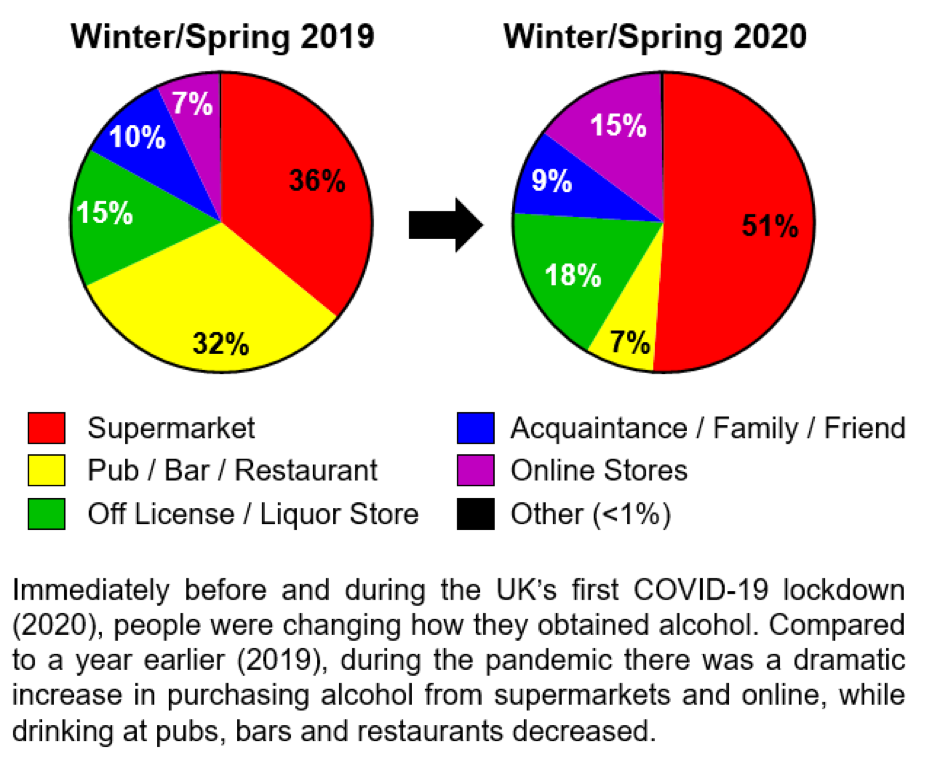
{"id":1191,"date":"2021-01-18T09:00:00","date_gmt":"2021-01-18T09:00:00","guid":{"rendered":"http:\/\/blogs.sussex.ac.uk\/psychology\/?p=1191"},"modified":"2021-01-15T13:25:18","modified_gmt":"2021-01-15T13:25:18","slug":"alcohol-addiction-research","status":"publish","type":"post","link":"https:\/\/blogs.sussex.ac.uk\/psychology\/2021\/01\/18\/alcohol-addiction-research\/","title":{"rendered":"Alcohol Addiction Research"},"content":{"rendered":"\n<p>By Dr Bryan Singer<\/p>\n\n\n\n<p>The <a href=\"http:\/\/www.sussex.ac.uk\/saric\/\">Sussex Addiction Research and Intervention Centre (SARIC)<\/a> is made up of a collection of investigators who are dedicated to understanding the biopsychosocial underpinnings of addiction and developing rational therapies for its treatment. Over the years, SARIC has been extraordinarily active in investigating why there is variation across individuals in the magnitude of binge-drinking and the susceptibility to developing an alcohol use disorder. The laboratory of <a href=\"https:\/\/profiles.sussex.ac.uk\/p8980-dora-duka\">Professor Dora Duka<\/a>, for example, uncovered that individual differences in <a href=\"https:\/\/pubmed.ncbi.nlm.nih.gov\/33364316\/\">impulsive behaviours and emotional-processing<\/a> can impact alcohol consumption, as well as how unique patterns of <a href=\"https:\/\/onlinelibrary.wiley.com\/doi\/abs\/10.1111\/ejn.14108\">brain activity regulate these processes<\/a>. The laboratory of SARIC researcher <a href=\"https:\/\/profiles.sussex.ac.uk\/p298980-aldo-badiani\">Professor Aldo Badiani<\/a> has also found that alcohol consumption may alter an individual\u2019s perception, including by <a href=\"http:\/\/sro.sussex.ac.uk\/id\/eprint\/83818\/\">enhancing the control a person feels they have over situations<\/a> (an increased \u2018sense of agency\u2019).<\/p>\n\n\n\n<p>During the COVID-19 pandemic, <a href=\"https:\/\/profiles.sussex.ac.uk\/p454349-bryan-singer\">Dr Bryan Singer\u2019s lab<\/a> at SARIC has started assessing how patterns of drug and alcohol use, as well as behavioural addictions such as gambling, have been changing. Participants were given several online questionnaires asking them to compare their behaviours during the pandemic to the previous year (research conducted by Adam Dickinson and Vlada Yarosh). While the data collected are still preliminary, some interesting patterns have emerged. In our <a href=\"http:\/\/sro.sussex.ac.uk\/id\/eprint\/84556\/\">previous work<\/a>, we have proposed that the act of drug-seeking may not always be dominated by habitual behaviours, as some research groups suggest; we argue that individuals who have an addiction may need to adapt to ever-changing circumstances to obtain their drug of choice. Our initial findings regarding alcohol use during the pandemic support this idea; individuals changed their behaviours to adapt to where and how they acquired alcohol (Figure 1). Preliminary data regarding cannabis use are similar. These initial findings highlight that drug- and alcohol-use may continue to be problematic during the pandemic and that individuals may be adapting how they pursue drugs and alcohol to continue their use.<\/p>\n\n\n\n<p>In a second effort to investigate if the reasons for alcohol and drug use have been changing during COVID-19, we have identified, thus far, two possible relationships. First, alcohol-use is strongly associated with employment status; individuals who have lost their job and have remained unemployed are at increased risk of showing symptoms of an alcohol use disorder. While we have not found a similar relationship between employment status and cannabis use, it appears that the degree of cannabis use is positively correlated with pandemic-related worry. Together, these preliminary findings suggest that during the pandemic how people are obtaining and why people are using alcohol and drugs may be changing. &nbsp;<\/p>\n\n\n\n<figure class=\"wp-block-image size-large\"><img data-attachment-id=\"1192\" data-permalink=\"https:\/\/blogs.sussex.ac.uk\/psychology\/2021\/01\/18\/alcohol-addiction-research\/saric-covid19-graph\/\" data-orig-file=\"https:\/\/i1.wp.com\/blogs.sussex.ac.uk\/psychology\/files\/2021\/01\/SARIC-covid19-graph.png?fit=941%2C764&amp;ssl=1\" data-orig-size=\"941,764\" data-comments-opened=\"1\" data-image-meta=\"{&quot;aperture&quot;:&quot;0&quot;,&quot;credit&quot;:&quot;&quot;,&quot;camera&quot;:&quot;&quot;,&quot;caption&quot;:&quot;&quot;,&quot;created_timestamp&quot;:&quot;0&quot;,&quot;copyright&quot;:&quot;&quot;,&quot;focal_length&quot;:&quot;0&quot;,&quot;iso&quot;:&quot;0&quot;,&quot;shutter_speed&quot;:&quot;0&quot;,&quot;title&quot;:&quot;&quot;,&quot;orientation&quot;:&quot;0&quot;}\" data-image-title=\"SARIC-covid19-graph\" data-image-description=\"\" data-image-caption=\"\" data-medium-file=\"https:\/\/i1.wp.com\/blogs.sussex.ac.uk\/psychology\/files\/2021\/01\/SARIC-covid19-graph.png?fit=300%2C244&amp;ssl=1\" data-large-file=\"https:\/\/i1.wp.com\/blogs.sussex.ac.uk\/psychology\/files\/2021\/01\/SARIC-covid19-graph.png?fit=550%2C447&amp;ssl=1\" loading=\"lazy\" width=\"550\" height=\"447\" src=\"https:\/\/i1.wp.com\/blogs.sussex.ac.uk\/psychology\/files\/2021\/01\/SARIC-covid19-graph.png?resize=550%2C447&#038;ssl=1\" alt=\"\" class=\"wp-image-1192\" srcset=\"https:\/\/i1.wp.com\/blogs.sussex.ac.uk\/psychology\/files\/2021\/01\/SARIC-covid19-graph.png?w=941&amp;ssl=1 941w, https:\/\/i1.wp.com\/blogs.sussex.ac.uk\/psychology\/files\/2021\/01\/SARIC-covid19-graph.png?resize=300%2C244&amp;ssl=1 300w, https:\/\/i1.wp.com\/blogs.sussex.ac.uk\/psychology\/files\/2021\/01\/SARIC-covid19-graph.png?resize=768%2C624&amp;ssl=1 768w, https:\/\/i1.wp.com\/blogs.sussex.ac.uk\/psychology\/files\/2021\/01\/SARIC-covid19-graph.png?resize=100%2C81&amp;ssl=1 100w, https:\/\/i1.wp.com\/blogs.sussex.ac.uk\/psychology\/files\/2021\/01\/SARIC-covid19-graph.png?resize=150%2C122&amp;ssl=1 150w, https:\/\/i1.wp.com\/blogs.sussex.ac.uk\/psychology\/files\/2021\/01\/SARIC-covid19-graph.png?resize=200%2C162&amp;ssl=1 200w, https:\/\/i1.wp.com\/blogs.sussex.ac.uk\/psychology\/files\/2021\/01\/SARIC-covid19-graph.png?resize=450%2C365&amp;ssl=1 450w, https:\/\/i1.wp.com\/blogs.sussex.ac.uk\/psychology\/files\/2021\/01\/SARIC-covid19-graph.png?resize=600%2C487&amp;ssl=1 600w, https:\/\/i1.wp.com\/blogs.sussex.ac.uk\/psychology\/files\/2021\/01\/SARIC-covid19-graph.png?resize=900%2C731&amp;ssl=1 900w\" sizes=\"(max-width: 550px) 100vw, 550px\" data-recalc-dims=\"1\" \/><\/figure>\n\n\n\n<p>Across research groups, SARIC is committed to understanding all aspects of alcohol use disorder and devising novel treatments to help individuals and communities impacted by the condition. <a href=\"https:\/\/alcoholchange.org.uk\/get-involved\/campaigns\/dry-january\">Dry January<\/a>, which is supported by research from SARIC\u2019s <a href=\"https:\/\/profiles.sussex.ac.uk\/p169775-richard-de-visser\">Dr Richard De Visser<\/a>, requires that individuals commit to an alcohol-free life during the month; this has a long-term effect, helping people to reduce their alcohol-consumption throughout the year. Therefore, minimising alcohol use during January\u2019s COVID-19 lockdown in the UK should reduce drinking in subsequent months, as pandemic-related restrictions are lifted and life slowly returns to normal.<\/p>\n\n\n\n<p><\/p>\n\n\n\n<p><em><a href=\"https:\/\/profiles.sussex.ac.uk\/p454349-bryan-singer\">Bryan Singer<\/a> is a Lecturer in Psychology and co-director of the <a href=\"http:\/\/www.sussex.ac.uk\/saric\/\">Sussex Addiction Research and Intervention Centre (SARIC)<\/a>. He is also part of the <a href=\"http:\/\/www.sussex.ac.uk\/psychology\/research\/behaviouralclinicalneuroscience\">Behavioural and Clinical Neuroscience research group<\/a> in the School of Psychology.<\/em><\/p>\n","protected":false},"excerpt":{"rendered":"<p>By Dr Bryan Singer The Sussex Addiction Research and Intervention Centre (SARIC) is made up of a collection of investigators who are dedicated to understanding the biopsychosocial underpinnings of addiction and developing rational therapies for its treatment. Over the years,<span class=\"ellipsis\">&hellip;<\/span><\/p>\n<div class=\"read-more\"><a href=\"https:\/\/blogs.sussex.ac.uk\/psychology\/2021\/01\/18\/alcohol-addiction-research\/\">Read more &#8250;<\/a><\/div>\n<p><!-- end of .read-more --><\/p>\n","protected":false},"author":156,"featured_media":0,"comment_status":"open","ping_status":"open","sticky":false,"template":"","format":"standard","meta":{"spay_email":"","jetpack_publicize_message":"","jetpack_is_tweetstorm":false},"categories":[98529],"tags":[168184,168185,168175,168186,168133],"jetpack_featured_media_url":"","jetpack_publicize_connections":[],"jetpack_sharing_enabled":true,"jetpack_shortlink":"https:\/\/wp.me\/pafdEV-jd","jetpack-related-posts":[{"id":2007,"url":"https:\/\/blogs.sussex.ac.uk\/psychology\/2023\/12\/19\/discussing-the-current-approach-to-the-treatment-of-addiction-a-public-session-hosted-by-saric-during-the-bna-festival\/","url_meta":{"origin":1191,"position":0},"title":"Discussing the current approach to the treatment of addiction: a public session hosted by SARIC during the BNA festival","date":"December 19, 2023","format":false,"excerpt":"By Nina Cork and Hattie Lockwood (University of Sussex students) In April this year, SARIC (Sussex Addiction Research and Intervention Centre) hosted a public panel as part of the British Neuroscience Association\u2019s International Festival of Neuroscience 2023, discussing the need to bridge the gap between academia and the community regarding\u2026","rel":"","context":"With 1 comment","img":{"alt_text":"","src":"https:\/\/i2.wp.com\/blogs.sussex.ac.uk\/psychology\/files\/2023\/12\/BNA-Panel-Photo-scaled.jpeg?resize=350%2C200&ssl=1","width":350,"height":200},"classes":[]},{"id":810,"url":"https:\/\/blogs.sussex.ac.uk\/psychology\/2019\/07\/16\/psychology-in-the-media-june-2019\/","url_meta":{"origin":1191,"position":1},"title":"Psychology in the Media: June 2019","date":"July 16, 2019","format":false,"excerpt":"The month of June started with an article about Ian Hadden's research on the Times Education Supplement: \u201cPositive writing \u201cboosts poorer pupils\u2019 maths scores\u201d. Ian and his PhD supervisor Dr Matt Easterbrook investigated whether self-affirmation writing exercises could improve the performance of low socio-economic status school students. Their study found\u2026","rel":"","context":"In &quot;Psychology in the Media&quot;","img":{"alt_text":"","src":"https:\/\/i2.wp.com\/blogs.sussex.ac.uk\/psychology\/files\/2019\/07\/drinking-wine.jpg?resize=350%2C200&ssl=1","width":350,"height":200},"classes":[]},{"id":527,"url":"https:\/\/blogs.sussex.ac.uk\/psychology\/2018\/05\/21\/the-dangers-of-over-hyping-sugar-addiction\/","url_meta":{"origin":1191,"position":2},"title":"The dangers of over-hyping \u2018sugar addiction\u2019.","date":"May 21, 2018","format":false,"excerpt":"By Jenny Morris Sugar seems to be frequently vilified in the media. Just a quick google search and headlines report\u00a0\u2018Sugar can destroy your brain\u2019,\u00a0\u2018Sugar is as addictive as cocaine\u2019\u00a0and\u00a0\u2018Sugar addiction \u2018should be treated as a form of drug abuse\u2019. It\u2019s frequently referred to as an addictive drug, which supports people\u2026","rel":"","context":"In &quot;PhD research&quot;","img":{"alt_text":"","src":"https:\/\/i1.wp.com\/blogs.sussex.ac.uk\/psychology\/files\/2018\/05\/cooking-crowd-food-104884-1024x624.jpg?resize=350%2C200","width":350,"height":200},"classes":[]},{"id":94,"url":"https:\/\/blogs.sussex.ac.uk\/psychology\/2015\/11\/02\/unexpected\/","url_meta":{"origin":1191,"position":3},"title":"Unexpected","date":"November 2, 2015","format":false,"excerpt":"By Hause Lin \u00a0 Many assigned readings for most modules seemed uninteresting at best. Two papers in particular\u2014White's (1967) \u201cThe historical roots of our ecologic crisis\u201d and Hardin's (1968) \u201cThe tragedy of the commons\u201d\u2014come instantly to mind. These titles just sound dull and mind-numbing, especially to a first-year undergraduate. Till\u2026","rel":"","context":"In \"Alumni\"","img":{"alt_text":"Undergraduate Awards at Farmleigh House and Estate. 20 November 2014 ","src":"https:\/\/i2.wp.com\/blogs.sussex.ac.uk\/psychology\/files\/2015\/10\/Hause-300x200.png?resize=350%2C200","width":350,"height":200},"classes":[]},{"id":915,"url":"https:\/\/blogs.sussex.ac.uk\/psychology\/2020\/03\/19\/can-culture-beat-the-coronavirus\/","url_meta":{"origin":1191,"position":4},"title":"Can Culture Beat the Coronavirus?","date":"March 19, 2020","format":false,"excerpt":"By Rotem Perach How can we beat the coronavirus? It seems that culture is already developing its own prescriptions, specifically, against the psychological effects of the coronavirus outbreak. In recent fashion week catwalks in\u00a0New York\u00a0and\u00a0Paris, designers re-imagined face masks as a fashionable, rather than solely contamination-protective, accessory. While some may\u2026","rel":"","context":"In &quot;Research staff&quot;","img":{"alt_text":"","src":"https:\/\/i1.wp.com\/blogs.sussex.ac.uk\/psychology\/files\/2020\/03\/woman-in-gray-coat-standing-on-stage-2920143.jpg?resize=350%2C200&ssl=1","width":350,"height":200},"classes":[]},{"id":1383,"url":"https:\/\/blogs.sussex.ac.uk\/psychology\/2021\/09\/21\/meet-professor-nicola-yuill\/","url_meta":{"origin":1191,"position":5},"title":"Meet Professor Nicola Yuill","date":"September 21, 2021","format":false,"excerpt":"Prof Nicola Yuill personifies the interdisciplinary spirit that has always been at the core of Sussex. Whether as a student or as a lecturer, she has been part of all the Psychology departments that historically spread across three different Schools at Sussex.\u00a0Her current research\u00a0is the result of this background, with\u2026","rel":"","context":"In &quot;History of Psychology at Sussex&quot;","img":{"alt_text":"","src":"https:\/\/i0.wp.com\/blogs.sussex.ac.uk\/psychology\/files\/2021\/07\/Nicola-Yuill.jpg?resize=350%2C200&ssl=1","width":350,"height":200},"classes":[]}],"_links":{"self":[{"href":"https:\/\/blogs.sussex.ac.uk\/psychology\/wp-json\/wp\/v2\/posts\/1191"}],"collection":[{"href":"https:\/\/blogs.sussex.ac.uk\/psychology\/wp-json\/wp\/v2\/posts"}],"about":[{"href":"https:\/\/blogs.sussex.ac.uk\/psychology\/wp-json\/wp\/v2\/types\/post"}],"author":[{"embeddable":true,"href":"https:\/\/blogs.sussex.ac.uk\/psychology\/wp-json\/wp\/v2\/users\/156"}],"replies":[{"embeddable":true,"href":"https:\/\/blogs.sussex.ac.uk\/psychology\/wp-json\/wp\/v2\/comments?post=1191"}],"version-history":[{"count":7,"href":"https:\/\/blogs.sussex.ac.uk\/psychology\/wp-json\/wp\/v2\/posts\/1191\/revisions"}],"predecessor-version":[{"id":1201,"href":"https:\/\/blogs.sussex.ac.uk\/psychology\/wp-json\/wp\/v2\/posts\/1191\/revisions\/1201"}],"wp:attachment":[{"href":"https:\/\/blogs.sussex.ac.uk\/psychology\/wp-json\/wp\/v2\/media?parent=1191"}],"wp:term":[{"taxonomy":"category","embeddable":true,"href":"https:\/\/blogs.sussex.ac.uk\/psychology\/wp-json\/wp\/v2\/categories?post=1191"},{"taxonomy":"post_tag","embeddable":true,"href":"https:\/\/blogs.sussex.ac.uk\/psychology\/wp-json\/wp\/v2\/tags?post=1191"}],"curies":[{"name":"wp","href":"https:\/\/api.w.org\/{rel}","templated":true}]}}