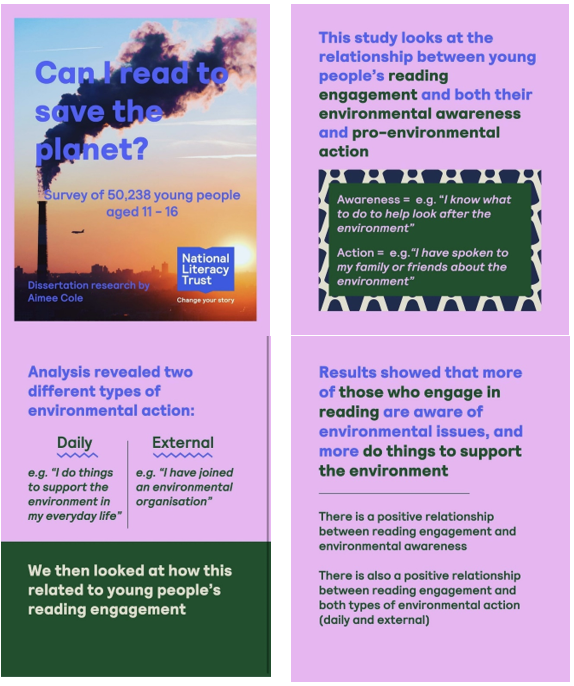
{"id":2014,"date":"2024-02-07T14:28:54","date_gmt":"2024-02-07T14:28:54","guid":{"rendered":"https:\/\/blogs.sussex.ac.uk\/psychology\/?p=2014"},"modified":"2024-02-07T14:35:17","modified_gmt":"2024-02-07T14:35:17","slug":"can-i-read-to-save-the-planet","status":"publish","type":"post","link":"https:\/\/blogs.sussex.ac.uk\/psychology\/2024\/02\/07\/can-i-read-to-save-the-planet\/","title":{"rendered":"Can I read to save the planet?"},"content":{"rendered":"\n<p>By Aimee Cole <\/p>\n\n\n\n<p><strong>Educational placement with the National Literacy Trust<\/strong><\/p>\n\n\n\n<p>When I began my Psychology course at Sussex back in 2019, I wasn\u2019t at all sure where I wanted my degree to take me. My interests were broad, ranging from psychopathology to sports psychology. I also had a keen interest in social justice and knew I wanted to work in a role where I felt I could make a positive contribution. I just couldn\u2019t picture how these interests could culminate in an interesting and appropriate job role. Among this, I also experienced a lot of anxiety, and couldn\u2019t imagine feeling confident in an unfamiliar workplace. Little did I know that my placement at the National Literacy Trust would transform me from a nervous student into a confident, published researcher and conference presenter.<\/p>\n\n\n\n<p>The National Literacy Trust is an independent charity that empowers children, young people, and adults with the literacy skills they need to succeed. My educational placement sat within the research team, who (to massively simplify the work that they do into a sentence) conduct bespoke research in the field of literacy and beyond, as well as internal and external evaluations of literacy-related programmes.<\/p>\n\n\n\n<p>Working with the research team enabled me to strengthen the skills I had developed as part of my degree, including developing literature reviews and writing reports, but also brought about new skills including data analysis using SPSS, and collecting evaluation data for internal programmes. The placement required me to collaborate with teams across the organisation and built on my confidence to advocate for the importance of our research and evaluation work both internally and externally.<\/p>\n\n\n\n<p><strong>My dissertation<\/strong><\/p>\n\n\n\n<p>When it came to deciding on a dissertation topic, I knew that I wanted to use data collected by the National Literacy Trust. The charity\u2019s Annual Literacy Survey asks children and young people across the United Kingdom about their literacy behaviours and attitudes, among other areas of interest, and is the largest survey of its kind. In 2022, the survey included additional questions about children and young people\u2019s awareness of environmental issues, and any behaviours they engaged in to support or protect the environment.<\/p>\n\n\n\n<p>In light of the climate crisis, environmental issues are something I care deeply about, and I have spent a lot of time researching and learning about the things that we can do to support our environment. This research often materialised in reading blogs, articles, or books- I had recently devoured \u2018Hothouse Earth\u2019 by Bill McGuire. Learning about the climate crisis in this way got me thinking- Was I more likely to, say, become vegan, because I read more regularly about the environment? How would my environmental awareness differ from someone who, for example, didn\u2019t consume much text at all?<\/p>\n\n\n\n<p><strong>The research<\/strong><\/p>\n\n\n\n<p>Ultimately, my dissertation examined the relationship between young people\u2019s reading engagement and both their environmental awareness and pro-environmental action. This was not related to reading specifically about the environment, but any reading at all, and included enjoyment, confidence, and frequency of reading. Overall, data from 50,238 children and young people aged from 11 to 16 was included in the analysis.<\/p>\n\n\n\n<p>The results showed a positive correlation between reading engagement and both environmental awareness and action. This suggested that the higher you scored on the reading engagement score, the higher you scored in your awareness of environmental issues, and the number of actions you engaged in to support the environment.<\/p>\n\n\n\n<p>More in-depth analysis also found that environmental awareness could partially explain the relationship between reading engagement and daily environmental action (e.g., \u2018I do things to support the environment in my everyday life\u2019), but not external environmental action (e.g., \u2018I have written to someone in power about the environment\u2019).<\/p>\n\n\n\n<p>As such, my research found that reading could act as a pathway to improving young people\u2019s awareness of environmental issues and engagement in actions to protect the planet. The study was the first to investigate and provide evidence of such a relationship in the UK.<\/p>\n\n\n\n<p><strong>Making research accessible<\/strong><\/p>\n\n\n\n<p>The National Literacy Trust aims to work towards a more equal society, and a key element of that is through making our work accessible to as many people as possible. As such, in addition to my research report being published on the National Literacy Trust\u2019s website (see <a href=\"https:\/\/nlt.cdn.ngo\/media\/documents\/Literacy_and_environmental_awareness_report_final_8fFi535.pdf\">Cole, 2023<\/a>), I worked closely with the charity\u2019s Social Media Manager, Hannah Riley, to find creative ways to display the findings. As you will see below, I felt it did the trick in pulling some strong key messages from a complex report!<\/p>\n\n\n\n<div class=\"wp-block-image\"><figure class=\"aligncenter size-large\"><a href=\"https:\/\/i2.wp.com\/blogs.sussex.ac.uk\/psychology\/files\/2024\/02\/Can-I-Read-to-save-the-planet.png?ssl=1\"><img data-attachment-id=\"2015\" data-permalink=\"https:\/\/blogs.sussex.ac.uk\/psychology\/2024\/02\/07\/can-i-read-to-save-the-planet\/can-i-read-to-save-the-planet\/\" data-orig-file=\"https:\/\/i2.wp.com\/blogs.sussex.ac.uk\/psychology\/files\/2024\/02\/Can-I-Read-to-save-the-planet.png?fit=574%2C686&amp;ssl=1\" data-orig-size=\"574,686\" data-comments-opened=\"1\" data-image-meta=\"{&quot;aperture&quot;:&quot;0&quot;,&quot;credit&quot;:&quot;&quot;,&quot;camera&quot;:&quot;&quot;,&quot;caption&quot;:&quot;&quot;,&quot;created_timestamp&quot;:&quot;0&quot;,&quot;copyright&quot;:&quot;&quot;,&quot;focal_length&quot;:&quot;0&quot;,&quot;iso&quot;:&quot;0&quot;,&quot;shutter_speed&quot;:&quot;0&quot;,&quot;title&quot;:&quot;&quot;,&quot;orientation&quot;:&quot;0&quot;}\" data-image-title=\"Can-I-Read-to-save-the-planet\" data-image-description=\"\" data-image-caption=\"\" data-medium-file=\"https:\/\/i2.wp.com\/blogs.sussex.ac.uk\/psychology\/files\/2024\/02\/Can-I-Read-to-save-the-planet.png?fit=251%2C300&amp;ssl=1\" data-large-file=\"https:\/\/i2.wp.com\/blogs.sussex.ac.uk\/psychology\/files\/2024\/02\/Can-I-Read-to-save-the-planet.png?fit=550%2C657&amp;ssl=1\" loading=\"lazy\" width=\"550\" height=\"657\" src=\"https:\/\/i2.wp.com\/blogs.sussex.ac.uk\/psychology\/files\/2024\/02\/Can-I-Read-to-save-the-planet.png?resize=550%2C657&#038;ssl=1\" alt=\"\" class=\"wp-image-2015\" srcset=\"https:\/\/i2.wp.com\/blogs.sussex.ac.uk\/psychology\/files\/2024\/02\/Can-I-Read-to-save-the-planet.png?w=574&amp;ssl=1 574w, https:\/\/i2.wp.com\/blogs.sussex.ac.uk\/psychology\/files\/2024\/02\/Can-I-Read-to-save-the-planet.png?resize=251%2C300&amp;ssl=1 251w, https:\/\/i2.wp.com\/blogs.sussex.ac.uk\/psychology\/files\/2024\/02\/Can-I-Read-to-save-the-planet.png?resize=100%2C120&amp;ssl=1 100w, https:\/\/i2.wp.com\/blogs.sussex.ac.uk\/psychology\/files\/2024\/02\/Can-I-Read-to-save-the-planet.png?resize=150%2C179&amp;ssl=1 150w, https:\/\/i2.wp.com\/blogs.sussex.ac.uk\/psychology\/files\/2024\/02\/Can-I-Read-to-save-the-planet.png?resize=200%2C239&amp;ssl=1 200w, https:\/\/i2.wp.com\/blogs.sussex.ac.uk\/psychology\/files\/2024\/02\/Can-I-Read-to-save-the-planet.png?resize=300%2C359&amp;ssl=1 300w, https:\/\/i2.wp.com\/blogs.sussex.ac.uk\/psychology\/files\/2024\/02\/Can-I-Read-to-save-the-planet.png?resize=450%2C538&amp;ssl=1 450w\" sizes=\"(max-width: 550px) 100vw, 550px\" data-recalc-dims=\"1\" \/><\/a><figcaption>A graphic illustration of the key themes in Aimee&#8217;s report<\/figcaption><\/figure><\/div>\n\n\n\n<p><strong>What\u2019s next?<\/strong><\/p>\n\n\n\n<p>Overall, my research highlighted the importance of promoting reading engagement in young people to enhance environmental awareness and action. This may be through educational initiatives, or public campaigns which leverage the link between reading and environmental engagement, to raise awareness, and inspire action. For example, teams within the National Literacy Trust are already beginning to incorporate reading about environmental issues into their programmatic work with children and young people, and the report is already being used across the organisation to support the work we do with partners that have an interest in the environment and sustainability. Given the scarcity of research in this area within the UK, I hope that this research sparks interest for others, and leads to more work in this space.<\/p>\n\n\n\n<p>You can read the full report, here: <a href=\"https:\/\/literacytrust.org.uk\/research-services\/research-reports\/can-i-read-to-save-the-planet\/\">Can I read to save the planet? | National Literacy Trust<\/a>&nbsp;<\/p>\n\n\n\n<p><em>With special thanks to Christina Clark, Anne Teravainen-Goff and Irene Picton from the National Literacy Trust, and Jane Oakhill, from the University of Sussex, who supervised this research dissertation.<\/em><\/p>\n\n\n\n<hr class=\"wp-block-separator\" \/>\n\n\n\n<div class=\"wp-block-media-text alignwide is-stacked-on-mobile\" style=\"grid-template-columns:22% auto\"><figure class=\"wp-block-media-text__media\"><img data-attachment-id=\"2019\" data-permalink=\"https:\/\/blogs.sussex.ac.uk\/psychology\/2024\/02\/07\/can-i-read-to-save-the-planet\/aimee-2-1\/\" data-orig-file=\"https:\/\/i2.wp.com\/blogs.sussex.ac.uk\/psychology\/files\/2024\/02\/Aimee-2-1.jpg?fit=582%2C964&amp;ssl=1\" data-orig-size=\"582,964\" data-comments-opened=\"1\" data-image-meta=\"{&quot;aperture&quot;:&quot;0&quot;,&quot;credit&quot;:&quot;&quot;,&quot;camera&quot;:&quot;&quot;,&quot;caption&quot;:&quot;&quot;,&quot;created_timestamp&quot;:&quot;1689953006&quot;,&quot;copyright&quot;:&quot;&quot;,&quot;focal_length&quot;:&quot;0&quot;,&quot;iso&quot;:&quot;0&quot;,&quot;shutter_speed&quot;:&quot;0&quot;,&quot;title&quot;:&quot;&quot;,&quot;orientation&quot;:&quot;0&quot;}\" data-image-title=\"Aimee-2-1\" data-image-description=\"\" data-image-caption=\"\" data-medium-file=\"https:\/\/i2.wp.com\/blogs.sussex.ac.uk\/psychology\/files\/2024\/02\/Aimee-2-1.jpg?fit=181%2C300&amp;ssl=1\" data-large-file=\"https:\/\/i2.wp.com\/blogs.sussex.ac.uk\/psychology\/files\/2024\/02\/Aimee-2-1.jpg?fit=550%2C911&amp;ssl=1\" loading=\"lazy\" width=\"550\" height=\"911\" src=\"https:\/\/i2.wp.com\/blogs.sussex.ac.uk\/psychology\/files\/2024\/02\/Aimee-2-1.jpg?resize=550%2C911&#038;ssl=1\" alt=\"\" class=\"wp-image-2019 size-full\" srcset=\"https:\/\/i2.wp.com\/blogs.sussex.ac.uk\/psychology\/files\/2024\/02\/Aimee-2-1.jpg?w=582&amp;ssl=1 582w, https:\/\/i2.wp.com\/blogs.sussex.ac.uk\/psychology\/files\/2024\/02\/Aimee-2-1.jpg?resize=181%2C300&amp;ssl=1 181w, https:\/\/i2.wp.com\/blogs.sussex.ac.uk\/psychology\/files\/2024\/02\/Aimee-2-1.jpg?resize=100%2C166&amp;ssl=1 100w, https:\/\/i2.wp.com\/blogs.sussex.ac.uk\/psychology\/files\/2024\/02\/Aimee-2-1.jpg?resize=150%2C248&amp;ssl=1 150w, https:\/\/i2.wp.com\/blogs.sussex.ac.uk\/psychology\/files\/2024\/02\/Aimee-2-1.jpg?resize=200%2C331&amp;ssl=1 200w, https:\/\/i2.wp.com\/blogs.sussex.ac.uk\/psychology\/files\/2024\/02\/Aimee-2-1.jpg?resize=300%2C497&amp;ssl=1 300w, https:\/\/i2.wp.com\/blogs.sussex.ac.uk\/psychology\/files\/2024\/02\/Aimee-2-1.jpg?resize=450%2C745&amp;ssl=1 450w\" sizes=\"(max-width: 550px) 100vw, 550px\" data-recalc-dims=\"1\" \/><\/figure><div class=\"wp-block-media-text__content\">\n<p class=\"has-text-align-left\"><em>Aimee Cole is a 2023 first-class graduate of the University of Sussex\u2019s School of Psychology. After completing her third-year placement with the National Literacy Trust, she continued working for their research team and was promoted to a full-time position as Evaluation Manager upon completing her degree. She is particularly interested in the link between literacy engagement, environmental awareness and positive mental wellbeing.<\/em><\/p>\n<\/div><\/div>\n","protected":false},"excerpt":{"rendered":"<p>By Aimee Cole Educational placement with the National Literacy Trust When I began my Psychology course at Sussex back in 2019, I wasn\u2019t at all sure where I wanted my degree to take me. My interests were broad, ranging from<span class=\"ellipsis\">&hellip;<\/span><\/p>\n<div class=\"read-more\"><a href=\"https:\/\/blogs.sussex.ac.uk\/psychology\/2024\/02\/07\/can-i-read-to-save-the-planet\/\">Read more &#8250;<\/a><\/div>\n<p><!-- end of .read-more --><\/p>\n","protected":false},"author":373,"featured_media":0,"comment_status":"open","ping_status":"open","sticky":false,"template":"","format":"standard","meta":{"spay_email":"","jetpack_publicize_message":"","jetpack_is_tweetstorm":false},"categories":[1],"tags":[],"jetpack_featured_media_url":"","jetpack_publicize_connections":[],"jetpack_sharing_enabled":true,"jetpack_shortlink":"https:\/\/wp.me\/pafdEV-wu","jetpack-related-posts":[{"id":1853,"url":"https:\/\/blogs.sussex.ac.uk\/psychology\/2023\/02\/28\/why-my-placement-has-changed-my-life\/","url_meta":{"origin":2014,"position":0},"title":"Why my placement has changed my life","date":"February 28, 2023","format":false,"excerpt":"By Kerry Moor We asked one of our current 2022-23 Psychology Professional placement students to tell us about their experience so far. Kerry is completing an internal research placement with the School of Psychology for the Sussex Centre for Research on Kindness. A Professional Placement year is completed between your\u2026","rel":"","context":"Similar post","img":{"alt_text":"","src":"https:\/\/i2.wp.com\/blogs.sussex.ac.uk\/psychology\/files\/2023\/02\/Placement-blog-photo-scaled.jpg?resize=350%2C200&ssl=1","width":350,"height":200},"classes":[]},{"id":125,"url":"https:\/\/blogs.sussex.ac.uk\/psychology\/2016\/02\/01\/my-placement-year-at-glaxosmithkline\/","url_meta":{"origin":2014,"position":1},"title":"My placement year at GlaxoSmithKline","date":"February 1, 2016","format":false,"excerpt":"By Lauren Maddock \u00a0 I did not begin my degree with the intention to complete a Placement year but decided during my second year that it would be a great development opportunity whilst also trialling a career area I was interested in. I am a Psychology undergraduate and so felt\u2026","rel":"","context":"In \"Employability\"","img":{"alt_text":"GSK Building","src":"https:\/\/i1.wp.com\/blogs.sussex.ac.uk\/psychology\/files\/2016\/01\/GSK-HOUSE-300x155.jpg?resize=350%2C200","width":350,"height":200},"classes":[]},{"id":2095,"url":"https:\/\/blogs.sussex.ac.uk\/psychology\/2025\/06\/25\/a-year-of-growth-inside-my-psychology-placement\/","url_meta":{"origin":2014,"position":2},"title":"A Year of Growth: Inside My Psychology Placement","date":"June 25, 2025","format":false,"excerpt":"As part of her placement year, undergraduate student, Alex Medintu, recently took up the challenge of organizing an event to raise awareness for Autism Acceptance Month. After the event, we had a chat with Alex to find out more about her placement with ACoRN Sussex. I chose to do a\u2026","rel":"","context":"Similar post","img":{"alt_text":"","src":"https:\/\/i1.wp.com\/blogs.sussex.ac.uk\/psychology\/files\/2025\/06\/photo-4.jpg?resize=350%2C200&ssl=1","width":350,"height":200},"classes":[]},{"id":1925,"url":"https:\/\/blogs.sussex.ac.uk\/psychology\/2023\/03\/30\/my-placement-with-acorns-and-an-ever-growing-interest-in-autism\/","url_meta":{"origin":2014,"position":3},"title":"My placement with ACoRNS and an ever-growing interest in autism","date":"March 30, 2023","format":false,"excerpt":"By Anjali Das As part of World Autism Acceptance Week, Psychology graduate Anjali Das writes about her work placement with the ACoRNs team and the experiences that have influenced her future goals and passion for autism research. One year ago, when I finished my degree, I would have laughed in\u2026","rel":"","context":"Similar post","img":{"alt_text":"","src":"https:\/\/i0.wp.com\/blogs.sussex.ac.uk\/psychology\/files\/2023\/03\/Anjali-blog-pic.jpeg?resize=350%2C200&ssl=1","width":350,"height":200},"classes":[]},{"id":897,"url":"https:\/\/blogs.sussex.ac.uk\/psychology\/2020\/03\/04\/are-your-clients-being-defensive-if-so-self-affirmation-may-help\/","url_meta":{"origin":2014,"position":4},"title":"Are your clients being defensive? If so, self-affirmation may help.","date":"March 4, 2020","format":false,"excerpt":"by Prof Pete Harris and Ian Hadden, from the Self-Affirmation Research Group. Have you ever been reluctant to face up to something you\u2019d rather ignore? Maybe your fondness for something bad for you that you eat too often or your tendency to avoid health check-ups? Well, you\u2019re not alone. Most\u2026","rel":"","context":"In &quot;Faculty research&quot;","img":{"alt_text":"","src":"https:\/\/i2.wp.com\/blogs.sussex.ac.uk\/psychology\/files\/2020\/03\/counselling-3630323_640.png?resize=350%2C200&ssl=1","width":350,"height":200},"classes":[]},{"id":842,"url":"https:\/\/blogs.sussex.ac.uk\/psychology\/2019\/10\/23\/professor-rupert-browns-retirement\/","url_meta":{"origin":2014,"position":5},"title":"Professor Rupert Brown's Retirement","date":"October 23, 2019","format":false,"excerpt":"Professor Rupert Brown This coming Thursday we are celebrating the career of Professor Rupert Brown with a special colloquium. Rupert joined the recently unified department of Psychology\u00a0at Sussex\u00a0in 2004 and has since been an essential figure for the School both in terms of his academic work\u00a0as well as his involvement\u2026","rel":"","context":"In &quot;History of Psychology at Sussex&quot;","img":{"alt_text":"","src":"https:\/\/i0.wp.com\/blogs.sussex.ac.uk\/psychology\/files\/2019\/10\/RJBphoto.jpg?resize=350%2C200&ssl=1","width":350,"height":200},"classes":[]}],"_links":{"self":[{"href":"https:\/\/blogs.sussex.ac.uk\/psychology\/wp-json\/wp\/v2\/posts\/2014"}],"collection":[{"href":"https:\/\/blogs.sussex.ac.uk\/psychology\/wp-json\/wp\/v2\/posts"}],"about":[{"href":"https:\/\/blogs.sussex.ac.uk\/psychology\/wp-json\/wp\/v2\/types\/post"}],"author":[{"embeddable":true,"href":"https:\/\/blogs.sussex.ac.uk\/psychology\/wp-json\/wp\/v2\/users\/373"}],"replies":[{"embeddable":true,"href":"https:\/\/blogs.sussex.ac.uk\/psychology\/wp-json\/wp\/v2\/comments?post=2014"}],"version-history":[{"count":7,"href":"https:\/\/blogs.sussex.ac.uk\/psychology\/wp-json\/wp\/v2\/posts\/2014\/revisions"}],"predecessor-version":[{"id":2026,"href":"https:\/\/blogs.sussex.ac.uk\/psychology\/wp-json\/wp\/v2\/posts\/2014\/revisions\/2026"}],"wp:attachment":[{"href":"https:\/\/blogs.sussex.ac.uk\/psychology\/wp-json\/wp\/v2\/media?parent=2014"}],"wp:term":[{"taxonomy":"category","embeddable":true,"href":"https:\/\/blogs.sussex.ac.uk\/psychology\/wp-json\/wp\/v2\/categories?post=2014"},{"taxonomy":"post_tag","embeddable":true,"href":"https:\/\/blogs.sussex.ac.uk\/psychology\/wp-json\/wp\/v2\/tags?post=2014"}],"curies":[{"name":"wp","href":"https:\/\/api.w.org\/{rel}","templated":true}]}}