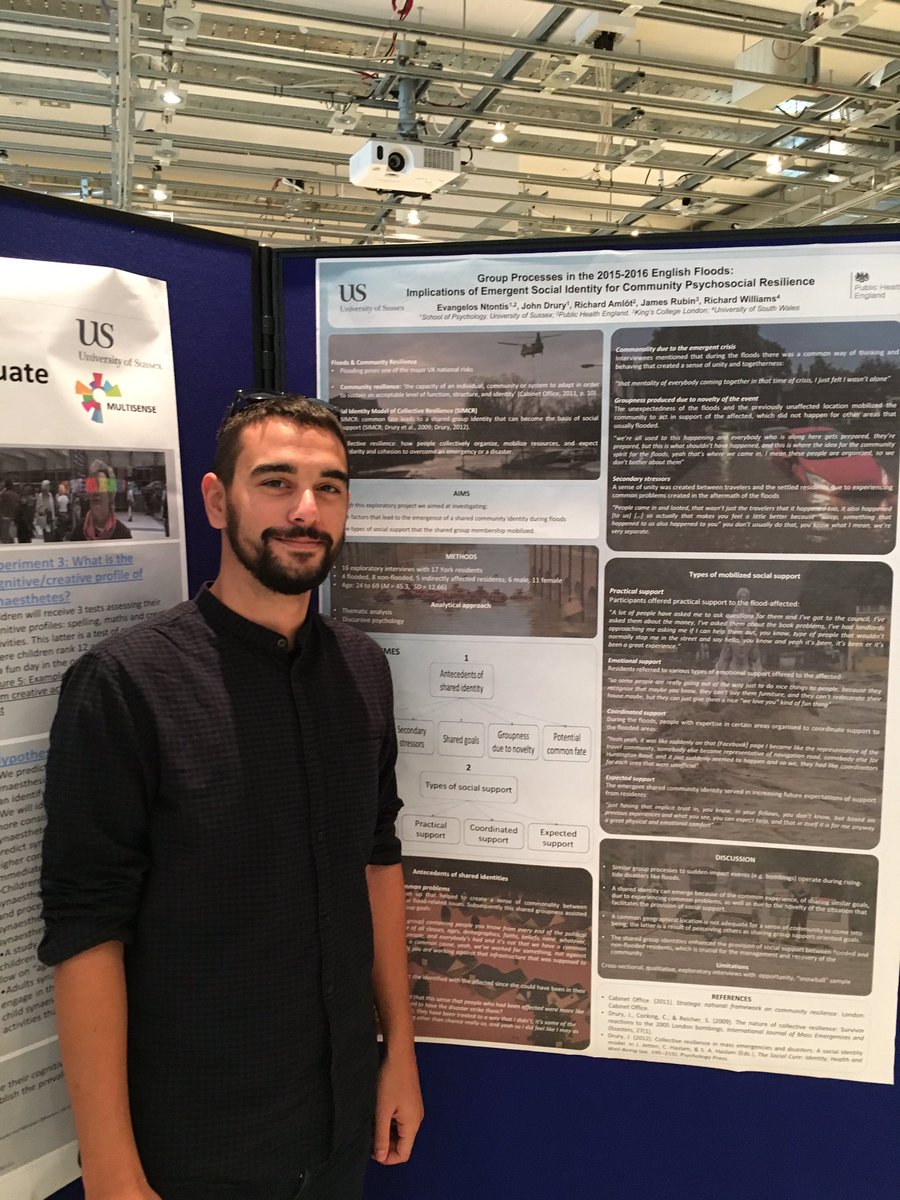
{"id":275,"date":"2016-10-18T11:59:10","date_gmt":"2016-10-18T11:59:10","guid":{"rendered":"http:\/\/blogs.sussex.ac.uk\/psychology\/?p=275"},"modified":"2020-05-28T14:02:12","modified_gmt":"2020-05-28T14:02:12","slug":"what-is-the-role-of-shared-identities-in-the-aftermath-of-floods","status":"publish","type":"post","link":"https:\/\/blogs.sussex.ac.uk\/psychology\/2016\/10\/18\/what-is-the-role-of-shared-identities-in-the-aftermath-of-floods\/","title":{"rendered":"What is the role of shared identities in the aftermath of floods?"},"content":{"rendered":"<p>By Evangelos Ntontis<\/p>\n<p>As a PhD student at the School of Psychology of Sussex University, I recently had the honour of winning the 2016 PhD poster conference. Of course winning is accompanied with writing a blog for the School\u2019s website, so I\u2019ll take this short space to briefly write about my overall research.<\/p>\n<p>Currently I am starting the second year of my PhD and my interests fall within social psychology. I am a member of the \u2018<a href=\"http:\/\/www.sussex.ac.uk\/psychology\/crowdsidentities\/\">Crowds and Identities<\/a>\u2019 research group led by John Drury, and our focus is on large-scale events that usually involve crowds (be it riots and protests, migration and refugees, mass emergencies and disasters, collective action etc.).<\/p>\n<p>My PhD project focuses on flooding and the role of shared identities in the response and recovery of communities. Putting it simply, a vast amount of research has shown that belonging to and identifying with groups is good for our well-being, since it provides a sense of belonging and we are more likely to offer and receive more support from other group members. Also, from studies of events like <a href=\"http:\/\/onlinelibrary.wiley.com\/doi\/10.1002\/ejsp.2146\/abstract\">earthquakes<\/a> and <a href=\"http:\/\/www.ijmed.org\/articles\/113\/download\/\">bombings<\/a> we know that the shared experience of adversity can unite people with no previous affiliations and they come to see themselves as sharing a common identity and group. Applying these principles and findings in flood-hit communities, we are investigating if and how the shared community identity arises, the role of identification with the broader community and its effects for the provision of support to those in need, the heightened expectations of future support, as well as the impact on individual well-being and perceptions of the community\u2019s ability to recover efficiently.<a href=\"https:\/\/i0.wp.com\/blogs.sussex.ac.uk\/psychology\/files\/2016\/10\/CtiS-_dWEAANpNI.jpg\"><img data-attachment-id=\"278\" data-permalink=\"https:\/\/blogs.sussex.ac.uk\/psychology\/2016\/10\/18\/what-is-the-role-of-shared-identities-in-the-aftermath-of-floods\/ctis-_dweaanpni\/\" data-orig-file=\"https:\/\/i0.wp.com\/blogs.sussex.ac.uk\/psychology\/files\/2016\/10\/CtiS-_dWEAANpNI.jpg?fit=900%2C1200&amp;ssl=1\" data-orig-size=\"900,1200\" data-comments-opened=\"1\" data-image-meta=\"{&quot;aperture&quot;:&quot;0&quot;,&quot;credit&quot;:&quot;&quot;,&quot;camera&quot;:&quot;&quot;,&quot;caption&quot;:&quot;&quot;,&quot;created_timestamp&quot;:&quot;0&quot;,&quot;copyright&quot;:&quot;&quot;,&quot;focal_length&quot;:&quot;0&quot;,&quot;iso&quot;:&quot;0&quot;,&quot;shutter_speed&quot;:&quot;0&quot;,&quot;title&quot;:&quot;&quot;,&quot;orientation&quot;:&quot;0&quot;}\" data-image-title=\"ctis-_dweaanpni\" data-image-description=\"\" data-image-caption=\"\" data-medium-file=\"https:\/\/i0.wp.com\/blogs.sussex.ac.uk\/psychology\/files\/2016\/10\/CtiS-_dWEAANpNI.jpg?fit=225%2C300&amp;ssl=1\" data-large-file=\"https:\/\/i0.wp.com\/blogs.sussex.ac.uk\/psychology\/files\/2016\/10\/CtiS-_dWEAANpNI.jpg?fit=550%2C733&amp;ssl=1\" loading=\"lazy\" class=\"size-medium wp-image-278 alignright\" src=\"https:\/\/i0.wp.com\/blogs.sussex.ac.uk\/psychology\/files\/2016\/10\/CtiS-_dWEAANpNI.jpg?resize=225%2C300\" alt=\"ctis-_dweaanpni\" width=\"225\" height=\"300\" srcset=\"https:\/\/i0.wp.com\/blogs.sussex.ac.uk\/psychology\/files\/2016\/10\/CtiS-_dWEAANpNI.jpg?resize=225%2C300&amp;ssl=1 225w, https:\/\/i0.wp.com\/blogs.sussex.ac.uk\/psychology\/files\/2016\/10\/CtiS-_dWEAANpNI.jpg?resize=768%2C1024&amp;ssl=1 768w, https:\/\/i0.wp.com\/blogs.sussex.ac.uk\/psychology\/files\/2016\/10\/CtiS-_dWEAANpNI.jpg?resize=100%2C133&amp;ssl=1 100w, https:\/\/i0.wp.com\/blogs.sussex.ac.uk\/psychology\/files\/2016\/10\/CtiS-_dWEAANpNI.jpg?resize=150%2C200&amp;ssl=1 150w, https:\/\/i0.wp.com\/blogs.sussex.ac.uk\/psychology\/files\/2016\/10\/CtiS-_dWEAANpNI.jpg?resize=200%2C267&amp;ssl=1 200w, https:\/\/i0.wp.com\/blogs.sussex.ac.uk\/psychology\/files\/2016\/10\/CtiS-_dWEAANpNI.jpg?resize=300%2C400&amp;ssl=1 300w, https:\/\/i0.wp.com\/blogs.sussex.ac.uk\/psychology\/files\/2016\/10\/CtiS-_dWEAANpNI.jpg?resize=450%2C600&amp;ssl=1 450w, https:\/\/i0.wp.com\/blogs.sussex.ac.uk\/psychology\/files\/2016\/10\/CtiS-_dWEAANpNI.jpg?resize=600%2C800&amp;ssl=1 600w, https:\/\/i0.wp.com\/blogs.sussex.ac.uk\/psychology\/files\/2016\/10\/CtiS-_dWEAANpNI.jpg?w=900&amp;ssl=1 900w\" sizes=\"(max-width: 225px) 100vw, 225px\" data-recalc-dims=\"1\" \/><\/a><\/p>\n<p>I focus on the city of York, which was affected by floods in December 2015. I visited York for one week and interviewed York residents in order to get a better idea of the situation, and the poster described my first complete interview study which is currently being prepared for submission in a peer-reviewed journal. Our participants reported that a sense of unity was felt during the floods because of the shared experience of the floods, because of experiencing common problems which led in having shared future goals, as well as because of identifying with those affected, even without sustaining any damage. People also reported various types of social support that were provided to those affected, like practical support, emotional support, coordinated support which individuals themselves would not be able to accomplish, and heightened expectations of future support.<\/p>\n<p>We also need to emphasize the important role of rhetoric for the recovery process of communities in the aftermath of disasters. During the emergency events people come together and form groups, which as we saw can have individual and collective benefits. However, it can take a long time for communities to fully recover, and certainly the problems do not disappear straight after the waters recede and the emergency responders leave the affected area. Groups and the sense of collectivity need to persist over time so that all types of social support keep flowing towards the affected residents. This can be achieved through invocations of the community and the collective, as well as through broad community group boundaries that will include both affected and non-affected residents. Thus people who identify with the community will tend to see others as fellow community members regardless of their status, which will make the provision of support easier and with prolonged benefits for the recovery process.<\/p>\n<p>Overall, these findings are a good first indicator of the positive role that shared identities can have during the recovery period, and a solid ground for us to move on and investigate those identity processes from more methodological approaches such as surveys and ethnographic analyses.<\/p>\n<p>With regards to the poster itself, I need to say a big Thank you to Khalifah Alfadhli and John Drury for their useful tips. To Khalifah for constantly scolding me and persisting that I reduce the amount of text (and it was really difficult for him to be satisfied, especially when taking into account that it was an interview study with lots of extracts!), and to John for insisting that I use more background pictures.<\/p>\n<p><em>If you want to know\u00a0more about poster presentations, you can read\u00a0a post by Ellen Thompson, the 2015 PhD Poster Presentation winner, here: <a href=\"http:\/\/blogs.sussex.ac.uk\/psychology\/2015\/10\/26\/do-multiple-adverse-childhood-experiences-aces-lead-to-anxiety-and-depression-in-later-life-a-poster-by-ellen-thompson\/\">Do multiple Adverse Childhood Experiences (ACEs) lead to anxiety and depression in later life?<\/a><\/em><\/p>\n<p class=\"entry-title post-title\">Find out more about our <a href=\"http:\/\/www.sussex.ac.uk\/psychology\/research\/socialandappliedpsychology\">research on Social and Applied Psychology<\/a>.<\/p>\n","protected":false},"excerpt":{"rendered":"<p>By Evangelos Ntontis As a PhD student at the School of Psychology of Sussex University, I recently had the honour of winning the 2016 PhD poster conference. Of course winning is accompanied with writing a blog for the School\u2019s website,<span class=\"ellipsis\">&hellip;<\/span><\/p>\n<div class=\"read-more\"><a href=\"https:\/\/blogs.sussex.ac.uk\/psychology\/2016\/10\/18\/what-is-the-role-of-shared-identities-in-the-aftermath-of-floods\/\">Read more &#8250;<\/a><\/div>\n<p><!-- end of .read-more --><\/p>\n","protected":false},"author":156,"featured_media":0,"comment_status":"open","ping_status":"open","sticky":false,"template":"","format":"standard","meta":{"spay_email":"","jetpack_publicize_message":"","jetpack_is_tweetstorm":false},"categories":[1],"tags":[97947,97945,98542,97941,98553,24,98552,97762],"jetpack_featured_media_url":"","jetpack_publicize_connections":[],"jetpack_sharing_enabled":true,"jetpack_shortlink":"https:\/\/wp.me\/pafdEV-4r","jetpack-related-posts":[{"id":52,"url":"https:\/\/blogs.sussex.ac.uk\/psychology\/2015\/09\/28\/psychology-phd-poster-conference-2015\/","url_meta":{"origin":275,"position":0},"title":"Psychology PhD Poster Conference 2015","date":"September 28, 2015","format":false,"excerpt":"At the start of every academic year, PhD students moving from Year 1 to Year 2 of their studies are asked to prepare a poster presentation of their research to date. This year it will be held on Wednesday 30th September from 2.30 to 5pm in the Creativity Zone, a\u2026","rel":"","context":"In \"PhD students\"","img":{"alt_text":"","src":"https:\/\/i0.wp.com\/blogs.sussex.ac.uk\/psychology\/files\/2015\/09\/Screen-Shot-2015-09-28-at-12.10.21.png?resize=350%2C200","width":350,"height":200},"classes":[]},{"id":83,"url":"https:\/\/blogs.sussex.ac.uk\/psychology\/2015\/10\/26\/do-multiple-adverse-childhood-experiences-aces-lead-to-anxiety-and-depression-in-later-life-a-poster-by-ellen-thompson\/","url_meta":{"origin":275,"position":1},"title":"Do multiple Adverse Childhood Experiences (ACEs) lead to anxiety and depression in later life?","date":"October 26, 2015","format":false,"excerpt":"By Ellen Thompson I recently had the honour of winning The Best Poster Award at the 2015 Psychology student poster conference! I have just commenced the second year of my PhD (how time flies!) and wanted to take this opportunity to talk about my research and share a couple of\u2026","rel":"","context":"In \"Academic Writing\"","img":{"alt_text":"","src":"https:\/\/i2.wp.com\/blogs.sussex.ac.uk\/psychology\/files\/2015\/10\/Ellen_poster-225x300.jpg?resize=350%2C200","width":350,"height":200},"classes":[]},{"id":261,"url":"https:\/\/blogs.sussex.ac.uk\/psychology\/2016\/09\/27\/a-busy-week\/","url_meta":{"origin":275,"position":2},"title":"A busy week","date":"September 27, 2016","format":false,"excerpt":"By Dr Sarah King This is a fun but busy week for the Director of Doctoral Studies (DDS), the job I have recently taken over. I have been meeting all the new PhD students and signing their forms to approve the stats and methods courses they are taking to support\u2026","rel":"","context":"In \"DDS\"","img":{"alt_text":"","src":"","width":0,"height":0},"classes":[]},{"id":451,"url":"https:\/\/blogs.sussex.ac.uk\/psychology\/2017\/09\/04\/the-social-psychology-of-the-hajj\/","url_meta":{"origin":275,"position":3},"title":"The social psychology of the Hajj","date":"September 4, 2017","format":false,"excerpt":"By John Drury Last week, the annual Hajj took place in Mecca (Makkah) and the other holy places nearby. This Muslim pilgrimage is one of the world\u2019s largest crowd events \u2013 the official figure for those attending last year was 1,862,909. The Hajj has been called the world\u2019s \u2018global gathering\u2019\u2026","rel":"","context":"In &quot;PhD research&quot;","img":{"alt_text":"","src":"https:\/\/i0.wp.com\/blogs.sussex.ac.uk\/psychology\/files\/2017\/09\/Inset-shows-density-of-6ppm2.jpg?resize=350%2C200","width":350,"height":200},"classes":[]},{"id":225,"url":"https:\/\/blogs.sussex.ac.uk\/psychology\/2016\/06\/14\/reflections-of-a-first-year-phd-student\/","url_meta":{"origin":275,"position":4},"title":"Reflections of a first year PhD student","date":"June 14, 2016","format":false,"excerpt":"By Mateo Legan\u00e9s Fonteneau Doing a PhD was never my lifetime objective. When I finished college I started studying an engineering degree, but I realised quite soon that it wasn\u2019t what I\u2019d expected. I then went on to study Social Work, hoping to help drug addicts when I finished. As\u2026","rel":"","context":"In \"First Year\"","img":{"alt_text":"Mateo with his colleagues, about to win a race","src":"https:\/\/i2.wp.com\/blogs.sussex.ac.uk\/psychology\/files\/2016\/06\/Unknown-300x169.jpeg?resize=350%2C200","width":350,"height":200},"classes":[]},{"id":850,"url":"https:\/\/blogs.sussex.ac.uk\/psychology\/2019\/10\/30\/tackling-hate-from-parliament-to-campus\/","url_meta":{"origin":275,"position":5},"title":"Tackling hate \u2013 from parliament to campus","date":"October 30, 2019","format":false,"excerpt":"By Carina Hoerst Two weeks ago was National Hate Crime Awareness Week. What started in 1999 as a reaction to attacks on the Black and LGBT community has become a big event and takes place every year since. Today, it seems to be more important than ever. The UK is\u2026","rel":"","context":"In &quot;PhD research&quot;","img":{"alt_text":"","src":"","width":0,"height":0},"classes":[]}],"_links":{"self":[{"href":"https:\/\/blogs.sussex.ac.uk\/psychology\/wp-json\/wp\/v2\/posts\/275"}],"collection":[{"href":"https:\/\/blogs.sussex.ac.uk\/psychology\/wp-json\/wp\/v2\/posts"}],"about":[{"href":"https:\/\/blogs.sussex.ac.uk\/psychology\/wp-json\/wp\/v2\/types\/post"}],"author":[{"embeddable":true,"href":"https:\/\/blogs.sussex.ac.uk\/psychology\/wp-json\/wp\/v2\/users\/156"}],"replies":[{"embeddable":true,"href":"https:\/\/blogs.sussex.ac.uk\/psychology\/wp-json\/wp\/v2\/comments?post=275"}],"version-history":[{"count":3,"href":"https:\/\/blogs.sussex.ac.uk\/psychology\/wp-json\/wp\/v2\/posts\/275\/revisions"}],"predecessor-version":[{"id":988,"href":"https:\/\/blogs.sussex.ac.uk\/psychology\/wp-json\/wp\/v2\/posts\/275\/revisions\/988"}],"wp:attachment":[{"href":"https:\/\/blogs.sussex.ac.uk\/psychology\/wp-json\/wp\/v2\/media?parent=275"}],"wp:term":[{"taxonomy":"category","embeddable":true,"href":"https:\/\/blogs.sussex.ac.uk\/psychology\/wp-json\/wp\/v2\/categories?post=275"},{"taxonomy":"post_tag","embeddable":true,"href":"https:\/\/blogs.sussex.ac.uk\/psychology\/wp-json\/wp\/v2\/tags?post=275"}],"curies":[{"name":"wp","href":"https:\/\/api.w.org\/{rel}","templated":true}]}}