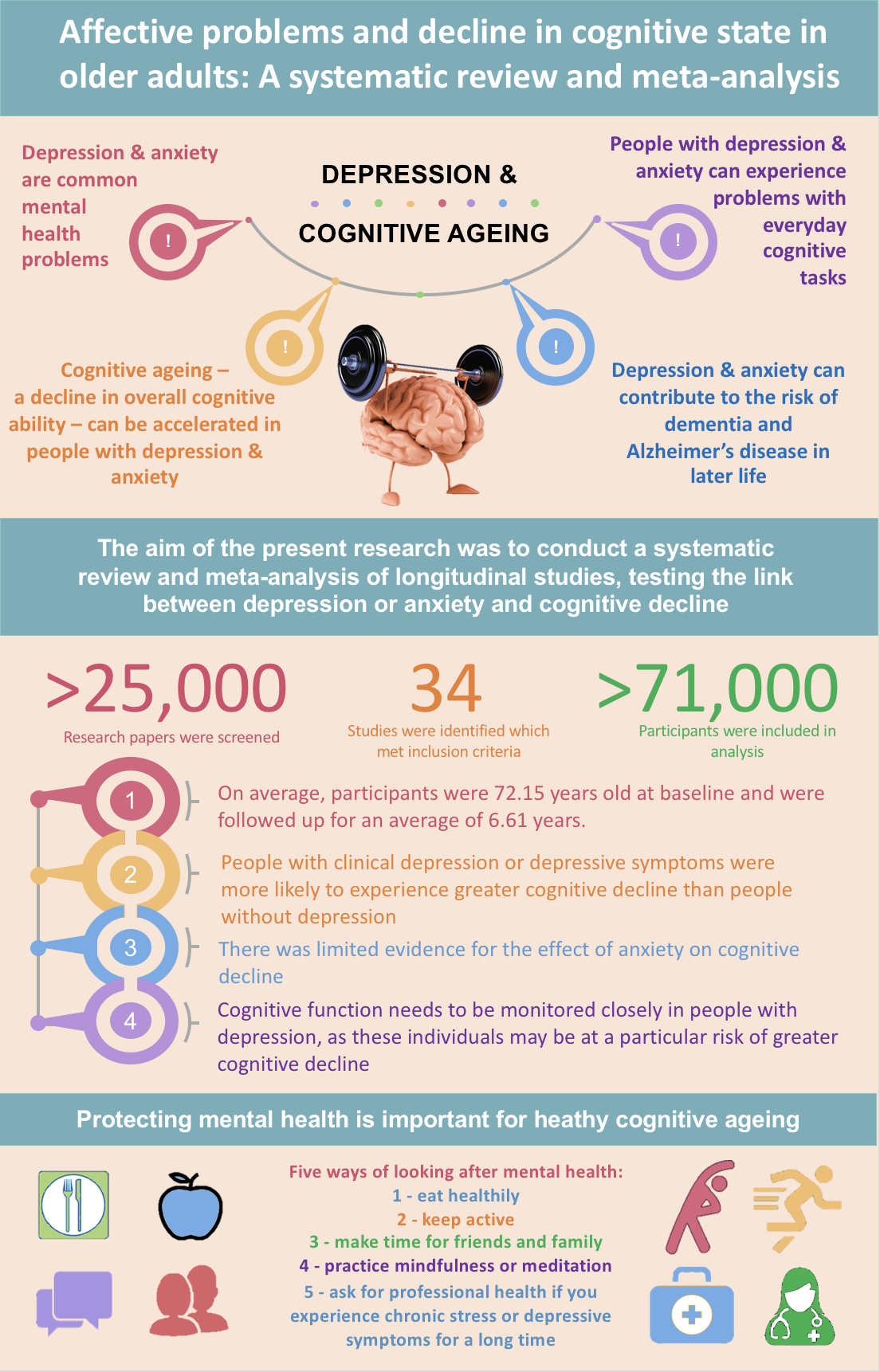
{"id":537,"date":"2018-06-11T15:50:45","date_gmt":"2018-06-11T15:50:45","guid":{"rendered":"http:\/\/blogs.sussex.ac.uk\/psychology\/?p=537"},"modified":"2020-05-28T12:46:20","modified_gmt":"2020-05-28T12:46:20","slug":"depression-and-cognitive-ageing","status":"publish","type":"post","link":"https:\/\/blogs.sussex.ac.uk\/psychology\/2018\/06\/11\/depression-and-cognitive-ageing\/","title":{"rendered":"Depression and Cognitive Ageing"},"content":{"rendered":"<p>By Amber John<\/p>\n<p>Depression is a common mental health problem which is experienced by people of all ages. It is estimated that each year around 1 in 5 people in the UK will experience depressive symptoms. Depression encompasses lots of different kinds of symptoms which can range from mild to severe. This can include psychological symptoms (such as a continuous low mood, feelings of hopelessness and guilt and lacking motivation), physical symptoms (such as changes in sleeping patterns, weight and appetite changes, and loss of energy), and social symptoms (such as withdrawal from friends and family, or underperforming at school or work). For more information on recognising symptoms of depression, follow this link to the NHS website, which can describe this in more depth: <a href=\"https:\/\/www.nhs.uk\/conditions\/clinical-depression\/symptoms\/\">https:\/\/www.nhs.uk\/conditions\/clinical-depression\/symptoms\/\u00a0<\/a><!--more--><\/p>\n<p>There is some evidence to suggest that depression may be linked with poorer physical, mental, and cognitive outcomes later in life. For example, scientists have previously reported that experiencing depression may be related to an increased risk of stroke, diabetes and early mortality. Researchers have also previously shown a link between depression in older adulthood and dementia. However, we do not yet know whether depression can lead to a faster cognitive decline in a population of individuals without dementia. The aim of our study was to test whether there is comprehensive evidence for the effect of depression on cognitive decline in cognitively healthy older adults.<\/p>\n<p><strong>\u00a0<\/strong><\/p>\n<p><strong>WHAT DID WE DO?<\/strong><\/p>\n<p>We conducted a systematic review and meta-analysis of longitudinal studies investigating the link between depression or anxiety and decline in cognitive function in people without dementia. In total, evidence from 34 studies and more than 71,000 participants was combined and synthesised. There were 32 studies looking at depression and cognitive decline; and 5 studies looking at anxiety and cognitive decline (Three of these studies assessed both depression and anxiety).<\/p>\n<p><a href=\"https:\/\/i1.wp.com\/blogs.sussex.ac.uk\/psychology\/files\/2018\/06\/Screen-Shot-2018-06-08-at-09.38.12.png\"><img data-attachment-id=\"538\" data-permalink=\"https:\/\/blogs.sussex.ac.uk\/psychology\/2018\/06\/11\/depression-and-cognitive-ageing\/screen-shot-2018-06-08-at-09-38-12\/\" data-orig-file=\"https:\/\/i1.wp.com\/blogs.sussex.ac.uk\/psychology\/files\/2018\/06\/Screen-Shot-2018-06-08-at-09.38.12.png?fit=1104%2C1722&amp;ssl=1\" data-orig-size=\"1104,1722\" data-comments-opened=\"1\" data-image-meta=\"{&quot;aperture&quot;:&quot;0&quot;,&quot;credit&quot;:&quot;&quot;,&quot;camera&quot;:&quot;&quot;,&quot;caption&quot;:&quot;&quot;,&quot;created_timestamp&quot;:&quot;0&quot;,&quot;copyright&quot;:&quot;&quot;,&quot;focal_length&quot;:&quot;0&quot;,&quot;iso&quot;:&quot;0&quot;,&quot;shutter_speed&quot;:&quot;0&quot;,&quot;title&quot;:&quot;&quot;,&quot;orientation&quot;:&quot;0&quot;}\" data-image-title=\"infograph &#8211; Depression &amp;amp; Ageing\" data-image-description=\"\" data-image-caption=\"\" data-medium-file=\"https:\/\/i1.wp.com\/blogs.sussex.ac.uk\/psychology\/files\/2018\/06\/Screen-Shot-2018-06-08-at-09.38.12.png?fit=192%2C300&amp;ssl=1\" data-large-file=\"https:\/\/i1.wp.com\/blogs.sussex.ac.uk\/psychology\/files\/2018\/06\/Screen-Shot-2018-06-08-at-09.38.12.png?fit=550%2C857&amp;ssl=1\" loading=\"lazy\" class=\" wp-image-538 alignright\" src=\"https:\/\/i1.wp.com\/blogs.sussex.ac.uk\/psychology\/files\/2018\/06\/Screen-Shot-2018-06-08-at-09.38.12.png?resize=428%2C667\" alt=\"\" width=\"428\" height=\"667\" srcset=\"https:\/\/i1.wp.com\/blogs.sussex.ac.uk\/psychology\/files\/2018\/06\/Screen-Shot-2018-06-08-at-09.38.12.png?resize=657%2C1024&amp;ssl=1 657w, https:\/\/i1.wp.com\/blogs.sussex.ac.uk\/psychology\/files\/2018\/06\/Screen-Shot-2018-06-08-at-09.38.12.png?resize=192%2C300&amp;ssl=1 192w, https:\/\/i1.wp.com\/blogs.sussex.ac.uk\/psychology\/files\/2018\/06\/Screen-Shot-2018-06-08-at-09.38.12.png?resize=768%2C1198&amp;ssl=1 768w, https:\/\/i1.wp.com\/blogs.sussex.ac.uk\/psychology\/files\/2018\/06\/Screen-Shot-2018-06-08-at-09.38.12.png?resize=100%2C156&amp;ssl=1 100w, https:\/\/i1.wp.com\/blogs.sussex.ac.uk\/psychology\/files\/2018\/06\/Screen-Shot-2018-06-08-at-09.38.12.png?resize=150%2C234&amp;ssl=1 150w, https:\/\/i1.wp.com\/blogs.sussex.ac.uk\/psychology\/files\/2018\/06\/Screen-Shot-2018-06-08-at-09.38.12.png?resize=200%2C312&amp;ssl=1 200w, https:\/\/i1.wp.com\/blogs.sussex.ac.uk\/psychology\/files\/2018\/06\/Screen-Shot-2018-06-08-at-09.38.12.png?resize=300%2C468&amp;ssl=1 300w, https:\/\/i1.wp.com\/blogs.sussex.ac.uk\/psychology\/files\/2018\/06\/Screen-Shot-2018-06-08-at-09.38.12.png?resize=450%2C702&amp;ssl=1 450w, https:\/\/i1.wp.com\/blogs.sussex.ac.uk\/psychology\/files\/2018\/06\/Screen-Shot-2018-06-08-at-09.38.12.png?resize=600%2C936&amp;ssl=1 600w, https:\/\/i1.wp.com\/blogs.sussex.ac.uk\/psychology\/files\/2018\/06\/Screen-Shot-2018-06-08-at-09.38.12.png?resize=900%2C1404&amp;ssl=1 900w, https:\/\/i1.wp.com\/blogs.sussex.ac.uk\/psychology\/files\/2018\/06\/Screen-Shot-2018-06-08-at-09.38.12.png?w=1104&amp;ssl=1 1104w\" sizes=\"(max-width: 428px) 100vw, 428px\" data-recalc-dims=\"1\" \/><\/a><\/p>\n<p><strong>WHAT WE FOUND AND WHAT IT MEANS<\/strong><\/p>\n<p>Our results suggest that people diagnosed with clinical depression are more likely to experience a faster cognitive decline over time than people without depression (OR 1.36, 95% CI 1.05\u20131.76, p = 0.02). We also found that people who do not have a formal diagnosis of depression but have elevated depressive symptoms are also more likely to show greater cognitive decline than people with lower depressive symptoms (B =\u22120.008, 95% CI \u22120.015 to \u22120.002, p = 0.012). There was mixed evidence regarding the link between anxiety and cognitive decline. Our results highlight the importance of protecting mental health in order to safeguard against cognitive decline in later life, particularly as our populations are ageing rapidly and the number of older adults living in our society is expected to increase significantly over the next few decades. For more information about this study you can access the publication online: <a href=\"https:\/\/www.ncbi.nlm.nih.gov\/pubmed\/29792244\">https:\/\/www.ncbi.nlm.nih.gov\/pubmed\/29792244<\/a> or see the infographic.<\/p>\n<p><strong>HOW TO PROTECT YOUR MENTAL HEALTH<\/strong><\/p>\n<p>Not everyone with depression will show faster cognitive decline. There are lots of other important factors which may play into the rate at which we age, such as genetic factors, education level, sleeping patterns, and diet. As there are so many other important factors which play a role in predicting cognitive health in older age, it is not inevitable that people with depression will experience poorer cognitive outcomes. Taking measures to manage and protect mental health and wellbeing may also help to support cognitive health in older adulthood. Some actions which can be taken to help protect mental health and wellbeing include:<\/p>\n<ol>\n<li>Practicing mindfulness meditation. Mindfulness meditation can be accessed using freely available websites and apps, such as Headspace (<a href=\"https:\/\/www.headspace.com\">https:\/\/www.headspace.com<\/a>).<\/li>\n<li>Maintaining a good work-life balance. Advice on how to stay well at work can be accessed on the following link: <a href=\"https:\/\/www.mind.org.uk\/workplace\/mental-health-at-work\/taking-care-of-yourself\/tips-for-employees\/\">https:\/\/www.mind.org.uk\/workplace\/mental-health-at-work\/taking-care-of-yourself\/tips-for-employees\/<\/a><\/li>\n<li>Maintaining social connections with others. Strong social networks with loved ones can foster important social relationships and protect against feelings of isolation and loneliness. See the following guidance for opening up to friends and family about your mental health: <a href=\"https:\/\/www.mind.org.uk\/information-support\/guides-to-support-and-services\/seeking-help-for-a-mental-health-problem\/talking-to-friends-family\/#.Wxkp0u4vxyw\">https:\/\/www.mind.org.uk\/information-support\/guides-to-support-and-services\/seeking-help-for-a-mental-health-problem\/talking-to-friends-family\/#.Wxkp0u4vxyw<\/a><\/li>\n<\/ol>\n<p>Also see our video below which describes a couple of practical steps that can be taken to protect mental health and wellbeing: <a href=\"https:\/\/www.youtube.com\/watch?v=NwQq1LQZX3o&amp;feature=youtu.be\">https:\/\/www.youtube.com\/watch?v=NwQq1LQZX3o&amp;feature=youtu.be<\/a><\/p>\n<p><strong>SEEKING HELP FOR YOUR MENTAL HEALTH<\/strong><\/p>\n<p>If you think you may be experiencing symptoms of depression, anxiety or any other mental health condition, it is important to talk to your GP who will be able to offer more tailored advice for you. See online guidance from MIND, a leading mental health charity, on seeking help for a mental health problem.<\/p>\n<p><a href=\"https:\/\/www.mind.org.uk\/information-support\/guides-to-support-and-services\/seeking-help-for-a-mental-health-problem\/where-to-start\/#.WxkScO4vxyx\">https:\/\/www.mind.org.uk\/information-support\/guides-to-support-and-services\/seeking-help-for-a-mental-health-problem\/where-to-start\/#.WxkScO4vxyx<\/a><\/p>\n<p>If you are worried about loved one or believe they may be experiencing a mental health problem, further online support can be found through the MIND website.<\/p>\n<p><a href=\"https:\/\/www.mind.org.uk\/information-support\/helping-someone-else\/\">https:\/\/www.mind.org.uk\/information-support\/helping-someone-else\/<\/a><\/p>\n<p>See the link below for a list of useful contacts if you need further information or support in relation to your mental health:<\/p>\n<p><a href=\"https:\/\/www.mind.org.uk\/information-support\/guides-to-support-and-services\/seeking-help-for-a-mental-health-problem\/useful-contacts\/#.WxkqPO4vxyx\">https:\/\/www.mind.org.uk\/information-support\/guides-to-support-and-services\/seeking-help-for-a-mental-health-problem\/useful-contacts\/#.WxkqPO4vxyx<\/a><\/p>\n<p><em>Amber is doing her PhD with <a href=\"http:\/\/www.sussex.ac.uk\/profiles\/329367\">Dr Darya Gaysina<\/a> at <a href=\"http:\/\/www.sussex.ac.uk\/psychology\/edgelab\/\">the EDGE Lab<\/a>.<\/em><\/p>\n<p>Find out more about our <a href=\"http:\/\/www.sussex.ac.uk\/psychology\/research\/developmentalandclinicalpsychology\">research on Developmental and Clinical Psychology<\/a>.<\/p>\n","protected":false},"excerpt":{"rendered":"<p>By Amber John Depression is a common mental health problem which is experienced by people of all ages. It is estimated that each year around 1 in 5 people in the UK will experience depressive symptoms. Depression encompasses lots of<span class=\"ellipsis\">&hellip;<\/span><\/p>\n<div class=\"read-more\"><a href=\"https:\/\/blogs.sussex.ac.uk\/psychology\/2018\/06\/11\/depression-and-cognitive-ageing\/\">Read more &#8250;<\/a><\/div>\n<p><!-- end of .read-more --><\/p>\n","protected":false},"author":156,"featured_media":0,"comment_status":"open","ping_status":"open","sticky":false,"template":"","format":"standard","meta":{"spay_email":"","jetpack_publicize_message":"","jetpack_is_tweetstorm":false},"categories":[98528,24],"tags":[90767,98546,97941,24],"jetpack_featured_media_url":"","jetpack_publicize_connections":[],"jetpack_sharing_enabled":true,"jetpack_shortlink":"https:\/\/wp.me\/pafdEV-8F","jetpack-related-posts":[{"id":598,"url":"https:\/\/blogs.sussex.ac.uk\/psychology\/2018\/10\/29\/my-jra-experience-at-the-edge-lab\/","url_meta":{"origin":537,"position":0},"title":"My JRA experience at the EDGE Lab","date":"October 29, 2018","format":false,"excerpt":"By Alexandra Schmidt Over the summer I had the pleasure to be part of the Junior Research Associate scheme and conduct my first own piece of research in the EDGE lab. I got interested in the scheme when I visited the poster exhibition of the previous year\u2019s JRA students and\u2026","rel":"","context":"In &quot;Research&quot;","img":{"alt_text":"","src":"https:\/\/i0.wp.com\/blogs.sussex.ac.uk\/psychology\/files\/2018\/10\/Screen-Shot-2018-10-26-at-17.05.15-723x1024.png?resize=350%2C200","width":350,"height":200},"classes":[]},{"id":1143,"url":"https:\/\/blogs.sussex.ac.uk\/psychology\/2020\/11\/23\/alzheimer-type-dementia\/","url_meta":{"origin":537,"position":1},"title":"Alzheimer type dementia","date":"November 23, 2020","format":false,"excerpt":"by Prof Jennifer Rusted Age is not synonymous with poor health, but Alzheimer type dementia (AD) is a disease of the brain for which age is the biggest risk factor \u2013 the older you are, the greater your risk of developing the disease.\u00a0 But it certainly is not inevitable, and\u2026","rel":"","context":"In &quot;Faculty research&quot;","img":{"alt_text":"","src":"https:\/\/i0.wp.com\/blogs.sussex.ac.uk\/psychology\/files\/2020\/11\/Old-lady-1.png?resize=350%2C200&ssl=1","width":350,"height":200},"classes":[]},{"id":83,"url":"https:\/\/blogs.sussex.ac.uk\/psychology\/2015\/10\/26\/do-multiple-adverse-childhood-experiences-aces-lead-to-anxiety-and-depression-in-later-life-a-poster-by-ellen-thompson\/","url_meta":{"origin":537,"position":2},"title":"Do multiple Adverse Childhood Experiences (ACEs) lead to anxiety and depression in later life?","date":"October 26, 2015","format":false,"excerpt":"By Ellen Thompson I recently had the honour of winning The Best Poster Award at the 2015 Psychology student poster conference! I have just commenced the second year of my PhD (how time flies!) and wanted to take this opportunity to talk about my research and share a couple of\u2026","rel":"","context":"In \"Academic Writing\"","img":{"alt_text":"","src":"https:\/\/i2.wp.com\/blogs.sussex.ac.uk\/psychology\/files\/2015\/10\/Ellen_poster-225x300.jpg?resize=350%2C200","width":350,"height":200},"classes":[]},{"id":377,"url":"https:\/\/blogs.sussex.ac.uk\/psychology\/2017\/05\/15\/surviving-or-thriving-lifelong-mental-health-in-children-with-chronic-physical-illness\/","url_meta":{"origin":537,"position":3},"title":"Surviving or Thriving? Lifelong mental health in children with chronic physical illness","date":"May 15, 2017","format":false,"excerpt":"By Ekin Secinti Chronic physical illness affects large numbers of children and families. Worldwide, 1 in 5 children has a chronic physical illness, including arthritis, asthma, cancer, chronic renal failure, congenital heart disease, cystic fibrosis, type-1 diabetes, and epilepsy. With the advances of medical therapies in the last decades, more\u2026","rel":"","context":"In &quot;Masters research&quot;","img":{"alt_text":"","src":"https:\/\/i1.wp.com\/blogs.sussex.ac.uk\/psychology\/files\/2017\/05\/vulnerable-child3-718x1024.jpeg?resize=350%2C200","width":350,"height":200},"classes":[]},{"id":1712,"url":"https:\/\/blogs.sussex.ac.uk\/psychology\/2022\/10\/06\/whats-in-a-word-using-speech-marker-to-diagnose-alzheimers-early\/","url_meta":{"origin":537,"position":4},"title":"What\u2019s in a word? Using speech marker to diagnose Alzheimer\u2019s early","date":"October 6, 2022","format":false,"excerpt":"By Alice Stanton September was World Alzheimer\u2019s Month, an international event run by Alzheimer\u2019s Disease International to spread awareness and challenge the stigmas that surround Alzheimer\u2019s and other forms of dementia. Alzheimer's is a degenerative neurological condition that is currently affecting more than 944,000 people in the UK and Alzheimer\u2019s\u2026","rel":"","context":"With 2 comments","img":{"alt_text":"","src":"https:\/\/i1.wp.com\/blogs.sussex.ac.uk\/psychology\/files\/2022\/10\/dementia-595638_1920.jpg?resize=350%2C200&ssl=1","width":350,"height":200},"classes":[]},{"id":1536,"url":"https:\/\/blogs.sussex.ac.uk\/psychology\/2022\/05\/12\/digital-mental-health-the-past-present-and-future\/","url_meta":{"origin":537,"position":5},"title":"Digital Mental Health: the past, present and future","date":"May 12, 2022","format":false,"excerpt":"By Dr Faith Matcham At the time of writing this, there were 52,564 healthcare and medical apps available to download on the Google Play store. According to a Deloitte report[1], global spending on mental health apps is likely to reach $500 million in 2022. Meanwhile, the smart-glasses, smart-textile and wearable\u2026","rel":"","context":"In &quot;Faculty research&quot;","img":{"alt_text":"","src":"https:\/\/i2.wp.com\/blogs.sussex.ac.uk\/psychology\/files\/2022\/05\/Untitled-design-11-3.png?resize=350%2C200&ssl=1","width":350,"height":200},"classes":[]}],"_links":{"self":[{"href":"https:\/\/blogs.sussex.ac.uk\/psychology\/wp-json\/wp\/v2\/posts\/537"}],"collection":[{"href":"https:\/\/blogs.sussex.ac.uk\/psychology\/wp-json\/wp\/v2\/posts"}],"about":[{"href":"https:\/\/blogs.sussex.ac.uk\/psychology\/wp-json\/wp\/v2\/types\/post"}],"author":[{"embeddable":true,"href":"https:\/\/blogs.sussex.ac.uk\/psychology\/wp-json\/wp\/v2\/users\/156"}],"replies":[{"embeddable":true,"href":"https:\/\/blogs.sussex.ac.uk\/psychology\/wp-json\/wp\/v2\/comments?post=537"}],"version-history":[{"count":5,"href":"https:\/\/blogs.sussex.ac.uk\/psychology\/wp-json\/wp\/v2\/posts\/537\/revisions"}],"predecessor-version":[{"id":976,"href":"https:\/\/blogs.sussex.ac.uk\/psychology\/wp-json\/wp\/v2\/posts\/537\/revisions\/976"}],"wp:attachment":[{"href":"https:\/\/blogs.sussex.ac.uk\/psychology\/wp-json\/wp\/v2\/media?parent=537"}],"wp:term":[{"taxonomy":"category","embeddable":true,"href":"https:\/\/blogs.sussex.ac.uk\/psychology\/wp-json\/wp\/v2\/categories?post=537"},{"taxonomy":"post_tag","embeddable":true,"href":"https:\/\/blogs.sussex.ac.uk\/psychology\/wp-json\/wp\/v2\/tags?post=537"}],"curies":[{"name":"wp","href":"https:\/\/api.w.org\/{rel}","templated":true}]}}