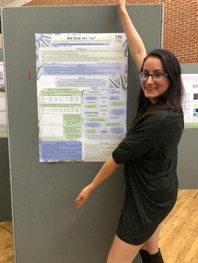
{"id":611,"date":"2018-11-12T10:10:46","date_gmt":"2018-11-12T10:10:46","guid":{"rendered":"http:\/\/blogs.sussex.ac.uk\/psychology\/?p=611"},"modified":"2020-05-28T12:42:50","modified_gmt":"2020-05-28T12:42:50","slug":"exploring-kindness-as-a-jra","status":"publish","type":"post","link":"https:\/\/blogs.sussex.ac.uk\/psychology\/2018\/11\/12\/exploring-kindness-as-a-jra\/","title":{"rendered":"Exploring Kindness as a JRA"},"content":{"rendered":"<p>By Alessia Goglio<\/p>\n<p>Being a Psychology undergraduate here at Sussex enabled me to explore different domains of interest in this fascinating subject and to develop my passion for \u201cPositive Psychology\u201d, the field that studies what is good in life. &nbsp;Among the topic explored in this field, there is kindness: a construct that had been shown to not only improve life satisfaction and well-being but also friendships and relationships.<\/p>\n<p>Kindness is a topic of growing interest in our university and one of the five core values of the <a href=\"https:\/\/www.sussex.ac.uk\/strategy\/\"><em>Sussex 2025 Strategic Framework<\/em><\/a>. Therefore, when I was given the amazing opportunity to work as a Junior Research Associate during summer 2018, I decided, with the help of my supervisor <a href=\"http:\/\/www.sussex.ac.uk\/profiles\/22548\">Professor Robin Banerjee<\/a> and my mentor <a href=\"http:\/\/www.sussex.ac.uk\/profiles\/341591\">Jessica Cotney<\/a>, to conduct a mixed-methods research investigating this positive construct.<\/p>\n<p><!--more--><\/p>\n<h4><strong>Background <\/strong><\/h4>\n<p>Research has investigated the main characteristics of kindness and its positive effect in people\u2019s lives, but no previous study has attempted to predict intention to perform kind acts or explored its facilitating and hindering factors. Thus, in my research we tried (1) to apply the Theory of Planned Behaviour model (TPB) (Ajzen, 1991) to the performance of kind acts, and (2) to investigate what factors affect kindness in the context of university life.<\/p>\n<p>&nbsp;<\/p>\n<table>\n<tbody>\n<tr>\n<td width=\"601\"><strong><em>The Theory of Planned Behaviour model<\/em><\/strong><em> state that attitudes (one\u2019s personal beliefs and evaluations); subjective norms (individuals\u2019 beliefs of how their significant others think they should behave) and perceived behavioural control (how much control the individual believes to have over the specific behaviour) are the main predicting factors of intentions to perform a wide range of behaviours (e.g. health protecting behaviours, healthy habits and prosocial behaviours).<\/em><\/td>\n<\/tr>\n<\/tbody>\n<\/table>\n<p>&nbsp;<\/p>\n<h4><strong>Main questions <\/strong><\/h4>\n<ul>\n<li>Does the Theory of Planned Behaviour model predict people\u2019s intentions to perform kind acts?<\/li>\n<li>Does the effect of personal attitudes on intentions to be kind depend on the perception of social norms and behavioural control?<\/li>\n<li>What are the factors that facilitate or hinder the performance of kind acts in the context of university life?<\/li>\n<\/ul>\n<table>\n<tbody>\n<tr>\n<td width=\"601\"><strong><em>Kind acts<\/em><\/strong><em> refer to low-level everyday kind behaviours, unmediated by other people or entities, not expected by the recipient, autonomously motivated and not planned in advance. Examples can be identified as picking something up for someone else, holding a door open, giving a compliment, offering emotional support, giving your seat to another person and smiling<\/em><\/td>\n<\/tr>\n<\/tbody>\n<\/table>\n<p>&nbsp;<\/p>\n<h4><strong>Data Collection and Results<\/strong><\/h4>\n<p>We developed and administered to a sample of 246 participants from 30 different countries a questionnaire measuring &nbsp;the Theory of Planned Behaviour variables: personal attitudes (e.g. \u201c<em>For me doing kind acts in my everyday life would be rewarding<\/em>\u201d), perceived social norms (e.g. <em>&#8220;Performing kind acts will make people hold a positive opinion of me&#8221;<\/em>), perceived behavioural control (e.g. <em>\u201c<\/em><em>If I wanted I could easily perform kind acts&#8221;<\/em>) and people\u2019s intentions to perform kind acts (e.g. &#8220;<em>In my everyday life I try to perform kind acts&#8221;<\/em>).<\/p>\n<p>The linear regression performed with the data of the questionnaire revealed that our hypothesis was correct: <strong>The Theory of Planned Behaviour model is effective in predicting people\u2019s intention to perform kind acts<\/strong>.<\/p>\n<p>Moreover, the moderation analysis of this data revealed two interesting findings:<\/p>\n<ul>\n<li><em>As perceived social norms increase, individual attitudes become less important for the intention to perform kind acts <\/em><\/li>\n<li><em>As perceived behavioural control increases, individual attitudes become less important for the intention to perform kind acts<\/em><\/li>\n<\/ul>\n<p>At the same time, we conducted two semi-structured focus group interviews exploring the variable expected to predict intentions and the factors that could facilitate or hinder the performance of kind acts in the context of our university.<\/p>\n<p>From the thematic analysis of the data collected, we were able to identify some social and organisational factors that are perceived as influential.<\/p>\n<ul>\n<li><strong>Facilitating factors<\/strong>:<em> gratefulness, recognition, spotting opportunities, positive mood and a surrounding culture of kindness<\/em>.<\/li>\n<li><strong>Hindering factors<\/strong>: <em>low level of connection, competitiveness, misinterpretation of kindness, lack of consistency and hierarchical structure. <\/em><\/li>\n<\/ul>\n<p>These findings contribute to our understanding of kindness and of the key factors involved in the performance of kind acts. Nevertheless, this study is only a small contribution to the topic and there are still many open questions that future research will need to address.<\/p>\n<h4><\/h4>\n<h4><strong>What is Next?<\/strong><\/h4>\n<p>As the last step, I had the opportunity to produce an academic poster and to present my research during the JRA exposition.&nbsp;<a href=\"https:\/\/i1.wp.com\/blogs.sussex.ac.uk\/psychology\/files\/2018\/11\/Picture1.jpg\"><img data-attachment-id=\"614\" data-permalink=\"https:\/\/blogs.sussex.ac.uk\/psychology\/2018\/11\/12\/exploring-kindness-as-a-jra\/picture1\/\" data-orig-file=\"https:\/\/i1.wp.com\/blogs.sussex.ac.uk\/psychology\/files\/2018\/11\/Picture1.jpg?fit=198%2C263&amp;ssl=1\" data-orig-size=\"198,263\" data-comments-opened=\"1\" data-image-meta=\"{&quot;aperture&quot;:&quot;0&quot;,&quot;credit&quot;:&quot;&quot;,&quot;camera&quot;:&quot;&quot;,&quot;caption&quot;:&quot;&quot;,&quot;created_timestamp&quot;:&quot;0&quot;,&quot;copyright&quot;:&quot;&quot;,&quot;focal_length&quot;:&quot;0&quot;,&quot;iso&quot;:&quot;0&quot;,&quot;shutter_speed&quot;:&quot;0&quot;,&quot;title&quot;:&quot;&quot;,&quot;orientation&quot;:&quot;0&quot;}\" data-image-title=\"Picture1\" data-image-description=\"\" data-image-caption=\"\" data-medium-file=\"https:\/\/i1.wp.com\/blogs.sussex.ac.uk\/psychology\/files\/2018\/11\/Picture1.jpg?fit=198%2C263&amp;ssl=1\" data-large-file=\"https:\/\/i1.wp.com\/blogs.sussex.ac.uk\/psychology\/files\/2018\/11\/Picture1.jpg?fit=198%2C263&amp;ssl=1\" loading=\"lazy\" class=\" wp-image-614 alignright\" src=\"https:\/\/i1.wp.com\/blogs.sussex.ac.uk\/psychology\/files\/2018\/11\/Picture1.jpg?resize=249%2C331\" alt=\"\" width=\"249\" height=\"331\" srcset=\"https:\/\/i1.wp.com\/blogs.sussex.ac.uk\/psychology\/files\/2018\/11\/Picture1.jpg?w=198&amp;ssl=1 198w, https:\/\/i1.wp.com\/blogs.sussex.ac.uk\/psychology\/files\/2018\/11\/Picture1.jpg?resize=100%2C133&amp;ssl=1 100w, https:\/\/i1.wp.com\/blogs.sussex.ac.uk\/psychology\/files\/2018\/11\/Picture1.jpg?resize=150%2C199&amp;ssl=1 150w\" sizes=\"(max-width: 249px) 100vw, 249px\" data-recalc-dims=\"1\" \/><\/a><\/p>\n<p>Being a JRA this summer was an amazing experience itself but, my experience did not end there! This scheme opened up many new opportunities for me in the future, such as continuing my research in my dissertation project and presenting my poster at the <a href=\"https:\/\/www.eventbrite.co.uk\/e\/university-of-sussex-kindness-symposium-2018-tickets-51580494648?platform=hootsuite\">Kindness Symposium 2018<\/a>.<\/p>\n<p>I would like to thank especially my supervisor <a href=\"http:\/\/www.sussex.ac.uk\/profiles\/22548\">Prof Robin Banerjee<\/a> and my mentor <a href=\"http:\/\/www.sussex.ac.uk\/profiles\/341591\">Jessica Cotney<\/a> for supporting me on a project I was passionate about, and for showing me how exciting and rewarding a career in research could be.<\/p>\n<p>&nbsp;<\/p>\n<p><em>For more information on the Junior Research Assistant Scheme go to:&nbsp;<a href=\"https:\/\/www.sussex.ac.uk\/study\/undergraduate\/undergraduate-research\/junior-research-associates\">https:\/\/www.sussex.ac.uk\/study\/undergraduate\/undergraduate-research\/junior-research-associates.<\/a><\/em><\/p>\n<p><em>Other posts by former JRAs:<\/em><\/p>\n<ul>\n<li>Alexandra Schmidt: <a href=\"https:\/\/blogs.sussex.ac.uk\/psychology\/2018\/10\/29\/my-jra-experience-at-the-edge-lab\/\">My JRA experience at the EDGE Lab<\/a><\/li>\n<li><em>Katie Barnes: <a href=\"https:\/\/blogs.sussex.ac.uk\/psychology\/2017\/09\/11\/my-colourful-jra\/\">My colourful JRA<\/a><\/em><\/li>\n<li><em>George Britton: <a href=\"https:\/\/blogs.sussex.ac.uk\/psychology\/2016\/11\/14\/jra-memories\/\">JRA Memories<\/a><\/em><\/li>\n<li><em>Clara Wilson: <a href=\"https:\/\/blogs.sussex.ac.uk\/psychology\/2015\/12\/07\/clara-wilsons-jra-experience\/\">Clara Wilson&#8217;s JRA Experience<\/a><\/em><\/li>\n<li><em>Ruihan Wu: <a href=\"https:\/\/blogs.sussex.ac.uk\/psychology\/2015\/11\/09\/experience-with-the-jra-scheme\/\">Experience with the JRA Scheme<\/a><\/em><\/li>\n<li><em>Dan Goodwin: <a href=\"https:\/\/blogs.sussex.ac.uk\/psychology\/2016\/02\/29\/dan-goodwin-junior-research-associate\/\">Junior Research Assistant<\/a><\/em><\/li>\n<li><em>Alex Earl: <a href=\"https:\/\/blogs.sussex.ac.uk\/psychology\/2015\/10\/05\/my-summer-as-a-junior-research-assistant\/\">My summer as Junior Research Assistant<\/a><\/em><\/li>\n<\/ul>\n\n\n<p>Find out more about our <a href=\"http:\/\/www.sussex.ac.uk\/psychology\/research\/developmentalandclinicalpsychology\">research on Developmental Psychology<\/a>.<\/p>\n","protected":false},"excerpt":{"rendered":"<p>By Alessia Goglio Being a Psychology undergraduate here at Sussex enabled me to explore different domains of interest in this fascinating subject and to develop my passion for \u201cPositive Psychology\u201d, the field that studies what is good in life. &nbsp;Among<span class=\"ellipsis\">&hellip;<\/span><\/p>\n<div class=\"read-more\"><a href=\"https:\/\/blogs.sussex.ac.uk\/psychology\/2018\/11\/12\/exploring-kindness-as-a-jra\/\">Read more &#8250;<\/a><\/div>\n<p><!-- end of .read-more --><\/p>\n","protected":false},"author":156,"featured_media":0,"comment_status":"open","ping_status":"open","sticky":false,"template":"","format":"standard","meta":{"spay_email":"","jetpack_publicize_message":"","jetpack_is_tweetstorm":false},"categories":[24,98530],"tags":[97956,98516,98551,24,97762,97946],"jetpack_featured_media_url":"","jetpack_publicize_connections":[],"jetpack_sharing_enabled":true,"jetpack_shortlink":"https:\/\/wp.me\/pafdEV-9R","jetpack-related-posts":[{"id":641,"url":"https:\/\/blogs.sussex.ac.uk\/psychology\/2018\/12\/10\/junior-research-associate-in-the-chatlab\/","url_meta":{"origin":611,"position":0},"title":"Junior Research Associate in the ChatLab","date":"December 10, 2018","format":false,"excerpt":"By Madeleine Weaver This summer I took part in the Junior Research Associates (JRA) scheme in the Children and Technology Lab (Chatlab)\u00a0http:\/\/www.sussex.ac.uk\/psychology\/chatlab\/ with Professor Nicola Yuill.\u00a0The JRA scheme is an 8 week programme designed for students who are considering post graduate study. Amongst other things, the Chatlab looks into how\u2026","rel":"","context":"In &quot;Research&quot;","img":{"alt_text":"","src":"https:\/\/i0.wp.com\/blogs.sussex.ac.uk\/psychology\/files\/2018\/12\/Doq-udNX4AIcAdF.jpg?resize=350%2C200","width":350,"height":200},"classes":[]},{"id":440,"url":"https:\/\/blogs.sussex.ac.uk\/psychology\/2017\/09\/11\/my-colourful-jra\/","url_meta":{"origin":611,"position":1},"title":"My Colourful JRA","date":"September 11, 2017","format":false,"excerpt":"By Katie Barnes Even before coming to Sussex, I was aware of the work being done by the Sussex Colour Group and knew that I would love to be involved in some colourful projects one day. The JRA enabled me to approach Professor Anna Franklin, leader and coordinator of the\u2026","rel":"","context":"In &quot;Undergraduate research&quot;","img":{"alt_text":"","src":"https:\/\/i0.wp.com\/blogs.sussex.ac.uk\/psychology\/files\/2017\/08\/fig-1.jpg?resize=350%2C200","width":350,"height":200},"classes":[]},{"id":97,"url":"https:\/\/blogs.sussex.ac.uk\/psychology\/2015\/11\/09\/experience-with-the-jra-scheme\/","url_meta":{"origin":611,"position":2},"title":"Experience with the JRA scheme","date":"November 9, 2015","format":false,"excerpt":"By Ruihan Wu In the spring term of the second year of my undergraduate degree, I applied to the Junior Research Associate (JRA) scheme, with Nicola Yuill of the Children and Technology Lab (insert link) as my supervisor. This scheme, funded by the doctoral school in the University with support\u2026","rel":"","context":"In \"Child development\"","img":{"alt_text":"Figure 2. The place where the experiment be conducted ","src":"https:\/\/i0.wp.com\/blogs.sussex.ac.uk\/psychology\/files\/2015\/10\/Ruihan2-300x225.png?resize=350%2C200","width":350,"height":200},"classes":[]},{"id":629,"url":"https:\/\/blogs.sussex.ac.uk\/psychology\/2018\/12\/03\/annual-kindness-symposium-at-sussex-2018\/","url_meta":{"origin":611,"position":3},"title":"Annual Kindness Symposium at Sussex 2018","date":"December 3, 2018","format":false,"excerpt":"By Jessica Cotney A few weeks ago, the University of Sussex hosted the third annual Sussex Kindness Symposium in order to celebrate World Kindness Day. The event was organised by Prof. Robin Banerjee from the School of Psychology, funded by Kindness UK as part of the Kindness UK Doctoral Conference\u2026","rel":"","context":"In &quot;Event&quot;","img":{"alt_text":"Robin 3rd Kindness Conference","src":"https:\/\/i1.wp.com\/blogs.sussex.ac.uk\/psychology\/files\/2018\/11\/KS-1-1024x724.jpg?resize=350%2C200","width":350,"height":200},"classes":[]},{"id":61,"url":"https:\/\/blogs.sussex.ac.uk\/psychology\/2015\/10\/05\/my-summer-as-a-junior-research-assistant\/","url_meta":{"origin":611,"position":4},"title":"My summer as a Junior Research Assistant","date":"October 5, 2015","format":false,"excerpt":"By Alex Earl I\u2019ve had the great pleasure over the summer to work as Junior Research Associate with Dr Bonamy Oliver in the Nurture Lab that she codirects with Dr Alison Pike. I was supported throughout by my PhD mentor, Rachel Latham. I\u2019m broadly interested in pre-school children, specifically why\u2026","rel":"","context":"In \"Award\"","img":{"alt_text":"","src":"https:\/\/i1.wp.com\/blogs.sussex.ac.uk\/psychology\/files\/2015\/10\/Alex-Earl-225x300.jpeg?resize=350%2C200","width":350,"height":200},"classes":[]},{"id":1853,"url":"https:\/\/blogs.sussex.ac.uk\/psychology\/2023\/02\/28\/why-my-placement-has-changed-my-life\/","url_meta":{"origin":611,"position":5},"title":"Why my placement has changed my life","date":"February 28, 2023","format":false,"excerpt":"By Kerry Moor We asked one of our current 2022-23 Psychology Professional placement students to tell us about their experience so far. Kerry is completing an internal research placement with the School of Psychology for the Sussex Centre for Research on Kindness. A Professional Placement year is completed between your\u2026","rel":"","context":"With 1 comment","img":{"alt_text":"","src":"https:\/\/i2.wp.com\/blogs.sussex.ac.uk\/psychology\/files\/2023\/02\/Placement-blog-photo-scaled.jpg?resize=350%2C200&ssl=1","width":350,"height":200},"classes":[]}],"_links":{"self":[{"href":"https:\/\/blogs.sussex.ac.uk\/psychology\/wp-json\/wp\/v2\/posts\/611"}],"collection":[{"href":"https:\/\/blogs.sussex.ac.uk\/psychology\/wp-json\/wp\/v2\/posts"}],"about":[{"href":"https:\/\/blogs.sussex.ac.uk\/psychology\/wp-json\/wp\/v2\/types\/post"}],"author":[{"embeddable":true,"href":"https:\/\/blogs.sussex.ac.uk\/psychology\/wp-json\/wp\/v2\/users\/156"}],"replies":[{"embeddable":true,"href":"https:\/\/blogs.sussex.ac.uk\/psychology\/wp-json\/wp\/v2\/comments?post=611"}],"version-history":[{"count":8,"href":"https:\/\/blogs.sussex.ac.uk\/psychology\/wp-json\/wp\/v2\/posts\/611\/revisions"}],"predecessor-version":[{"id":973,"href":"https:\/\/blogs.sussex.ac.uk\/psychology\/wp-json\/wp\/v2\/posts\/611\/revisions\/973"}],"wp:attachment":[{"href":"https:\/\/blogs.sussex.ac.uk\/psychology\/wp-json\/wp\/v2\/media?parent=611"}],"wp:term":[{"taxonomy":"category","embeddable":true,"href":"https:\/\/blogs.sussex.ac.uk\/psychology\/wp-json\/wp\/v2\/categories?post=611"},{"taxonomy":"post_tag","embeddable":true,"href":"https:\/\/blogs.sussex.ac.uk\/psychology\/wp-json\/wp\/v2\/tags?post=611"}],"curies":[{"name":"wp","href":"https:\/\/api.w.org\/{rel}","templated":true}]}}