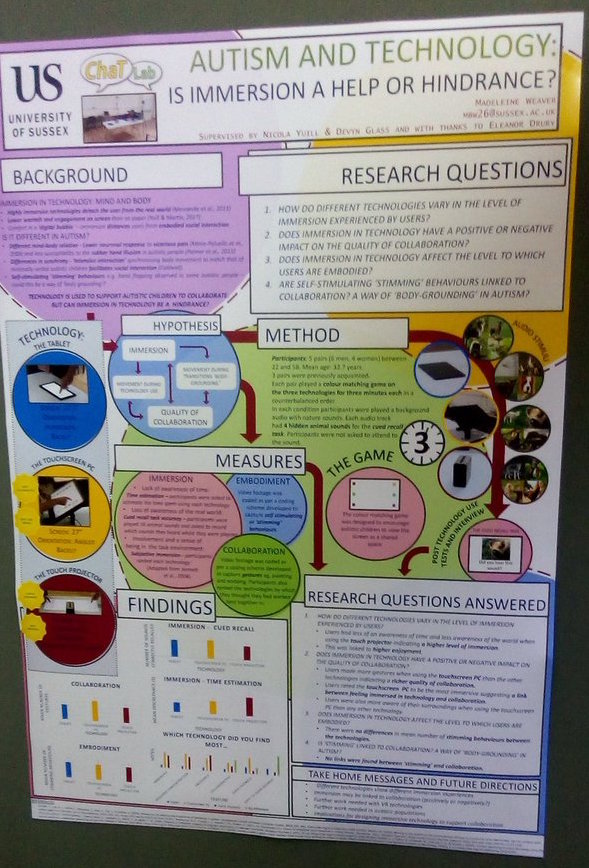
{"id":641,"date":"2018-12-10T14:15:28","date_gmt":"2018-12-10T14:15:28","guid":{"rendered":"http:\/\/blogs.sussex.ac.uk\/psychology\/?p=641"},"modified":"2020-05-28T12:36:07","modified_gmt":"2020-05-28T12:36:07","slug":"junior-research-associate-in-the-chatlab","status":"publish","type":"post","link":"https:\/\/blogs.sussex.ac.uk\/psychology\/2018\/12\/10\/junior-research-associate-in-the-chatlab\/","title":{"rendered":"Junior Research Associate in the ChatLab"},"content":{"rendered":"<p>By Madeleine Weaver<\/p>\n<p class=\"p1\"><span class=\"s1\">This summer I took part in the Junior Research Associates (JRA) scheme in the Children and Technology Lab (Chatlab)\u00a0<\/span><span class=\"s1\"><a href=\"http:\/\/www.sussex.ac.uk\/psychology\/chatlab\/\"><span class=\"s2\">http:\/\/www.sussex.ac.uk\/psychology\/chatlab\/<\/span><\/a> with <a href=\"http:\/\/www.sussex.ac.uk\/profiles\/3045\">Professor Nicola Yuill<\/a>.\u00a0The JRA scheme is an 8 week programme designed for students who are considering post graduate study.<\/span><\/p>\n<p class=\"p1\"><span class=\"s1\">Amongst other things, the Chatlab looks into how technology can be used to support children with autism to collaborate.\u00a0 I wanted to research immersion in technology and how this might be linked to body movement and collaboration in people with autism. This idea came about from my own observations of people with Autism Spectrum Conditions (ASC) being highly immersed in technology, &#8216;digital bubbles&#8217; <a href=\"http:\/\/digitalbubbles.org.uk\/\"><span class=\"s2\">http:\/\/digitalbubbles.org.uk\/<\/span><\/a>; combined with knowledge on embodied cognition I gained from my course at Sussex: Psychology with Cognitive Science. I thought this research could be useful in understanding the impact that highly immersive technologies might have on the embodied aspects of social interaction such as gestures and facial expressions, that are already difficult for people with ASC to understand.\u00a0<\/span><\/p>\n<p><!--more--><\/p>\n<p class=\"p1\"><span class=\"s1\"><a href=\"https:\/\/i0.wp.com\/blogs.sussex.ac.uk\/psychology\/files\/2018\/12\/Doq-udNX4AIcAdF.jpg\"><img data-attachment-id=\"644\" data-permalink=\"https:\/\/blogs.sussex.ac.uk\/psychology\/2018\/12\/10\/junior-research-associate-in-the-chatlab\/doq-udnx4aicadf\/\" data-orig-file=\"https:\/\/i0.wp.com\/blogs.sussex.ac.uk\/psychology\/files\/2018\/12\/Doq-udNX4AIcAdF.jpg?fit=589%2C868&amp;ssl=1\" data-orig-size=\"589,868\" data-comments-opened=\"1\" data-image-meta=\"{&quot;aperture&quot;:&quot;0&quot;,&quot;credit&quot;:&quot;&quot;,&quot;camera&quot;:&quot;&quot;,&quot;caption&quot;:&quot;&quot;,&quot;created_timestamp&quot;:&quot;0&quot;,&quot;copyright&quot;:&quot;&quot;,&quot;focal_length&quot;:&quot;0&quot;,&quot;iso&quot;:&quot;0&quot;,&quot;shutter_speed&quot;:&quot;0&quot;,&quot;title&quot;:&quot;&quot;,&quot;orientation&quot;:&quot;1&quot;}\" data-image-title=\"Doq-udNX4AIcAdF\" data-image-description=\"\" data-image-caption=\"\" data-medium-file=\"https:\/\/i0.wp.com\/blogs.sussex.ac.uk\/psychology\/files\/2018\/12\/Doq-udNX4AIcAdF.jpg?fit=204%2C300&amp;ssl=1\" data-large-file=\"https:\/\/i0.wp.com\/blogs.sussex.ac.uk\/psychology\/files\/2018\/12\/Doq-udNX4AIcAdF.jpg?fit=550%2C811&amp;ssl=1\" loading=\"lazy\" class=\" wp-image-644 alignleft\" src=\"https:\/\/i0.wp.com\/blogs.sussex.ac.uk\/psychology\/files\/2018\/12\/Doq-udNX4AIcAdF.jpg?resize=471%2C694\" alt=\"\" width=\"471\" height=\"694\" srcset=\"https:\/\/i0.wp.com\/blogs.sussex.ac.uk\/psychology\/files\/2018\/12\/Doq-udNX4AIcAdF.jpg?w=589&amp;ssl=1 589w, https:\/\/i0.wp.com\/blogs.sussex.ac.uk\/psychology\/files\/2018\/12\/Doq-udNX4AIcAdF.jpg?resize=204%2C300&amp;ssl=1 204w, https:\/\/i0.wp.com\/blogs.sussex.ac.uk\/psychology\/files\/2018\/12\/Doq-udNX4AIcAdF.jpg?resize=100%2C147&amp;ssl=1 100w, https:\/\/i0.wp.com\/blogs.sussex.ac.uk\/psychology\/files\/2018\/12\/Doq-udNX4AIcAdF.jpg?resize=150%2C221&amp;ssl=1 150w, https:\/\/i0.wp.com\/blogs.sussex.ac.uk\/psychology\/files\/2018\/12\/Doq-udNX4AIcAdF.jpg?resize=200%2C295&amp;ssl=1 200w, https:\/\/i0.wp.com\/blogs.sussex.ac.uk\/psychology\/files\/2018\/12\/Doq-udNX4AIcAdF.jpg?resize=300%2C442&amp;ssl=1 300w, https:\/\/i0.wp.com\/blogs.sussex.ac.uk\/psychology\/files\/2018\/12\/Doq-udNX4AIcAdF.jpg?resize=450%2C663&amp;ssl=1 450w\" sizes=\"(max-width: 471px) 100vw, 471px\" data-recalc-dims=\"1\" \/><\/a><\/span><\/p>\n<p class=\"p1\"><span class=\"s1\">I used three different technologies: the Windows Surface tablet, a 27&#8243; Dell touchscreen computer, and the new Sony Xperia touch projector. I had a lot of trouble with technology in the first few weeks trying to get things to work, but thanks to Nicola managed to get hold of some really fun tech in the end. I was unable to recruit any participants with ASC in time for my research deadline so the study ended up being with neurotypical adults only. This means that the study has yet to be carried out with the target group, but still provides the groundwork for further research.<\/span><\/p>\n<p class=\"p1\"><span class=\"s1\">A visiting researcher Eleanor Drury (University of Bath) helped me with data collection. In pairs, participants played a colour matching game\u00a0on each of the technology platforms. The game was designed by Stefan Kreitmayer (University College London) to encourage autistic children to view a screen as a shared space. We measured immersion in three different ways based on recommendations from Jennett et al. (2004):<\/span><\/p>\n<ul class=\"ul1\">\n<li class=\"li1\"><span class=\"s1\">Lack of awareness of time \u2013 participants were asked to estimate the time spent using each technology. A large time discrepancy indicated higher immersion.<\/span><\/li>\n<\/ul>\n<ul class=\"ul1\">\n<li class=\"li1\"><span class=\"s1\">Loss of awareness of the real world &#8211; during the technology use participants were played 12 animal noises. After completing all the conditions they were given a cued recall task in which they were played 16 animal noises and asked which ones they think they had heard. A lower accuracy indicated higher immersion.<\/span><\/li>\n<\/ul>\n<ul class=\"ul1\">\n<li class=\"li1\"><span class=\"s1\">Involvement and a sense of being in the task environment &#8211; this was a subjective measure, participants ranked each technology on how immersed they felt.<\/span><\/li>\n<\/ul>\n<p class=\"p1\"><span class=\"s1\">We filmed participants completing the activities so that their behaviour could be coded afterwards. I was taught how to use a behavioural coding software tool called Interact by Devyn Glass (UoS) and developed coding schemes to capture gestures (collaboration) and self-stimulatory behaviours (body movement).<\/span><\/p>\n<p class=\"p1\"><span class=\"s1\">In the end I found a couple of patterns:<\/span><\/p>\n<ul class=\"ul1\">\n<li class=\"li1\"><span class=\"s1\">The touch projector had the highest levels of objective immersion which was linked to enjoyment<\/span><\/li>\n<li class=\"li1\"><span class=\"s1\">Users collaborated more around the Dell touchscreen computer which was linked to a subjective reporting of feeling immersed.<\/span><\/li>\n<li class=\"li1\"><span class=\"s1\">There were no differences in body movement between the technologies, but further work is needed in autistic populations.<\/span><\/li>\n<\/ul>\n<p class=\"p1\"><span class=\"s1\">My research was far from perfect, but I learned a lot and am more prepared for my dissertation in third year and for post graduate research.<\/span><\/p>\n<p class=\"p1\"><span class=\"s1\">I learned how to understand basic computer code with the help of my friend Jon King (UoS) for the cued recall task using Inquisit software, and I also learned how to create a successful ethical review application. In addition to this, at the end of the summer, all JRAs are required to create an academic poster to summarise their research, so I got the chance to take part in a poster exhibition which was exciting!<\/span><\/p>\n<p class=\"p1\"><span class=\"s1\">All in all, I had a really brilliant summer. I learned so many new skills and massively improved my existing ones. I met so many great people from not just the University of Sussex but from other universities around the country. I was able to attend lab meetings and listen to experts talk about their research which was an invaluable experience. I also made some really good friends with visiting researchers and other students working in the Chatlab who I have stayed in contact with. It was a lot of hard work and things didn&#8217;t always go right but I would thoroughly recommend the JRA to any student considering post-graduate research.<\/span><\/p>\n<p><em>For more information on the Junior Research Assistant Scheme go to:\u00a0<a href=\"https:\/\/www.sussex.ac.uk\/study\/undergraduate\/undergraduate-research\/junior-research-associates\">https:\/\/www.sussex.ac.uk\/study\/undergraduate\/undergraduate-research\/junior-research-associates.<\/a><\/em><\/p>\n<p><em>Other posts by former JRAs:<\/em><\/p>\n<ul>\n<li>Alessia Goglio:\u00a0<a href=\"https:\/\/blogs.sussex.ac.uk\/psychology\/2018\/11\/12\/exploring-kindness-as-a-jra\/\">Exploring Kindness as a JRA<\/a><\/li>\n<li>Alexandra Schmidt: <a href=\"https:\/\/blogs.sussex.ac.uk\/psychology\/2018\/10\/29\/my-jra-experience-at-the-edge-lab\/\">My JRA experience at the EDGE Lab<\/a><\/li>\n<li><em>Katie Barnes: <a href=\"https:\/\/blogs.sussex.ac.uk\/psychology\/2017\/09\/11\/my-colourful-jra\/\">My colourful JRA<\/a><\/em><\/li>\n<li><em>George Britton: <a href=\"https:\/\/blogs.sussex.ac.uk\/psychology\/2016\/11\/14\/jra-memories\/\">JRA Memories<\/a><\/em><\/li>\n<li><em>Clara Wilson: <a href=\"https:\/\/blogs.sussex.ac.uk\/psychology\/2015\/12\/07\/clara-wilsons-jra-experience\/\">Clara Wilson&#8217;s JRA Experience<\/a><\/em><\/li>\n<li><em>Ruihan Wu: <a href=\"https:\/\/blogs.sussex.ac.uk\/psychology\/2015\/11\/09\/experience-with-the-jra-scheme\/\">Experience with the JRA Scheme<\/a><\/em><\/li>\n<li><em>Dan Goodwin: <a href=\"https:\/\/blogs.sussex.ac.uk\/psychology\/2016\/02\/29\/dan-goodwin-junior-research-associate\/\">Junior Research Assistant<\/a><\/em><\/li>\n<li><em>Alex Earl: <a href=\"https:\/\/blogs.sussex.ac.uk\/psychology\/2015\/10\/05\/my-summer-as-a-junior-research-assistant\/\">My summer as Junior Research Assistant<\/a><\/em><\/li>\n<\/ul>\n<p>Find out more about our <a href=\"http:\/\/www.sussex.ac.uk\/psychology\/research\/developmentalandclinicalpsychology\">research on Developmental Psychology<\/a>.<\/p>\n","protected":false},"excerpt":{"rendered":"<p>By Madeleine Weaver This summer I took part in the Junior Research Associates (JRA) scheme in the Children and Technology Lab (Chatlab)\u00a0http:\/\/www.sussex.ac.uk\/psychology\/chatlab\/ with Professor Nicola Yuill.\u00a0The JRA scheme is an 8 week programme designed for students who are considering post<span class=\"ellipsis\">&hellip;<\/span><\/p>\n<div class=\"read-more\"><a href=\"https:\/\/blogs.sussex.ac.uk\/psychology\/2018\/12\/10\/junior-research-associate-in-the-chatlab\/\">Read more &#8250;<\/a><\/div>\n<p><!-- end of .read-more --><\/p>\n","protected":false},"author":156,"featured_media":0,"comment_status":"open","ping_status":"open","sticky":false,"template":"","format":"standard","meta":{"spay_email":"","jetpack_publicize_message":"","jetpack_is_tweetstorm":false},"categories":[24,98530],"tags":[103437,143,97956,24,97946],"jetpack_featured_media_url":"","jetpack_publicize_connections":[],"jetpack_sharing_enabled":true,"jetpack_shortlink":"https:\/\/wp.me\/pafdEV-al","jetpack-related-posts":[{"id":97,"url":"https:\/\/blogs.sussex.ac.uk\/psychology\/2015\/11\/09\/experience-with-the-jra-scheme\/","url_meta":{"origin":641,"position":0},"title":"Experience with the JRA scheme","date":"November 9, 2015","format":false,"excerpt":"By Ruihan Wu In the spring term of the second year of my undergraduate degree, I applied to the Junior Research Associate (JRA) scheme, with Nicola Yuill of the Children and Technology Lab (insert link) as my supervisor. This scheme, funded by the doctoral school in the University with support\u2026","rel":"","context":"In \"Child development\"","img":{"alt_text":"Figure 2. The place where the experiment be conducted ","src":"https:\/\/i0.wp.com\/blogs.sussex.ac.uk\/psychology\/files\/2015\/10\/Ruihan2-300x225.png?resize=350%2C200","width":350,"height":200},"classes":[]},{"id":475,"url":"https:\/\/blogs.sussex.ac.uk\/psychology\/2017\/10\/23\/statement-for-excellence-in-research-degrees\/","url_meta":{"origin":641,"position":1},"title":"Statement for Excellence in Research Degrees","date":"October 23, 2017","format":false,"excerpt":"By Dr Zo\u00eb Hopkins Trite as it sounds, I can remember exactly where I was and what I was doing when I became interested in autism and language. Throughout my undergraduate years (as a student of English Literature, rather than Psychology), I was employed as a support worker on the\u2026","rel":"","context":"In &quot;Faculty research&quot;","img":{"alt_text":"","src":"https:\/\/i1.wp.com\/blogs.sussex.ac.uk\/psychology\/files\/2017\/10\/ZoeH.png?resize=350%2C200","width":350,"height":200},"classes":[]},{"id":1307,"url":"https:\/\/blogs.sussex.ac.uk\/psychology\/2021\/06\/18\/autistic-pride-day\/","url_meta":{"origin":641,"position":2},"title":"Autistic Pride Day","date":"June 18, 2021","format":false,"excerpt":"by Prof Nicola Yuill \u00a0Autistic Pride Flag by\u00a0Autistic Empire\u00a0is licensed under a\u00a0Creative Commons Attribution-ShareAlike 4.0 International License. Based on a work at\u00a0https:\/\/www.autisticempire.com\/autistic-pride. It sometimes seems there is an awareness day, week or month for every possible cause \u2013 June sees Loneliness Awareness, Men\u2019s Health, National Candy Month and Employer Branding\u2026","rel":"","context":"In &quot;Faculty research&quot;","img":{"alt_text":"","src":"https:\/\/i2.wp.com\/blogs.sussex.ac.uk\/psychology\/files\/2021\/06\/Autistic-Pride-Flag.jpg?resize=350%2C200&ssl=1","width":350,"height":200},"classes":[]},{"id":1257,"url":"https:\/\/blogs.sussex.ac.uk\/psychology\/2021\/03\/30\/creating-a-society-that-works-for-autistic-people-the-acorns-health-webinar\/","url_meta":{"origin":641,"position":3},"title":"Creating a society that works for autistic people: The ACoRNS Health webinar","date":"March 30, 2021","format":false,"excerpt":"By Ethan Lam and Prof Nicola Yuill The Autism Community Research Network Sussex was launched last year as a collaboration between Psychology and Education researchers at the University of Sussex and local autism stakeholders involved in education, health and social care services. ACoRNS is a sister organisation to AcoRN Southampton\u2026","rel":"","context":"In &quot;Event&quot;","img":{"alt_text":"","src":"","width":0,"height":0},"classes":[]},{"id":598,"url":"https:\/\/blogs.sussex.ac.uk\/psychology\/2018\/10\/29\/my-jra-experience-at-the-edge-lab\/","url_meta":{"origin":641,"position":4},"title":"My JRA experience at the EDGE Lab","date":"October 29, 2018","format":false,"excerpt":"By Alexandra Schmidt Over the summer I had the pleasure to be part of the Junior Research Associate scheme and conduct my first own piece of research in the EDGE lab. I got interested in the scheme when I visited the poster exhibition of the previous year\u2019s JRA students and\u2026","rel":"","context":"In &quot;Research&quot;","img":{"alt_text":"","src":"https:\/\/i0.wp.com\/blogs.sussex.ac.uk\/psychology\/files\/2018\/10\/Screen-Shot-2018-10-26-at-17.05.15-723x1024.png?resize=350%2C200","width":350,"height":200},"classes":[]},{"id":611,"url":"https:\/\/blogs.sussex.ac.uk\/psychology\/2018\/11\/12\/exploring-kindness-as-a-jra\/","url_meta":{"origin":641,"position":5},"title":"Exploring Kindness as a JRA","date":"November 12, 2018","format":false,"excerpt":"By Alessia Goglio Being a Psychology undergraduate here at Sussex enabled me to explore different domains of interest in this fascinating subject and to develop my passion for \u201cPositive Psychology\u201d, the field that studies what is good in life. \u00a0Among the topic explored in this field, there is kindness: a\u2026","rel":"","context":"In &quot;Research&quot;","img":{"alt_text":"","src":"https:\/\/i1.wp.com\/blogs.sussex.ac.uk\/psychology\/files\/2018\/11\/Picture1.jpg?resize=350%2C200","width":350,"height":200},"classes":[]}],"_links":{"self":[{"href":"https:\/\/blogs.sussex.ac.uk\/psychology\/wp-json\/wp\/v2\/posts\/641"}],"collection":[{"href":"https:\/\/blogs.sussex.ac.uk\/psychology\/wp-json\/wp\/v2\/posts"}],"about":[{"href":"https:\/\/blogs.sussex.ac.uk\/psychology\/wp-json\/wp\/v2\/types\/post"}],"author":[{"embeddable":true,"href":"https:\/\/blogs.sussex.ac.uk\/psychology\/wp-json\/wp\/v2\/users\/156"}],"replies":[{"embeddable":true,"href":"https:\/\/blogs.sussex.ac.uk\/psychology\/wp-json\/wp\/v2\/comments?post=641"}],"version-history":[{"count":6,"href":"https:\/\/blogs.sussex.ac.uk\/psychology\/wp-json\/wp\/v2\/posts\/641\/revisions"}],"predecessor-version":[{"id":971,"href":"https:\/\/blogs.sussex.ac.uk\/psychology\/wp-json\/wp\/v2\/posts\/641\/revisions\/971"}],"wp:attachment":[{"href":"https:\/\/blogs.sussex.ac.uk\/psychology\/wp-json\/wp\/v2\/media?parent=641"}],"wp:term":[{"taxonomy":"category","embeddable":true,"href":"https:\/\/blogs.sussex.ac.uk\/psychology\/wp-json\/wp\/v2\/categories?post=641"},{"taxonomy":"post_tag","embeddable":true,"href":"https:\/\/blogs.sussex.ac.uk\/psychology\/wp-json\/wp\/v2\/tags?post=641"}],"curies":[{"name":"wp","href":"https:\/\/api.w.org\/{rel}","templated":true}]}}