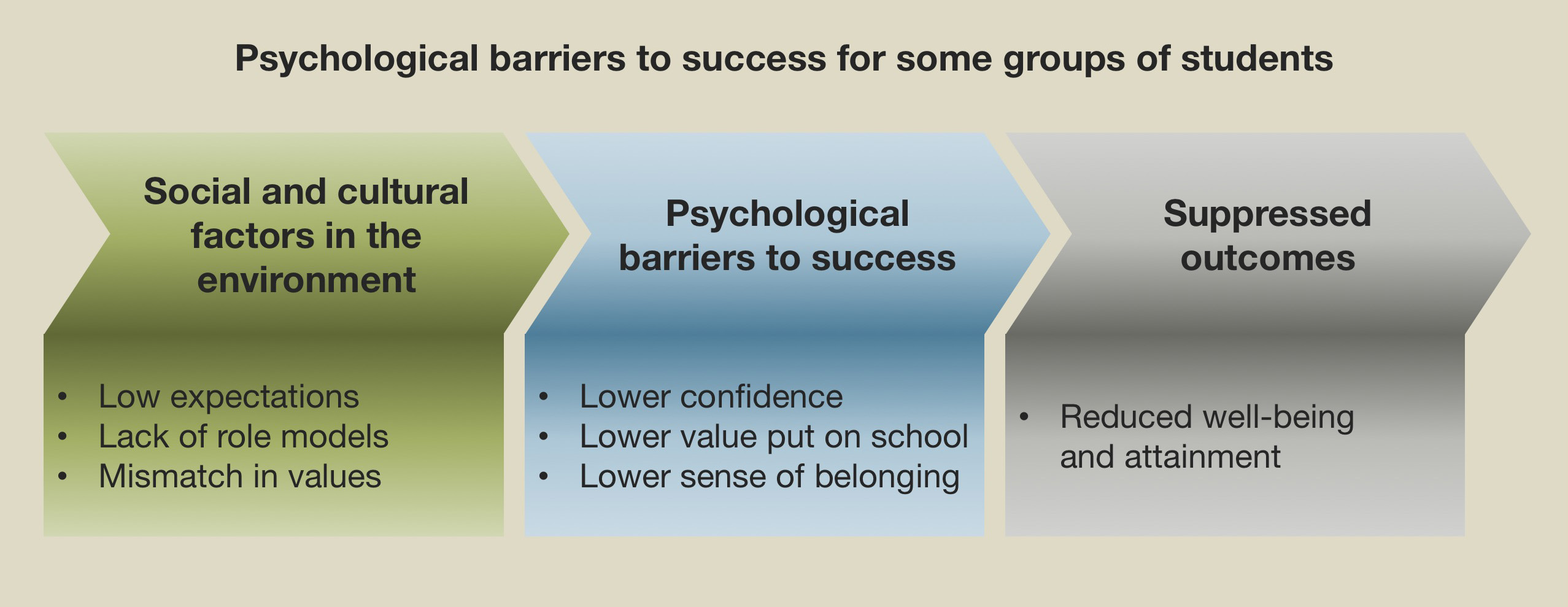
{"id":683,"date":"2019-02-18T10:59:03","date_gmt":"2019-02-18T10:59:03","guid":{"rendered":"http:\/\/blogs.sussex.ac.uk\/psychology\/?p=683"},"modified":"2020-05-28T12:33:05","modified_gmt":"2020-05-28T12:33:05","slug":"breaking-down-the-psychological-barriers-to-success-at-school","status":"publish","type":"post","link":"https:\/\/blogs.sussex.ac.uk\/psychology\/2019\/02\/18\/breaking-down-the-psychological-barriers-to-success-at-school\/","title":{"rendered":"Breaking down the psychological barriers to success at school"},"content":{"rendered":"\n<h2>Looking into how carefully-targeted low-cost interventions can reduce the psychological barriers to success of some groups of school students and help them prepare for a happy and productive life. <\/h2>\n\n\n\n<p>by Ian Hadden<\/p>\n\n\n\n<p>It only takes a quick glance at GCSE results across the country to see that some groups of students don\u2019t do as well as others, notably boys, students from some ethnic backgrounds, and students from poorer families. Some well-known <em>structural <\/em>barriers to success, such as poor nutrition and low-quality housing, play a crucial role. But social and cultural factors that students experience in their everyday environment can create other, more subtle, <em>psychological<\/em> barriers. Here\u2019s a quick look at how three of these factors can lead to barriers that affect some groups of students more than others.<\/p>\n\n\n\n<p><strong><em>Barrier 1: Low\nexpectations leading to lower confidence. <\/em><\/strong>There can be widely-held expectations across\nsociety that certain types of student will do poorly at school. This can either\nbe across the whole curriculum (e.g. \u201cwhite working-class boys just don\u2019t do\nwell at school\u201d) or in certain subjects (e.g. \u201cgirls aren\u2019t cut out for maths\u201d).\nUnsurprisingly, these expectations may cause students to doubt their ability to\nthrive academically. The result can be a vicious circle of lower confidence\nleading to lower performance and further reduced expectations.<\/p>\n\n\n\n<p><strong><em>Barrier 2: Lack of\nrole models leading to a lower value placed on school. <\/em><\/strong>Now consider students who look\naround them and don\u2019t see <em>people like\nthem<\/em> \u2013 family members, members of their community \u2013&nbsp;doing well at school\nand progressing into high-status universities or occupations. For example, when\nonly 6% of doctors describe themselves as being from a working-class background,\nstudents from low-income families may not see the medical profession as a\nrealistic life path for them. Such a lack of role models with whom they can\nidentify may lead them to question the value of doing well at school.<\/p>\n\n\n\n<p><strong><em>Barrier 3: Mismatch in\nvalues leading to a lower sense of belonging. <\/em><\/strong>Finally, research suggests that people from\ndifferent national, cultural and socioeconomic backgrounds place different\nemphasis on independent versus interdependent values. Is it more important to\nflourish as an individual, or to play your part in a tightly-knit family or\ncommunity group? If school emphasises one of these sets of values, then students\nfrom backgrounds that emphasise the other set may feel a distinct lack of ease.\nThis sort of mismatch can lead students to feel that they don\u2019t really belong\nin school, with predictable consequences.<\/p>\n\n\n\n<figure class=\"wp-block-image\"><img data-attachment-id=\"684\" data-permalink=\"https:\/\/blogs.sussex.ac.uk\/psychology\/2019\/02\/18\/breaking-down-the-psychological-barriers-to-success-at-school\/psychological-barriers\/\" data-orig-file=\"https:\/\/i1.wp.com\/blogs.sussex.ac.uk\/psychology\/files\/2019\/02\/Psychological-barriers.jpeg?fit=2555%2C989&amp;ssl=1\" data-orig-size=\"2555,989\" data-comments-opened=\"1\" data-image-meta=\"{&quot;aperture&quot;:&quot;0&quot;,&quot;credit&quot;:&quot;&quot;,&quot;camera&quot;:&quot;&quot;,&quot;caption&quot;:&quot;&quot;,&quot;created_timestamp&quot;:&quot;0&quot;,&quot;copyright&quot;:&quot;&quot;,&quot;focal_length&quot;:&quot;0&quot;,&quot;iso&quot;:&quot;0&quot;,&quot;shutter_speed&quot;:&quot;0&quot;,&quot;title&quot;:&quot;&quot;,&quot;orientation&quot;:&quot;1&quot;}\" data-image-title=\"Psychological barriers\" data-image-description=\"\" data-image-caption=\"\" data-medium-file=\"https:\/\/i1.wp.com\/blogs.sussex.ac.uk\/psychology\/files\/2019\/02\/Psychological-barriers.jpeg?fit=300%2C116&amp;ssl=1\" data-large-file=\"https:\/\/i1.wp.com\/blogs.sussex.ac.uk\/psychology\/files\/2019\/02\/Psychological-barriers.jpeg?fit=550%2C213&amp;ssl=1\" loading=\"lazy\" width=\"2555\" height=\"989\" src=\"https:\/\/i0.wp.com\/blogs.sussex.ac.uk\/psychology\/files\/2019\/02\/Psychological-barriers.jpeg?fit=550%2C213&amp;ssl=1\" alt=\"\" class=\"wp-image-684\" srcset=\"https:\/\/i1.wp.com\/blogs.sussex.ac.uk\/psychology\/files\/2019\/02\/Psychological-barriers.jpeg?w=2555&amp;ssl=1 2555w, https:\/\/i1.wp.com\/blogs.sussex.ac.uk\/psychology\/files\/2019\/02\/Psychological-barriers.jpeg?resize=300%2C116&amp;ssl=1 300w, https:\/\/i1.wp.com\/blogs.sussex.ac.uk\/psychology\/files\/2019\/02\/Psychological-barriers.jpeg?resize=768%2C297&amp;ssl=1 768w, https:\/\/i1.wp.com\/blogs.sussex.ac.uk\/psychology\/files\/2019\/02\/Psychological-barriers.jpeg?resize=1024%2C396&amp;ssl=1 1024w, https:\/\/i1.wp.com\/blogs.sussex.ac.uk\/psychology\/files\/2019\/02\/Psychological-barriers.jpeg?resize=100%2C39&amp;ssl=1 100w, https:\/\/i1.wp.com\/blogs.sussex.ac.uk\/psychology\/files\/2019\/02\/Psychological-barriers.jpeg?resize=150%2C58&amp;ssl=1 150w, https:\/\/i1.wp.com\/blogs.sussex.ac.uk\/psychology\/files\/2019\/02\/Psychological-barriers.jpeg?resize=200%2C77&amp;ssl=1 200w, https:\/\/i1.wp.com\/blogs.sussex.ac.uk\/psychology\/files\/2019\/02\/Psychological-barriers.jpeg?resize=450%2C174&amp;ssl=1 450w, https:\/\/i1.wp.com\/blogs.sussex.ac.uk\/psychology\/files\/2019\/02\/Psychological-barriers.jpeg?resize=600%2C232&amp;ssl=1 600w, https:\/\/i1.wp.com\/blogs.sussex.ac.uk\/psychology\/files\/2019\/02\/Psychological-barriers.jpeg?resize=900%2C348&amp;ssl=1 900w, https:\/\/i1.wp.com\/blogs.sussex.ac.uk\/psychology\/files\/2019\/02\/Psychological-barriers.jpeg?w=1100 1100w, https:\/\/i1.wp.com\/blogs.sussex.ac.uk\/psychology\/files\/2019\/02\/Psychological-barriers.jpeg?w=1650 1650w\" sizes=\"(max-width: 550px) 100vw, 550px\" \/><\/figure>\n\n\n\n<p>Researchers\nhave tested a wide range of low-cost, simple-to-implement interventions aimed\nat reducing these types of barriers to success, and many have resulted in surprisingly\nlarge improvements across a range of outcomes. For example, I recently trialed a\nvery low-cost intervention aimed at increasing the confidence of a group of\nunderperforming Year 7-9 students. The intervention reduced the stress they\nreported experiencing and raised their academic performance; as a result, they\nclosed well over half of the pre-existing gap in maths scores with their peers.<\/p>\n\n\n\n<p>So, how might\nany particular school benefit from all this? Well, I\u2019m currently testing a\nthree-stage process: diagnosis, design and trial.<\/p>\n\n\n\n<p><strong><em>1. Diagnosis.<\/em><\/strong> The first stage is to ask the\nschool\u2019s students, teachers and parents about their experiences through a\nseries of surveys and focus groups. This will help unpack the social and\ncultural factors that the students are experiencing and build a rich picture of\nany psychological barriers that might be suppressing outcomes for some.<\/p>\n\n\n\n<p><strong><em>2. Design.<\/em><\/strong> Based on this diagnosis, I aim to identify\nan environmental factor or psychological barrier that seems to be most suppressing\noutcomes for some groups of students, and design a simple but potentially\nhigh-impact intervention aimed at reducing it. This is likely to be based on a proven\nintervention from prior research, tailored for the specific social and cultural\ncontext of the school.<\/p>\n\n\n\n<p><strong><em>3. Trial.<\/em><\/strong> Finally, the school will test the\nintervention in a randomised controlled trial across a school year. Depending\non the results, the intervention could potentially become embedded in the\nschool\u2019s curriculum or working practices in subsequent years.<\/p>\n\n\n\n<p>My work is,\nof course, just the start. While a good deal of evidence has already been accumulated,\nmost has been in the US and it\u2019s not clear how it will translate to the\ndifferent contexts of different schools in England. We will need an extensive\nprogramme of research in order to fully understand in what contexts these types\nof intervention are effective across the country.<\/p>\n\n\n\n<p>This is an exciting time for\nresearch that has the potential to make a substantial difference to the lives\nof many young people.<\/p>\n\n\n\n<p><em>Ian Hadden is a PhD student under the supervision of\u00a0\u00a0<\/em><a href=\"http:\/\/www.sussex.ac.uk\/profiles\/173988\"><em>Dr Matt Easterbrook<\/em><\/a><em>\u00a0and\u00a0<\/em><a href=\"http:\/\/www.sussex.ac.uk\/profiles\/10678\"><em>Prof Pete Harris<\/em><\/a><em>. He\u00a0is also part of the\u00a0<\/em><a href=\"https:\/\/www.sussex.ac.uk\/psychology\/sarg\/index\"><em>Self Affirmation Research Group (SARG)<\/em><\/a><em>. Other posts by Ian: <\/em><a href=\"https:\/\/blogs.sussex.ac.uk\/psychology\/2018\/10\/15\/grouping-by-attainment-in-schools-can-psychological-interventions-help-turbo-charge-poor-students-performance\/\"><em>Grouping by attainment in schools: can psychological interventions help turbo-charge poor students\u2019 performance?<\/em><\/a><em>\u00a0and <\/em><a href=\"https:\/\/blogs.sussex.ac.uk\/psychology\/2018\/03\/05\/an-appetite-for-bringing-research-into-practice-at-researched\/\"><em>An appetite for bringing research into practice at ResearchED<\/em><\/a><\/p>\n\n\n\n<p>Find out more about our <a href=\"http:\/\/www.sussex.ac.uk\/psychology\/research\/socialandappliedpsychology\">research on Social and Applied Psychology<\/a>.<\/p>\n","protected":false},"excerpt":{"rendered":"<p>Looking into how carefully-targeted low-cost interventions can reduce the psychological barriers to success of some groups of school students and help them prepare for a happy and productive life. by Ian Hadden It only takes a quick glance at GCSE<span class=\"ellipsis\">&hellip;<\/span><\/p>\n<div class=\"read-more\"><a href=\"https:\/\/blogs.sussex.ac.uk\/psychology\/2019\/02\/18\/breaking-down-the-psychological-barriers-to-success-at-school\/\">Read more &#8250;<\/a><\/div>\n<p><!-- end of .read-more --><\/p>\n","protected":false},"author":156,"featured_media":0,"comment_status":"open","ping_status":"open","sticky":false,"template":"","format":"standard","meta":{"spay_email":"","jetpack_publicize_message":"","jetpack_is_tweetstorm":false},"categories":[98528],"tags":[94164,97941,168122,98552],"jetpack_featured_media_url":"","jetpack_publicize_connections":[],"jetpack_sharing_enabled":true,"jetpack_shortlink":"https:\/\/wp.me\/pafdEV-b1","jetpack-related-posts":[{"id":583,"url":"https:\/\/blogs.sussex.ac.uk\/psychology\/2018\/10\/15\/grouping-by-attainment-in-schools-can-psychological-interventions-help-turbo-charge-poor-students-performance\/","url_meta":{"origin":683,"position":0},"title":"Grouping by attainment in schools: can psychological interventions help turbo-charge poor students\u2019 performance?","date":"October 15, 2018","format":false,"excerpt":"By Ian Hadden Last month I attended the impressive \u2013\u00a0and buzzy \u2013 sell-out researchED 2018 annual conference in London. The highlight for me was a fascinating piece of research presented by Becky Francis and Jeremy Hodgen of the UCL Institute of Education (IOE) on grouping secondary school students into classes\u2026","rel":"","context":"In &quot;PhD research&quot;","img":{"alt_text":"","src":"https:\/\/i1.wp.com\/blogs.sussex.ac.uk\/psychology\/files\/2018\/10\/Unknown-1024x617.jpeg?resize=350%2C200","width":350,"height":200},"classes":[]},{"id":333,"url":"https:\/\/blogs.sussex.ac.uk\/psychology\/2017\/01\/31\/thesis-boot-camp\/","url_meta":{"origin":683,"position":1},"title":"Thesis Boot Camp","date":"January 31, 2017","format":false,"excerpt":"By Molly Berenhaus Right before the holiday season, I decided to attend the doctoral school\u2019s Thesis Boot Camp and was pleasantly surprised by how much I accomplished and learned. One limitation was that the writing workshops mostly catered to the humanities so, in addition to sharing top tips, I\u2019ll also\u2026","rel":"","context":"In \"Academic Writing\"","img":{"alt_text":"","src":"https:\/\/i1.wp.com\/blogs.sussex.ac.uk\/psychology\/files\/2017\/01\/MollyB-300x225.png?resize=350%2C200","width":350,"height":200},"classes":[]},{"id":451,"url":"https:\/\/blogs.sussex.ac.uk\/psychology\/2017\/09\/04\/the-social-psychology-of-the-hajj\/","url_meta":{"origin":683,"position":2},"title":"The social psychology of the Hajj","date":"September 4, 2017","format":false,"excerpt":"By John Drury Last week, the annual Hajj took place in Mecca (Makkah) and the other holy places nearby. This Muslim pilgrimage is one of the world\u2019s largest crowd events \u2013 the official figure for those attending last year was 1,862,909. The Hajj has been called the world\u2019s \u2018global gathering\u2019\u2026","rel":"","context":"In &quot;PhD research&quot;","img":{"alt_text":"","src":"https:\/\/i0.wp.com\/blogs.sussex.ac.uk\/psychology\/files\/2017\/09\/Inset-shows-density-of-6ppm2.jpg?resize=350%2C200","width":350,"height":200},"classes":[]},{"id":1879,"url":"https:\/\/blogs.sussex.ac.uk\/psychology\/2023\/03\/14\/being-a-neurodivergent-researcher-imposter-thoughts-doom-boxes-and-the-academic-monolith\/","url_meta":{"origin":683,"position":3},"title":"Being a neurodivergent researcher: imposter thoughts, doom-boxes and the academic monolith","date":"March 14, 2023","format":false,"excerpt":"By Josh Francis In recognition of Neurodiversity Celebration Week, Psychology PhD student and neurodivergent researcher, Josh Francis has written about his experiences and personal journey through university which led him to his ADHD diagnosis. In this blog, Josh expresses his determination to raise awareness for neurodiversity by suggesting tools and\u2026","rel":"","context":"Similar post","img":{"alt_text":"","src":"https:\/\/i1.wp.com\/blogs.sussex.ac.uk\/psychology\/files\/2023\/03\/ADHD-picture-scaled.jpg?resize=350%2C200&ssl=1","width":350,"height":200},"classes":[]},{"id":751,"url":"https:\/\/blogs.sussex.ac.uk\/psychology\/2019\/04\/28\/what-is-the-psychological-methods-mres-actually-like-a-student-perspective\/","url_meta":{"origin":683,"position":4},"title":"What is the Psychological Methods MRes actually like? \u2013 A student perspective","date":"April 28, 2019","format":false,"excerpt":"Robert Avery is a student in the MRes in Psychological Methods. A dual citizen of the United Kingdom and Switzerland, Robert studied a BSc in Psychology at the University of Fribourg and is now planning to do a PhD. He is interested in the influence of gendered languages on adolescents\u2019\u2026","rel":"","context":"Similar post","img":{"alt_text":"","src":"https:\/\/i2.wp.com\/blogs.sussex.ac.uk\/psychology\/files\/2019\/04\/Robert-Avery-1.png?resize=350%2C200&ssl=1","width":350,"height":200},"classes":[]},{"id":1330,"url":"https:\/\/blogs.sussex.ac.uk\/psychology\/2021\/06\/21\/virtual-group-music-making-during-lockdowns\/","url_meta":{"origin":683,"position":5},"title":"Virtual group music-making during lockdowns","date":"June 21, 2021","format":false,"excerpt":"By Maru\u0161a Levstek When the pandemic hit in late 2019 and the whole world had to practically retract to their homes, everyone was talking about furlough, lockdown, and home-schooling. However, there was barely any thought about the extra-curricular activities that used to be an incredibly big part of many young\u2026","rel":"","context":"In &quot;PhD research&quot;","img":{"alt_text":"","src":"https:\/\/i0.wp.com\/blogs.sussex.ac.uk\/psychology\/files\/2021\/06\/virtual-music-making.jpg?resize=350%2C200&ssl=1","width":350,"height":200},"classes":[]}],"_links":{"self":[{"href":"https:\/\/blogs.sussex.ac.uk\/psychology\/wp-json\/wp\/v2\/posts\/683"}],"collection":[{"href":"https:\/\/blogs.sussex.ac.uk\/psychology\/wp-json\/wp\/v2\/posts"}],"about":[{"href":"https:\/\/blogs.sussex.ac.uk\/psychology\/wp-json\/wp\/v2\/types\/post"}],"author":[{"embeddable":true,"href":"https:\/\/blogs.sussex.ac.uk\/psychology\/wp-json\/wp\/v2\/users\/156"}],"replies":[{"embeddable":true,"href":"https:\/\/blogs.sussex.ac.uk\/psychology\/wp-json\/wp\/v2\/comments?post=683"}],"version-history":[{"count":6,"href":"https:\/\/blogs.sussex.ac.uk\/psychology\/wp-json\/wp\/v2\/posts\/683\/revisions"}],"predecessor-version":[{"id":969,"href":"https:\/\/blogs.sussex.ac.uk\/psychology\/wp-json\/wp\/v2\/posts\/683\/revisions\/969"}],"wp:attachment":[{"href":"https:\/\/blogs.sussex.ac.uk\/psychology\/wp-json\/wp\/v2\/media?parent=683"}],"wp:term":[{"taxonomy":"category","embeddable":true,"href":"https:\/\/blogs.sussex.ac.uk\/psychology\/wp-json\/wp\/v2\/categories?post=683"},{"taxonomy":"post_tag","embeddable":true,"href":"https:\/\/blogs.sussex.ac.uk\/psychology\/wp-json\/wp\/v2\/tags?post=683"}],"curies":[{"name":"wp","href":"https:\/\/api.w.org\/{rel}","templated":true}]}}