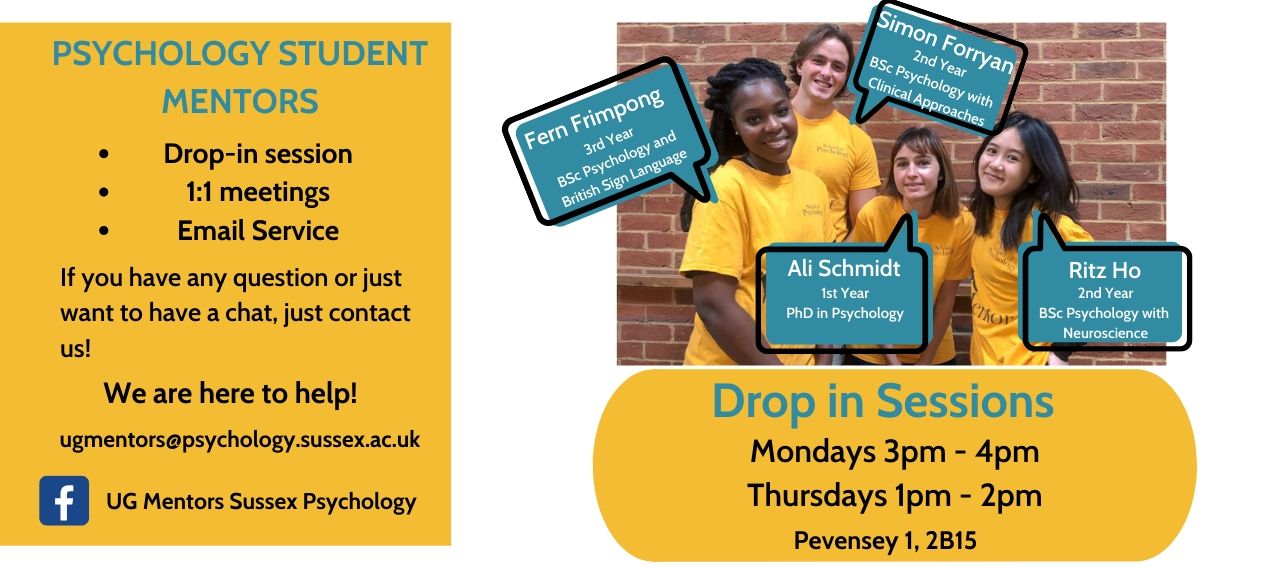
Student mentors are both undergraduate and postgraduate students, who have been trained to provide information and support to other students in the School of Psychology. <\/p>\n\n\n\n
 <\/figure><\/div>\n\n\n\n
We can offer information and support on a\nrange of academic issues, help you find your way around campus, develop study\nskills and point you towards events or online resources available to support\nyou. For example, we can help with essay structuring, preparation of lab reports,\nrevision tips and planning, time management or presentation skills. The student mentor team includes an\ninternational student, a mature student and 1 PhD student, so we hope between\nus to be able to cover anything that comes up for you.<\/p>\n\n\n\n
What makes you different from an Academic Advisor?<\/strong><\/h3>\n\n\n\nWe are different from academic advisors as we are all students ourselves and have gone through similar experiences and worries. We are familiar with the assignments you\u2019re working on and are able to provide tips and advice based on very recent experiences of assignment and revision stress. <\/p>\n\n\n\n
What made\nyou want to become a student mentor?<\/strong><\/h3>\n\n\n\nI became a student mentor as I have a\ngenuine interest in helping people. This goes for people who might need more\nhelp or have come across difficult times, but equally for someone who is\nalready doing well but would like to improve on their performance. <\/p>\n\n\n\n
I remember in my first year especially,\nthere were many times I would have liked to speak to someone about\nuncertainties regarding assignments, when I felt things weren\u2019t progressing and\nwere starting to feel like they were getting on top of me. <\/p>\n\n\n\n
What\u2019s the best piece of advice you can give as a student mentor?<\/strong><\/h3>\n\n\n\nWhen you are stuck or overwhelmed, it\u2019s easy to think that\neveryone else is coping much better and therefore you might not speak to anyone\nabout your worries or you may not feel like you can ask for help. But most\noften, that\u2019s not the case and other people are feeling a similar way.\nTherefore, try and use opportunities to speak to friends and peers, organise\nstudy groups, speak to your tutors or come and see the student mentors! Mentors are good listeners and when you come\nand see us, all our time is focused on you and what you have come to talk to us\nabout. <\/p>\n\n\n\n
Thinking\nback to your first year, is there anything you\u2019d like to pass on to those who\nare about to begin their Psychology degree?<\/strong><\/h3>\n\n\n\nMy fellow mentors have said that they would have liked to have\nknown how to make the most of assignment feedback.<\/p>\n\n\n\n
My advice is to take time to read and understand what your marker\nhas written and if you need further clarity, book some time within a markers\u2019 office\nhours and ask your marker for more information on what they have written. <\/p>\n\n\n\n
Feedback is so important as it does not only tell you where you\ncan improve but also what went well. This will really help focus your efforts when\npreparing your next assignment. <\/p>\n\n\n\n
For me personally, looking back I would have liked to have told\nmyself to get to know as many fellow students as possible.<\/p>\n\n\n\n
This is one of the greatest insights that I\u2019ve come out of the course with. I met so many interesting people in my 3rd<\/sup> year who I have really enjoyed spending time with on and off-campus. I wish I had got to know them earlier. <\/p>\n\n\n\nMy advice also goes to students in other year groups too, for\nexample, as a second-year student choosing modules and supervisors for third\nyear, it can be really interesting and helpful to speak to someone who has gone\nthrough the modules you\u2019re considering. Similarly, this applies to your wider\ndevelopment, for example, when you\u2019re trying to decide on whether to take a\nyear out on either placement or study abroad. Or if you want to apply for the\nJunior Research Associate (JRA) scheme and want to talk through the application\nprocess with someone who\u2019s already completed it. You\u2019ll get first hand\n(informal) info on what it was like which will put you in a better position to\nmake the right choices. <\/p>\n\n\n\n
Student mentors have either done these things or can put you in\ntouch with someone who has. <\/p>\n\n\n\n
Where to\nfind us<\/strong><\/h3>\n\n\n\nDuring term time, we run weekly drop-in sessions where you can\ncome and have a chat with us with a cup of tea and biscuits. <\/p>\n\n\n\n
I became a student mentor as I have a\ngenuine interest in helping people. This goes for people who might need more\nhelp or have come across difficult times, but equally for someone who is\nalready doing well but would like to improve on their performance. <\/p>\n\n\n\n
I remember in my first year especially,\nthere were many times I would have liked to speak to someone about\nuncertainties regarding assignments, when I felt things weren\u2019t progressing and\nwere starting to feel like they were getting on top of me. <\/p>\n\n\n\n
What\u2019s the best piece of advice you can give as a student mentor?<\/strong><\/h3>\n\n\n\nWhen you are stuck or overwhelmed, it\u2019s easy to think that\neveryone else is coping much better and therefore you might not speak to anyone\nabout your worries or you may not feel like you can ask for help. But most\noften, that\u2019s not the case and other people are feeling a similar way.\nTherefore, try and use opportunities to speak to friends and peers, organise\nstudy groups, speak to your tutors or come and see the student mentors! Mentors are good listeners and when you come\nand see us, all our time is focused on you and what you have come to talk to us\nabout. <\/p>\n\n\n\n
Thinking\nback to your first year, is there anything you\u2019d like to pass on to those who\nare about to begin their Psychology degree?<\/strong><\/h3>\n\n\n\nMy fellow mentors have said that they would have liked to have\nknown how to make the most of assignment feedback.<\/p>\n\n\n\n
My advice is to take time to read and understand what your marker\nhas written and if you need further clarity, book some time within a markers\u2019 office\nhours and ask your marker for more information on what they have written. <\/p>\n\n\n\n
Feedback is so important as it does not only tell you where you\ncan improve but also what went well. This will really help focus your efforts when\npreparing your next assignment. <\/p>\n\n\n\n
For me personally, looking back I would have liked to have told\nmyself to get to know as many fellow students as possible.<\/p>\n\n\n\n
This is one of the greatest insights that I\u2019ve come out of the course with. I met so many interesting people in my 3rd<\/sup> year who I have really enjoyed spending time with on and off-campus. I wish I had got to know them earlier. <\/p>\n\n\n\nMy advice also goes to students in other year groups too, for\nexample, as a second-year student choosing modules and supervisors for third\nyear, it can be really interesting and helpful to speak to someone who has gone\nthrough the modules you\u2019re considering. Similarly, this applies to your wider\ndevelopment, for example, when you\u2019re trying to decide on whether to take a\nyear out on either placement or study abroad. Or if you want to apply for the\nJunior Research Associate (JRA) scheme and want to talk through the application\nprocess with someone who\u2019s already completed it. You\u2019ll get first hand\n(informal) info on what it was like which will put you in a better position to\nmake the right choices. <\/p>\n\n\n\n
Student mentors have either done these things or can put you in\ntouch with someone who has. <\/p>\n\n\n\n
Where to\nfind us<\/strong><\/h3>\n\n\n\nDuring term time, we run weekly drop-in sessions where you can\ncome and have a chat with us with a cup of tea and biscuits. <\/p>\n\n\n\n
My fellow mentors have said that they would have liked to have\nknown how to make the most of assignment feedback.<\/p>\n\n\n\n
My advice is to take time to read and understand what your marker\nhas written and if you need further clarity, book some time within a markers\u2019 office\nhours and ask your marker for more information on what they have written. <\/p>\n\n\n\n
Feedback is so important as it does not only tell you where you\ncan improve but also what went well. This will really help focus your efforts when\npreparing your next assignment. <\/p>\n\n\n\n
For me personally, looking back I would have liked to have told\nmyself to get to know as many fellow students as possible.<\/p>\n\n\n\n
This is one of the greatest insights that I\u2019ve come out of the course with. I met so many interesting people in my 3rd<\/sup> year who I have really enjoyed spending time with on and off-campus. I wish I had got to know them earlier. <\/p>\n\n\n\n My advice also goes to students in other year groups too, for\nexample, as a second-year student choosing modules and supervisors for third\nyear, it can be really interesting and helpful to speak to someone who has gone\nthrough the modules you\u2019re considering. Similarly, this applies to your wider\ndevelopment, for example, when you\u2019re trying to decide on whether to take a\nyear out on either placement or study abroad. Or if you want to apply for the\nJunior Research Associate (JRA) scheme and want to talk through the application\nprocess with someone who\u2019s already completed it. You\u2019ll get first hand\n(informal) info on what it was like which will put you in a better position to\nmake the right choices. <\/p>\n\n\n\n Student mentors have either done these things or can put you in\ntouch with someone who has. <\/p>\n\n\n\n During term time, we run weekly drop-in sessions where you can\ncome and have a chat with us with a cup of tea and biscuits. <\/p>\n\n\n\nWhere to\nfind us<\/strong><\/h3>\n\n\n\n