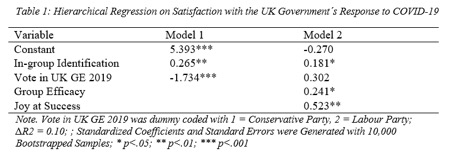
{"id":939,"date":"2020-05-04T09:25:00","date_gmt":"2020-05-04T09:25:00","guid":{"rendered":"http:\/\/blogs.sussex.ac.uk\/psychology\/?p=939"},"modified":"2020-05-28T12:22:56","modified_gmt":"2020-05-28T12:22:56","slug":"looking-back-the-role-of-the-general-election-in-satisfaction-with-uk-response-to-covid-19","status":"publish","type":"post","link":"https:\/\/blogs.sussex.ac.uk\/psychology\/2020\/05\/04\/looking-back-the-role-of-the-general-election-in-satisfaction-with-uk-response-to-covid-19\/","title":{"rendered":"Looking Back: The Role of the General Election in Satisfaction with UK Response to COVID-19"},"content":{"rendered":"\n<p>By Carina&nbsp;Hoerst<\/p>\n\n\n\n<p>Recently, a group of people with controversial stances <a href=\"https:\/\/coloradotimesrecorder.com\/2020\/04\/proud-boys-anti-vaxxers-and-conspiracy-theorists-among-reopen-colorado-protestors\/22827\/\">protested against lockdown restrictions in the US<\/a> \u2013 a particularly concerning move since the protest action was carried out against the ban of public assembly and could <a href=\"https:\/\/www.theguardian.com\/us-news\/2020\/apr\/20\/us-protests-lockdown-coronavirus-cases-surge-warning\">increase the infection rate of COVID-19<\/a>. More Republicans agree that Donald Trump was doing an <a href=\"https:\/\/www.people-press.org\/2020\/04\/16\/trumps-handling-of-coronavirus-outbreak\/?utm_content=buffera3faf&amp;utm_medium=social&amp;utm_source=twitter.com&amp;utm_campaign=buffer\">\u2018excellent job\u2019 about the ongoing crisis compared to only 13% of Democrat voters.<\/a> Recent polls revealed that in the US, such partisan effects might be connected to perceiving a low threat of COVID-19. Similarly, 27% more Democrats than Republican voters <a href=\"https:\/\/medium.com\/@YouGovBlue\/new-coronavirus-polling-shows-americans-are-responding-to-the-threat-unevenly-641026301516\">adhered to social distancing<\/a>. This is in line with mid-March survey results, <a href=\"https:\/\/www.vox.com\/2020\/3\/15\/21180506\/coronavirus-poll-democrats-republicans-trump\">showing that 68% of Democrats voters were concerned about COVID-19<\/a>, compared to only 35% of Republican voters. <\/p>\n\n\n\n<p>In the UK, public\n<a href=\"https:\/\/www.parliamentlive.tv\/Event\/Index\/b0c2813b-cfeb-434c-8858-a24a7e3568f3\">compliance\nwith safety measures is high<\/a>, the handling of the situation different. Can\nwe nonetheless find similar partisan effects as seen in the US? <\/p>\n\n\n\n<p>Although the first\nCOVID-19 cases in the UK occurred quite early in the year, the UK government\nreacted relatively late with implementing strict measures to tackle the spread\nof the virus. While other European countries had already started to act, the UK\nmight have been \u2018<a href=\"https:\/\/www.theguardian.com\/world\/2020\/apr\/18\/how-did-britain-get-its-response-to-coronavirus-so-wrong?utm_term=RWRpdG9yaWFsX0d1YXJkaWFuVG9kYXlVS19XZWVrZW5kLTIwMDQxOQ%3D%3D&amp;utm_source=esp&amp;utm_medium=Email&amp;CMP=GTUK_email&amp;utm_campaign=GuardianTodayUK\">too\nbusy with Brexit<\/a>\u2019 preparations and\ncelebrations to shift its attention to COVID-19. The official statement that\nwould align the country with others and apply stronger measures was <a href=\"https:\/\/eachother.org.uk\/uk-coronavirus-timeline-from-liberty-to-lockdown\/\">only\nannounced on the 23<sup>rd<\/sup> of March<\/a>. <\/p>\n\n\n\n<p>A national survey\n(<a href=\"https:\/\/www.hopenothate.org.uk\/2020\/03\/27\/new-polling-brits-are-divided-over-the-governments-coronavirus-response\/\"><em>Hope\nNot Hate<\/em><\/a>) revealed that while a third of the people did not seem to have\nfaith in how the government dealt with the situation, 74% of those that\nsupported the Conservative Party in the UK General Election 2019 were positive\nabout how the government handled the situation. Interestingly, so were 29% of\nLabour voters. According to <em>YouGov,<\/em> 55% of the respondents also seemed\nto be <a href=\"https:\/\/yougov.co.uk\/topics\/politics\/articles-reports\/2020\/03\/24\/coronavirus-reaction-pushes-pms-popularity-positiv\">supportive\nof PM Boris Johnson<\/a>.<\/p>\n\n\n\n<p>In a survey of 200 participants I conducted on 26<sup>th<\/sup> March 2020 investigating attitudes and beliefs in light of the UK General Election 2019, I found similar results: Conservative Party supporters were significantly more satisfied<a href=\"#_ftn1\">[1]<\/a> with the UK government&#8217;s response to COVID-19, with 77% of Conservative Party and 38% of Labour Party supporters being slightly to highly satisfied. Besides this, participants&#8217; identification as \u2018British\u2019 was a significant factor in explaining the satisfaction with the government&#8217;s response (see table 1, Model 1). <\/p>\n\n\n\n<div class=\"wp-block-image\"><figure class=\"aligncenter size-full is-resized\"><img data-attachment-id=\"940\" data-permalink=\"https:\/\/blogs.sussex.ac.uk\/psychology\/2020\/05\/04\/looking-back-the-role-of-the-general-election-in-satisfaction-with-uk-response-to-covid-19\/uk-gov-and-covid19\/\" data-orig-file=\"https:\/\/i0.wp.com\/blogs.sussex.ac.uk\/psychology\/files\/2020\/04\/UK-Gov-and-COVID19.jpg?fit=454%2C165&amp;ssl=1\" data-orig-size=\"454,165\" data-comments-opened=\"1\" data-image-meta=\"{&quot;aperture&quot;:&quot;0&quot;,&quot;credit&quot;:&quot;&quot;,&quot;camera&quot;:&quot;&quot;,&quot;caption&quot;:&quot;&quot;,&quot;created_timestamp&quot;:&quot;0&quot;,&quot;copyright&quot;:&quot;&quot;,&quot;focal_length&quot;:&quot;0&quot;,&quot;iso&quot;:&quot;0&quot;,&quot;shutter_speed&quot;:&quot;0&quot;,&quot;title&quot;:&quot;&quot;,&quot;orientation&quot;:&quot;0&quot;}\" data-image-title=\"UK-Gov-and-COVID19\" data-image-description=\"\" data-image-caption=\"\" data-medium-file=\"https:\/\/i0.wp.com\/blogs.sussex.ac.uk\/psychology\/files\/2020\/04\/UK-Gov-and-COVID19.jpg?fit=300%2C109&amp;ssl=1\" data-large-file=\"https:\/\/i0.wp.com\/blogs.sussex.ac.uk\/psychology\/files\/2020\/04\/UK-Gov-and-COVID19.jpg?fit=454%2C165&amp;ssl=1\" loading=\"lazy\" src=\"https:\/\/i0.wp.com\/blogs.sussex.ac.uk\/psychology\/files\/2020\/04\/UK-Gov-and-COVID19.jpg?resize=546%2C176&#038;ssl=1\" alt=\"\" class=\"wp-image-940\" width=\"546\" height=\"176\" srcset=\"https:\/\/i0.wp.com\/blogs.sussex.ac.uk\/psychology\/files\/2020\/04\/UK-Gov-and-COVID19.jpg?zoom=2&amp;resize=546%2C176 1092w, https:\/\/i0.wp.com\/blogs.sussex.ac.uk\/psychology\/files\/2020\/04\/UK-Gov-and-COVID19.jpg?zoom=3&amp;resize=546%2C176 1638w\" sizes=\"(max-width: 546px) 100vw, 546px\" data-recalc-dims=\"1\" \/><\/figure><\/div>\n\n\n\n<p>However, party loyalty as an explanation might only be half of the story; when I additionally included collective psychological empowerment (measured as group efficacy and the experience of joy at success) as a predictor, I found that, first, identifying as \u2018British\u2019 remained a significant factor, but also that, second, party support did not seem to play a significant role anymore. Instead, the empowerment measures turned out to be significant key predictors of satisfaction with the UK government&#8217;s response to COVID-19 (see table 1, Model 2). This seems to be in line with a recent US study that found that party support alone only had an indirect influence on the lack of COVID-19 threat perception, but that instead underlying political beliefs connected this relationship with mistrust towards the government being the only belief without this effect. Instead, the authors suggest that it was more important \u2018how [participants] <em>feel<\/em> about governmental policy choices\u2019. <\/p>\n\n\n\n<p>Now, the outbreak of COVID-19 affects everybody&#8217;s life and research has shown that during disasters, people can perceive a sense of <a href=\"https:\/\/www.frontiersin.org\/articles\/10.3389\/fpubh.2019.00141\/full\">common fate<\/a>. This might make people also more aware of the superordinate in-group &nbsp;(\u2018the British\u2019) and explain why in-group identification turned out to be a key factor for satisfaction and why a third of the Labour voters expressed their approval for the Conservative government. <\/p>\n\n\n\n<p>But how can the empowerment\neffect, assessed in light of the general election, be explained concerning the current\nsituation? <\/p>\n\n\n\n<p>The Conservative Party was not only supported by longstanding designated voters, but also by people that were attracted by its controversial manifesto to leave the EU for good. After the party won the election with an overwhelming majority, we would assume that Conservative voters expected nationwide support for their views and believed that change (\u2018get Brexit done\u2019) was now possible. In this way, Conservative voters saw their <a href=\"https:\/\/onlinelibrary.wiley.com\/doi\/abs\/10.1002\/ejsp.2650\">values realized against opponent<\/a> views and parties. The latter were defeated, which, in turn, can lead to the <a href=\"https:\/\/spssi.onlinelibrary.wiley.com\/doi\/abs\/10.1111\/j.1540-4560.2009.01622.x\">experience of disempowerment<\/a> amongst its voters. My study results reflect this: Conservative voters expressed significantly more joy at success and group efficacy compared to Labour voters. <\/p>\n\n\n\n<p>Interestingly, these empowerment effects were established over three months after the election took place. Previous research found that the endurance of empowerment depends on a stable realization and maintenance of the aspired <a href=\"https:\/\/doi.org\/10.1002\/ejsp.231\">change in social relations<\/a>. The electoral win strengthened the Conservative Party to unobstructedly enact these changes since, \u2013 <a href=\"https:\/\/www.theguardian.com\/politics\/2019\/sep\/15\/johnson-to-defy-benn-bill-quit-31-october-come-what-may\">\u2018come what may\u2019<\/a>.<\/p>\n\n\n\n<p>Let&#8217;s summarise: Identification with the Conservative Party might still be present but superseded by the perception that change is possible and by the experience of positivity amongst its voters, and this effect was enduring. This might explain why satisfaction with the government&#8217;s response to COVID-19 in March 2020 was accounted for by collective empowerment, over party support. Thus, the discussion around public approval based on partisan effects might only need to be extended by the social-psychological effects of (enduring) collective empowerment. We live in rapidly changing times though, and the UK government has recently come under <a href=\"https:\/\/www.theguardian.com\/society\/2020\/apr\/19\/hospital-leaders-hit-out-government-ppe-shortage-row-escalates-nhs?utm_term=RWRpdG9yaWFsX0d1YXJkaWFuVG9kYXlVS19XZWVrZGF5cy0yMDA0MjA=&amp;utm_source=esp&amp;utm_medium=Email&amp;CMP=GTUK_email&amp;utm_campaign=GuardianTodayUK\">increased criticism for its delayed reaction<\/a>, <a href=\"https:\/\/www.theguardian.com\/world\/live\/2020\/apr\/20\/uk-coronavirus-live-boris-johnson-against-lifting-lockdown-over-second-wave-fears?page=with:block-5e9d50ac8f08bade1f2965a8\">missed meetings and deadlines, as well as for clinging on the EU exit<\/a>, even at the expense of public health. Therefore, one might see whether satisfaction with its handling remains and if empowerment effects are unconditionally robust to changes over time. <\/p>\n\n\n\n<p><\/p>\n\n\n\n<hr class=\"wp-block-separator\" \/>\n\n\n\n<p><a href=\"#_ftnref1\">[1]<\/a> This was based on one question asking participants how satisfied they were with the UK government&#8217;s response to COVID-19. However, the question was not further specified so that we cannot say whether participants were satisfied with the pace of the government&#8217;s action or the lockdown regulations implemented three days before.<\/p>\n\n\n\n<p><\/p>\n\n\n\n<p><em>Carina\u00a0Hoerst is a PhD student in Social Psychology under the supervision of Prof John Drury. She is part of the <a href=\"http:\/\/www.sussex.ac.uk\/psychology\/crowdsidentities\/\">Crowds and Identities Group<\/a>.<\/em><\/p>\n\n\n\n<p>Find out more about our research on <a href=\"http:\/\/www.sussex.ac.uk\/psychology\/research\/socialandappliedpsychology\">Social and Applied Psychology<\/a>.<\/p>\n","protected":false},"excerpt":{"rendered":"<p>By Carina&nbsp;Hoerst Recently, a group of people with controversial stances protested against lockdown restrictions in the US \u2013 a particularly concerning move since the protest action was carried out against the ban of public assembly and could increase the infection<span class=\"ellipsis\">&hellip;<\/span><\/p>\n<div class=\"read-more\"><a href=\"https:\/\/blogs.sussex.ac.uk\/psychology\/2020\/05\/04\/looking-back-the-role-of-the-general-election-in-satisfaction-with-uk-response-to-covid-19\/\">Read more &#8250;<\/a><\/div>\n<p><!-- end of .read-more --><\/p>\n","protected":false},"author":156,"featured_media":0,"comment_status":"open","ping_status":"open","sticky":false,"template":"","format":"standard","meta":{"spay_email":"","jetpack_publicize_message":"","jetpack_is_tweetstorm":false},"categories":[98528],"tags":[168160,147993,176767,98552],"jetpack_featured_media_url":"","jetpack_publicize_connections":[],"jetpack_sharing_enabled":true,"jetpack_shortlink":"https:\/\/wp.me\/pafdEV-f9","jetpack-related-posts":[{"id":1297,"url":"https:\/\/blogs.sussex.ac.uk\/psychology\/2021\/06\/02\/who-helps-the-helpers-8-tips-for-voluntary-groups\/","url_meta":{"origin":939,"position":0},"title":"Who helps the helpers? 8 tips for voluntary groups","date":"June 2, 2021","format":false,"excerpt":"Local voluntary mutual aid groups have been critically important for many people during Covid. But keeping the momentum going is difficult even when the need for the kind of help these groups provide is still high. Groups & COVID: Community, Support and Mutual Aid, a project led by\u00a0Prof John Drury,\u2026","rel":"","context":"In &quot;Faculty research&quot;","img":{"alt_text":"","src":"https:\/\/i1.wp.com\/blogs.sussex.ac.uk\/psychology\/files\/2021\/06\/Volunteers.jpg?resize=350%2C200&ssl=1","width":350,"height":200},"classes":[]},{"id":1046,"url":"https:\/\/blogs.sussex.ac.uk\/psychology\/2020\/08\/09\/neighbours-support-each-other-during-covid-19\/","url_meta":{"origin":939,"position":1},"title":"Neighbours support each other during COVID-19","date":"August 9, 2020","format":false,"excerpt":"By Selin Tekin Guven Since the beginning of March 2020, COVID-19 pandemic related news has been the main topic in the media. Medical experts have explained different methods to prevent the spread, and authorities in each country have implemented various strategies to deal with the effects of the virus in\u2026","rel":"","context":"In &quot;PhD research&quot;","img":{"alt_text":"","src":"","width":0,"height":0},"classes":[]},{"id":1188,"url":"https:\/\/blogs.sussex.ac.uk\/psychology\/2021\/01\/25\/mitigating-the-new-variant-sars-cov-2-virus-how-to-support-public-adherence-to-physical-distancing\/","url_meta":{"origin":939,"position":2},"title":"Mitigating the new variant SARS-CoV-2 virus: How to support public adherence to physical distancing","date":"January 25, 2021","format":false,"excerpt":"By John Drury Journalists often ask me how the public will behave when the next set of Covid-19 restrictions begins. Will they accept the rules or ignore them? This matters crucially right now. With rising infections in many areas of the country, and with the new variant of the virus\u2026","rel":"","context":"In &quot;Faculty research&quot;","img":{"alt_text":"","src":"https:\/\/i2.wp.com\/blogs.sussex.ac.uk\/psychology\/files\/2021\/01\/timeline.png?resize=350%2C200&ssl=1","width":350,"height":200},"classes":[]},{"id":1420,"url":"https:\/\/blogs.sussex.ac.uk\/psychology\/2021\/09\/01\/primary-school-attendance-problems-in-the-context-of-covid-19\/","url_meta":{"origin":939,"position":3},"title":"Primary school attendance problems in the context of Covid-19","date":"September 1, 2021","format":false,"excerpt":"By Bront\u00eb McDonald Bront\u00eb's poster won the first award at the Festival of Doctoral Research in July 2021 The Covid-19 pandemic has significantly disrupted the educational lives of children across the world. In the UK, the government attempted to curb the spread of the virus by closing schools for extended\u2026","rel":"","context":"In &quot;PhD research&quot;","img":{"alt_text":"","src":"https:\/\/i0.wp.com\/blogs.sussex.ac.uk\/psychology\/files\/2021\/08\/School-attendance-problems-during-covid19-poster.png?resize=350%2C200&ssl=1","width":350,"height":200},"classes":[]},{"id":1698,"url":"https:\/\/blogs.sussex.ac.uk\/psychology\/2022\/08\/19\/dissertation-to-publication-barbershops-as-a-setting-for-supporting-mens-mental-health-during-the-covid-19-pandemic\/","url_meta":{"origin":939,"position":4},"title":"Dissertation to Publication: Barbershops as a setting for supporting men's mental health during the COVID-19 pandemic","date":"August 19, 2022","format":false,"excerpt":"By Georgina Ogborn, BSc Psychology Graduate My third-year dissertation project at Sussex was the culmination of my university studies and an important step towards realising my ambition to work in the field of clinical psychology. My project investigated the topic of barbershops as a community setting to support male mental\u2026","rel":"","context":"Similar post","img":{"alt_text":"","src":"https:\/\/i1.wp.com\/blogs.sussex.ac.uk\/psychology\/files\/2022\/08\/GO-Blog-Picture-1-scaled.jpg?resize=350%2C200&ssl=1","width":350,"height":200},"classes":[]},{"id":1116,"url":"https:\/\/blogs.sussex.ac.uk\/psychology\/2020\/11\/04\/they-dont-know-weve-got-legs-meeting-online-and-in-person\/","url_meta":{"origin":939,"position":5},"title":"\u201cThey don\u2019t know we\u2019ve got legs\u201d: meeting online and in-person","date":"November 4, 2020","format":false,"excerpt":"By Prof Nicola Yuill Covid-19 restrictions haven\u2019t just stopped us meeting in person \u2013 instead, they have nudged us into new ways of connecting. Humans are the ultimate social species: evolutionary biologists regard the human tendency towards cooperation as having created the complex coordination we manage in politics, the arts,\u2026","rel":"","context":"In &quot;Faculty research&quot;","img":{"alt_text":"","src":"https:\/\/i0.wp.com\/blogs.sussex.ac.uk\/psychology\/files\/2020\/11\/Screen-Shot-2020-11-03-at-14.50.27.png?resize=350%2C200&ssl=1","width":350,"height":200},"classes":[]}],"_links":{"self":[{"href":"https:\/\/blogs.sussex.ac.uk\/psychology\/wp-json\/wp\/v2\/posts\/939"}],"collection":[{"href":"https:\/\/blogs.sussex.ac.uk\/psychology\/wp-json\/wp\/v2\/posts"}],"about":[{"href":"https:\/\/blogs.sussex.ac.uk\/psychology\/wp-json\/wp\/v2\/types\/post"}],"author":[{"embeddable":true,"href":"https:\/\/blogs.sussex.ac.uk\/psychology\/wp-json\/wp\/v2\/users\/156"}],"replies":[{"embeddable":true,"href":"https:\/\/blogs.sussex.ac.uk\/psychology\/wp-json\/wp\/v2\/comments?post=939"}],"version-history":[{"count":6,"href":"https:\/\/blogs.sussex.ac.uk\/psychology\/wp-json\/wp\/v2\/posts\/939\/revisions"}],"predecessor-version":[{"id":959,"href":"https:\/\/blogs.sussex.ac.uk\/psychology\/wp-json\/wp\/v2\/posts\/939\/revisions\/959"}],"wp:attachment":[{"href":"https:\/\/blogs.sussex.ac.uk\/psychology\/wp-json\/wp\/v2\/media?parent=939"}],"wp:term":[{"taxonomy":"category","embeddable":true,"href":"https:\/\/blogs.sussex.ac.uk\/psychology\/wp-json\/wp\/v2\/categories?post=939"},{"taxonomy":"post_tag","embeddable":true,"href":"https:\/\/blogs.sussex.ac.uk\/psychology\/wp-json\/wp\/v2\/tags?post=939"}],"curies":[{"name":"wp","href":"https:\/\/api.w.org\/{rel}","templated":true}]}}