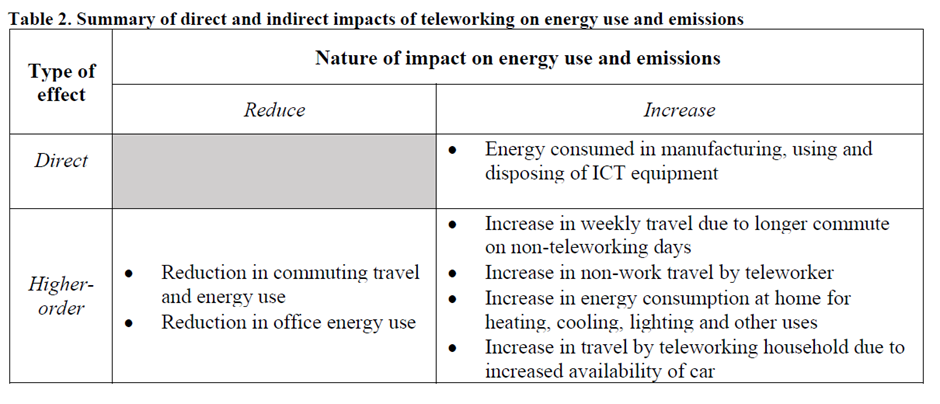
{"id":2182,"date":"2020-06-30T11:00:06","date_gmt":"2020-06-30T11:00:06","guid":{"rendered":"http:\/\/blogs.sussex.ac.uk\/sussexenergygroup\/?p=2182"},"modified":"2024-02-13T15:33:47","modified_gmt":"2024-02-13T15:33:47","slug":"lockdown-lifestyle-does-working-from-home-reduce-carbon-emissions","status":"publish","type":"post","link":"https:\/\/blogs.sussex.ac.uk\/sussexenergygroup\/2020\/06\/30\/lockdown-lifestyle-does-working-from-home-reduce-carbon-emissions\/","title":{"rendered":"Lockdown Lifestyle: Does Working from Home Reduce Carbon Emissions?"},"content":{"rendered":"\n<p>Up until recently, only an estimated 9% of Americans have teleworked more than once a week. Slow adoption of teleworking has been due to a lack of consensus around its environmental benefits, the perception among workers that not being visible in the office may hinder career advancement, and fears among employers about potential drops in worker performance and efficiency.<\/p>\n\n\n\n<p>In COVID-19&#8217;s wake, remote working across the globe has abruptly switched from a \u2018perk\u2019 offered by forward-thinking employers to a necessary practice for many workers. But before it became an integral part of public health policy, telecommuting was often seen as an employee-pleasing way to reduce energy demand and its associated carbon emissions. Emissions from daily commutes and office maintenance could be substituted by the lower emissions of home- or co-working space- based employment.<\/p>\n\n\n\n<p>But is it really this simple? A study from SEG\u2019s work for the <a href=\"https:\/\/www.creds.ac.uk\/\">Centre for Research into Energy Demand Solutions (CREDS)<\/a> has assessed the current research landscape to uncover the true capacity of teleworking for achieving energy savings. The results have been written up in their paper <a href=\"https:\/\/iopscience.iop.org\/article\/10.1088\/1748-9326\/ab8a84\">\u2018A systematic review of the energy and climate impacts of teleworking\u2019.<\/a><\/p>\n\n\n\n<p>The findings of the paper are derived from 39 studies across the US, Europe, Asia and the Middle East. In their analysis, they try to make sense of how these individual papers vary between those suggesting teleworking can reduce emissions by up to 77% to others that suggest it could even increase emissions.<\/p>\n\n\n\n<p>The table below summarises the results of the review, appearing to support the theory that teleworking reduces energy use, with two thirds of the sampled papers supporting that conclusion. However, due to the scope and variety of methodologies used across the papers surveyed, the evidence is not as clear-cut as it might first appear, as we will explain below.<\/p>\n\n\n\n<figure class=\"wp-block-image size-large\"><img loading=\"lazy\" width=\"550\" height=\"84\" src=\"https:\/\/i0.wp.com\/blogs.sussex.ac.uk\/sussexenergygroup\/files\/2020\/06\/Table-8.png?resize=550%2C84&#038;ssl=1\" alt=\"\" class=\"wp-image-2184\" srcset=\"https:\/\/i0.wp.com\/blogs.sussex.ac.uk\/sussexenergygroup\/files\/2020\/06\/Table-8.png?w=940&amp;ssl=1 940w, https:\/\/i0.wp.com\/blogs.sussex.ac.uk\/sussexenergygroup\/files\/2020\/06\/Table-8.png?resize=300%2C46&amp;ssl=1 300w, https:\/\/i0.wp.com\/blogs.sussex.ac.uk\/sussexenergygroup\/files\/2020\/06\/Table-8.png?resize=768%2C117&amp;ssl=1 768w, https:\/\/i0.wp.com\/blogs.sussex.ac.uk\/sussexenergygroup\/files\/2020\/06\/Table-8.png?resize=100%2C15&amp;ssl=1 100w, https:\/\/i0.wp.com\/blogs.sussex.ac.uk\/sussexenergygroup\/files\/2020\/06\/Table-8.png?resize=150%2C23&amp;ssl=1 150w, https:\/\/i0.wp.com\/blogs.sussex.ac.uk\/sussexenergygroup\/files\/2020\/06\/Table-8.png?resize=200%2C30&amp;ssl=1 200w, https:\/\/i0.wp.com\/blogs.sussex.ac.uk\/sussexenergygroup\/files\/2020\/06\/Table-8.png?resize=450%2C68&amp;ssl=1 450w, https:\/\/i0.wp.com\/blogs.sussex.ac.uk\/sussexenergygroup\/files\/2020\/06\/Table-8.png?resize=600%2C91&amp;ssl=1 600w, https:\/\/i0.wp.com\/blogs.sussex.ac.uk\/sussexenergygroup\/files\/2020\/06\/Table-8.png?resize=900%2C137&amp;ssl=1 900w\" sizes=\"(max-width: 550px) 100vw, 550px\" data-recalc-dims=\"1\" \/><\/figure>\n\n\n\n<h2>Understanding teleworking\u2019s energy savings<\/h2>\n\n\n\n<p>The premise that home working saves energy relies on a simple substitution effect: transport emissions from the worker\u2019s commute are removed in favour of the typically lower emissions of ICT enabled remote working. However, by itself this provides an incomplete picture. The act of teleworking is surrounded by a variety of factors and influences on personal behaviour, which complicate the initially straightforward equation.<\/p>\n\n\n\n<p>Attempting to untangle this issue begins by dividing end energy use into two types:<\/p>\n\n\n\n<p>\u201cDirect impacts\u201d are defined as<strong> the energy used for the manufacture, operation and disposal of ICTs.<\/strong><\/p>\n\n\n\n<p>\u201cHigher order impacts\u201d, on the other hand, are <strong>changes in energy consumption stimulated by ICT use.<\/strong> These encompass the consequences of choices made around the initial decision to work from home.<\/p>\n\n\n\n<figure class=\"wp-block-image size-large\"><img loading=\"lazy\" width=\"550\" height=\"236\" src=\"https:\/\/i2.wp.com\/blogs.sussex.ac.uk\/sussexenergygroup\/files\/2020\/06\/Table-2.png?resize=550%2C236&#038;ssl=1\" alt=\"\" class=\"wp-image-2185\" srcset=\"https:\/\/i2.wp.com\/blogs.sussex.ac.uk\/sussexenergygroup\/files\/2020\/06\/Table-2.png?w=940&amp;ssl=1 940w, https:\/\/i2.wp.com\/blogs.sussex.ac.uk\/sussexenergygroup\/files\/2020\/06\/Table-2.png?resize=300%2C129&amp;ssl=1 300w, https:\/\/i2.wp.com\/blogs.sussex.ac.uk\/sussexenergygroup\/files\/2020\/06\/Table-2.png?resize=768%2C330&amp;ssl=1 768w, https:\/\/i2.wp.com\/blogs.sussex.ac.uk\/sussexenergygroup\/files\/2020\/06\/Table-2.png?resize=100%2C43&amp;ssl=1 100w, https:\/\/i2.wp.com\/blogs.sussex.ac.uk\/sussexenergygroup\/files\/2020\/06\/Table-2.png?resize=150%2C64&amp;ssl=1 150w, https:\/\/i2.wp.com\/blogs.sussex.ac.uk\/sussexenergygroup\/files\/2020\/06\/Table-2.png?resize=200%2C86&amp;ssl=1 200w, https:\/\/i2.wp.com\/blogs.sussex.ac.uk\/sussexenergygroup\/files\/2020\/06\/Table-2.png?resize=450%2C193&amp;ssl=1 450w, https:\/\/i2.wp.com\/blogs.sussex.ac.uk\/sussexenergygroup\/files\/2020\/06\/Table-2.png?resize=600%2C258&amp;ssl=1 600w, https:\/\/i2.wp.com\/blogs.sussex.ac.uk\/sussexenergygroup\/files\/2020\/06\/Table-2.png?resize=900%2C387&amp;ssl=1 900w\" sizes=\"(max-width: 550px) 100vw, 550px\" data-recalc-dims=\"1\" \/><\/figure>\n\n\n\n<h2>Emission savings or rebounds?<\/h2>\n\n\n\n<p>While teleworking may eliminate or reduce energy consumption and associated emissions generated from the office commute, it may also lead to increased energy use due to homeworking, a so-called \u2018rebound\u2019 effect. This may be as a result of greater use of home appliances, heating, cooling, and lighting. Teleworking may also generate higher \u2018non-work\u2019 travel, as workers use their new \u2018time savings\u2019 to take more regulars holidays or breaks.<\/p>\n\n\n\n<figure class=\"wp-block-image size-large\"><img loading=\"lazy\" width=\"1125\" height=\"750\" src=\"https:\/\/i2.wp.com\/blogs.sussex.ac.uk\/sussexenergygroup\/files\/2020\/06\/pexels-photo.jpg?fit=550%2C367&amp;ssl=1\" alt=\"\" class=\"wp-image-2186\" srcset=\"https:\/\/i2.wp.com\/blogs.sussex.ac.uk\/sussexenergygroup\/files\/2020\/06\/pexels-photo.jpg?w=1125&amp;ssl=1 1125w, https:\/\/i2.wp.com\/blogs.sussex.ac.uk\/sussexenergygroup\/files\/2020\/06\/pexels-photo.jpg?resize=300%2C200&amp;ssl=1 300w, https:\/\/i2.wp.com\/blogs.sussex.ac.uk\/sussexenergygroup\/files\/2020\/06\/pexels-photo.jpg?resize=1024%2C683&amp;ssl=1 1024w, https:\/\/i2.wp.com\/blogs.sussex.ac.uk\/sussexenergygroup\/files\/2020\/06\/pexels-photo.jpg?resize=768%2C512&amp;ssl=1 768w, https:\/\/i2.wp.com\/blogs.sussex.ac.uk\/sussexenergygroup\/files\/2020\/06\/pexels-photo.jpg?resize=100%2C67&amp;ssl=1 100w, https:\/\/i2.wp.com\/blogs.sussex.ac.uk\/sussexenergygroup\/files\/2020\/06\/pexels-photo.jpg?resize=150%2C100&amp;ssl=1 150w, https:\/\/i2.wp.com\/blogs.sussex.ac.uk\/sussexenergygroup\/files\/2020\/06\/pexels-photo.jpg?resize=200%2C133&amp;ssl=1 200w, https:\/\/i2.wp.com\/blogs.sussex.ac.uk\/sussexenergygroup\/files\/2020\/06\/pexels-photo.jpg?resize=450%2C300&amp;ssl=1 450w, https:\/\/i2.wp.com\/blogs.sussex.ac.uk\/sussexenergygroup\/files\/2020\/06\/pexels-photo.jpg?resize=600%2C400&amp;ssl=1 600w, https:\/\/i2.wp.com\/blogs.sussex.ac.uk\/sussexenergygroup\/files\/2020\/06\/pexels-photo.jpg?resize=900%2C600&amp;ssl=1 900w\" sizes=\"(max-width: 550px) 100vw, 550px\" \/><\/figure>\n\n\n\n<p>One psychological driver of the increase in non-work travel may be the simple desire to get out of the house; indeed, many people working under lockdown conditions could identify with the statement made within the paper that \u201canother induced travel effect could be where the feelings of isolation and sedentariness generated by teleworking stimulate a desire for movement and mobility\u201d. Alternatively, workers may purchase more consumer items online, contributing to higher society-wide energy consumption through increased production of goods and home delivery travel.<\/p>\n\n\n\n<p>Where teleworking is only partial (say, two days a week), the overall travel distance per week may not be significantly reduced, especially if workers live far from the office (a phenomenon that has been, paradoxically, facilitated by teleworking). To take one example, a survey conducted as part of a Finnish study noticed teleworkers lived, on average, 3.7km further from the workplace. Their commutes were less frequent, but their average journey consumed more energy whenever it took place.<\/p>\n\n\n\n<p>Overall, although workers may save money and gain time through their reduced or eliminated commutes on days that they work from home, increases in energy consumption in other areas (such as through non-work travel and home energy consumption) may mean that the net energy savings are minimal, or even negative.<\/p>\n\n\n\n<h2>Change of scope and methodology<\/h2>\n\n\n\n<p>The complexity and scope of the teleworking impacts will therefore need much further study. Many of the studies focus on comparing weekly work distance travelled, hence neglecting non-work travel. As a result, they may overestimate the total reduction in travel distance. One paper found \u201cvehicle travel distance is 8% lower per month for teleworkers than non-teleworkers; whereas Zhu (2012), who also considers impacts on non-work travel, finds a negligible impact on total vehicle distance travelled.&#8221;<\/p>\n\n\n\n<p><a href=\"https:\/\/profiles.sussex.ac.uk\/p335845-andrew-hook\">Dr Andrew Hook<\/a>, one of the study\u2019s authors, elaborates how differences in scope and methodology impact their findings below:<\/p>\n\n\n\n<blockquote class=\"wp-block-quote\"><p>\u201cWhile most studies conclude that teleworking can contribute energy savings, the more rigorous studies and those with a broader scope present more ambiguous findings. Where studies include additional impacts, such as non-work travel or office and home energy use, the potential energy savings appear more limited \u2013 with some studies suggesting that, in the context of growing distances between the workplace and home, part-week teleworking could lead to a net increase in energy consumption.\u201d<\/p><cite><br><\/cite><\/blockquote>\n\n\n\n<figure class=\"wp-block-image size-large\"><img loading=\"lazy\" width=\"1125\" height=\"750\" src=\"https:\/\/i0.wp.com\/blogs.sussex.ac.uk\/sussexenergygroup\/files\/2020\/06\/pexels-photo-712490.jpeg?fit=550%2C367&amp;ssl=1\" alt=\"\" class=\"wp-image-2187\" srcset=\"https:\/\/i0.wp.com\/blogs.sussex.ac.uk\/sussexenergygroup\/files\/2020\/06\/pexels-photo-712490.jpeg?w=1125&amp;ssl=1 1125w, https:\/\/i0.wp.com\/blogs.sussex.ac.uk\/sussexenergygroup\/files\/2020\/06\/pexels-photo-712490.jpeg?resize=300%2C200&amp;ssl=1 300w, https:\/\/i0.wp.com\/blogs.sussex.ac.uk\/sussexenergygroup\/files\/2020\/06\/pexels-photo-712490.jpeg?resize=1024%2C683&amp;ssl=1 1024w, https:\/\/i0.wp.com\/blogs.sussex.ac.uk\/sussexenergygroup\/files\/2020\/06\/pexels-photo-712490.jpeg?resize=768%2C512&amp;ssl=1 768w, https:\/\/i0.wp.com\/blogs.sussex.ac.uk\/sussexenergygroup\/files\/2020\/06\/pexels-photo-712490.jpeg?resize=100%2C67&amp;ssl=1 100w, https:\/\/i0.wp.com\/blogs.sussex.ac.uk\/sussexenergygroup\/files\/2020\/06\/pexels-photo-712490.jpeg?resize=150%2C100&amp;ssl=1 150w, https:\/\/i0.wp.com\/blogs.sussex.ac.uk\/sussexenergygroup\/files\/2020\/06\/pexels-photo-712490.jpeg?resize=200%2C133&amp;ssl=1 200w, https:\/\/i0.wp.com\/blogs.sussex.ac.uk\/sussexenergygroup\/files\/2020\/06\/pexels-photo-712490.jpeg?resize=450%2C300&amp;ssl=1 450w, https:\/\/i0.wp.com\/blogs.sussex.ac.uk\/sussexenergygroup\/files\/2020\/06\/pexels-photo-712490.jpeg?resize=600%2C400&amp;ssl=1 600w, https:\/\/i0.wp.com\/blogs.sussex.ac.uk\/sussexenergygroup\/files\/2020\/06\/pexels-photo-712490.jpeg?resize=900%2C600&amp;ssl=1 900w\" sizes=\"(max-width: 550px) 100vw, 550px\" \/><\/figure>\n\n\n\n<h2>Next steps for \u201cteleworking\u201d research?<\/h2>\n\n\n\n<p>The notion of teleworking itself is one that predates the internet, referencing a past where innovations like telecentres and the fax machine were seen as the answer to removing or reducing arduous commutes. These terms could be attached to outdated ideas of work, failing to account for the present day of Wi-Fi enabled work from libraries\/cafes\/trains, flexible working arrangements, and the increased proportion of the workforce on varying \u201czero hour contracts\u201d. Future studies may need to address the fact that \u201c<em>modern modes of flexible or mobile work have become so non-linear and fluid (but also increasingly energy intensive in places) that it has become increasingly difficult to track their energy footprint, or to compare it with a dissolving notion of \u2018regular\u2019 work (Hopkins &amp; McKay 2019).<\/em>\u201d<\/p>\n\n\n\n<p>The use of digital services, such as videoconferencing and cloud storage, may lead to higher emissions from home working when compared to older technological regimes. The evidence base tends to lag behind recent trends, with most studies pre-dating these technologies. When we examine the benefits of home working, we therefore need to make sure the analysis is of the modern reality rather than of systems which no longer exist. The paper therefore concludes that future studies may better account for modern work practices and the uncertainties of tracking energy savings by trying to account for the complexity of new working patterns:<\/p>\n\n\n\n<blockquote class=\"wp-block-quote\"><p>\u201cStudies interested in appraising the potential of more flexible, ICT-enabled work practices should therefore aim to combine a range of methods capable of capturing the dynamic new configurations of working conditions. As well as accounting for change in commuting travel, non-commuting travel, distance between home and office, and home and office energy consumption, these studies must also consider other factors, such as the mode of commuting transport in the region being studied and the ways that people choose to use their time when they no longer have to commute to and from work. As many of these realities can only be established through qualitative methods, modellers must work together with other social scientists in order to build a better picture of the changing patterns of work and the energy saving potential of new working practices (e.g. Hampton 2017).\u201d<\/p><\/blockquote>\n\n\n\n<p><a href=\"https:\/\/www.bbc.co.uk\/programmes\/articles\/2Mky6fvrChwCRd7fWQW8h9l\/the-highs-and-lows-of-working-from-home\">Popular coverage on working from home<\/a> often makes the assumption that it provides unarguable environmental benefits. This work questions that assumption, hopes to indicate where future studies need to be focused in order to more accurately account for the rebounds inherent in these practices, and understand what sustainable teleworking should look like going forward.<\/p>\n\n\n\n<p><a href=\"https:\/\/profiles.sussex.ac.uk\/p373957-benjamin-sovacool\">Benjamin Sovacool<\/a> adds a cautionary addendum to those seeing it as an easy win-win:<\/p>\n\n\n\n<blockquote class=\"wp-block-quote\"><p> \u201cA scenario after the threat of coronavirus has cleared where workers will want the best of both worlds; retaining the freedom and flexibility they found from working from home but the social aspects of working at an office that they&#8217;ve missed out on during lockdown, will not deliver the energy savings the world needs\u201d.<\/p><\/blockquote>\n\n\n\n<p><br><strong>This blog is based on the article: <a href=\"https:\/\/iopscience.iop.org\/article\/10.1088\/1748-9326\/ab8a84\">A systematic review of the energy and climate impacts of teleworking &#8211; Environmental Research Letters by Andrew Hook, Victor Court, Benjamin Sovacool and Steven Sorrell.<\/a><\/strong><\/p>\n\n\n\n<p><strong>Thanks to Andrew Hook and Ed Dearnley for feedback and corrections.<\/strong><\/p>\nFollow Sussex Energy Group      <span class=\"synved-social-container synved-social-container-follow\"><a class=\"synved-social-button synved-social-button-follow synved-social-size-16 synved-social-resolution-single synved-social-provider-facebook nolightbox\" data-provider=\"facebook\" target=\"_blank\" rel=\"nofollow\" title=\"Follow us on Facebook\" href=\"https:\/\/www.facebook.com\/pages\/Sussex-Energy-Group\/448345351971248?ref=hl\" style=\"font-size: 0px; width:16px;height:16px;margin:0;margin-bottom:5px;margin-right:5px;\"><img alt=\"Facebook\" title=\"Follow us on Facebook\" class=\"synved-share-image synved-social-image synved-social-image-follow\" width=\"16\" height=\"16\" style=\"display: inline; width:16px;height:16px; margin: 0; padding: 0; border: none; box-shadow: none;\" src=\"https:\/\/i0.wp.com\/blogs.sussex.ac.uk\/sussexenergygroup\/wp-content\/plugins\/social-media-feather\/synved-social\/image\/social\/regular\/32x32\/facebook.png?resize=16%2C16&#038;ssl=1\" data-recalc-dims=\"1\" \/><\/a><a class=\"synved-social-button synved-social-button-follow synved-social-size-16 synved-social-resolution-single synved-social-provider-twitter nolightbox\" data-provider=\"twitter\" target=\"_blank\" rel=\"nofollow\" title=\"Follow us on Twitter\" href=\"https:\/\/twitter.com\/SussexNRGGroup\" style=\"font-size: 0px; width:16px;height:16px;margin:0;margin-bottom:5px;margin-right:5px;\"><img alt=\"twitter\" title=\"Follow us on Twitter\" class=\"synved-share-image synved-social-image synved-social-image-follow\" width=\"16\" height=\"16\" style=\"display: inline; width:16px;height:16px; margin: 0; padding: 0; border: none; box-shadow: none;\" src=\"https:\/\/i2.wp.com\/blogs.sussex.ac.uk\/sussexenergygroup\/wp-content\/plugins\/social-media-feather\/synved-social\/image\/social\/regular\/32x32\/twitter.png?resize=16%2C16&#038;ssl=1\" data-recalc-dims=\"1\" \/><\/a><a class=\"synved-social-button synved-social-button-follow synved-social-size-16 synved-social-resolution-single synved-social-provider-linkedin nolightbox\" data-provider=\"linkedin\" target=\"_blank\" rel=\"nofollow\" title=\"Find us on Linkedin\" href=\"https:\/\/www.linkedin.com\/company\/sussex-energy-group\" style=\"font-size: 0px; width:16px;height:16px;margin:0;margin-bottom:5px;\"><img alt=\"linkedin\" title=\"Find us on Linkedin\" class=\"synved-share-image synved-social-image synved-social-image-follow\" width=\"16\" height=\"16\" style=\"display: inline; width:16px;height:16px; margin: 0; padding: 0; border: none; box-shadow: none;\" src=\"https:\/\/i2.wp.com\/blogs.sussex.ac.uk\/sussexenergygroup\/wp-content\/plugins\/social-media-feather\/synved-social\/image\/social\/regular\/32x32\/linkedin.png?resize=16%2C16&#038;ssl=1\" data-recalc-dims=\"1\" \/><\/a><\/span>","protected":false},"excerpt":{"rendered":"<p>Up until recently, only an estimated 9% of Americans have teleworked more than once a week. Slow adoption of teleworking has been due to a lack of consensus around its environmental benefits, the perception among workers that not being visible<span class=\"ellipsis\">&hellip;<\/span><\/p>\n<div class=\"read-more\"><a href=\"https:\/\/blogs.sussex.ac.uk\/sussexenergygroup\/2020\/06\/30\/lockdown-lifestyle-does-working-from-home-reduce-carbon-emissions\/\">Read more &#8250;<\/a><\/div>\n<p><!-- end of .read-more --><\/p>\n","protected":false},"author":322,"featured_media":2183,"comment_status":"open","ping_status":"open","sticky":false,"template":"","format":"standard","meta":{"spay_email":"","jetpack_publicize_message":"","jetpack_is_tweetstorm":false},"categories":[96027,161328,161333],"tags":[152633,152608,152632,152631],"yoast_head":"<!-- This site is optimized with the Yoast SEO plugin v16.6.1 - https:\/\/yoast.com\/wordpress\/plugins\/seo\/ -->\n<meta name=\"robots\" content=\"index, follow, max-snippet:-1, max-image-preview:large, max-video-preview:-1\" \/>\n<link rel=\"canonical\" href=\"https:\/\/blogs.sussex.ac.uk\/sussexenergygroup\/2020\/06\/30\/lockdown-lifestyle-does-working-from-home-reduce-carbon-emissions\/\" \/>\n<meta property=\"og:locale\" content=\"en_GB\" \/>\n<meta property=\"og:type\" content=\"article\" \/>\n<meta property=\"og:title\" content=\"Lockdown Lifestyle: Does Working from Home Reduce Carbon Emissions? - Sussex Energy Group at SPRU\" \/>\n<meta property=\"og:description\" content=\"Up until recently, only an estimated 9% of Americans have teleworked more than once a week. Slow adoption of teleworking has been due to a lack of consensus around its environmental benefits, the perception among workers that not being visible&hellip;Read more &#8250;\" \/>\n<meta property=\"og:url\" content=\"https:\/\/blogs.sussex.ac.uk\/sussexenergygroup\/2020\/06\/30\/lockdown-lifestyle-does-working-from-home-reduce-carbon-emissions\/\" \/>\n<meta property=\"og:site_name\" content=\"Sussex Energy Group at SPRU\" \/>\n<meta property=\"article:published_time\" content=\"2020-06-30T11:00:06+00:00\" \/>\n<meta property=\"article:modified_time\" content=\"2024-02-13T15:33:47+00:00\" \/>\n<meta property=\"og:image\" content=\"http:\/\/blogs.sussex.ac.uk\/sussexenergygroup\/files\/2020\/06\/apartment-comfortable-contemporary-couch-269129-scaled.jpg\" \/>\n\t<meta property=\"og:image:width\" content=\"2560\" \/>\n\t<meta property=\"og:image:height\" content=\"1828\" \/>\n<meta name=\"twitter:card\" content=\"summary\" \/>\n<meta name=\"twitter:label1\" content=\"Estimated reading time\" \/>\n\t<meta name=\"twitter:data1\" content=\"8 minutes\" \/>\n<script type=\"application\/ld+json\" class=\"yoast-schema-graph\">{\"@context\":\"https:\/\/schema.org\",\"@graph\":[{\"@type\":\"Organization\",\"@id\":\"http:\/\/blogs.sussex.ac.uk\/sussexenergygroup\/#organization\",\"name\":\"Sussex Energy Group at SPRU\",\"url\":\"http:\/\/blogs.sussex.ac.uk\/sussexenergygroup\/\",\"sameAs\":[],\"logo\":{\"@type\":\"ImageObject\",\"@id\":\"http:\/\/blogs.sussex.ac.uk\/sussexenergygroup\/#logo\",\"inLanguage\":\"en-GB\",\"url\":\"https:\/\/i0.wp.com\/blogs.sussex.ac.uk\/sussexenergygroup\/files\/2015\/06\/Energy_landscape_rgb-from-Charlotte-360width.jpg?fit=2232%2C360&ssl=1\",\"contentUrl\":\"https:\/\/i0.wp.com\/blogs.sussex.ac.uk\/sussexenergygroup\/files\/2015\/06\/Energy_landscape_rgb-from-Charlotte-360width.jpg?fit=2232%2C360&ssl=1\",\"width\":2232,\"height\":360,\"caption\":\"Sussex Energy Group at SPRU\"},\"image\":{\"@id\":\"http:\/\/blogs.sussex.ac.uk\/sussexenergygroup\/#logo\"}},{\"@type\":\"WebSite\",\"@id\":\"http:\/\/blogs.sussex.ac.uk\/sussexenergygroup\/#website\",\"url\":\"http:\/\/blogs.sussex.ac.uk\/sussexenergygroup\/\",\"name\":\"Sussex Energy Group at SPRU\",\"description\":\"Researching ways to achieve the transition to sustainable, low carbon energy systems\",\"publisher\":{\"@id\":\"http:\/\/blogs.sussex.ac.uk\/sussexenergygroup\/#organization\"},\"potentialAction\":[{\"@type\":\"SearchAction\",\"target\":{\"@type\":\"EntryPoint\",\"urlTemplate\":\"http:\/\/blogs.sussex.ac.uk\/sussexenergygroup\/?s={search_term_string}\"},\"query-input\":\"required name=search_term_string\"}],\"inLanguage\":\"en-GB\"},{\"@type\":\"ImageObject\",\"@id\":\"https:\/\/blogs.sussex.ac.uk\/sussexenergygroup\/2020\/06\/30\/lockdown-lifestyle-does-working-from-home-reduce-carbon-emissions\/#primaryimage\",\"inLanguage\":\"en-GB\",\"url\":\"https:\/\/i2.wp.com\/blogs.sussex.ac.uk\/sussexenergygroup\/files\/2020\/06\/apartment-comfortable-contemporary-couch-269129-scaled.jpg?fit=2560%2C1828&ssl=1\",\"contentUrl\":\"https:\/\/i2.wp.com\/blogs.sussex.ac.uk\/sussexenergygroup\/files\/2020\/06\/apartment-comfortable-contemporary-couch-269129-scaled.jpg?fit=2560%2C1828&ssl=1\",\"width\":2560,\"height\":1828},{\"@type\":\"WebPage\",\"@id\":\"https:\/\/blogs.sussex.ac.uk\/sussexenergygroup\/2020\/06\/30\/lockdown-lifestyle-does-working-from-home-reduce-carbon-emissions\/#webpage\",\"url\":\"https:\/\/blogs.sussex.ac.uk\/sussexenergygroup\/2020\/06\/30\/lockdown-lifestyle-does-working-from-home-reduce-carbon-emissions\/\",\"name\":\"Lockdown Lifestyle: Does Working from Home Reduce Carbon Emissions? - Sussex Energy Group at SPRU\",\"isPartOf\":{\"@id\":\"http:\/\/blogs.sussex.ac.uk\/sussexenergygroup\/#website\"},\"primaryImageOfPage\":{\"@id\":\"https:\/\/blogs.sussex.ac.uk\/sussexenergygroup\/2020\/06\/30\/lockdown-lifestyle-does-working-from-home-reduce-carbon-emissions\/#primaryimage\"},\"datePublished\":\"2020-06-30T11:00:06+00:00\",\"dateModified\":\"2024-02-13T15:33:47+00:00\",\"breadcrumb\":{\"@id\":\"https:\/\/blogs.sussex.ac.uk\/sussexenergygroup\/2020\/06\/30\/lockdown-lifestyle-does-working-from-home-reduce-carbon-emissions\/#breadcrumb\"},\"inLanguage\":\"en-GB\",\"potentialAction\":[{\"@type\":\"ReadAction\",\"target\":[\"https:\/\/blogs.sussex.ac.uk\/sussexenergygroup\/2020\/06\/30\/lockdown-lifestyle-does-working-from-home-reduce-carbon-emissions\/\"]}]},{\"@type\":\"BreadcrumbList\",\"@id\":\"https:\/\/blogs.sussex.ac.uk\/sussexenergygroup\/2020\/06\/30\/lockdown-lifestyle-does-working-from-home-reduce-carbon-emissions\/#breadcrumb\",\"itemListElement\":[{\"@type\":\"ListItem\",\"position\":1,\"name\":\"Home\",\"item\":\"http:\/\/blogs.sussex.ac.uk\/sussexenergygroup\/\"},{\"@type\":\"ListItem\",\"position\":2,\"name\":\"Lockdown Lifestyle: Does Working from Home Reduce Carbon Emissions?\"}]},{\"@type\":\"Article\",\"@id\":\"https:\/\/blogs.sussex.ac.uk\/sussexenergygroup\/2020\/06\/30\/lockdown-lifestyle-does-working-from-home-reduce-carbon-emissions\/#article\",\"isPartOf\":{\"@id\":\"https:\/\/blogs.sussex.ac.uk\/sussexenergygroup\/2020\/06\/30\/lockdown-lifestyle-does-working-from-home-reduce-carbon-emissions\/#webpage\"},\"author\":{\"@id\":\"http:\/\/blogs.sussex.ac.uk\/sussexenergygroup\/#\/schema\/person\/388d1f5b9bc4c880b1f91bf9f6c610bd\"},\"headline\":\"Lockdown Lifestyle: Does Working from Home Reduce Carbon Emissions?\",\"datePublished\":\"2020-06-30T11:00:06+00:00\",\"dateModified\":\"2024-02-13T15:33:47+00:00\",\"mainEntityOfPage\":{\"@id\":\"https:\/\/blogs.sussex.ac.uk\/sussexenergygroup\/2020\/06\/30\/lockdown-lifestyle-does-working-from-home-reduce-carbon-emissions\/#webpage\"},\"wordCount\":1430,\"commentCount\":0,\"publisher\":{\"@id\":\"http:\/\/blogs.sussex.ac.uk\/sussexenergygroup\/#organization\"},\"image\":{\"@id\":\"https:\/\/blogs.sussex.ac.uk\/sussexenergygroup\/2020\/06\/30\/lockdown-lifestyle-does-working-from-home-reduce-carbon-emissions\/#primaryimage\"},\"thumbnailUrl\":\"https:\/\/i2.wp.com\/blogs.sussex.ac.uk\/sussexenergygroup\/files\/2020\/06\/apartment-comfortable-contemporary-couch-269129-scaled.jpg?fit=2560%2C1828&ssl=1\",\"keywords\":[\"Centre for Research into Energy Demand Solutions\",\"emissions reductions\",\"systematic review\",\"teleworking\"],\"articleSection\":[\"All Posts\",\"Energy and Society\",\"Energy demand and behaviour\"],\"inLanguage\":\"en-GB\",\"potentialAction\":[{\"@type\":\"CommentAction\",\"name\":\"Comment\",\"target\":[\"https:\/\/blogs.sussex.ac.uk\/sussexenergygroup\/2020\/06\/30\/lockdown-lifestyle-does-working-from-home-reduce-carbon-emissions\/#respond\"]}]},{\"@type\":\"Person\",\"@id\":\"http:\/\/blogs.sussex.ac.uk\/sussexenergygroup\/#\/schema\/person\/388d1f5b9bc4c880b1f91bf9f6c610bd\",\"name\":\"Francisco Dominguez\",\"url\":\"https:\/\/blogs.sussex.ac.uk\/sussexenergygroup\/author\/fd49\/\"}]}<\/script>\n<!-- \/ Yoast SEO plugin. -->","jetpack_featured_media_url":"https:\/\/i2.wp.com\/blogs.sussex.ac.uk\/sussexenergygroup\/files\/2020\/06\/apartment-comfortable-contemporary-couch-269129-scaled.jpg?fit=2560%2C1828&ssl=1","jetpack_publicize_connections":[],"jetpack_sharing_enabled":true,"jetpack_shortlink":"https:\/\/wp.me\/p5oaUf-zc","jetpack-related-posts":[{"id":2238,"url":"https:\/\/blogs.sussex.ac.uk\/sussexenergygroup\/2020\/10\/05\/project-update-creds\/","url_meta":{"origin":2182,"position":0},"title":"Project update: CREDS","date":"5 October 2020","format":false,"excerpt":"This update is shared in SEG\u2019s autumn 2020 newsletter. Join our new mailing list to get the latest updates about our research and events on transitions to sustainable, low-carbon energy systems. The Centre for Research into Energy Demand Solutions (CREDS) aims to understand the changes in energy demand needed for\u2026","rel":"","context":"In &quot;All Posts&quot;","img":{"alt_text":"","src":"https:\/\/i2.wp.com\/blogs.sussex.ac.uk\/sussexenergygroup\/files\/2020\/10\/CREDS-LogoStrapline_620_296_int_s.jpg?fit=620%2C296&ssl=1&resize=350%2C200","width":350,"height":200},"classes":[]},{"id":2501,"url":"https:\/\/blogs.sussex.ac.uk\/sussexenergygroup\/2022\/04\/12\/do-teleworkers-travel-less-the-challenge-of-tele-sprawl\/","url_meta":{"origin":2182,"position":1},"title":"Do teleworkers travel less? The challenge of tele-sprawl","date":"12 April 2022","format":false,"excerpt":"The Covid-19 pandemic has triggered far-reaching changes in working practices, with a large fraction of the UK population now working from home for several days a week. Despite the removal of lockdown restrictions, UK travel patterns have been slow to return to pre-pandemic levels and teleworking has become an established\u2026","rel":"","context":"In &quot;All Posts&quot;","img":{"alt_text":"","src":"https:\/\/i1.wp.com\/blogs.sussex.ac.uk\/sussexenergygroup\/files\/2022\/04\/Capture.jpg?fit=1195%2C360&ssl=1&resize=350%2C200","width":350,"height":200},"classes":[]},{"id":161,"url":"https:\/\/blogs.sussex.ac.uk\/sussexenergygroup\/2014\/07\/25\/rising-energy-costs-and-insecurity-show-eu-must-get-real-about-reducing-demand\/","url_meta":{"origin":2182,"position":2},"title":"Rising energy costs and insecurity show EU must get real about reducing demand","date":"25 July 2014","format":false,"excerpt":"In proposing a 30% rather than a 40% energy demand reduction target, the European Commission is increasing the risks that European Union member states face from fossil fuel dependence and slowing the economic and social benefits of better insulated homes and lower energy bills. The EU should have the courage\u2026","rel":"","context":"In &quot;All Posts&quot;","img":{"alt_text":"","src":"https:\/\/i1.wp.com\/blogs.sussex.ac.uk\/sussexenergygroup\/files\/2014\/07\/thermal-image-house.jpg?resize=350%2C200","width":350,"height":200},"classes":[]},{"id":2414,"url":"https:\/\/blogs.sussex.ac.uk\/sussexenergygroup\/2021\/06\/30\/long-run-trends-in-ict-demand-and-its-impact-on-energy-consumption\/","url_meta":{"origin":2182,"position":3},"title":"Long Run Trends in ICT Demand and its Impact on Energy Consumption","date":"30 June 2021","format":false,"excerpt":"This article was written by Dr Roger Fouquet, Associate Professorial Research Fellow at the Grantham Research Institute on Climate Change and the Environment, on his CREDS Digital Society project. Understanding ICT Long Run Trends Social distancing rules associated with Covid-19 have led many in the UK and across the world\u2026","rel":"","context":"In &quot;All Posts&quot;","img":{"alt_text":"Phone screen being held in one hand","src":"https:\/\/i2.wp.com\/blogs.sussex.ac.uk\/sussexenergygroup\/files\/2021\/06\/pexels-tracy-le-blanc-607812-scaled.jpg?fit=1200%2C800&ssl=1&resize=350%2C200","width":350,"height":200},"classes":[]},{"id":86,"url":"https:\/\/blogs.sussex.ac.uk\/sussexenergygroup\/2014\/03\/21\/budget-2014-short-term-gains-for-business-bad-news-for-the-environment\/","url_meta":{"origin":2182,"position":4},"title":"Budget 2014: short-term gains for business, bad news for the environment","date":"21 March 2014","format":false,"excerpt":"By Jim Watson, Research Director, UK Energy Research Centre\u00a0and \u00a0Professor of Energy Policy, Sussex Energy Group\u00a0in SPRU, University of Sussex This post originally\u00a0appeared on \u00a0The Conversation The big energy policy headline in the budget was well trailed. As expected, the level of the UK\u2019s carbon tax on electricity generation will\u2026","rel":"","context":"In &quot;All Posts&quot;","img":{"alt_text":"","src":"","width":0,"height":0},"classes":[]},{"id":2506,"url":"https:\/\/blogs.sussex.ac.uk\/sussexenergygroup\/2022\/04\/07\/its-time-to-save-it-for-your-monergy-and-for-the-planet-too\/","url_meta":{"origin":2182,"position":5},"title":"It\u2019s time to Save it for your Monergy! (and for the planet too)","date":"7 April 2022","format":false,"excerpt":"By Dr Mari Martiskainen The Energy Security Strategy misses an opportunity for deep energy demand reduction The UK announced its long-awaited Energy Security Strategy today. As expected, it outlines\u00a0 major energy supply related options: more nuclear power, more fracking exploration, developing hydrogen, and expanding on renewable energy generation. The Strategy\u2019s\u2026","rel":"","context":"In &quot;All Posts&quot;","img":{"alt_text":"","src":"","width":0,"height":0},"classes":[]}],"_links":{"self":[{"href":"https:\/\/blogs.sussex.ac.uk\/sussexenergygroup\/wp-json\/wp\/v2\/posts\/2182"}],"collection":[{"href":"https:\/\/blogs.sussex.ac.uk\/sussexenergygroup\/wp-json\/wp\/v2\/posts"}],"about":[{"href":"https:\/\/blogs.sussex.ac.uk\/sussexenergygroup\/wp-json\/wp\/v2\/types\/post"}],"author":[{"embeddable":true,"href":"https:\/\/blogs.sussex.ac.uk\/sussexenergygroup\/wp-json\/wp\/v2\/users\/322"}],"replies":[{"embeddable":true,"href":"https:\/\/blogs.sussex.ac.uk\/sussexenergygroup\/wp-json\/wp\/v2\/comments?post=2182"}],"version-history":[{"count":5,"href":"https:\/\/blogs.sussex.ac.uk\/sussexenergygroup\/wp-json\/wp\/v2\/posts\/2182\/revisions"}],"predecessor-version":[{"id":2966,"href":"https:\/\/blogs.sussex.ac.uk\/sussexenergygroup\/wp-json\/wp\/v2\/posts\/2182\/revisions\/2966"}],"wp:featuredmedia":[{"embeddable":true,"href":"https:\/\/blogs.sussex.ac.uk\/sussexenergygroup\/wp-json\/wp\/v2\/media\/2183"}],"wp:attachment":[{"href":"https:\/\/blogs.sussex.ac.uk\/sussexenergygroup\/wp-json\/wp\/v2\/media?parent=2182"}],"wp:term":[{"taxonomy":"category","embeddable":true,"href":"https:\/\/blogs.sussex.ac.uk\/sussexenergygroup\/wp-json\/wp\/v2\/categories?post=2182"},{"taxonomy":"post_tag","embeddable":true,"href":"https:\/\/blogs.sussex.ac.uk\/sussexenergygroup\/wp-json\/wp\/v2\/tags?post=2182"}],"curies":[{"name":"wp","href":"https:\/\/api.w.org\/{rel}","templated":true}]}}