 <\/a><\/figure>\n\n\n\n
Introducing energy phenomenology<\/u><\/strong><\/h2>\n\n\n\n\u2018Energy phenomenology\u2019 is the paper\u2019s proposed means of understanding people\u2019s heating choices. It combines the lived experience approach with energy biographies to form a framework for understanding how experiences, practices and identities shape energy services and consumption.<\/p>\n\n\n\n
The lived experience approach<\/strong> studies individual\u2019s unique human actions and behaviour along with the subjective meanings associated with life events. It describes emotions and non-rational elements of behaviour not captured by many other modes of inquiry, including stated preference techniques.<\/p>\n\n\n\nEnergy biographies<\/strong> interrogate how energy use expresses shared practices and attaches meaning to everyday behaviours which can often be taken for granted.<\/p>\n\n\n\nThe paper combines both approaches to form “the energy phenomenology framework”.<\/p>\n\n\n\n
Identity shapes heating use. Seeing yourself as an environmentalist or consumerist, a parent or a child, wealthy or poor, will influence energy consumption. These identities and their associated values and priorities with domestic niceties like a warm home, a clean bathroom, a comfortable living room, or a convenient way of doing a chore will shape consumption. “Historically shared practices, routines, habits, and norms can fuse together with infrastructure such as appliances, gas boilers, or buildings to lead to socio-material attachment. Heat practices are also dynamic and temporally complex, altering and changing across life events and stages, a process we term lifestyle changes.\u201d<\/p>\n\n\n\n
Parenting, preening, pets and pipes: what motivates heating decisions?<\/u><\/strong><\/h2>\n\n\n\nResearchers applied the energy phenomenology framework to experiential data gathered through the Energy Systems Catapult\u2019s Living Lab<\/a>, which provided 100 homes across Birmingham, Bridgend, Manchester and Newcastle with smart heating and digitally operable zonal heating controls.<\/p>\n\n\n\nData collected through interviews and diaries produced hundreds of pages of qualitative data, within which researchers identified seven distinct themes recurring in participants\u2019 energy usage.<\/p>\n\n\n\n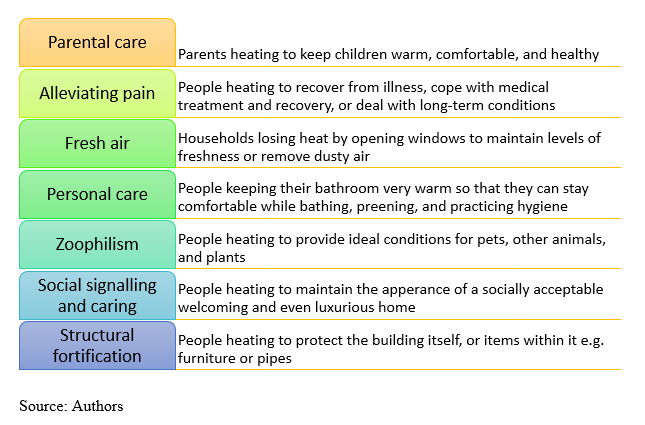 <\/a><\/figure>\n\n\n\n
Fig. 1: The seven phenomenological uses of smart heating controls and diversity of heating practices.<\/p>\n\n\n\n
One of the most prominent themes is heat\u2019s versatile application to provide care and compassion through adjusting a thermostat. Residents used heating to anticipate children\u2019s discomfort, soothe arthritic joints, and relieve symptoms of illnesses or their treatments. This application of care is often extended to non-human household members, with residents recording how they would leave heating on for pets, and even houseplants, when leaving their homes otherwise empty.<\/p>\n\n\n\n
Once the wellbeing and comfort of the inhabitants had been assured, residents often applied heat to the needs of the building that house them. Several households explained how their use of smart heat intended to prevent structural damp and protect pipework from the possibility of freezing.<\/p>\n\n\n\n
\u201cIt\u2019s important to keep the building warm, you know? We haven\u2019t got damp and one of the reasons is presumably because we\u2019ve got the heating on.\u201d<\/em><\/p>\n\n\n\nSocial signalling can also be an element behind heating decisions, projecting comfort and hospitality. What host could pass up the opportunity to bask in the approval of their well-toasted guests, as well as the warmth of their hardworking boiler?<\/p>\n\n\n\n
\u201cI want a home that is warm, comfortable, family friendly, and homely. That\u2019s what heat is for.\u201d<\/em><\/p>\n\n\n\nIdentity, needs, attachment and transition \u2013 what lies behind heating motivations?<\/u><\/strong><\/h2>\n\n\n\nHow can the functional uses of heating, as used by the Living Lab\u2019s residents, be placed within the energy phenomenology of smart heat? The paper puts forward four influences behind the motivations for heating decisions.<\/p>\n\n\n\n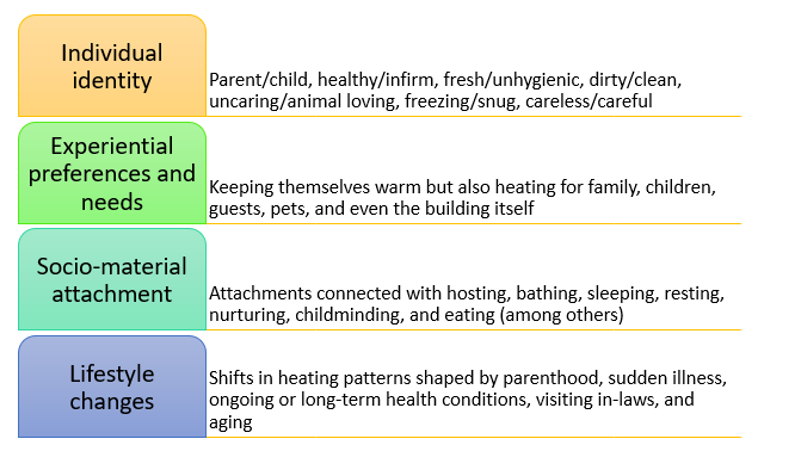 <\/a><\/figure>\n\n\n\n
Fig. 2. Identity, needs, attachment and transition in the energy phenomenology of smart heating controls and practices.<\/p>\n\n\n\n
Individual identity. <\/strong>Heat controls provide an outlet for the roles an individual assumes. Heating practices help to communicate that sense of being a nurturing parent or caregiver, or conscientious homeowner. They can even replicate rituals from childhood, with one resident keen to provide their son with heated pyjamas despite his equally heated opposition.<\/p>\n\n\n\n\u201cI used to like it when I was little, so I have passed it along to him. Sometimes he whines, and says, \u2018It\u2019s too hot, it\u2019s too hot,\u2019 but it\u2019s better than having a cold pair of pyjamas, isn\u2019t it, really?\u201d.<\/em><\/p>\n\n\n\n <\/a>
<\/a>Parental identities are strong influences on heating decisions<\/figcaption><\/figure>\n\n\n\nExperiential preferences and needs. <\/strong>The diary entries reveal how many needs can be met through the calibration of a virtual thermostat. The paper\u2019s most memorable example comes in the unexpected form of a cat\u2019s birthday party, where the host\u2019s pet-loving instincts combine with social signalling and expressions of care for elderly houseguests.<\/p>\n\n\n\n\u201cWhen people come over, we want to make sure the house is warm. Especially if there is something special going on, like it being the cat\u2019s birthday or something crazy like that. We just have a party for anything. Any excuse for a party. So when I am roasting a dinner on a Sunday or something, and then we had an excuse for a cake and stuff, people will come over. And some of our friends are old, or disabled, so we need to keep it always really warm for them.\u201d<\/em><\/p>\n\n\n\nSocio-material attachment. <\/strong>Domestic habits are often shaped by a mix of personal behaviours and ingrained behaviours formed in response to an inhabitant\u2019s surrounding infrastructure. Smart heating proved to be no exception to this. Several residents used smart heating controls to indulge a fond concept of the bathroom as \u201ca special room\u201d for self-confessed extravagance. Some residents use their controls to give it \u201can extra boost\u201d <\/em>before use, with one even leaving theirs perpetually heated. These attachments can be more sustainable (e.g. letting rooms cool before sleeping) or less sustainable (e.g. always keeping the bathroom warm). Either way, but they are a considerable factor in heating usage.<\/p>\n\n\n\nLifestyle changes. <\/strong>Heating needs and experiences shift over time and as lifestyles change. Hallmarks of adult life, such as hosting guests and raising children, can give way to managing long-term illnesses and increasing sensitivity to temperatures with age. These shifts demonstrate the changing nature of heat and offer promising opportunities for predicting and improving heat management.<\/p>\n\n\n\nHumanising heat research and policy<\/u><\/strong><\/h2>\n\n\n\nWhat does energy phenomenology\u2019s perspective of these themes and motivations mean for how we understand heating use? This research highlights that \u201cfor occupants, heating preferences must be discovered through a process of learning, engagement and living, rather than existing as something innate or predetermined, or known in advance\u201d. Heating users may not recognise their own heating preferences and expectations without the degree of immersive involvement facilitated by initiatives like the Living Lab.<\/p>\n\n\n\n
This means stated<\/em> preferences, as often derived from surveys and similar research tools, acquire only an insufficient understanding of the topic. Instead, revealed<\/em> preferences can allow policymakers and planners to account for the diversity, irrationality and unpredictability of heating practices shown in the study.<\/p>\n\n\n\nThe paper contrasts the arguably more successful efforts to decarbonise transport, with policy approaches to decarbonise heating. Policy developments in heat have encouraged increased efficiency and encouraged the adoption of low carbon heating systems. However, with this and other studies clearly illustrating the value of heat for a multitude of other purposes, the industry could learn from carmakers\u2019 talent for meeting consumer needs along a range of price points. Luxury home comfort items meeting similar needs, like electric powered \u201cfire\u201dplaces, have become increasingly popular. These products point to an untapped potential to capture some of the glamour and momentum of carmakers like Tesla, the principles behind their success selling a vision of \u201cluxurious forms of electric mobility\u201d applied to the mundane world of boilers and radiators.<\/p>\n\n\n\n
Whether it\u2019s warming pyjamas, impressing guests, comforting the elderly or bathing in extravagantly humid bathrooms, heat and its human (and often humane) application reflect the diversity of human experience and identity. Researchers, policymakers, planners and even smart heat technologists can benefit from greater insights into how these easily overlooked factors work for and against decarbonisation objectives.<\/p>\nFollow Sussex Energy Group  <\/a>
<\/a> <\/a>
<\/a> <\/a><\/span>","protected":false},"excerpt":{"rendered":"
Home heating is essential through any blustery British winter, especially as Covid-19 restrictions confine us to our own living spaces and deepen our appreciation of home comforts. Accounting for 37% of the UK\u2019s greenhouse gas emissions, the heating sector also…<\/span><\/p>\n
Energy biographies<\/strong> interrogate how energy use expresses shared practices and attaches meaning to everyday behaviours which can often be taken for granted.<\/p>\n\n\n\n The paper combines both approaches to form “the energy phenomenology framework”.<\/p>\n\n\n\n Identity shapes heating use. Seeing yourself as an environmentalist or consumerist, a parent or a child, wealthy or poor, will influence energy consumption. These identities and their associated values and priorities with domestic niceties like a warm home, a clean bathroom, a comfortable living room, or a convenient way of doing a chore will shape consumption. “Historically shared practices, routines, habits, and norms can fuse together with infrastructure such as appliances, gas boilers, or buildings to lead to socio-material attachment. Heat practices are also dynamic and temporally complex, altering and changing across life events and stages, a process we term lifestyle changes.\u201d<\/p>\n\n\n\n Researchers applied the energy phenomenology framework to experiential data gathered through the Energy Systems Catapult\u2019s Living Lab<\/a>, which provided 100 homes across Birmingham, Bridgend, Manchester and Newcastle with smart heating and digitally operable zonal heating controls.<\/p>\n\n\n\n Data collected through interviews and diaries produced hundreds of pages of qualitative data, within which researchers identified seven distinct themes recurring in participants\u2019 energy usage.<\/p>\n\n\n\n Fig. 1: The seven phenomenological uses of smart heating controls and diversity of heating practices.<\/p>\n\n\n\n One of the most prominent themes is heat\u2019s versatile application to provide care and compassion through adjusting a thermostat. Residents used heating to anticipate children\u2019s discomfort, soothe arthritic joints, and relieve symptoms of illnesses or their treatments. This application of care is often extended to non-human household members, with residents recording how they would leave heating on for pets, and even houseplants, when leaving their homes otherwise empty.<\/p>\n\n\n\n Once the wellbeing and comfort of the inhabitants had been assured, residents often applied heat to the needs of the building that house them. Several households explained how their use of smart heat intended to prevent structural damp and protect pipework from the possibility of freezing.<\/p>\n\n\n\n \u201cIt\u2019s important to keep the building warm, you know? We haven\u2019t got damp and one of the reasons is presumably because we\u2019ve got the heating on.\u201d<\/em><\/p>\n\n\n\n Social signalling can also be an element behind heating decisions, projecting comfort and hospitality. What host could pass up the opportunity to bask in the approval of their well-toasted guests, as well as the warmth of their hardworking boiler?<\/p>\n\n\n\n \u201cI want a home that is warm, comfortable, family friendly, and homely. That\u2019s what heat is for.\u201d<\/em><\/p>\n\n\n\n How can the functional uses of heating, as used by the Living Lab\u2019s residents, be placed within the energy phenomenology of smart heat? The paper puts forward four influences behind the motivations for heating decisions.<\/p>\n\n\n\n Fig. 2. Identity, needs, attachment and transition in the energy phenomenology of smart heating controls and practices.<\/p>\n\n\n\n Individual identity. <\/strong>Heat controls provide an outlet for the roles an individual assumes. Heating practices help to communicate that sense of being a nurturing parent or caregiver, or conscientious homeowner. They can even replicate rituals from childhood, with one resident keen to provide their son with heated pyjamas despite his equally heated opposition.<\/p>\n\n\n\n \u201cI used to like it when I was little, so I have passed it along to him. Sometimes he whines, and says, \u2018It\u2019s too hot, it\u2019s too hot,\u2019 but it\u2019s better than having a cold pair of pyjamas, isn\u2019t it, really?\u201d.<\/em><\/p>\n\n\n\n Experiential preferences and needs. <\/strong>The diary entries reveal how many needs can be met through the calibration of a virtual thermostat. The paper\u2019s most memorable example comes in the unexpected form of a cat\u2019s birthday party, where the host\u2019s pet-loving instincts combine with social signalling and expressions of care for elderly houseguests.<\/p>\n\n\n\n \u201cWhen people come over, we want to make sure the house is warm. Especially if there is something special going on, like it being the cat\u2019s birthday or something crazy like that. We just have a party for anything. Any excuse for a party. So when I am roasting a dinner on a Sunday or something, and then we had an excuse for a cake and stuff, people will come over. And some of our friends are old, or disabled, so we need to keep it always really warm for them.\u201d<\/em><\/p>\n\n\n\n Socio-material attachment. <\/strong>Domestic habits are often shaped by a mix of personal behaviours and ingrained behaviours formed in response to an inhabitant\u2019s surrounding infrastructure. Smart heating proved to be no exception to this. Several residents used smart heating controls to indulge a fond concept of the bathroom as \u201ca special room\u201d for self-confessed extravagance. Some residents use their controls to give it \u201can extra boost\u201d <\/em>before use, with one even leaving theirs perpetually heated. These attachments can be more sustainable (e.g. letting rooms cool before sleeping) or less sustainable (e.g. always keeping the bathroom warm). Either way, but they are a considerable factor in heating usage.<\/p>\n\n\n\n Lifestyle changes. <\/strong>Heating needs and experiences shift over time and as lifestyles change. Hallmarks of adult life, such as hosting guests and raising children, can give way to managing long-term illnesses and increasing sensitivity to temperatures with age. These shifts demonstrate the changing nature of heat and offer promising opportunities for predicting and improving heat management.<\/p>\n\n\n\n What does energy phenomenology\u2019s perspective of these themes and motivations mean for how we understand heating use? This research highlights that \u201cfor occupants, heating preferences must be discovered through a process of learning, engagement and living, rather than existing as something innate or predetermined, or known in advance\u201d. Heating users may not recognise their own heating preferences and expectations without the degree of immersive involvement facilitated by initiatives like the Living Lab.<\/p>\n\n\n\n This means stated<\/em> preferences, as often derived from surveys and similar research tools, acquire only an insufficient understanding of the topic. Instead, revealed<\/em> preferences can allow policymakers and planners to account for the diversity, irrationality and unpredictability of heating practices shown in the study.<\/p>\n\n\n\n The paper contrasts the arguably more successful efforts to decarbonise transport, with policy approaches to decarbonise heating. Policy developments in heat have encouraged increased efficiency and encouraged the adoption of low carbon heating systems. However, with this and other studies clearly illustrating the value of heat for a multitude of other purposes, the industry could learn from carmakers\u2019 talent for meeting consumer needs along a range of price points. Luxury home comfort items meeting similar needs, like electric powered \u201cfire\u201dplaces, have become increasingly popular. These products point to an untapped potential to capture some of the glamour and momentum of carmakers like Tesla, the principles behind their success selling a vision of \u201cluxurious forms of electric mobility\u201d applied to the mundane world of boilers and radiators.<\/p>\n\n\n\n Whether it\u2019s warming pyjamas, impressing guests, comforting the elderly or bathing in extravagantly humid bathrooms, heat and its human (and often humane) application reflect the diversity of human experience and identity. Researchers, policymakers, planners and even smart heat technologists can benefit from greater insights into how these easily overlooked factors work for and against decarbonisation objectives.<\/p>\nFollow Sussex Energy Group Home heating is essential through any blustery British winter, especially as Covid-19 restrictions confine us to our own living spaces and deepen our appreciation of home comforts. Accounting for 37% of the UK\u2019s greenhouse gas emissions, the heating sector also…<\/span><\/p>\nParenting, preening, pets and pipes: what motivates heating decisions?<\/u><\/strong><\/h2>\n\n\n\n
<\/a><\/figure>\n\n\n\nIdentity, needs, attachment and transition \u2013 what lies behind heating motivations?<\/u><\/strong><\/h2>\n\n\n\n
<\/a><\/figure>\n\n\n\n<\/a>Humanising heat research and policy<\/u><\/strong><\/h2>\n\n\n\n
<\/a><\/a><\/a><\/span>","protected":false},"excerpt":{"rendered":"