

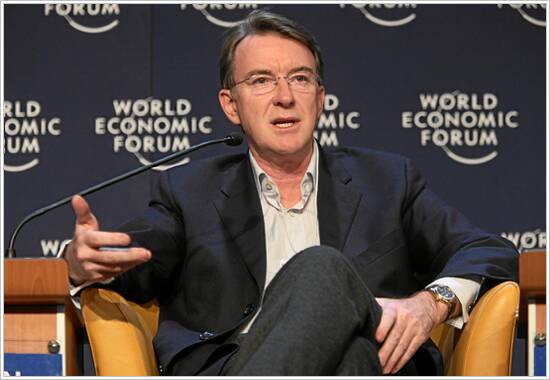
Professor Robert Barrington of the Centre for the Study of Corruption (CSC) applies the lens of corruption analysis to the Peter Mandelson case, to explore whether we can apply the term in this case and why that might be useful.
Is Peter Mandelson corrupt (assuming the allegations against him are true)? Long story short: yes. Here’s why.
There are three broad sets of allegations:
- that he leaked sensitive government information to Jeffrey Epstein and received some kind of benefit in return
- that the relationship with the Epstein network and the casual leaking of government information illustrates the existence of a self-serving chumocracy
- that as a part of the Epstein network, he is very likely to have had some insight into the sexual exploitation of minors that was going coordinated by Epstein and Ghislaine Maxwell, and often taking place at Epstein’s properties.
We can analyse Mandelson’s actions using the recently published definition by our team at the Centre for the Study of Corruption: ‘The abuse of entrusted power for private gain which harms the public interest, typically breaching laws, regulations and/or integrity standards.’ This gives us a four-step test for establishing whether corruption has occurred.
The Epstein case is difficult and sensitive territory. Applying the lens of corruption analysis will focus us on aspects of the case other than the sexual predation, but that should in no way diminish the sense of shame and responsibility that must be felt towards the victims. Looking through the corruption lens, hobnobbing with known sex offenders, or the enjoyment of a luxury lifestyle provided by them, is more akin to the old-fashioned usage of being morally corrupt, a term which might be generally applied to all those who were both part of the Epstein network and had any inkling of what was going on.
Abuse of entrusted power
Let’s apply the CSC four-step definition above specifically to the allegation that Mandelson leaked state secrets to Epstein and received some kind of benefit. Most obviously, as a government minister, he was in a position of entrusted power. The leak of sensitive government documents is an abuse – magnified here because the leak was to someone entirely outside government, a national of and located in another country, and in a good position to make a significant personal gain from those documents as they contained market sensitive information.
Harm to the public interest
Likewise, we can make a default assumption that there is likely to be harm to the public interest through the leaking of government documents. This does not mean a specific harm caused by any individual document, but a generalised harm caused by a breach of the ministerial code and the Nolan principles. I think we must always assume – unless proven otherwise – that a minister leaking sensitive government documents to a third-party who benefits from them is not in the public interest, hence the outcry from former officials, former ministers and the former Prime Minister under whom Mandelson served. The launch of an investigation by the Metropolitan Police may also establish there was criminality, but that is not a pre-requisite in terms of corruption: even if Mandelson does not face criminal charges, he may still have acted corruptly.
Private gain
But what about the private gain? We can see that Epstein was in a position to gain – but he was not abusing his trusted power. He was simply the beneficiary of an influential and well-connected friend passing him information. The key question is whether there was gain by Mandelson, the person with entrusted power.
It seems so, in two ways. First, both he and his husband seem to have gained financially and materially from the Epstein relationship in diverse forms over the years. It is worthwhile noting that often in bribery schemes, the quid pro quo can come years before or years after the public official acting improperly. That pattern has been well established in legal cases. Secondly, there are the lifestyle and commercial gains to Peter Mandelson from the hobnobbing and the highlife. In one of his emails to Epstein he says that he cannot live on his salary alone, and it is clear that he was intending to benefit from Epstein’s network and connections in building his own consultancy business and enjoying a lifestyle of travel, trips and good living.
So, by applying the CSC definition’s four-step test, we can clearly say that if these allegations and documents prove to be valid, Mandelson must be considered corrupt. He might also be considered to have committed misconduct in public office and, to use another old-fashioned term, to be a traitor.
Can we say more?
But there is a further way of looking at this. Does this tell us anything about the establishment and cronyism, sometimes described as chumocracy, which are often cited as a British form of corruption?
The Epstein documents give us an unusual insight into how such power and influence networks operate. We can see that businesses and financiers are keen to use their relationships with politicians to influence decisions which favour them financially – and that politicians will sometimes oblige, and seem to be in a subordinate relationship. We can also see there is a globalised elite, which lives in a bubble in which they seem to find it hard to distinguish between right and wrong, at times apparently believing that their own personal and business interests are somehow in the public interest. They have a sense of entitlement and impunity. They use aggressive lawyers to shut people up. It is also evident that you do not have to lay out a lot of money to co-opt – or bribe – a British minister, if you can find one who is easily tempted.
I do not think the documents tell us that everyone is at it. The incentives are certainly there for many businesses, and the ultra-high net worth elite, to build these networks and exploit these connections. But are all politicians on the make like Mandelson? There have been enough similar instances – multiple examples under the Johnson government, the David Cameron relationship with Lex Greensill, even Keir Starmer and wardrobe-gate – for this to be an obvious conclusion. As an aside, we should remember that this kind of relationship building with a hope of future payback is what may be happening every time a large political donation is made.
But many politicians would say that is unfair. They are in a constant courtship with those who wish to influence them, their parties are constantly on the lookout for donations to keep the apparatus afloat, and any politician who has ambitions for promotion or leadership will want their own pack of wealthy supporters. If we give the bulk of politicians the benefit of the doubt for not being like Mandelson, we must at least note that we put a lot of trust in the integrity of the individual politicians to manage this system, and in the systems that are meant to control bad behaviour like the Ministerial Code, but which were all too easily by-passed by the Johnson government.
Is it an example of chumocracy?
Does the Mandelson-Epstein relationship therefore exemplify the chumocracy in operation? It seems to share some characteristics with the oft-cited allegation that a self-serving British establishment represents a form of structural corruption in our political economy. But there are also some differences. What we see with Epstein and Mandelson is representatives of a global elite more than a national elite. It is made possible by extreme wealth, which in turn has sometimes been made possible by fixing the rules of market regulation and taxation in their own favour.
There may have been some corrupt acts in there as well, but to look for those may rather be missing the bigger picture – we might even describe Epstein’s entire network as a corrupting force. It resembles an organised crime group: in the exchanges of favours between big players, sometimes with no immediate reward in sight but with the comfort of being in the network; the interplay between the legitimate economy and wealth acquired through darker means (in this case that we now know about, likely insider trading); the deliberate bringing together of money and politics; and the underlying criminality which members of the network tolerate because there is a veneer of civilised behaviour behind which they can shelter.
Mandelson’s embarrassingly craven efforts to be part of this Epstein network also bring to mind an earlier scandal in his career, when he enjoyed hospitality on the superyacht of a now-sanctioned Russian oligarch, and was then responsible for tariff changes that were favourable to the aluminium business of his oligarch chum. Those of us who have long campaigned for stronger laws against kleptocracy and money laundering are naturally left wondering how far such networks have contributed behind the scenes to the British government’s inertia on issues like progressing measures for beneficial ownership transparency in the British Virgin Islands.
My own conclusion is that the Mandelson case does not quite demonstrate the structural corruption of the British establishment, but it does make the case for a thorough overhaul of the UK’s approach to political corruption – as promised by Starmer in opposition, but not to date delivered.
Why does it matter?
Finally, we might ask why it is important to label Peter Mandelson as corrupt, when he is already disgraced and subject to a criminal investigation. I think there are three good reasons:
- he may never be successfully prosecuted, but he should be shamed and disgraced – applying the label of corruption can contribute to this;
- if he is acknowledged as being corrupt, there should be no possibility of a future return to any public office or any public honour;
- more or less everyone accepts corruption is a bad thing, and demonstrating that corruption has been in operation at the heart of our politics should reinforce the case for tightening up our defences against political corruption.
The fallout from this sorry saga is likely to be both damaging and depressing. It may prove difficult to hold Mandelson accountable for his disgraceful behaviour, certainly in a court of law. But even worse, more people will become disillusioned with politics and the probity of politicians. Surely, they will think, there must be something better on offer than a tainted democracy which fails to deliver on people’s everyday needs and priorities, while the politicians at the top are corrupt. For an example of where that leads voters, we need look no further than Epstein’s home country, the United States.
Acknowledgement: my colleagues and MA students at the Centre for the Study of Corruption have debated this case extensively over the past few days, which has been enormously helpful in refining the reflections and insights in this blog.
Leave a Reply