A peek into Bristol’s vibrant community energy scene

Last week I visited Bristol to attend the event ‘Our energy future: the road not (yet) taken’. This was part of the city’s annual Big Green Week, an ‘international festival of better living and great ideas’, which incidentally, is now two weeks long. The people I met convinced me that the city has much to offer when it comes to innovative approaches to the challenges faced by those searching for fairer and more sustainable energy futures. Energy poverty, community engagement, and sustainability were high on the agenda.

The event aimed to air different stakeholder positions on Bristol’s potential energy future and began with short intros from six panelists before an hour of audience-led Q&A debate. Hosted and chaired by Jake Barnes of Bristol Energy Network (my colleague at SPRU), the event featured a diverse and interesting panel, with representatives from the Bristol City Council, community energy groups, the Centre for Sustainable Energy and Good Energy and Ovo Energy. The composition of the panel demonstrates the diversity of actors that have a stake in the future energy sector.

Pinning down a debate like this is always a challenging task, so I wanted to share some of my insights from this discussion in this post. Read more ›

Follow Sussex Energy Group Facebooktwitterlinkedin
Tagged with: , , , , , , , , , ,
Posted in All Posts, Community Energy, Housing

The end of onshore wind subsidies: what now for ‘secure, affordable and low-carbon’ electricity?

On Thursday, the government announced that it would be ending subsidies for onshore wind under the Renewables Obligation a year earlier than planned, in April 2016. There are also plans to give local communities a veto over new wind farms, in line with Conservative manifesto commitments. By removing support for one of the UK’s most cost-effective low-carbon generating technologies, this decision could make it far more difficult to achieve DECC’s stated aim of a ‘secure, affordable and low-carbon energy system’, and illustrates DECC’s complete lack of decision-making power. The announcement was met with consternation from some quarters, and confusion from others. The Scottish government said that the plans are “irrational” and “deeply regrettable”, whilst industry body Scottish Renewables said the move would put many of the 5,400 jobs in Scotland’s onshore wind sector at risk, according to the Financial Times.

Carbon Brief, meanwhile, notes that there is considerable uncertainty around the interaction between the new Contracts for Difference (which were designed to replace the Renewables Obligation) and the Conservative manifesto commitment to end subsidies for onshore wind. Amber Rudd stated that “with regard to CfDs, we have the tools available to implement our manifesto commitments on onshore wind and I will set out how I will do so when announcing plans in relation to further CfD allocations”. Such vague statements can surely do little to appease the rampant uncertainty which is currently flying around amongst investors.

Read more ›

Follow Sussex Energy Group Facebooktwitterlinkedin
Tagged with: , , , , , , , , , ,
Posted in All Posts, policy, Wind energy

Dr Jan Rosenow joins the Centre on Innovation and Energy Demand

Jan Rosenow

I am very excited to be joining CIED and be able to work with some of the most established academics in the field of energy efficiency. To CIED I bring an interest in the politics of energy efficiency, an area which remains under-researched. Most of the work on energy efficiency focuses on economics, technology, and policy design. In my research, I try to understand what drives policy evolution using case studies including energy efficiency obligations, on-bill finance and soft loans. I also have an interest in fuel poverty policy and the equity implications of energy policy in general. In the past, I mainly worked on environmental and energy economics, largely in the area of external costs of energy.

Read more ›

Follow Sussex Energy Group Facebooktwitterlinkedin
Tagged with: , , , , , ,
Posted in All Posts, News

Highlights of the 2015 ECEEE Summer Study conference

The ECEEE Summer Study is the ‘work hard / play hard’  conference of the energy research world. Set in the beautiful Giens Peninsula on the south coast of France, intense sessions, plenaries and informal meetings co-existed with swimming in the Mediterranean, petanque tournaments and long, delicious lunches and dinners, where local wine (efficiently) fuelled more discussions and networking.

A few of my highlights from this year’s presentations:

  • Sarah Royston had the best use of Prezi I’ve ever seen, contrasting active consumers with dolls in a doll house. She told us about nonstandard energy efficiency practices in the home, some of which might be long-standing traditional heating or insulation measures, and some which are new home-made innovations.
  • Tim Chatterton looked at possible correlations between household electricity, gas and car usage. He suggested that if we recognise the importance of ‘fuel poverty’, we might want to think about the opposite cluster, those with behaviour we might call ‘energy decadence’.
  • Jillian Anable introduced us to ‘flexi-mobility’, challenging the received wisdom that travel patterns are entirely stable and habit driven. Instead, she showed that many of us have at least occasional variations of modes of travel, even in our regular commuting. Those who rely solely on cars are the least flexible, and might be worst off in times of disruption.
  • Anja Bierwirth compared sufficiency with efficiency. Her talk led to an excellent discussion which touched on cultural variations and how culture changes over time; questioned generational effects (Are younger people less interested in owning cars and houses? Is that only true in the developed world?); and considered ethical perspectives (Is sufficiency only for the wealthy? Is that a problem?).
  • Philipp Grünewald’s witty presentation questioned the complex relationship between GDP and electricity use. His work will see smart phones and diaries record thousands of people’s one-day activities, giving us higher resolution information to help explain daily electricity loads. He asked the audience for ideas about how best to use such data… and whether it would be ethical to send the user a message ‘Take a break‘.

Read more ›

Follow Sussex Energy Group Facebooktwitterlinkedin
Tagged with: , , , , , , ,
Posted in All Posts, CIED, ECEEE series

Reflections, rebound, a week in France

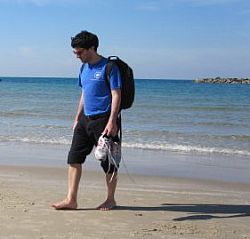
A picture of Lee's feet, in the sunshine on a beach

The European Council for an Energy Efficient Economy (ECEEE) convenes an international conference every two years. This, spanning the 1st-6th June 2015, was my first experience of this biennial event located on a dazzling peninsula in the South of France – at Belambra Les Criques. The scenery there is stunning and the weather was glorious too  – I wore shorts everyday (mostly the same pair because I spilt coffee on the only other pair I had, shortly after putting them on).

A picture of Lee's feet, in the sunshine on a beachThis got me to thinking, what stays the same at these conferences and what changes? I imagine that you could or would have heard a lot of the same rhetoric two or (many) more years ago at an earlier incarnation of this particular conference or a similarly themed alternative. The fact that there are fundamental problems with assumptions underlying neoclassical economics, the need for long-term thinking and multi- and inter-disciplinary approaches to policy relevant research questions are just a few examples. In terms of the latter, can we even agree on what the appropriate unit of analysis is for studying energy and climate issues? Objects? Subjects? Practices? All three, or something else?

But things change too. Buzzwords, concepts, theories and methods often change and evolve. Governments and policies come and go. The urgency of mitigating greenhouse gas emissions becomes more and more critical as another year passes.  Where will we hold these conferences if and when these splendid coastal locations are inundated by sea level rise?

I attended this conference to talk about work I’ve carried out with Steve Sorrell (my boss at Sussex) and Tim Schwanen (at Oxford) into the direct rebound effect associated with personal car travel in Great Britain.  In practise this means that as the technical efficiency of cars has improved over time, effectively reducing their running costs (assuming the absence of taxation), how much further do people travel in their cars because they’re cheaper to run?

What’s ‘the same’ about this work is our over-arching conclusion: we estimate the direct rebound effect to be in the region of 20% which accords well with previous studies particularly in a U.S. context. Put differently if fuel prices (per unit of energy used to run your car) or fuel costs (per kilometre driven in your car) decrease by 100%, this stimulates the average person to drive 20% further.

What’s ‘different’ about this work is our investigation into the relationship between model quality (measured in terms of how many so-called diagnostic tests a model passes) and the size of the rebound effect. This hasn’t been investigated before in any context and we found no relationship between model quality and the size of the rebound effect. It could be argued that this bodes well for the existing literature on this subject where the tendency has been to partially or wholly neglect model quality issues. An early-bird view of this work is available here and our full study is currently under revision for the journal Energy Economics.

This conference will be held again in the summer of 2017 most likely in the same or a similarly stunning location.


Lee StapletonDr Lee Stapleton is a research Fellow in SPRU (Science Policy Research Unit) and the Tyndall Centre for Climate Change Research.  Working principally in the  Centre on Innovation and Energy Demand (CIED) within the Sussex Energy Group, his research focuses on the application of time-series (static, dynamic and co-integrating) regression models to estimate so-called ‘rebound effects’ in the transport sector.

Follow Sussex Energy Group Facebooktwitterlinkedin
Tagged with: , , , , , ,
Posted in All Posts, CIED, ECEEE series

Follow Sussex Energy Group on Twitter

Disclaimer

The views and opinions expressed here are solely those of the individual authors and do not represent Sussex Energy Group.

Subscribe to Blog via Email

Enter your email address to subscribe to this blog and receive notifications of new posts by email.

Join 113 other subscribers.

Archives

Subscribe to Sussex Energy Group's quarterly newsletter