By Mari Martiskainen and Sarah Schepers, Centre on Innovation and Energy Demand, November 2015
Fuel poverty – an issue affecting 2.35 million people in England alone, one that has wide-reaching causes and implications not only for those directly affected, but also for the wider society and economy. Annually, It costs the NHS approximately £1.36m as a major contributing factor in several thousand deaths from the cold weather and thousands more hospital treatments for related illnesses. With no long term policy support, it is fast becoming a major public policy issue. Read more ›
As we approach winter, many of us start turning the heating back on, but there are thousands of people across the UK who dread the onset of colder weather as they are forced into the fuel poverty trap. It is a phenomenon that kills, and worse, something we have become accustomed to. Another year, another set of headlines that should shock us into action, but rarely do.
In 2013, an estimated 2.35m households lived in fuel poverty in England. Furthermore, there are an estimated 26,000 deaths each year which can be linked to the cold weather during the winter months, and at least partly explained by fuel poverty.
Fuel poverty statistics for England (2003-2013) DECC, 2015. Annual Fuel Poverty Statistics Report.
Fuel poverty is a persistent problem, but what exactly is it? There is no one global definition of fuel poverty, but many countries use the initial UK definition. In brief, you are in fuel poverty if you need to spend more than 10% of your income on heating and electricity in order to have the required energy services to cook, have lighting, keep warm, have a hot shower and so on. This definition has been updated since, but the old version is still widely used across EU countries. It also means that it is possible to be fuel poor even though you may not be otherwise living below the poverty line.
It is estimated that anywhere between 50m-125m people live in fuel poverty in the EU, and that figure is expected to rise in the coming years. Whichever end of that range you choose to believe, then this is a significant number considering that there are around 500m people living in the EU. While the issue of fuel poverty has been recognised in many countries, awareness is still lacking.
Cause and effect
There are usually three causes linked to fuel poverty: the poor energy efficiency of housing stock; high energy bills; and low incomes. As a combination, these three factors often mean that people vulnerable to fuel poverty have to make hard decisions over which room of the house to heat and whether to wash clothes by hand or not wash them at all. Furthermore, being fuel poor also means that you are more likely to suffer from poor health, especially respiratory diseases like asthma, as well as anxiety and depression. The Fuel Poverty Advisory Group estimated in February that the impact of cold homes cost the NHS some £1.36 billion every year.
There have been numerous programmes in the UK, which have been aimed at fuel poverty, including the Winter Fuel Payments. However, it seems that official action on fuel poverty has not been able to get to the root of the problem – especially given that the government’s commitment to deliver energy efficiency measures has reduced considerably in the last two years.
Being fuel poor often has a stigma attached to it and it is not always easy for authorities to immediately recognise those who may be in need of help. The persistence of the problem has prompted others to dive in. These have included health workers, who can see a benefit in helping those who live with fuel poverty and have respiratory or other health complaints. It is a simple equation as lifting people out of fuel poverty usually also improves their health, which then reduces their need for hospital visits. You also get interventions from civil society; community groups which address sustainable energy often have both the means and the motivation to offer help.
Those community-run initiatives can include “energy cafés” like the events run by South East London Community Energy. Around ten energy cafes have been set up across the UK by different groups, to provide information and advice for those vulnerable to fuel poverty. They often involve getting volunteers into a high street location for a limited amount of time, from where they can hand out advice about energy issues to the public. This might focus on energy market engagement – like how to switch energy providers, on energy efficiency or behaviour change. These community-led cafés are pretty well placed to reach those at risk of fuel poverty; it can be as simple as an informal discussion over a cup of tea.
Stepping in
However, the immediate question this raises is clear. When ad hoc initiatives start to address national concerns, then it is time to ask whose responsibility is it really to tackle fuel poverty, and who should pay for it? Should it be community groups, health authorities or the government?
Community groups are well placed to access people in a subtler manner than government agencies or energy companies might be able to. However, many rely on volunteer time and grant money – both often intermittent and limited.
While fuel poverty has been tackled from many angles, the problem ultimately cannot be solved without dedicated, long-term, government action to address the quality of the housing stock, not only in terms of improved energy efficiency but also in terms of improved quality of life. It is vital that we as a society address fuel poverty as part of a wider ethics issue, and ask the government can it really afford to lose another 26,000 people to fuel poverty this winter?
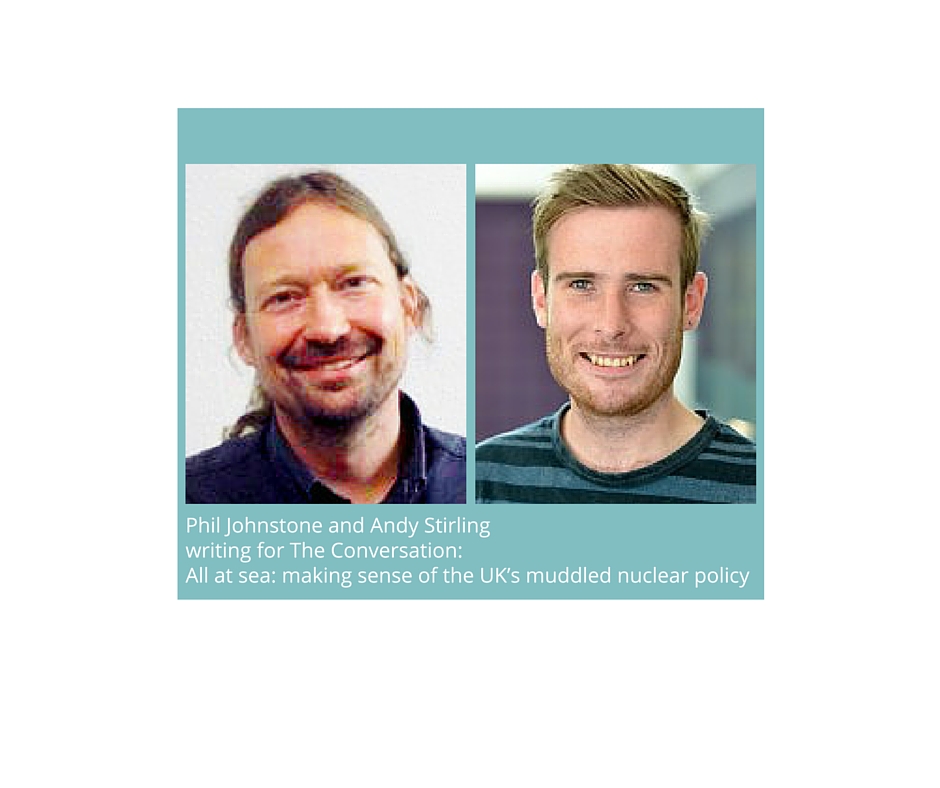
The chancellor of the exchequer, George Osborne, has recently been waving huge wads of cash at different (but similarly delinquent) parts of UK nuclear policy. In August, he sailed triumphantly up the Clyde to the Trident-hosting Faslane Naval base to announce £500m of investment. This was a move many considered to be jumping the gun, or even “arrogant” given that no final decision has been made on its renewal.
It has got to the point with Hinkley C where one must wonder how Osborne, the secretary of state for Energy and Climate Change, Amber Rudd and the chief executive of EDF, Vincent de Rivaz, manage to keep straight faces while repeating what a good deal the project will be for everybody. The French state-owned energy firm EDF is due to partner with the Chinese under the deal announced by Osborne in Beijing, and Rivaz’s boss, Jean-Bernard Levy, has admitted that the Chinese state is the only investor that can be persuaded that the project is viable.
Never plausible to anyone recalling past episodes of nuclear enthusiasm, the latest bout of zeal for a “nuclear renaissance” has now lost all credibility. With global investments in renewable electricity two years ago overtaking those in all fossil fuel generation put together, the direction of change is clear. Numerousinternational assessments show renewables are already price-competitive even with optimistic costings for new nuclear.
So it is an understatement to say it is odd that DECC is cutting support for onshore wind, solar power and ending support for home energy efficiency – while unswervingly staying committed to extortionate new nuclear power. Former minister for energy, Ed Davey, puts it bluntly:
For Davey, the only explanation can be one of partisan commitment by Osborne – because “he just wanted a nuclear power plant”. It is sure that Osborne is no environmentalist. With so much nuclear work contracted abroad and UK employment allowed to haemorrhage in other sectors – for instance in steel and solar power – it doesn’t seem Osborne is motivated by jobs.
Attracting Chinese infrastructure investment may play a role, but the realities make it clear there are many more economically promising alternatives than nuclear. And encouraging Chinese involvement in a technology with such grave national security implications further compounds the oddity. George Osborne’s nuclear obsession really does require some kind of explanation.
‘Deep state’
As we have explored elsewhere, perhaps the best clue lies in Osborne’s trip up the Clyde to Faslane; maybe the real commitment here is to maintaining Britain’s nuclear arsenal. Amid the clamour of the recent China visit, it was also announced that a big slice of Hinkley contracts would go to Rolls Royce – the makers of Britain’s nuclear submarine reactors.
The calculation seems to be, that trickle-down from foreign power reactor manufacturers may be just enough to sustain a national industrial capability sufficient to continue the nuclear-armed status that current debates remind is so emotively cherished both by Tories and at the top of Labour. There are tantalising signs that this lay behind the strange reversal in nuclear white papers mentioned above. If this is not at the bottom of Osborne’s mind, it is difficult to know what is.
If so, the implications for the health of UK politics are extremely serious. The Jeremy Corbyn-led Labour Party is raising these issues anew. All sides are limbering up for the coming argument over Trident. But if the above analysis is true, then massive financial pre-commitments are being made (and some already firmly in place) on an unprecedented scale, that risk effectively locking in a decision before the process of making it has ostensibly begun.
With mainstream press reports of senior British Army figures mooting mutiny under a Corbyn government, this carries more than a whiff of something akin to an unaccountable British “deep state”. For anyone who cares about democracy – whatever their views on nuclear power or nuclear weapons – now is the moment to ask some searching questions about what nuclear policy is doing to British politics. And there seems no-one better to ask than Osborne.
Despite ongoing and major delays in financing Hinkley Point C, which would be the first new nuclear power station in the UK for over 25 years, enthusiasm for new nuclear power remains high in several quarters. This includes the Energy Technologies Institute (ETI), a public-private partnership between the UK Government and energy and engineering companies. It has just produced an ‘insights’ report on the future UK role of nuclear power.[1]
Although the report is about all potential future nuclear technologies, it gives little attention to the large scale reactors that are the only currently feasible technology choice for nuclear. But in considering such reactors, it now believes that in its ‘optimistic’ scenario for the future (‘Clockwork’) the possible feasible total capacity by 2050 of large reactors is 35 GWe, down from a previous maximum of 40 GWe. Given that the UK Government gave the green light for nuclear power back in 2008 and the earliest we are now likely to get any power from new reactors is around 2025, this would still be going some.
What the report is really interested in exploring is the potential for Small Modular Reactors (SMRs), which ETI sees as potentially complementary to large reactors.[2] SMRs are reactors of below 300 MWe, (some 4 or more times smaller than current designs), none of which yet exists, though there are many possibilities. ETI argues that 21 GWe of these SMRs might be in place by 2050, an apparently modest total compared to the 63 GWe of ‘theoretical capacity’ of SMRs for the same year. All this is in the context of the ETI’s optimistic, high-growth scenario – its more pessimistic scenario (‘Patchwork’) is not considered, so we are in an exclusively nuclear–positive world. In this scenario, ETI seems to suggest that SMRs are a good prospect.
However there are at least two serious problems – according to ETI’s own account – that could prove destructive to the SMR ambition.
The first is that ETI only expects that SMRs might be economically viable if there were a pre-existing district heating network at city-scale. SMRs could feed otherwise wasted heat from the nuclear reaction into this network – in addition to feeding electricity into the grid. But this network would already have to exist and have been paid for. The costs of adding this network to the costs of SMRs is, implicitly but clearly, enough to render SMRs economically unviable. There is no obvious reason to expect these multiple heating networks to be so conveniently available as a ‘free good’ to SMRs on so large a scale, if at all.
Second there is the economic appraisal itself. Given that the construction costs of SMRs are yet entirely unknown, but will be dominant in overall costs, ETI is in a difficult position in trying to make a stab at what these costs might be. Its report says that its estimates are ‘independent of any specific vendor estimates’ and ‘are not derived from the traditional bottom up application of established power plant cost breakdown structures’. Unfortunately ETI does not say exactly how its cost estimates are derived, nor show any intermediate steps in this process. Given that there cannot be any commercial confidentiality issues involved because of the ‘independence’ of the estimates. This omission is unfortunate, especially in the light of chronic historic optimism in previous nuclear cost estimates, even when designs are well established.
There are three further issues with the ETI report. The first is the assertion, muted but clear, that a major objective is for the UK to acquire full IPRs in any SMRs that might be deployed. While development of indigenous technology capabilities is generally desirable, the UK has no serious capabilities in SMRs at present. The acquisition of intellectual property rights (IPRs) would be a long and costly process and ETI do not clarify how this might be done. It would also seriously extend timescales and highlights tensions between climate change-derived urgency and other worthwhile objectives. Given that the UK has no ambitions to acquire IPRs for the three reactor types currently being pursued, it is not at all clear why this becomes so important for SMRs if low carbon is the dominant objective.
Second there is the almost total neglect of the need for public engagement and consent for SMRs, especially as they would need to be sited relatively close to cities (so that the district heating systems would be viable). This might or might not be a show-stopper but it certainly constitutes a major public acceptance risk and at the very least suggests that major delays are likely.
Finally there is the unsupported assertion that ‘action needs to be taken now if the option to deploy SMRs …is not to be closed off’, echoing similar remarks by the Select Committee on Energy and Climate Change a few months ago. [3] This makes no sense at all. It would be much more prudent to wait and see whether other countries’ proposed deployment of SMRs proves successful before premature commitments are made to a technology that is economically and socially high-risk. And if, as seems probable in a time of continuing reductions in public expenditure, no such supportive public action will be taken now,[4] this kind of rhetoric may easily backfire.
So what can we conclude from this report? It may reflect growing disillusion within the nuclear community with the large reactors currently proving so hard to finance and deploy. Whether this is the case or not, ETI – while advocating early development of SMRs in the UK – have in practice demonstrated quite how thin the current case for SMR pursuit really is.
Gordon MacKerron
[1] Energy Technologies Institute Nuclear – the role for nuclear within a low carbon energy system An insights report, October 2015
[3] House of Commons Energy and Climate Change Committee Small nuclear power 4th report, Session 2014-2015, HC 347, 17 December 2014
[4] The Government’s response to the Energy and Climate Change Committee cited above makes no commitment to significant expenditure, instead concentrating on further studies. House of Commons Energy and Climate Change Committee Small nuclear power – Government response to the Committee’s 4th report, Session 2014-2015, HC 1105 5 March 2015










 So what can we conclude from this report? It may reflect growing disillusion within the nuclear community with the large reactors currently proving so hard to finance and deploy. Whether this is the case or not, ETI – while advocating early development of SMRs in the UK – have in practice demonstrated quite how thin the current case for SMR pursuit really is.


