

Welcome to March 2026’s Spotlight on AI in Education bulletin. With how fast things are moving, this will help you cut through the noise and catch what’s important. The bulletin highlights on-the-ground practice, institutional perspectives and trends in generative AI use across the sector and beyond. We hope you find this useful.
If you have anything you’d like to contribute or see in this bulletin please email EE@sussex.ac.uk
What’s been happening at Sussex?
Educational Enhancement hosted the fifth in-person meeting of The University of Sussex’s Teaching with AI Community of Practice on Monday 16th March. Our focus was Critical AI Literacy, aligned with the university’s second AI principle (see our principles here).
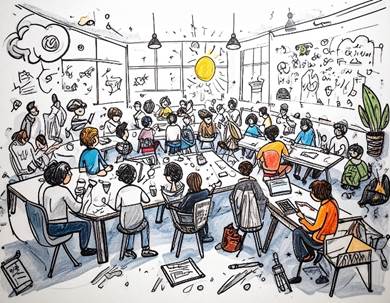
We welcomed Dr Gabriella Cagliesi (USBS), who provided an update on her work using GenAI bots to replicate the role of a teaching assistant with her Macroeconomics class, and Nick Heavey (Teaching and Learning Librarian) who shared how students are being supported to develop their Information Literacy at Sussex.
AI generated image by Adobe Firefly 25th March 2026 using HM’s prompt “a room with groups of people at tables, discussing ideas” with settings art and doodle selected.
Gabriella offered valuable insights into how working with Microsoft CoPilot has been different to her previous investigations using ChatGPT. CoPilot is a supported and secure platform available for all Sussex staff and students so Gabriella’s work exploring its efficacy is particularly useful.
Nick reported on the interesting work the Library Teaching team have been doing to expand the Information Literacy offer to include AI Literacy, considering UNESCO’s AI competency framework for students, and the collaborative work he has done with other colleagues at Sussex to support students. Nick’s presentation sparked a very interesting discussion about the varying perspectives and experiences of students and staff at the university.
The slides for both presentations are available to Sussex staff via the Teams channel. Click here to request to join.
Following the presentations, we worked in groups to evaluate some attributes of critical AI Literacy. Taking the idea of a Diamond 9 but adapting the expectation so people could create whichever form of hierarchy suited them, each group ranked what they considered to be important markers of critical literacy when it comes to using AI in their subject area or their practice. Some groups considered this in terms of student attributes, staff or in general.
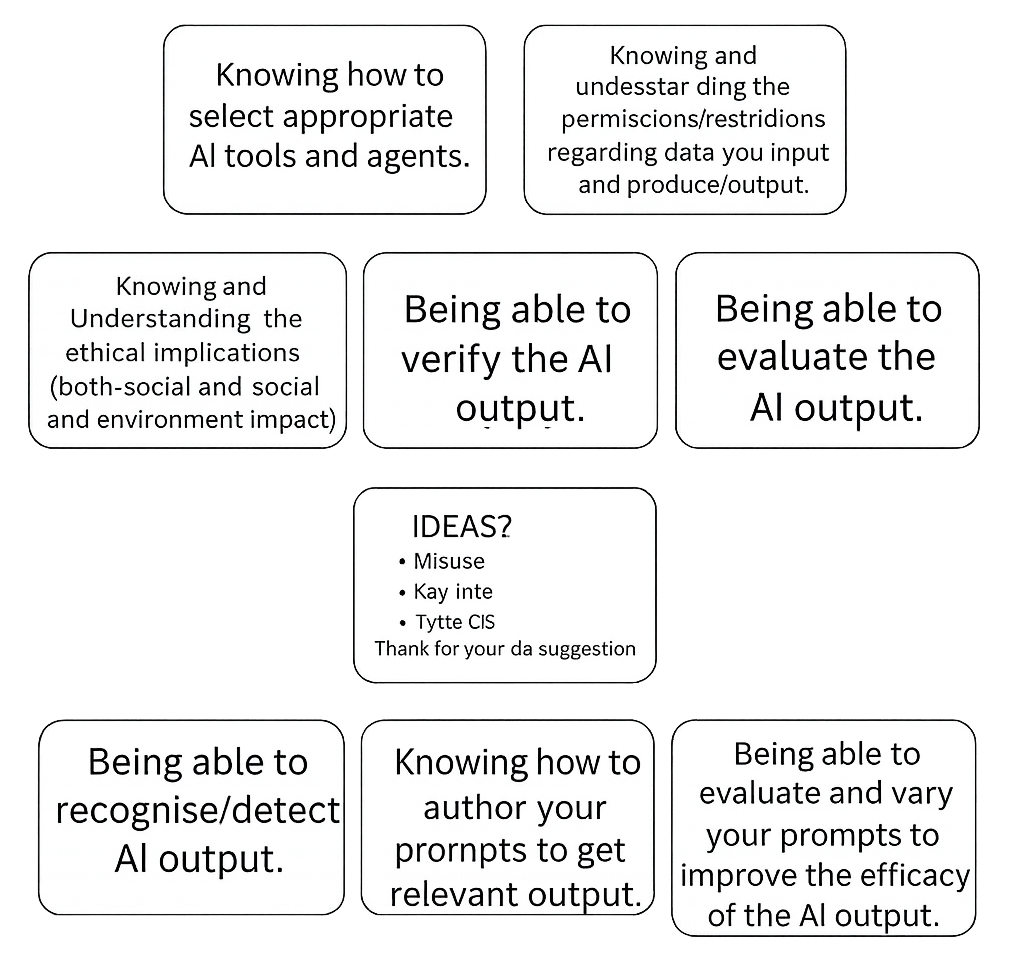
The results varied and were representative of how broad a topic Critical AI Literacy is. Photographs and notes from the final 9s, and the nine suggested attributes, are available to view here, and for your entertainment I’ll share a CoPilot rendering of one of them:
Microsoft CoPilot rendering of a photograph of nine cards with text on. The position of the cards is accurate.
The Teaching with AI Community of Practice will meet again 8th June when we look forward to hosting a salon-style event with opportunities to reflect on 25/26 and discuss your ideas, experiences and questions with each other.
We will meet in-person on the University Campus, exact venue tbc. Please register to attend here: Register to attend Teaching with AI Community of Practice – 8th June 2026 (in person). Completing the form is particularly useful for us to accommodate and access requirements.
Read more about our previous AI CoPs on the blog.
Upcoming Training and Events:
Training:
- Self-enrol to Educational Enhancement’s Canvas module “AI at Sussex” https://canvas.sussex.ac.uk/enroll/MCFLFT (Sussex staff and students only) to support your use of AI in your teaching and learning, Please remember that CoPilot and other tools are constantly being developed and the material might not always reflect how the tool operates on a given day.
- Our resources and guidance on Teaching with AI, and talking to your students about it, can be found here Artificial Intelligence in teaching and assessment : Support and guidance : Educational Enhancement : Staff Hub : University of Sussex.
- The JISC Building Digital Capabilities Toolkit is available to all Sussex staff and students, and includes guidance on how to improve your own critical AI literacy. Access the toolkit here.
Events:
Intentional AI: Building with Vibe Coding
15 April 2026 15:00 – 17:00
University of Sussex Campus – Sussex Humanities Lab (opposite SB211) Silverstone Building
Vibe coding is describing what you want in everyday language and AI builds it for you, removing the need for programming knowledge.
“This hands-on workshop from LHC Labs teaches participants to build working apps using vibe coding tools and to think critically about what they’re building”
More information and registration: Intentional AI: Building with Vibe Coding : Staff Hub : University of Sussex
Educating the AI Generation
Thursday 30 April 2026, 12:00 – 13:00 (Online)
Wonkhe
“Drawing on exclusive new research from Wonkhe and Kortext, this webinar will try to chart a path on how best to support educators across higher education to use AI in the most appropriate and impactful ways.”
More information and registration: Educating the AI generation | Wonkhe
Designing an institutional AI literacy pathway
Wednesday 13th May 2026, 13:00 (Online)
University of Liverpool GAIN
This seminar will be delivered by Amanda Seys from Harper Adams University. The session will explore the development of a staged AI literacy pathway at Harper Adams University that equips staff and students to engage critically, ethically and effectively with generative AI, addressing confidence gaps, integrity concerns and emerging pedagogic and ethical challenges. (text adapted from UoL).
Email gain@liverpool.ac.uk to register.
Recording available: Grasping the roots of problematic AI use
Also from GAIN, there is a recording of a webinar from 5th March: Grasping the roots of problematic AI use: Why we need to see GenAI through a harm reduction lens featuring Andrew Routledge, Lecturer in Political Theory at the University of Liverpool. Routledge: “In this talk I offer an analysis of the different kinds of responses to GenAI on the ground in HE and compare these reactions in the classrooms and staff rooms to the emerging consensus in the pedagogical literature. I argue that no existing approach pays sufficient attention to the root causes of problematic AI use and describe an alternative that better addresses the full range of harms that students face.”
Follow this link to watch a recording of this session: https://liverpool.instructuremedia.com/embed/63691473-60b7-467f-82b2-9643ba13053d
Across the Sector
The University of Bath, in partnership with Stellenbosch University and QAA, ran a project “Making Human Learning Visible in a World of Invisible AI: An International Perspective” and have published their findings here. The QAA website contains the report and a toolkit of resources that educators can use in their own work.
The University of Southampton have declared they are “lead[ing] the way with introduction of artificial intelligence skills for all students” and are committing to every student learning “how to use AI tools effectively and responsibly” with a new initiative that will see all undergraduates take a specific course in AI skills. See more here: Southampton leads the way with introduction of artificial intelligence skills for all students.
Colleagues from The University of Edinburgh have signed an open letter calling for the university not to renew its contract with OpenAI, saying it “does not align” with the university’s artificial intelligence and procurement principles. Read more in the THE here: Edinburgh staff urge university to ditch OpenAI deal. University of Sussex staff and students can access THE articles using the institution account.
More to read
March seems to have brought a flurry of articles on AI in Education. Here are some that crossed my desk this month:
HEPI 2026 survey (published 12 March 2026)
This very useful survey published by HEPI reveals that “AI use is now ‘near universal” among undergraduates, but students are divided on its impact. Three years is an interesting timespan when talking about Higher Education, as it is the standard duration of an undergraduate course of study. This survey shows that is has taken less time than that for , generative AI to move from novelty to near universality among graduates.
Trained to Stop Learning
New research from Wonkhe finds that assessment design – not AI policy – is what determines whether students use AI to learn or to produce. Jim Dickinson and Mack Marshall explain.
“Students are submitting work they cannot fully explain, facing AI policies that do not function in practice, and responding strategically to assessment systems that reward production over understanding. The costs of that incoherence fall hardest on the most conscientious students.”
Jim Dickinson, Associate Editor (SUs) at Wonkhe and Mack Marshall, Wonkhe SUs’ Community and Policy Officer.
More from Jim Dickinson at WonkHE this month:
- Students know exactly where learning happens – and it’s not in the upload | Wonkhe
- AI policy is penalising the students most trying to comply | Wonkhe
- AI enforcement apparatus exists to punish the anxious middle | Wonkhe
AI Is Not Replacing Learning—It’s Exposing Where Learning Was Thin to Begin With
AI Exposes Where Learning Was Thin to Begin With (opinion)
Xinyao Yi (University of Virginia) describes how “before AI, producing a working solution usually required enough effort that students were forced to engage with the material along the way. That friction masked weaknesses. Now that friction is gone.”
Something to Listen To:
Wonkhe research finds that nearly half of students worry their grades don’t reflect what they actually know…
The Wonkhe Show: Secret Life of Students AI special
In this special edition of The Secret Life of Students, Helen King, Director of Learning Innovation, Development and Skills at Bath Spa University; Rosie Birch, Communities Officer at Brighton Students’ Union; John Blake, Director at The Post-18 Project; and presented by Jim Dickinson, Associate Editor at Wonkhe discuss new Wonkhe research that found that nearly half of students worry their grades don’t reflect what they actually know – so what does that tell us about how students are making decisions around AI use, and what does it mean for assessment in higher education?
- Join the Teaching and Learning with GenAI Community: If you’d like to join the community and be first to hear about events. Get in touch with us and we can add you to the list and dedicated MS Teams community. www.tinyurl.com/sussex-ai-cop
- Disclaimer on any tools not supported at Sussex. Please do not share Sussex, student, colleague, sensitive or personal data via these platforms. Not being supported means they have not passed stringent Data Protection assessments and could put you at breach of policy and legislation. For a list of supported platforms for teaching and learning please visit the Educational Enhancement website.
This was a Spotlight on AI in Education update from Educational Enhancement

Leave a Reply