Welcome to November’s Spotlight on AI in Education bulletin. With how fast things are moving, this will help you cut through the noise and catch what’s important. The bulletin highlights on-the-ground practice, institutional perspectives and trends in generative AI use across the sector and beyond. We hope you find this useful.
If you have anything you’d like to contribute or see in this bulletin please email EE@sussex.ac.uk
On-the-ground at Sussex
Enhancing assessment and feedback
Read this if: You’re interested in ‘the practical implementation of AI in education and its implications for student learning outcomes, equity and academic integrity.’
Angela Ya Gao, Lecturer in Accounting in the Business School, has contributed the case study Changing the paradigm: rethinking assessment in the AI era to a compendium produced by AdvanceHE. Under the theme of Assessment and Feedback in a Digital Era, Angela’s case study details a project to design a Level 7 PG report assessment, introducing the use of AI in an assistive role with students being required to both use and show how they use the tools.
Video guide on using Generative AI to enhance teaching in higher education
Read this if: You’d like to see examples of using generative AI tools to support the cycle of teaching admin from planning to dealing with module feedback.
In a video shared via the Generative AI Network Jiscmail list, Dr Tadhg Blommerde, Assistant Professor at Northumbria University presents ‘six practical applications of generative AI to help streamline our work and improve student experience’. Covering such things as creating engaging lesson plans and supporting students with complex topics.
A student’s guide to writing with ChatGPT, by OpenAI
Read this if: You want to see how the platforms themselves guide students in using their tools.
OpenAI have put together this brief guide for using ChatGPT to assist with writing tasks. From getting feedback to helping with the ‘grunt work’ of formatting references.
The University of Sussex Business School is actively exploring the role of artificial intelligence in higher education, focusing on practical approaches to both enhance learning and address the challenges Artificial Intelligence (AI) brings. Through collaborative workshops, events and exploration of assistive tools the School is helping staff and students navigate this evolving landscape. These initiatives are designed to support faculty in adapting assessments, to streamline student support, and to encourage discussions about AI’s impact on teaching and learning.
Co-creating workshops
Over the summer, the Business School collaborated with students to create a series of workshops designed to help faculty adapt assessments in light of advancements in AI. Led by Aaron Fowler and Max Baylis, recent Sussex graduates, and Dr Lisa Blatch, Senior Lecturer in Strategy, the eight sessions were attended by more than 80 members of staff and aimed to support attendees in understanding how to design assessments that are less vulnerable to AI automation.
Aaron Fowler, Max Baylis, Dr Lisa Blatch (L-R)
One central focus of these workshops was on testing assignments for automatability by examining whether AI could easily complete them. By experimenting with putting their assessments through generative AI tools, educators learned how to identify assessment types that are susceptible to AI and, as a result, were able to structure their assessments so that they were based on evaluative and contextualised thinking, and material that is not significantly available online.
Exploring chatbots
In addition to assessment focused workshops, the Business School launched two projects, funded through the Business School Education and Students Small Grant Awards. The first project is led by Dr René Moolenaar, Senior Lecturer in Strategy, and is investigating whether a custom GPT-based chatbot could streamline the work of the School’s Student Academic Success Advisors (SASA). By handling routine queries this chatbot has the potential to make student support more responsive, freeing up SASA staff for more complex cases.
The second is led by Dr Małgorzata (Gosia) Sulimierska, Senior Lecturer in Banking and FinTech, and aims to integrate an interactive chatbot which provides a knowledge assistant that helps with module information and answers student questions on sustainable finance. Developed in collaboration with colleagues in the School of Engineering and Informatics, this chatbot aims to not only improve academic support but also create an interactive, engaging learning experience for students exploring sustainable finance.
A third tool, Plato, is also being explored by the School. Created by a recent Sussex graduate, Nikita Dumitriuc, Plato is an interactive platform that supports student learning by providing personalised resources and insights and can be integrated into Canvas modules. Through Plato students have access to a chatbot, curated study material like revision flashcards and quizzes, as well as a note taking tool.
Plato
Festival of SustAInable Education
In May the School held the inaugural Festival of SustAInable Education, which provided a forum for discussing AI’s impact on education and explored the intersection of AI and sustainability, AI and education, and education in sustainability. With a dedicated strand on AI, the festival featured discussions on the ethical implications of AI in learning and the skills students will need in an AI-influenced world. Faculty, students, and external experts came together to share insights on balancing AI’s benefits with ethical concerns and the need for inclusive practices. The event was organised by a team led by Gabriella Cagliesi and featured guest speakers including: Sir Mark Lowcock, Jean-Christophe Carteron, Sir Anthony Seldon and Sophia the robot.
Dr René Moolenaar, Dr Małgorzata (Gosia) Sulimierska, Gabriella Cagliesi (L-R)
Looking ahead
In the coming months, the chatbot tools will be developed further and evaluated to determine their effectiveness in supporting students and faculty. The co-created workshops are set to continue in the Spring term, with updates to reflect the changing AI landscape. These ongoing efforts reflect the School’s commitment to fostering an adaptive and sustainable approach to AI in teaching, learning and assessment. A small group has also been appointed to start formalising the Faculty’s policy position on AI.
In the field of scholarship, no singular research method is universally preferred. There are many methods we can use to gather and analyse data. This autumn, the Scholarship Series at Sussex provides workshops that cover a number of research methods that can be undertaken for scholarship. We hope to see you there! Sessions are open to academics across the HE sector with an interest in educational scholarship.
Spotlight on AI in education:
Review the new and improved AI in education update, now to be published monthly(ish) on the Educational Enhancement blog.
Join the 3rd Teaching with AI Community of Practice event will be held in the Open Learning Space in the Library on Monday 9th December, 1pm-3pm. There will be teas and coffee available (bring a cup if you have one) and you are welcome to bring your lunch. If you have not yet signed up or accepted a meeting invitation, please complete the form to register your interest.
We want to hear about your inclusive educational practice:
Educational Enhancement would like to collate good practices around inclusive education. The aim of this is to showcase some of the excellent inclusivity work happening at Sussex and align it with the University’s recently articulated principle that curricula at Sussex will be inclusive and student-centred. We welcome examples from any area of inclusive educational practice. For example:
Providing a learning experience that reflects a diversity of knowledge, ideas, and backgrounds, helping students to connect with, and see themselves reflected in, their field of study.
Ensuring material that supports learning and assessment is offered in accessible formats.
Providing (where practicable) supported flexibility and optionality in assessment modes and formats to enable students to take ownership of their learning.
Facilitating a smooth and supportive journey for students as they transition into, progress through, and graduate from university.
Providing clear and accessible feedback mechanisms on curricula, fostering a culture of critical reflection for staff and students regarding the ways in which we teach and learn.
Aligning our inclusive and student-centred curricula with the University’s Access and Participation Plan (APP).
Ensuring students are supported to engage with curriculum development and evaluation, e.g., via our Connector Programme.
Do you have ideas, research, or resources to share with colleagues at Sussex? If so, get in touch with sarah.watson@sussex.ac.uk
SFHEA event and further information:
For staff who are interested in completing their SFHEA join the next Senior Fellowship writing day will be Friday 8 November 9:30 until 15:00: Senior Fellowship writing day (online).
Perceptions of scholarship within the Education & Scholarship track:
Thank you to everyone who has already completed the questionnaire that aims to investigate perceptions of scholarship within the Education & Scholarship track role at the University of Sussex (Ethical Review no.: ER/ZP64/3).
We have received 165 responses so far. However, to ensure we gather as much input as possible for this important development, we’d like to extend the response period by one more week.
If you haven’t had a chance yet, please take a few moments to share your insights by following the link: questionnaire.
The data collected will be used to formulate academic papers and reports, which will include recommendations on this subject. We estimate that completing the questionnaire will take approximately 10 to 12 minutes of your time.
Please see our Participant Information Sheet. Your consent is granted upon submission of the questionnaire, and you can withdraw from the study at any point by not clicking submit.
The survey is open until 7 November 2024. Participants must be on Education & Research, Education & Scholarship and Research track to complete this questionnaire.
Upcoming Conferences (outside Sussex):
Interdisciplinary learning and teaching UK conference is taking place at LSE on 10th April 2025. See the call for papers for details.
International Assessment in Higher Education (AHE) Conference 2025 (Thursday 19 & Friday 20 June, Manchester) call for papers.
Reminder to sign up for the NTF Information session on 1 November:
There’s still time for potential NTF applicants to sign up for the NTF information session tomorrow
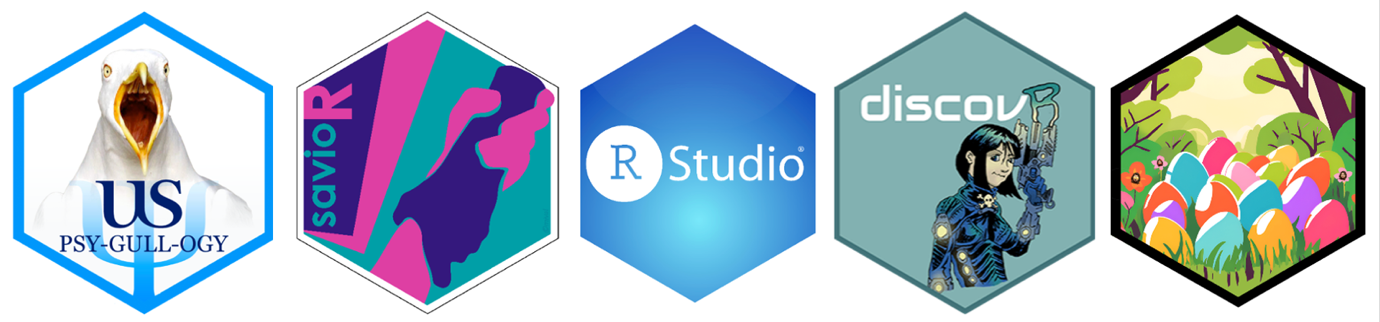
Colleagues in the School of Psychology are exploring the use of Canvas Credentials Badges to encourage student engagement on their Discovering Statistics module. The team had already introduced a gamification element to the statistical methods modules, by way of awarding highly-prized* physical Hex stickers to students for reaching key milestones, and were keen to try Canvas Badges as a way of managing the distribution of digital versions of the stickers.
Dr Danielle Evans, Lecturer in Psychology, says “The process of setting up and using Canvas Badges has been surprisingly easy and straightforward. From creating and customising the badges to integrating them with our course, it’s all been smooth. It’s been great to see how students respond, with many engaging more actively to earn their badges and the sticker version of them we’ll hand out at the end of term.”
So what exactly are Canvas Credentials Badges?
Formerly known as badgr, Canvas Credentials Badges allows you to create and award Open Badges. Open Badges are digital certificates recognising learning and achievement. They can be awarded privately, within our Canvas Learning Management System, to encourage engagement on modules, as is happening in the School of Psychology. But there’s more to digital badges than just a sticker. Digital badges “contain metadata within that provides exhaustive information about the tasks performed, criteria of their assessment, the time needed to perform and the volume of the task, etc., that serves in increasing transparency of assessment”. (Trepulé et al, 2021, p132). When digital badges are made public, and students share them, for instance via their LinkedIn profile, the metadata can be read by anyone and serves to give the badges credibility. The University of Edinburgh’s badges site shows some good examples of what open badges can be used for, including badges for Digital Skills and Community Engagement.
So, how does Canvas Credentials Badges work in Canvas?
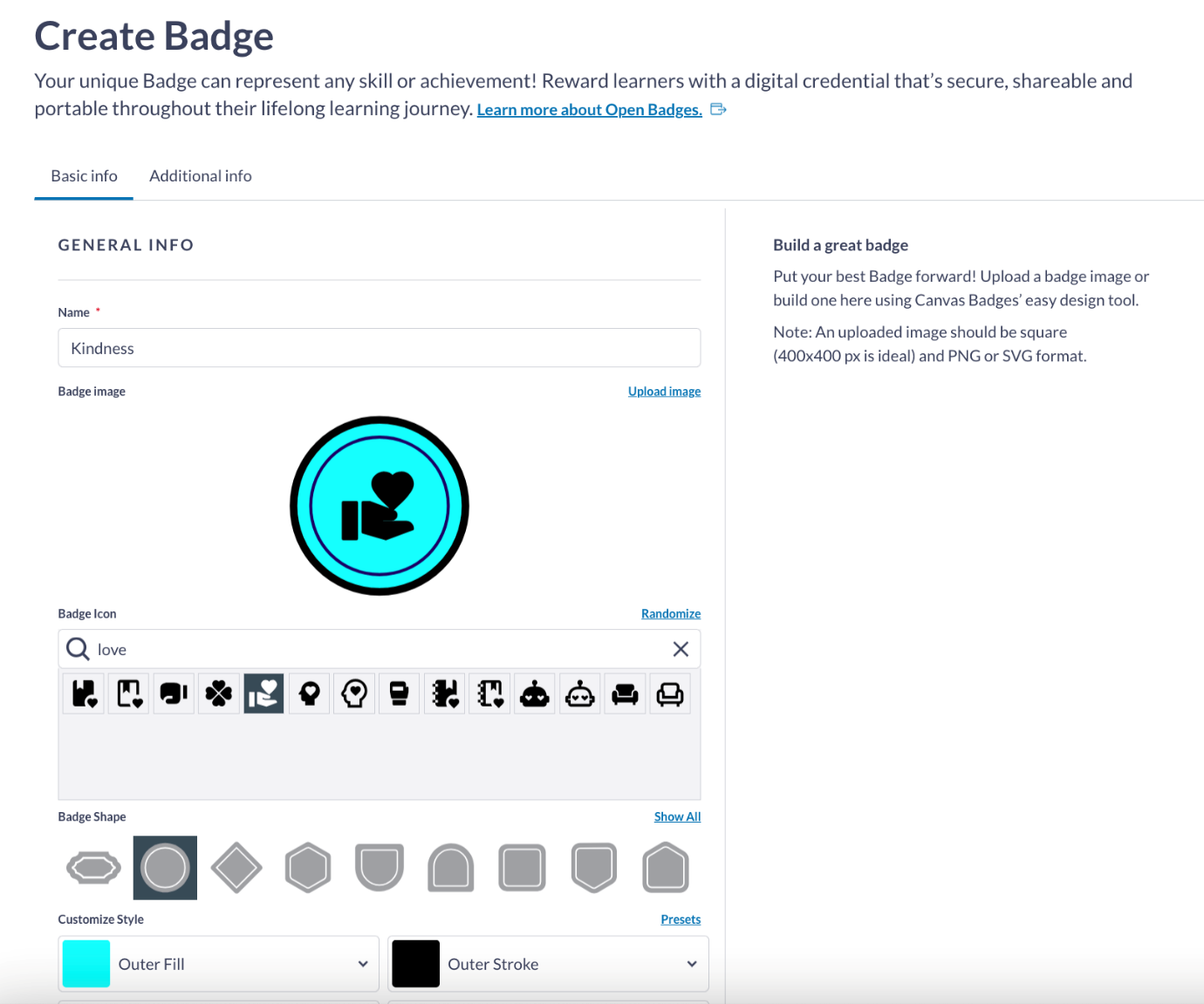
Once Educational Enhancement add the Canvas Credentials app to your Canvas site, you can then create the badges you need. You can either upload your own designs, as Dr Evans and her colleagues have done with the beautiful Hex stickers, or use Canvas’s in-built badge designer.
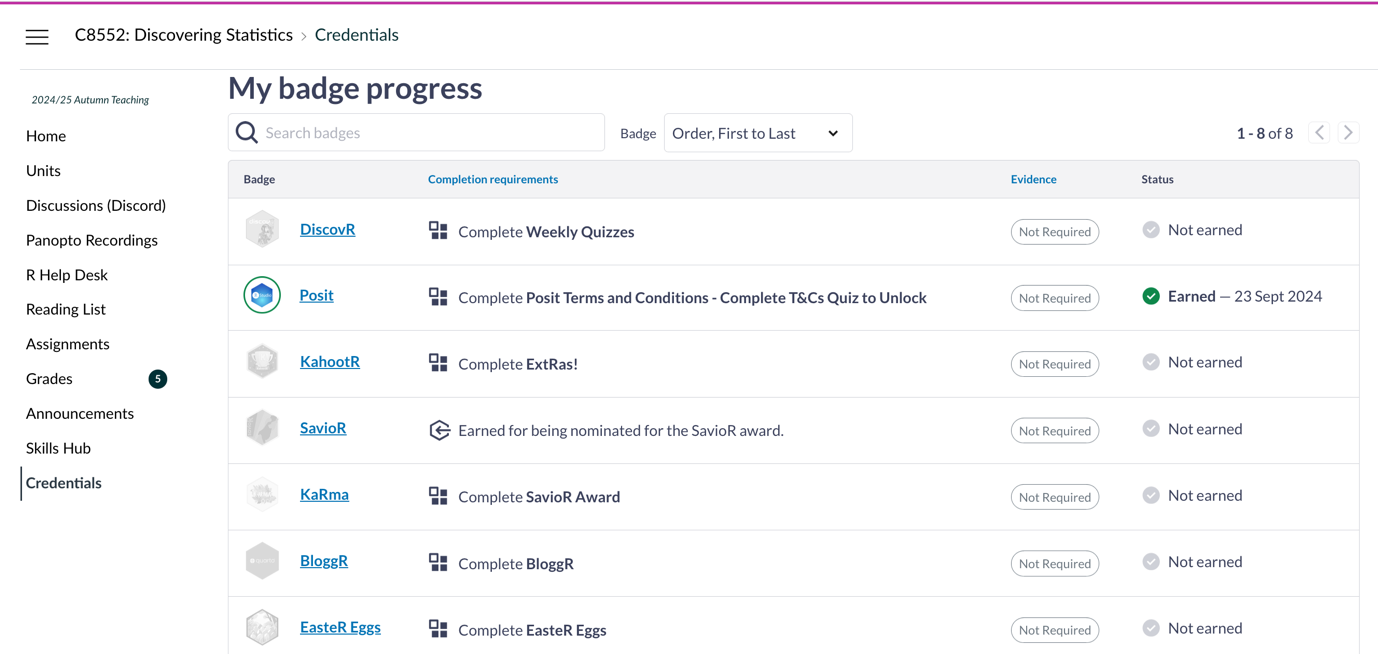
You then choose how to award the badges. Canvas can automatically award students a badge for completing a certain activity, such as contributing to a discussion, or reaching a certain score in a quiz. Alternatively, you can choose to award badges manually, with options to award badges in bulk via a spreadsheet. Students can see the badges they can aim for on the module, and track their progress via the Canvas Credentials screen.
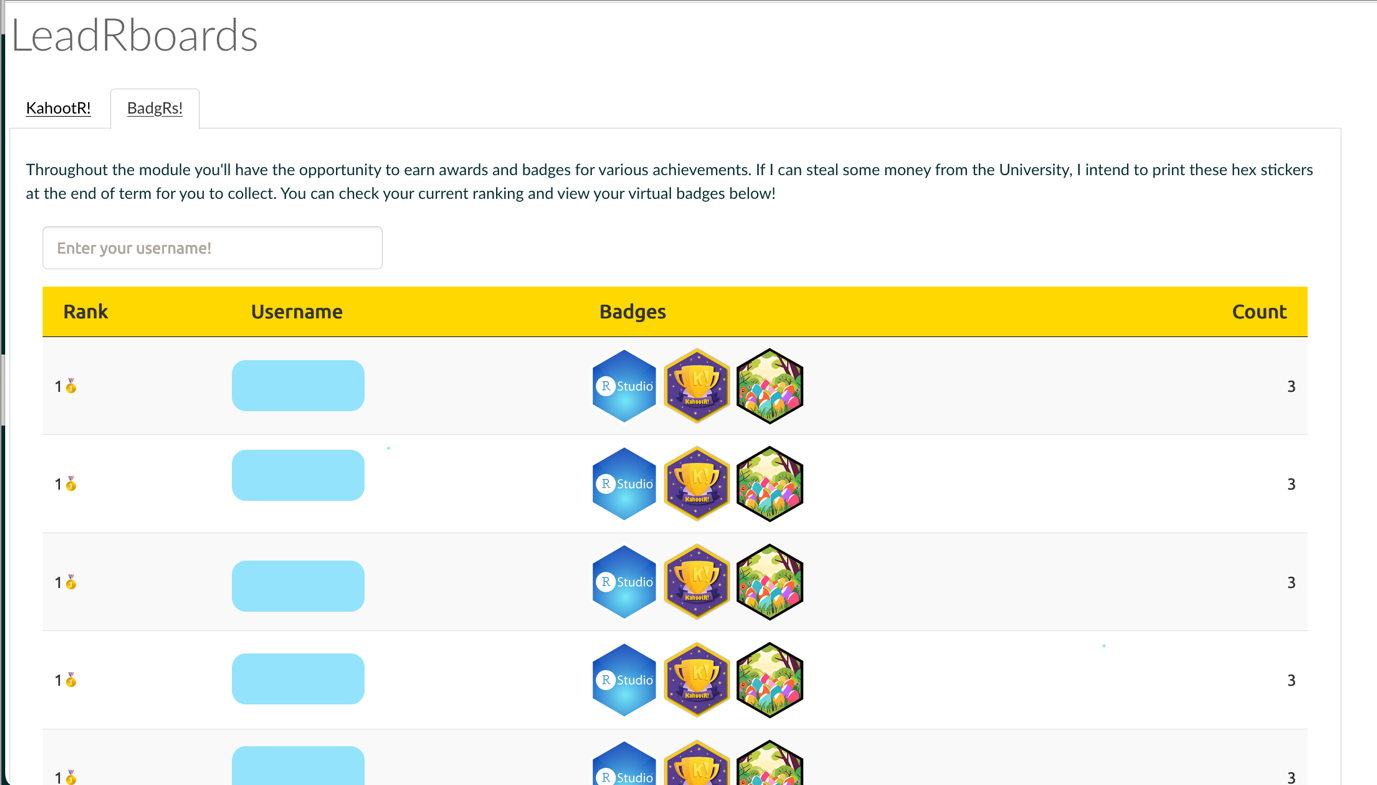
Dr Evans has gone one step further, and has even written some code to set up a leaderboard, to “add a fun, competitive edge that motivates students.”
According to Dr Evans “the badge system has been incredibly useful for monitoring student engagement with various tasks and course components. Overall, it’s been a simple yet effective way to enhance the learning experience. I’d definitely encourage others to give it a go!”
How to get started with Canvas Credential Badges
There’s a little bit of set up before you can start using Canvas Badges with your students, so if you’d like to use Canvas Badges, contact your Learning Technologist by emailing ee@sussex.ac.uk.
*The Hex badges in School of Psychology are highly prized by me. I’m still hoping to get my hands on a Hex sticker for joining some of their great staff R workshops.
Further reading
Elena TREPULĖ et al. (2021) ‘How to Increase the Value of Digital Badges for Assessment and Recognition in Higher Education. A University Case’, Informatics in education, 20(1), pp. 131–152. Available at: https://doi.org/10.15388/infedu.2021.07.
Law, V. et al. (2024) ‘A meta-analysis of digital badges in learning environments in educational settings’, Educational Technology & Society, 27(3), pp. 29–45. Available at: https://doi.org/10.30191/ETS.202407_27(3).RP02.
Simon Overton: Today I am joined by Brena Collyer De Aguiar, Online Distance Learning Manager focusing on Course Development and Delivery, and Senior Learning Technologist for ODL. Welcome, Brena.
Brena Collyer De Aguiar: Thank you, Simon.
Simon: Why don’t we start by you telling me exactly what you do? What do you get up to every day?
Brena: Basically, as a Senior Learning Technologist, I support academics involved with the ODL courses we have at Sussex. This includes supporting them in teaching, developing, or refreshing modules. I also deliver training, encouraging academics to innovate and improve their teaching practices.
As ODL Manager, I liaise with our partners for course development, best practice reviews, accessibility, and incorporating technology to enhance learning engagement.
Simon: ODL is, I think, one of the shining stars of Education Enhancement at Sussex. Why don’t you describe what ODL actually is and what we offer?
Brena: We offer nine fully online courses, including Master’s courses, PGCEs, PGDIPs, and a CPD course. Our students are around the world—in about 150 countries last time we counted.
Simon: Do you know how many students have gone through the ODL?
Brena: Our courses are built to be flexible, so students can join at different points and take breaks when needed for careers or family commitments. I think the last intake was about 900 students, with others on break or graduated already.
Simon: So, you’ve been involved in a project called Project Dandelion. Dandelions are lovely, but I’m sure it’s not just about dandelions. What is it actually about?
Brena: The project gamifies a module on sustainable development. One of our academics, Lucila Newell, the module leader, noticed students were feeling depressed studying issues like food waste and climate change. In response, we decided to gamify the module to engage students more positively. Students complete missions, quests, and challenges in a narrative-driven experience where they travel back from a future where climate issues have been resolved to understand the solutions that got us there.
The narrative includes time travel, and we place students in a setting where climate issues are already solved. Their role is to document what was done to achieve this, not to “save the world.” The dandelion symbol represents spreading seeds of change and healing.
Simon: That’s so lovely. I noticed that instead of modules, you’ve got missions—correct?
Brena: Yes. We added gamified elements like missions, quests, and challenges. We also encourage students to connect with their emotions and environment. They can choose avatars like animals or plants that inspire change in them, and they work in groups to find and connect with people in their communities promoting change. The game focuses on narrative rather than high-tech elements.
Simon: What’s been the feedback from students?
Brena: Most students find it engaging and enjoy the group work and leaderboards we added for scoring. Some felt the gamified module was demanding due to other commitments, so we made adjustments like flexible deadlines and clear expectations. We also explained the pedagogical purpose of gamification, showing it as a tool for deeper learning.
Simon: This approach addresses so many educational concerns—group engagement, real-world application, participation. Do you think gamification could apply to other topics, or is it particularly suited to sustainability?
Brena: I think gamification, especially through narrative and role-playing, works well for some topics but isn’t suited for all. It’s about using the right tool for the right purpose. Not every module needs to be gamified; it’s about choosing methodologies that genuinely enhance learning.
Simon: Yes, it’s a tool rather than the tool.
Brena: Exactly. Coming from a background with limited resources, I believe tools and technologies should only be applied if there’s a solid pedagogical reason for them. It’s about improving the student experience, not just making things fun.
Simon: You introduced Project Dandelion at the Playful Learning Conference. Do you want to reflect on that experience?
Brena: It was fantastic to connect with people using playfulness in education, especially on big topics that impact us all. Playfulness encourages creativity and bravery because there’s no real risk in a game, and it allows us to connect emotionally. Play and joy were recently recognised in Universal Design for Learning guidelines, so it’s encouraging to know we’re heading in the right direction.
Simon: Incredibly innovative as well.
Brena: I hope so! I’m grateful for my background. My primary school teacher used role-playing games to teach history and philosophy, sparking my interest. Later, in my degree, I joined a research group on games and narratives in learning. That experience has guided my approach to innovative teaching.
This conversation was recorded on 17 October 2024. AI was used to edit the raw transcript into a more “readable” article but was checked by our team for language and meaning before publishing.
Welcome to the first of our Spotlight on AI in Education bulletins. With how fast things are moving, this will help you cut through the noise and catch what’s important. The bulletin highlights on-the-ground practice, institutional perspectives and trends in generative AI use across the sector and beyond. We hope you find this useful.
If you have anything you’d like to contribute or see in this bulletin please email EE@sussex.ac.uk
On-the-ground at Sussex
Plato gets the green light for a small trial in the Business School.
Read this if: You want to know more about how AI can be used to help students use their Canvas module content in different ways.
A small (1 module) pilot is underway using the platform Plato. Designed to enhance student engagement and learning outcomes by offering features such as personalised chatbots for module-specific questions and AI-generated flashcards and quizzes for revision. Plato integrates into Canvas allowing students to take notes and link them to specific teaching materials helping to contextualise their notes with the associated module material.
Find out more about other AI trials and learning initiatives happening across the university on the Educational Enhancement and Learning Matters blogs. I you’d like to be involved in future trials (including but not limited to AI tools) please get in touch.
Institutional Perspective
The AI for Teaching and Learning Community of Practice is back for 24/25
Read this if: You want to get involved or hear what’s happening across Sussex when it comes to generative AI for use in education.
The next AI CoP is back on Monday 9th December, 1-3pm in the Library’s Open Learning Space. The first of this years events will shine the spotlight on a variety of smaller-scale AI projects and experiments. With no “star of the show,” we’re creating more space for participants to engage, share, and explore. Expect interactive “market stalls” to spark discussions, a retrospective of Sussex’s AI in Education journey, and some festive fun with mince pies and an advent calendar!
Read this if: You’re interested in how generative AI tools can support creative processes.
“For the writers Pigg studied and the students I interviewed for this article, ChatGPT was not so much a perfect plagiarism tool as a sounding board. The chatbot couldn’t produce large sections of usable text, but it could explore ideas, sharpen existing prose, or provide rough text for the student to polish. It allowed writers to play with their own words and ideas. In some cases, these interactions with ChatGPT seem almost parasocial.”
Simon Overton: I’m very happy to welcome Dan Axson, Learning Technologies Manager in the Educational Enhancement team here at Sussex. Welcome, Dan.
Dan Axson: Hi, Simon.
SO: So it’s the start of a new academic year and the theme of this episode is looking forward, but before we do that I think it’s important to look back at the previous year. What were some of the highlights for you last year?
DA: Oh, it’s a really tough question. Last year, I felt like it passed by in about a day, but a lot’s happened. For me, the highlights have absolutely been seeing our team do what they do best and support each other. It sounds really cheesy and corny, but it’s absolutely true. We’ve had a really challenging number of months for different reasons: external factors, internal factors, staffing, the usual stuff. But the way they rally around and support each other is exceptional, and it makes me feel really good, but also makes me feel better about the decisions of hiring that I’ve made!
I think a couple of things spring to mind. One is, they’re a relatively new team still to the university, and universities do have very complex processes to get to grips with. But they’re all pretty much experts in that now. How they’ve responded to changes in the technological environment around us, artificial intelligence being one, has been remarkable. Their personal and professional development as well over the year, some of them doing PG Cert, for example, as well as their day job. So, I think the team has been the highlight of the year. Like I say, it sounds cheesy to say, but it’s easily the top one.
SO: When you say it’s a relatively new team, I mean, it did exist before as TEL [Technology Enhanced Learning]…
DA: Sure. What I mean by that is the people in it are relatively new. So, the last two, two and a bit years, most of the team have been with us. We had a bit of a refresh a couple of years ago, through retirements, promotions, and so on. They hit the ground running back then, but they’re just going strength to strength. They’re a team of very passionate, interested, caring people who have nothing but support and each other’s backs when they need it most. It’s great to see.
SO: Talking about AI, the AI Community of Practice was a really strong way to approach that and to grab the hot potato and run with it (if I may mix a metaphor).
DA: Yes, you’re right. With the AI Community of Practice, that was spun up and led predominantly by Sam [Hemsley], our colleague in Academic Development. We’re going to be more involved in that. What that highlights is, despite the day-to-day stuff of a learning technologist role or a team such as ours, Educational Enhancement, we get involved in some of the really mundane runnings of a university. But it’s important to remember that one of our core functions is to assess what’s out there, make sense of it, and help people understand it.
I wrote a blog post (a little plug on this!) a little while ago, likening us to noise-cancelling headphones. Helping bring a community around something that’s quite frightening to many academics and people, and help understand it. We get into the weeds on ethical and sustainable use, but also, what does this mean for me as a teacher? What’s the day-to-day going to look like with AI? Are my students all going to cheat? What about them? Helping people talk to each other and understand, we’re all a bit new to this. Let’s explore it together, and it’s okay. That’s been a highlight, seeing that develop over the last year. I can’t wait to see what that brings in the coming year.
SO: So what projects do we (E.E.) have in the pipeline? And how do you see them playing out this year?
DA: That’s a good question. One of my soapbox things is digital accessibility. When it comes to our virtual learning environment, Canvas, we’re doing a big project this year around the templates for modules. When we first got Canvas, it was the Wild West. Every module site was slightly different, and students quickly said they wanted something more consistent, but also accessible, easy to use, navigable. Then Web Accessibility legislation came in, not at a dissimilar time, a couple of years later. It made some of this obligatory, upfront rather than reactive in terms of accessibility and design. We’ve tried to make sure that our templates are consistent with that. We’re in a position now where many schools have templates, but there are still some inconsistencies. You get students doing electives or dual honours, and buttons aren’t in the same place or some websites have the “scroll of doom” on a mobile phone. We have to accept that the student population changes how they view their module sites and what they view them on.
A big project this year is looking at how we consolidate templates to improve the student experience, particularly for those on the margins with digital accessibility needs or other access needs. But also, it needs to be easier for staff to update because anything we can do to reduce admin of teaching and learning is good to give people more space for teaching and learning.
SO: I find digital accessibility interesting. I don’t enter into it too much in my role but for example making sure that you’ve always got “alt text” on images. I find that quite a nice exercise to go through because it asks you implicitly “What is the purpose of this image? Are you just sticking something in to make it look pretty? Or does it actually have a function? And can you distill that function down to a sentence or two?” That’s a real positive that’s come out of that for me, something that I’ve not really considered before, i.e.: people using e-readers, and that’s really helped me to reflect on my work.
DA: Yes, I agree. It is a helpful activity, and arguably one you should be asking of anything you’re putting out. Despite it being a legal obligation, it’s really easy to get away with not doing it, which is a problem. So, there’s two sides to that. One is, we need to make it easier for people to do this stuff, reduce the admin. But also, we need to raise awareness that there’s an obligation on tutors, support staff, and EE to do that work. Sometimes it is “work”, but it’s critical for many students. I think we can do better, and I look forward to seeing how that goes this year. We’re hoping to work with Student Connectors on that and have students directly involved in the development over the year.
SO: We always talk about AI. Not just in this podcast / blog but generally around the office and in our meetings, and in fact, we’ve already talked about it in this conversation, but let’s talk about it a little bit more. How or where do you see AI technology going this year, and how do you think it’s going to affect education further?
DA: Big questions that we probably won’t fully answer here. In short, I think over the next year, conversations will shift from “this is terrifying and must be stopped” to “how do we work with this?” What’s the right attitude to take? What should we be scared or worried about?
We know from speaking to colleagues across the university that some are flying with this. They’re well-versed in it. Some of them create it; they’re experts. Sussex has a rich history in artificial intelligence. When it comes to generative AI for teaching and learning, some are developing or using tools, while others are terrified and shutting it out, saying, “It’s a hard ‘no’, you’re not allowed to use it.”
There’s a real spectrum, but I think the ability to have an informed conversation will grow. There’ll be a more consistent understanding of where students stand, helping them have informed conversations, understand best practices, and maintain academic integrity without falling foul of misconduct, either purposely or accidentally. That’s what will change – a more common language will emerge. Our role will be creating that forum and helping colleagues, which is what we’ve always done with technology, whether it was Canvas or anything else. AI is no different, except that its potential for changing education is more significant.
SO: Any final thoughts or words of wisdom?
DA: When we’re bogged down in day-to-day admin like assessment, it’s easy to forget that this job can be fun. There’s a lot of fun stuff to do. Katie [Piatt] and the team getting the CATE Award for their Playful Learning Conference shows that within EE, we have the capacity to enjoy what we do. It’s easy to forget that sometimes. I hope we get space to do that this year, whether it’s personal professional development or our Learning Technologists exploring video games, AI, or playful learning. Finding the fun in what we do is important. It’s okay to have fun and play with things.
That’s what a learning technologist does best, I think.
This conversation was recorded on 1 October 2024. AI was used to edit the raw transcript into a more “readable” article but was checked by our team for language and meaning before publishing.
July saw the launch of the Learning Matters Podcast which captures insights into, experiences of, and conversations around education at the University of Sussex. The podcast is hosted by Prof Wendy Garnham and Dr Heather Taylor. It runs monthly, and each month is centered around a particular theme. The next episode focuses on the international student experience and will go live at the start of October. Give it a listen!
Education and Innovation Fund
Five new projects have been funded by the Education and Innovation Fund, and the winning projects are;
Dr Xuan Huy Nguyen, Dr Ngoc Luu – Developing entrepreneurial teams among students across disciplines as a strategy to promote inclusivity, belonging and enhanced curricula
Dr Kathryn Lester (Lead),Dr Matthias Gobel, Dr Dave Smalley, Dr Sean Figgins – It’s about more than bums on seats: Co-designing and establishing the feasibility and acceptability of a brief online “Circles” intervention to improve sense of belonging, connectedness and attendance in first year Psychology students
Dr Alex Stuart-Kelly (Lead), Dr Oli Steele, Dr Nicola Schmidt-Renfree, Dr Elaney Youssef – ‘Closing the loop’: Leveraging project-based learning to understand student engagement in large group teaching across Medicine and Life Sciences.
Dr Charlie Crouch (Lead), Dr Keith Perera (Lead),Helen Morley, Rachael Thomas, Liz Cousins, Andy Lowe – The future Sussex student: how is generative AI impacting the way that sixth formers learn and study?
Dr Haruko Okamoto (Lead),Prof Daniel Osorio, Dr John Anderson – Building LifeSci STEM Ambassador Network for Students & Staff
Please note that there are currently no further funding rounds for the Education and Innovation Fund planned.
National Teaching Fellowship and Collaborative Award for Teaching Excellence
Educational Enhancement’s Dr Katie Piatt – as part of The Playful Learning Association (PLA) – has won a CATE
Links we liked
Embracing the role of undergraduate students as engaged researchers: The teaching of undergraduate research can suffer from being overly mechanical. Erica Cargill and James Cunningham of Aberdeen University share an innovative approach and call for deeper engagement (WonkHE, 21/06/24)
SFHEA events
There are several opportunities for staff who are interested in completing their SFHEA, to recognise the hard work you do to support and lead in teaching and learning. You can make an independent application to Advance HE, which can be done at any time. This is currently supported at Sussex through termly information sessions and writing days, along with a Canvas site: https://canvas.sussex.ac.uk/courses/15023.
The next information session will be Wednesday 2 October 13:00 until 14:00:
BoS are coming up – if anyone wants to get in touch with their AD to discuss changes to assessment then please get in touch –
Kitty Horne, Academic Developer (University of Sussex Business School) Email: k.r.horne@sussex.ac.uk
Sarah Watson, Academic Developer (School of Media, Art and Humanities) Email: Sarah.Watson@sussex.ac.uk
Sam Hemsley, Academic Developer (School of Psychology; School of Life Sciences; School of Mathematical and Physical Sciences; School of Engineering and Informatics) Email: S.Hemsley@sussex.ac.uk
Charlotte Crouch, Academic Developer (School of Education and Social Work; School of Global Studies; School of Law, Politics and Sociology) Email: C.H.Crouch@sussex.ac.uk
We are the Educational Enhancement team at the University of Sussex. We publish posts each fortnight about the use of technology to support teaching and learning. Read more about us.