

The Learning Matters Podcast captures insights into, experiences of, and conversations around education at the University of Sussex. The podcast is hosted by Prof Wendy Garnham and Dr Heather Taylor. It is recorded monthly, and each month is centred around a particular theme. The theme of our eighth episode is ‘communities of practice’ and we hear from Dr. Wendy Ashall and Dr. Maria Hadjimarkou.
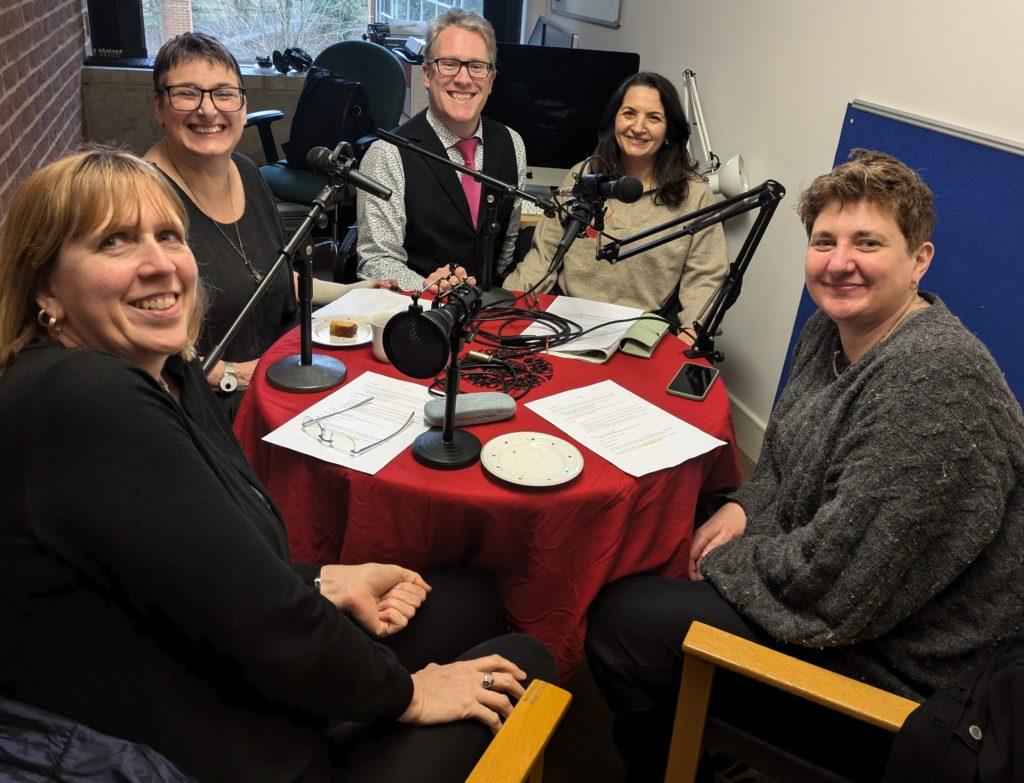
Recording
Listen to the recording of Episode 8 on Spotify
Transcript
Heather Taylor:
Welcome to the Learning Matters podcast from the University of Sussex where we capture insights, experiences, and conversations around education, our institution and beyond. Our theme for this episode is Communities of Practice and our guests are Doctor Wendy Ashall from Global Studies and Doctor Maria Hadjimarkou from Psychology. Our names are Wendy Garnham and Heather Taylor, and we are your presenters today. Welcome everyone.
Wendy Garnham:
Can you give us an idea of what communities practice you are or have been working with? And I’m going to direct that to you, Wendy, first of all.
Wendy Ashall:
So I co-chair the SEDA Transitions Community of Practice, which brings together practitioners globally to talk about all things to do with supporting students in transition, so as they enter the university, as they journey through, and as they leave the university to enter the world of work.
Wendy Garnham:
Maria, same question to you. What Communities of Practice are you working with?
Maria Hadjimarkou:
So for the past year, I have been attending the Community of Practice of Transitions that was just mentioned. And in October 2024, I created my own Community of Practice, which is community dedicated to the teaching of biological psychology. So, yeah, it’s been really great.
Heather Taylor:
So, Maria, can you tell us a little bit about the context of your scholarship that led you to develop your Community of Practice?
Maria Hadjimarkou:
So I I feel that psychology students generally find the biological aspects of the curriculum a bit more challenging. So I thought that other colleagues probably feel the same way. So I thought it would be a good idea to form a community to bring colleagues from other institutions together and see whether we can resolve some of the challenges that we are facing in an increasingly diverse student population.
Heather Taylor:
And same question to you, Wendy.
Wendy Ashall (02:15):
So before I joined the University of Sussex, I was teaching access to HE courses in further education. So an awful lot of what we were doing was about supporting students who were joining new to the university context, so preparing them with study skills, confidence, etc. When I came to the University of Sussex to teach the foundation year, I was delighted to discover that I had colleagues that were as interested in supporting our students to equip themselves with the skills and self confidence they need to be really successful undergraduate students. Myself and Wendy Garnham then worked together on a SEDA special, special 44, I think it was, which was looking at student transitions. And to support the publication of that SEDA special, we decided, because it was still in mid COVID, to do a series of online webinars to publicize the special. And actually, the Community of Practice kind of grew organically out of that. Those webinars were so well attended and well received we realised that there was a community of people across the country and then ultimately globally who were really interested in discussing this further and supporting each other.
Wendy Garnham:
I think the support was a really key issue for the community to sort of develop further, just people coming together with a shared interest, which I guess both of you may well have been finding in your communities, just trying to support each other in the challenges within those areas. Which brings us to the next question, which is really what issues do you see as being particularly challenging in establishing and maintaining these sorts of communities? And I’ll address that to you first, Maria.
Maria Hadjimarkou (04:10):
So as I said, my community is rather new. So my challenge at moment the is to maybe increase the number of participants, so get the word out. And another challenge is also because everybody is busy and we work on different institutions, it’s rather tricky to find a common time where people can make the meetings and attend. But luckily, the meetings are remote, so we can really have the meeting at a time where people can make it.
Wendy Garnham:
Was there any sort of issue that you felt, Wendy, was particularly challenging in establishing and maintaining the community?
Wendy Ashall:
Yeah. I think I mean, when we first started, we had that interest building off the back of the publication. So the challenge has been more about the maintenance part of it. I think the scheduling is a problem, and particularly as the network, the community has grown. So we now have members in Australia, and so finding a time that enables them to attend but also fits in our busy teaching schedules. And I think that’s one of the other challenges. It’s about workload because the types of people who are keenest to be involved in a community like this are those who tend to have higher teaching loads or admin responsibilities, etc. So trying to keep that energy going for us to actually host it, but also for attendees. And I think sometimes it’s difficult to make sure that you’ve got the next speaker booked in time so that you’re keeping that momentum going, that you’re getting the invite out there early enough so that people can protect the time in their diaries.
I’m very blessed because Wendy Garnham is a diva with our Padlet board. She’s absolutely amazing. She’s sharing lots of resources on there, which I think then helps the community exist outside and in between the individual meetings.
Wendy Garnham:
Making me blush. I think one of the issues that you hit on there was just that sort of that workload impact, sort of trying to maintain that investment. But having that regular meeting, I think, is absolutely critical. You know, from my perspective, just knowing that every month there is going to be a meeting, it sort of does prime you a little bit to expect that at some point in your calendar each month. I think, you know, if it becomes irregular, that’s probably quite a challenge for people to remember about the existence of the community, I guess.
Wendy Ashall:
Yeah. I think one of the other challenges is because a lot of the people, you’re only meeting them online. I mean, we’ve been blessed to have some in person meetings, which has been fantastic, and I’d love to do more of that because not everybody wants to have their camera on, which is understandable, but we don’t want to be triggered by horrible memories of COVID teaching.
Yeah. It’s so lovely when everybody’s got their cameras on and everybody’s nodding and smiling as you’re talking. It’s it that helps create the energy as well.
Heather Taylor:
Yeah. Yeah. 100% actually. And you’re right about that sort of nightmare of COVID because there’s nothing quite like talking to a blank screen, but you’re right, even with the cameras on, I think you don’t get the same, you know, having the opportunity to see people in person is, yeah, really important.
Wendy Ashall:
But then I suppose on the other side, being able to do something like that online has enabled us to reach way more people, And there’s no way we’d be able to get everybody together in fact, so this is enabled – by doing it online we’ve got colleagues from across the country. It’s brilliant, you know, to be able to do that.
Heather Taylor:
Yeah. Maybe you should do a conference.
Wendy Ashall:
I have suggested it. I’m like, I haven’t had time.
Wendy Garnham (07:58):
I think sort of when you’ve got colleagues in, like, Australia and America, I know Maria you said you’ve got some international members of the community. So I think, you know, the downside of being online is sort of somewhat outweighed by the fact that you’ve got a bigger community in the sense that you’re able to integrate people from all over the world into your community practice, it does sort of create a bit of a challenge, I agree, in terms of timing, but I guess sort of one outweighs the other. So, you know, people in Australia, say, would not be able necessarily come to a conference, but doing it online every month, we can make contact, we can share our good practice.
Heather Taylor:
So Maria, what impact do you hope your scholarship in this area will have?
Maria Hadjimarkou:
I’m hoping to be a resource for the community, to be a resource for other colleagues, so to figure out solutions and be able to help each other because we all face common challenges in teaching biological psychology. So and it’s already we already see evidence of that, that we share similar challenges, and we can exchange ideas, share best practice, and figure things out as we go.
Heather Taylor:
I mean I can view it from a student’s perspective. I know we’ve had this chat before where, you know, biological psychology, for me, you know, I didn’t do well at GCSE biology. I think I’ve got a D in my science GCSEs, which is, you know, okay. But it’s not perfect for if you’re gonna be studying essentially biology at undergraduate level. So, you know, I did really struggle with it. And I think, you know, I think it’s tricky because it’s such an important subject, same as research methods. They will have this issue with some students just don’t want to learn it, be it so sort of key to psychology. So, yeah, I was just wondering sort of what you know, in order to get students engaged, get those students that maybe don’t have a very good background in biology, have you have you got any examples of sort of things you might have done so far or conversations you’ve had around that even?
Maria Hadjimarkou (10:16):
So, yes, it is always a bit of a challenge, so we always have to rethink and improve the way that we teach. So a lot of times, we need to break things down a bit more to have very organized lectures, to say ahead of time what is expected from the students, maybe have more interactive components and also use analogies because the biological or molecular aspects of the lectures may seem a bit abstract, so it’s hard for them to understand. So I generally tend to use analogies, which make things a bit easier for them understand. So for example, when I teach my neurodevelopment lecture and talk about the growth cone of a neuron, I tend to say that the extension just goes around and looks for other neurons to make contact. Then I always mention the analogy of them, for example, waking up in the middle of the night and reaching out and searching for it with their eyes closed, and they’re kind of trying to feel for their phone. So that, I think helps them to put a picture and understand the content a bit better.
Heather Taylor:
Yeah. I think that’s a great way to remember as well. It would make it, you know, having something personally, because if I do find it quite abstract, yeah, having something like that where it’s, you know, something I do, right, you know, I do wake up and try and find my phone, it is I think it’d be much easier for them to remember as well. So I think that’s brilliant. That sounds great. Yeah.
So same question to you then, Wendy. What impact do you hope your scholarship in this area will have?
Wendy Ashall:
I think there’s two different dimensions to it. So on the one hand, it’s about improving the student experience and student outcomes. So one of the things that’s really, I found, really enriching about the Community of Practice is that we’re bringing together colleagues who are sharing what they’ve been doing and the learner centered approaches that they’re taking in supporting students, but also thinking about the support needs of different types of students as well without sort of falling back on problematic deficit models, but really thinking through, okay, what does this mean for this cohort when we do this thing when we’re supporting students as they move from Year 1 to Year 2 or whatever? So it’s really taking that student centered learning journey approach. And I think a Community of Practice can be so powerful and really quickly disseminating those ideas because publication can take such a long time, and there are quite a lot of barriers to publication. But if I can go onto a call and Maria can explain what she’s doing, and then I can go, oh, I can steal that idea and use it in my practice straight away. Yeah. I think that’s really, really powerful. But the other side of it is the support for ourselves as colleagues that we get to network with other people, that we get to share our ideas and test them out with people who are informed and so get that feedback before we might even think about putting together a publication. We’ve got that audience to say, well, I’ve got this idea. I’ve been working on this, what do you guys think? And it’s so I think the Transitions Community of Practice is so warm and friendly and supportive. You feel held by it, so it’s given us that opportunity to really test our ideas and develop really supportive networks.
Heather Taylor:
Yeah. Amazing.
Wendy Garnham (13:45):
Yeah, I think the networking for Communities of Practice generally is the absolute key. It’s like taking what you’re doing outside of the four walls of your classroom, sharing it with, you know, the bigger community, getting feedback on it. You know, it might be that somebody else has tried something similar, or, you know, perhaps somebody’s tried what you’re already thinking of, and they’ve got some advice so you can tweak it. So it is a real work in progress feeling, but in that very supportive context. Everyone’s cooperating with this sort of the central theme of the community in mind. So, I mean, one of the things I know has happened even in some of the discussions is there’s been a lot of talk about belonging. One of the offshoots of that is there’s now a Community of Practice specifically looking at belonging. So, you know, just from one big community, we’ve now got offshoots occurring. So, yeah, I think that networking is really central, really key, but it has been a really positive experience.
Wendy Ashall :
Can I add to that? Because I’d meant to share an email with you, Wendy, that came in before Christmas, and I haven’t got around to sending it because I’ve been so busy. But one of the members of our Community of Practice emailed to say that actually to say thank you for being allowed to attend, like we were gatekeeping or something. It was brilliant. And he’d got promoted because he’d been able to share some of the ideas in his department. They’d been really quite warmly received and had a good impact on student experience and outcomes, and that had fed into his promotion application. I will bump the email over. But it’s that kind of thing. So we’re improving the experience for students, but we’re also supporting ourselves as colleagues as well.
Wendy Garnham:
Maria, I’m just wondering, given that we’ve been talking about Communities of Practice, do you want to just tell listeners exactly what happens during one of your Community of Practice meetings to give us an idea of sort of what Community of Practice feels like to actually be part of.
Maria Hadjimarkou (15:58):
So it can vary, really. But in some of the sessions, we just discussed, for example, some challenges that we may have recently or, yeah, as we started to progress a bit more, we started to have people who want to lead and present a topic. So we had, for example, recently, a presentation on alternative assessment modes that involved the use of AI, which is one of the big challenges that we are facing. So yes, it can it can be very relaxed, and that I think that’s a strength of the community that we can get together and exchange ideas, in an informal kind of, setting. And from time to time, people can present their work and lead their sessions. So, yeah, this is generally what happens.
Wendy Garnham:
And same question to you, Wendy.
Wendy Ashall :
Because our Community of Practice arose organically out the publications, the early webinars were very much focused on the publication chapters. So we had the authors of each chapter presenting their work and being available to answer questions on it. Since then, as the community has grown, the content of each individual session has varied slightly. So sometimes we have somebody coming with a question that they want the hive mind of the community to help them find an answer to. Other times, we have colleagues sharing interventions or policies or activities that they’ve been delivering to support their students and getting feedback on it. Recently, for example, I’ve just finished my doctorate, so I totally selfishly shared the findings, one of my findings chapters with the community, which was really good because it kind of helped me prepare for the viva, which was a little bit selfish, but, you know, there we go. And lately, Wendy did a session as well thinking about particular challenges.
Wendy Garnham:
Yeah. Talking about time management and how that impacts successful or unsuccessful transition.
Wendy Ashall:
But what we now because we have so many members, what we tend to find is that people are wanting to share their work. So whatever it is that they’re doing or whatever stage of that, they can then get support, like, whether they’ve got an emergent idea or something that’s really worked up and has been delivered that they’re evaluating that they want to get out there. And that means that the sessions vary in content. So I know some sessions, we’ve just posed questions like, what does everybody think about this? So, yeah, and that keeps it fresh as well, I think.
Heather Taylor (18:45):
Love that idea actually that you can present work at any stage of where you’re at because of, you know, some people I mean, I know I’ve done this before where I’ve developed an idea. It’s just a small thing for a lesson to help the students with something, and I’ll put so much effort into it right? And then I’ll deliver it. And sometimes it’s a flop, you know? And I almost feel like it’d be really beneficial to have just to have these conversations with other people where they can go, oh no, I tried that, you know, that maybe do it a bit more like this or, you know, it’s lovely just to have other people who are enthusiastic about what you’re doing give you input and feedback, and yeah, great.
Wendy Garnham:
So one of the things that made me think of was sometimes people will just, you know, in presenting one thing, they’ll mention, oh, you know, I was wondering about X or wondering about Y. I know one of the conversations that came up in the transitions Community of Practice was about what students are led to expect of university. So, looking at the expectations before they arrive, And just wondering about that at the end of one presentation led to a number of people in the community coming together after to really sort of look at how we might take that forward. So, sometimes it’s just the conversation itself just initiates further ideas or projects. So, it can be another valuable impact, I guess. So, our last question really is just what advice would you give to anyone regarding creating a Community of Practice? Wendy, I’ll address that to you first.
Wendy Ashall:
Have Wendy Garnham do it with you. No. But seriously, I think because it came out that publication and because we work closely together anyway, and we’re both very student focused, that having the fizzing of ideas between us, I think, has been really generative. And that then means that when we go into the sessions, we’re quite enthusiastic, and we bounce off each other. And I think that helps energize the meetings as well, And don’t underestimate the work involved. I think that would be the other thing because these things look like it’s just an hour out of your day, but I know that Wendy does the mailing list. I throw together the slides. There is work that goes on behind the scenes updating the Padlet, etc, that maybe isn’t visible that you might need to consider if you’re setting up a new one.
Wendy Garnham:
And same question to you, Maria.
Maria Hadjimarkou:
Oh, I would say don’t hesitate. It’s a brilliant thing to do, and I was hesitating at the start. But it’s really nice because you’re not alone in whatever it is that you are thinking about. Maybe you’re having some difficulty with teaching or anything. There’s probably more people that are having the same questions, challenges, issues, as you. So I would say go ahead, with it. It may not be massive. So but it’s really worth it, and you’ll find other people to share your ideas and brainstorm together and find solutions. So, yeah, I would say go ahead.
Wendy Garnham:
It sounds like from both of you, it sounds like one of the real benefits of creating a Community of Practice and participating in it is that sort of supportive element. That’s come through in a lot of the answers. Do you want to say anything more about that sort of sense of support?
Wendy Ashall (22:26):
Yeah. I think sometimes I mean, particularly when you work in research intensive institutions, there is an awful lot of support for people who are engaged in research, a lot of career guidance, a lot of focus on the REF and impact studies. So when you’re teaching focused, you can be a little isolated, maybe people don’t want to talk about teaching in the same way or supporting students in the same way. So being able to build that community beyond your own institution really means that you feel held, that you’re not alone in your focus and in your in what you consider important. And I think that’s really important in these days. You know, in particularly with the challenges we face in the current climate in universities, having that feeling that you’re not alone cannot be undervalued.
Wendy Garnham:
That sort of feeling of being heard I guess.
Maria Hadjimarkou:
Besides the common challenges and the common experiences or ideas that we can share in the community, I also find benefit to the fact that we’re exposed to diversity because different institutions do things differently. Their curriculum is set up differently. There is a big difference in the sizes of departments. So for example, in Sussex, we’re a big psychology school. Other universities may have just 20 faculty members, for example. It’s very different. So it has been very enlightening to see. So through this diversity, you may also have other ideas or just gain different perspective on things. So I think that’s viable as well.
Wendy Garnham:
I would like to thank our guests, Wendy Ashall and Maria Hadjimarkou.
Wendy Ashall:
Thank you.
Wendy Garnham:
And thank you for listening. Goodbye.
This has been the Learning Matters podcast from the University of Sussex, created by Sarah Watson, Wendy Garnham and Heather Taylor, and produced by Simon Overton. For more episodes, as well as articles, blogs, case studies, and infographics, please visit blogs.sussex.ac.uk/learning-matters.
Heather Taylor:
That was cool, hopefully you’ll get more, I mean yours has got loads in it already, ain’t it? Your participants in your Community of Practice.
Wendy Garnham:
There’s well, there’s over a 100, But, you know, you get about anywhere between 10 and 30 at a meeting, and that’s part of what you were saying about, you know, it’s sort of it’s basically you can lay on a meeting but not everyone’s going to get there because of work commitments or teaching commitments or whatever, so you just have to roll with it that actually if one month you only get 10 people come in, for those 10 people that’s really valuable. And so it doesn’t mean that it’s no longer having an effect or it’s no longer gaining traction. It probably is, it’s just that that particular time just doesn’t work for a lot of people – like our December meeting, you know, normally the attendance at the December meeting is quite small but that’s often because you know some have finished early, certainly you know if they’re at universities in Scotland they might have finished and so they’re taking leave, other people are sort of deep into the last week of term and so you know it’s a question of do you just not have the meeting but then you lose that regularity or do you have a meeting and just a few come which is what we tend to do but it’s still useful for those people who can attend.
Heather Taylor:
I think as well it’s worth noting you know you said you started in October and you’ve got like 20 people, that’s like quite amazing I think.
Maria Hadjimarkou:
Yeah I hope we continue to grow.
Heather Taylor:
But I mean even that even still just, know, what are we in? It’s not even in March yet are we? So that’s yes like that.
Maria Hadjimarkou:
No it’s been good like you said not everyone will be in but the people that do come it’s really nice.
Heather Taylor:
I often can’t go to transitions because of teaching but know what? But when I don’t have teaching that week, it’s really nice. And even though I’m not always going, like, well, I’m rarely going because of my teaching, but I really like it that it’s there. Do you know what I mean, though? So I know it’s there. It’s like a supportive place to go if I have a separate idea or you know what I mean?
Wendy Ashall:
Yeah.
Heather Taylor:
And so which is which is probably super annoying for you if you have people like me thinking that but it is actually comforting like you were saying about being held.
Wendy Ashall:
Yeah.
Heather Taylor:
It is actually comforting as an education and scholarship lecturer to know and especially one who’s so keen on transitions, you know, like obviously foundation year to well, because I do admissions, it’s wherever they’ve been to foundation into Year 1. I’ve got academic advisees all over the years. So it’s really nice just to know that there is a place where people care about that. So, yeah, brilliant.
Simon Overton (27:41):
I actually have a proper question. So I come from teaching, from primary and to lesser extent secondary school teaching. But coming here into further education, it’s the first time I’ve heard this phrase Community of Practice. And I wondered why. Why is that a thing that exists in further education and not, or does it exist elsewhere but under you know, with a different name?
Wendy Ashall:
I’m familiar with it from pedagogic research. The idea that we create communities of practice for our students, particularly in small group teaching, it’s about creating a place in which you are role modelling what it is to do the academic work of your discipline, but also supporting students to build their social capital and their skills.
So I can’t remember that, who is it that did the Community of Practice. I’ve cited it recently, and I can’t remember. Was it Lave and Wenger? I think it might have been Lave and Wenger, but it’s this idea that your classroom practice is about building a community and that you’re training students or supporting students to develop skills and self confidence and social capital to exist in that community. So that’s what you’re doing in your teaching practice. But likewise, as educators, we’re still learning. And so but we don’t often have the opportunity to learn from each other because you’re alone in the classroom.
Wendy Garnham:
I think the interesting thing there is that when I first worked in HE some years back, it was very much about you were sort of in competition with your other colleagues and it was every man for himself. And then coming back into it, having taught, you know, again through primary, secondary, sixth form, coming then back into HE, suddenly the landscape had changed a lot and it’s now more about cooperation. I think now we value cooperation and we see that actually that is where you can be innovative and you can drive education forward, is by looking at collaboration, cooperation, all those things that I really wanted many, many years ago that just didn’t exist. And I think the community’s idea has really grown out of that different perspective. It’s actually now we are all a community, you know, we’re all working in HE so let’s just sort of come together as a group.
So you know from my perspective, aside the pedagogical side of things, think that’s sort of like a natural transition to realising that actually coming together is what works. And that’s where a lot of the innovation happens. Whereas before it was very much you were on your own, you tried things out on your own, you know, it was really sort of in competition, you didn’t want to share anything in case your idea was sort of taken by someone else. Whereas now it’s like, well it’s great, you know, if someone else takes my idea it shows impact. So yeah, I think communities, the whole idea of communities I think is very closely tied in with this new sort of lovely perspective that actually it is about collaboration and cooperation. That would be my take on it.
Wendy Ashall:
That’s interesting because your experiences of higher education got me thinking about my time in further education where everybody was so much more part of a community that you weren’t in competition with your colleagues, would share ideas, you were in a shared office even so you know if you’d come running in late on the morning and you didn’t have anything for your 09:00 class somebody go quick do this handout you know I did it last week with my lot and it worked really well. You’ve got time to quickly adapt it. So you did feel supported more in what you were doing in your teaching practice. So it’s interesting that maybe higher education is beginning to catch up with other aspects of the education sector in that regard.
Wendy Garnham:
Yeah, I think that I can very much sort of identify with that. I think there is that sense of, you know, community certainly and you know when I was teaching in sixth form it was very much a sort of team, and the team planned and the team worked together to try and tweak what was happening from one term to the next. Whereas coming into HE, the first time I was in HE, before I’d even taught anywhere else, it was very much, you know, I say every man for himself. And then going into schools, it was quite a culture shock going the other way, going into that sort of team environment, you were part of a team. But yeah, it’s interesting how we’ve now flipped that and we’re now getting that team spirit back, which I think is where the communities idea comes in.
Heather Taylor:
There is so much more student focused as well because like, just within psychology foundation year, me Wendy Garnham and Chris, who does academic development, will always consult each other with changes we’re making or you know just check that what we’re doing is going to align with what they’re doing and so on because of our ultimate goal is to essentially make sure the students have the best experience and are best prepared for going into Year 1 and it would be an absolute I mean I’ve only ever known it this way right so it would be an absolute nightmare for me if that wasn’t how we were doing things because it would feel pointless because if you go into teaching you’re going into teaching and this is wherever in teaching you’re doing it, you’re going into it because of your commitment to students and their learning and their growth and essentially their outcomes and what they want to do next so the idea of competing with other people in the place you’re working how is that going to benefit anybody you know?
Wendy Garnham:
But it might also be because of the sort of the creation of like the education focused roles because when I was here the first time you know they didn’t exist. You know, there was just no education and scholarship route. There was no teaching fellow route. You literally were sort of employed as a lecturer and your goal was to develop your research profile. So maybe that has also had quite an impact, the idea that now you have education focused roles and so that has helped to sort of bring in this more cooperative sort of perspective. I don’t know. I mean, I’m guessing, but it sort of makes sense, I think.
Wendy Ashall:
I don’t want to finish on a bum note. The sector is facing significant challenges as we all know at the moment, and my worry is that those challenges might be impacting disproportionately on teaching focused members of staff. And so actually these communities are more important than ever before, particularly when we’re thinking about student experience because if each module is just doing its own thing, then how is that impacting on the student’s journey through? But does the sector really value teaching in the way that it needs to improve the student experience and to ensure that students are met with at the place at which they’ve started and supported to get to where they need them to be. I worry that that might not be the case. Yeah. Sorry.
Heather Taylor:
No, I agree.
Simon Overton:
Yeah. Perhaps though that the very fact of the existence of communities of practice points to the underlying idea that people do care very much and are willing to create something that they don’t have to do necessarily for part of their job or whatever their academic or job role demands. But they do that anyway and maybe that speaks to some sort of underlying truth that it’s not under threat, that it will survive, that it will maintain and that we could perhaps be positive about that.