

Haruko Okamoto is an Education and Scholarship academic in the School of Life Sciences in the Faculty of Science Engineering & Medicine. She has a doctoral degree in Biology (Plant Physiology & Genetics) from Tokyo Metropolitan University and has worked with Agri tech industry in the UK supporting sustainable agriculture. She obtained a postgraduate qualification in teaching and learning for higher education in 2015 from the University of Southampton where she was a lecturer. She joined Sussex in 2018 and was promoted to Associate Professor in 2021.
What we did
Haruko has been developing a phone app, PhotoFolia, with Dr John Anderson and Professor Daniel Osorio which uses images taken by smart phone camera to accurately estimate levels of green pigment chlorophyll in leaves which is one of the best indications of plant health. This function to accurately estimate chlorophyll in leaves allows users to research agricultural crops and organisms with chlorophyll grown under various environmental conditions over time. While growers and horticulturists have clear goals to analyse their subjects, this very function is available to any smart phone users including teenagers with inquisitive mind. We have been supporting 6th form students develop hypothesis to test environmental impact to pollutants on plants growing around them.
Clearly, our UG students are trained in their A-levels and are continuing to develop their research skills at Sussex. Here we provided UG and PGT students with our outreach opportunities together with the use of PhotoFolia to engage in STEM education. We were awarded the Education Innovation Fund in the academic year 2024/25 to build the STEM Ambassadors and volunteer network for students and staff.
Building the community
We met weekly throughout the academic year 2024/25. Regular members made a core group which decided on agenda, created outreach activities and materials and worked towards two outreach events, International Day of Women and Girls in Science in February 2025 and Open Day STEM student society outreach in June 2025. It was felt these regular weekly meetings were key to keeping the community work together. We met on a weekly basis for two hours during Autumn 2024 and Spring 2025. Here, we made meeting times and attendance flexible to accommodate students’ busy schedules.
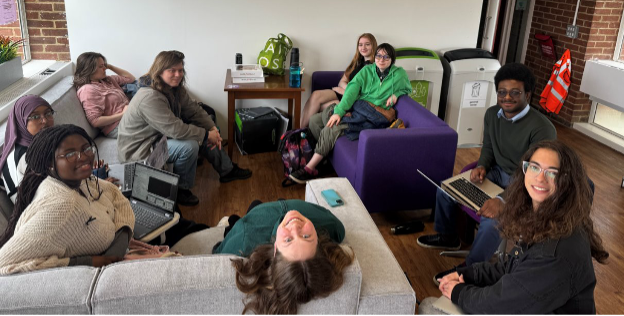
We had three missions. We will create an inclusive community where students feel their value in the society. We advertised our meeting on our career’s Canvas page initially in October 2024 and the community grew to 60 UG/PGT/PGR students from across the Faculty of Science, Engineering, and Medicine as well as from the Faculty of Social Science over the following 9 months.
Creating communication lines
Another anecdotal take home here was the importance of keeping good communication. We cocreated a Canvas page for STEM volunteers/ambassadors with the participating students. This allowed students to own the community and to learn developing html-based web pages and to communicate with each other on Canvas.
Providing outreach opportunities
Daniel and I are members of the School of Life Sciences’ EDI committee and together we supported the EDI lead, Majid Hafezparast and the Athena Swan lead, George Kostakis in organising an event for the International Day of Women and Girls in Science 2025 on the 11th of February. Here are the list of activities created.
- International Day of Women and Girls in Science 11 February 2025
- Student Society Outreach Activity Showcasing Event 23 May 2025
- June Open Day STEM Student Society Outreach Event 7 June 2025
- Supported students to deliver their outreach activity at a local 6th form college BHASVIC on 5 June 2025
Provided travel expenses for UG outreach
With the EI Fund, we supported student travel expenses to outreach. Travel expenses are less likely to impact student ability to participate in on campus outreach during the term time. However, Open day outreach events are scheduled on weekends and this can become a barrier for some students. On this assumption, we set aside funds to support students. The outcome of this is that we now have an estimate of cost to support students on weekend activities.
Why we did it
Science, Technology, Engineering, and Maths for STEM Ambassador scheme organised by STEM Learning is one of the perfect ways to integrate students’ passion for the STEM topics with skill sets such as timely communication, collaborative experience, community building, resourcefulness, initiative, and career preparedness. STEM Ambassador scheme is run entirely on volunteering by the members.
Volunteer experience is said to be valued by more than 80% of potential future employers (2016 Deloitte Impact Survey). While many of the doctoral training programmes and PGR students have access to funding for outreach travel support etc, there is currently no support for UG and PGT students.
Our main objective was to support UG/PGT students studying STEM subjects to develop STEM outreach skills, to build the STEM volunteering community, and to co-create STEM outreach opportunities on campus.
We supported UG/PGT students individually to connect with each other and to find the common interest in STEM outreach. We also connected with many STEM student societies develop hands-on activities along with exhibiting their findings to build STEM outreach.
Our approach to date is to signpost STEM volunteering opportunities to the Career’s Hub, which itself is a great way for our students to find what they want. Such activities can be led by academics in the School or in most cases students decide whether to join or not. Currently, there isn’t any resources nor support for organising Life Sciences students to become a STEM ambassador.
How It Went
Nearly half of the 60 student volunteers engaged in attending and participating in outreach activities and a quarter of the group are registered as STEM ambassadors with public profile since we started in October 2024. Four student societies, Women in STEM, Interdisciplinary Sciences, Neuroscience, and Wild at Sussex, contributed and created posters and outreach activities. We collaborated with many more professional services including the central open day team. Together, we were able to run an outreach event during the June Open Day in 2025.
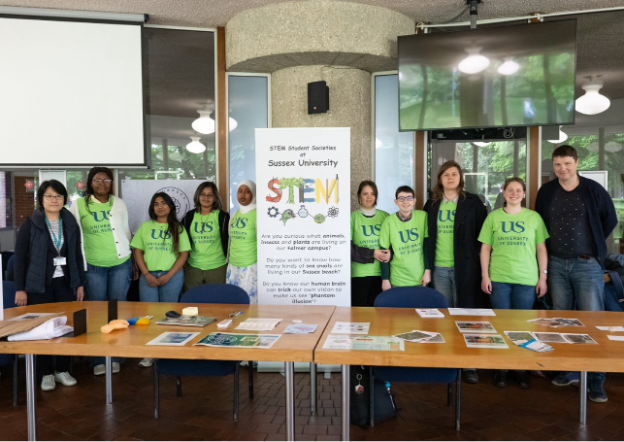
Students nominated us for the Teaching Awards in 2025 clearly appreciated the support from us and the university.
Haruko advances STEM engagement at the University of Sussex through citizen science projects like PhotoFolia, ColourWorker and Shelltering Sussex while fostering an interdisciplinary community that champions innovative learning.
She hosts weekly open meetings that provide tailored guidance on topics ranging from JRA proposals to Student Society outreach events. These sessions ensure students’ ideas are heard and nurtured, empowering them to explore subjects beyond their curriculum and contributing to a more diverse and inclusive academic environment.
Beyond routine academic support, Haruko actively creates spaces for cross-disciplinary dialogue, encouraging students from non-STEM backgrounds to engage with scientific methods and concepts. This approach has broken down traditional barriers and sparked creative collaborations, with her group now including students from IDS, Global Studies, and Life Sciences…Haruko has boosted participation among groups less likely to engage with STEM, underscoring the relevance of science and celebrating campus diversity…Haruko Okamoto’s passion for collaborative learning and innovative education makes her and her team outstanding candidates for the award, as they continue to inspire and empower students.
Nomination endorsed by the student societies ‘Interdisciplinary Sciences Society’ and ‘Wild at Sussex’
Future Practice
The STEM volunteering group will continue to meet every week, expand our network, and continue contributing to building STEM outreach community at Sussex. We have plans to develop links with STEM student societies and the Student Union at Sussex to organise outreach events on campus.
Top tips
- Meet regularly at the same time
- Create outreach opportunities on campus where everyone feels safe
- Be inclusive
Acknowledgements
We’d like to thank the funding and support we had for this Education and Innovation Award. We’d also like to thank the Head of School of Life Sciences and the Head of Department of Biochemistry and Biomedicine for their continued support.