


Dr Verona Ni Drisceoil is a Reader in Legal Education and a member of the Education Team, currently leading on Assessment and Gen AI policy, at Sussex Law School. She is a Senior Fellow of the Higher Education Academy (SFHEA), Co-Convenor of the International Connecting Legal Education Network and a Judge of the OUP Law Teacher of the Year Award.
Introduction
In the Spring Term of 2025, I, along with my colleagues Jeanette Ashton and Jo Wilson, ‘walked with’ nine of our first-year students to better understand and explore what community, belonging and inclusion means for them in the everyday. In this blog post, I share the background of the ‘Walk with Me’ project, a bit about walking interviews and some of the preliminary findings from the project, in advance of a longer piece. I hope these findings will be useful as we all prepare for another academic year. The ‘Walk with Me’ project was supported by the Sussex Education and Innovation Fund.
Background
The start point for the ‘Walk with Me’ project came about from a place of discomfort with our commitments to community and belonging in higher education. Whilst the terms community, belonging and inclusion are commonplace in higher education (HE) policy and viewed as positive and required for an enhanced student experience, there is much less clarity, as I have previously noted, about what the terms really mean and look like for the everyday lived experience of students, and indeed staff, in HE. Drawing on the work of Gravett, Ajjawi and O’Shea, I argue that we need to challenge our conceptualisation of these terms as they relate to both students and staff and the perceived frame within which community and belonging sits in HE.
Set against the challenges presented by increased student numbers, post pandemic trauma, the cost-of-living crisis, low attendance and poor mental health, this project, utilising walking as a research method, set out to walk with students to help better understand community, belonging and inclusion in the everyday. This approach (walking with students 1-2-1, side by side), as opposed to more traditional surveys and student group interviews, hoped to shift the power imbalance somewhat and to provide for more meaningful and authentic opportunities for spontaneous and holistic conversation about self and being within what can often become rather abstract or superficial conversations about community and belonging in HE.
Why walking interviews?
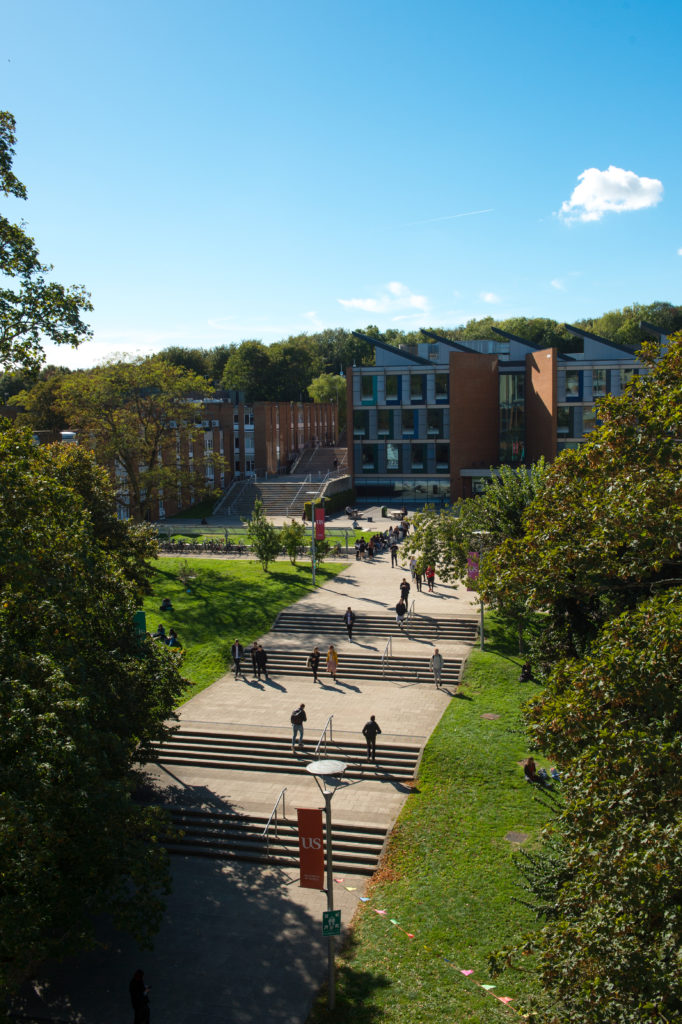
Walking as a research method, often referred to as walking interviews or mobile ethnography, has gained popularity in qualitative research due to its unique benefits (See O’ Neill & Roberts, 2019). It has been used widely in geography and more recently in health studies, criminology, and education. As researchers, it was not an approach we were familiar with, but we all felt drawn to engaging in a research approach that felt deeper, and more relational (see Gravett, 2023). According to O’Neill & Roberts, walking interviews allow the researcher to engage with participants ‘on the move’ in a more natural and holistic way, thereby providing insights into daily lives and experiences. The act of walking, they write, ‘engages the senses: looking, hearing, the feeling of being touched by air, rain, or other elements of the environmental atmosphere, and contact with changing aromas’ (O’Neill & Roberts, 2019:16) On the elements, we certainly experienced them all – cold, rain, wind, and sunshine. We all agreed that if we were taking this approach again, we would give more thought to the timing of the year. So, something to factor in, if you are keen to utilise walking interviews! Other things to factor in include time commitments, recording devices and transcription. There are, of course, now several AI tools that can be used to transcribe audio recordings, but this may not be allowed within your ethical review so do explore in advance.
The unique benefits…
On the unique benefits that O’Neill & Roberts speak about, as researchers we felt a more meaningful connection with the participants through this research. The student participants also spoke positively about the experience; how they enjoyed the conversations and building a connection with us. For us, as we moved through the term, the interviews (but felt more like conversations, and that is the point) moved into deeper discussions on a range of community and belonging issues including accessibility and the lack of accessibility on campus (one of our participants is visually impaired), race, class, discrimination, faith, and physical spaces – and how all can impact belonging, and a sense of community. In some respects, the conversations reinforced much of what we knew but it’s quite different when a first-year student walking side by side shares their personal story and journey of what community, belonging, class, race and exclusion feels like in the everyday. That ‘you have to be selective about events you go to in welcome week because of cost’, that ‘I was worried about racism in this country before starting university’, or that ‘I sometimes feel more connected to my teacher than other students’.

Some preliminary findings…
As researchers, we all felt this project was different – it felt more meaningful and relational. The stories and voices of the project were powerful. There was space and time to hear the nuance and challenge our own biases and practice too. Belonging, and community, is not, as Ajjawi, Gravett and O’ Shea write, a homogeneous experience. In fact, belonging can be ‘political’ (see Yuval-Davis, 2006). It can be ableist (Nieminen & Pesonen, 2021). The stories of this project landed in a way that served as an important reminder to us as legal educators to be mindful of how our students, all with their own story and lived experience, are navigating through our law schools and campuses – and that for students not from the global majority, the challenge can be greater; that community, belonging and ‘inclusion’ events can be exclusionary, and reinforce barriers to connection and relationality. Who gets to belong?
Below, I highlight four preliminary findings from the project:
- Many of our students value their faith; that it is part of belongingand it can help them through difficult periods of the academic year. By admission, we weren’t expecting this to come through as strongly as it did. When we talk to students about wellbeing, friendships, academic and personal challenges, recognise that faith might be a key part of a student’s identity and life and hold a space for that.
- Students value meaningful connections with their teachers. It is probably fair to say that when we speak of community and belonging, we often focus on creating spaces ‘for’ students, rather than ‘with’. Many students value connection with their teachers as well.
- Social and extra-curricular have a place in our efforts to build community and belonging but it is important to also focus on what happens in the classroom. Our default to the social and extra-curricular as sites of, and for, building community and belonging, and often inclusion, though understandable, can be problematic, and can lead to “feel good” visible performativity rather than meaningful interventions and attention for all students in the academic sphere. Moreover, the framing and over reliance on the social can be particularly problematic in a cost-of-living crisis when we know that many of our students are now commuting or forced to work 20 to 40 hours a week to pay rent and bills. Coming to campus for additional social, ‘community’ orientated (community for who?) events may no longer be feasible or a priority for many of our students.
- Build an enabling environment. Teaching structures, timetables and physical environments matter in terms of how students experience and ‘feel’ community and belonging. Have you ever thought about how the timetable and/or layout of your classroom hinders or supports connection? Is there anything you can do to design a more meaningful learning experience for all students such as changing the layout of the room.
References
Ajjawi, R., Gravett, K., & O’Shea, S. (2023). The politics of student belonging: Identity and purpose. Teaching in Higher Education, 28(1), 1-14.
Gravett, K., & Ajjawi, R. (2022). Belonging as situated practice. Studies in Higher Education, 47(7), 1386-1398.
Gravett, K. (2023). Relational pedagogies: Connections and mattering in higher education. Bloomsbury Academic.
Gravett, K., Ajjawi, R., & O’Shea, S., Belonging to and beyond higher education in hybrid spaces (Society for Research in Higher Education 2023). Available: https://srhe.ac.uk/wp-content/uploads/2023/06/Karen_Gravett_Award_Report.pdf;
Moore, I., & Ní Drisceoil, V. (2023). Wellbeing and transition to law school: The complexities of confidence, community, and belonging. In E. Jones & C. Strevens (Eds.), Wellbeing and transitions in law: Legal education and the legal profession (pp. 18-19). Palgrave Macmillan.
Ní Drisceoil, V. (2025). Critiquing commitments to community and belonging in today’s law school: who does the labour? The Law Teacher, 59(2), 181–199.
Nieminen, J., & Pesonen, H. (2021). Politicising inclusive learning environments: How to foster belonging and challenge ableism? Higher Education Research & Development, 41(6), 2020
O’Neill, M., & Roberts, B. (2019). Walking methods: Research on the move. Routledge.
Yuval-Davis, N. (2006). Belonging and the politics of belonging. Patterns of Prejudice, 40(3), 197-211.