
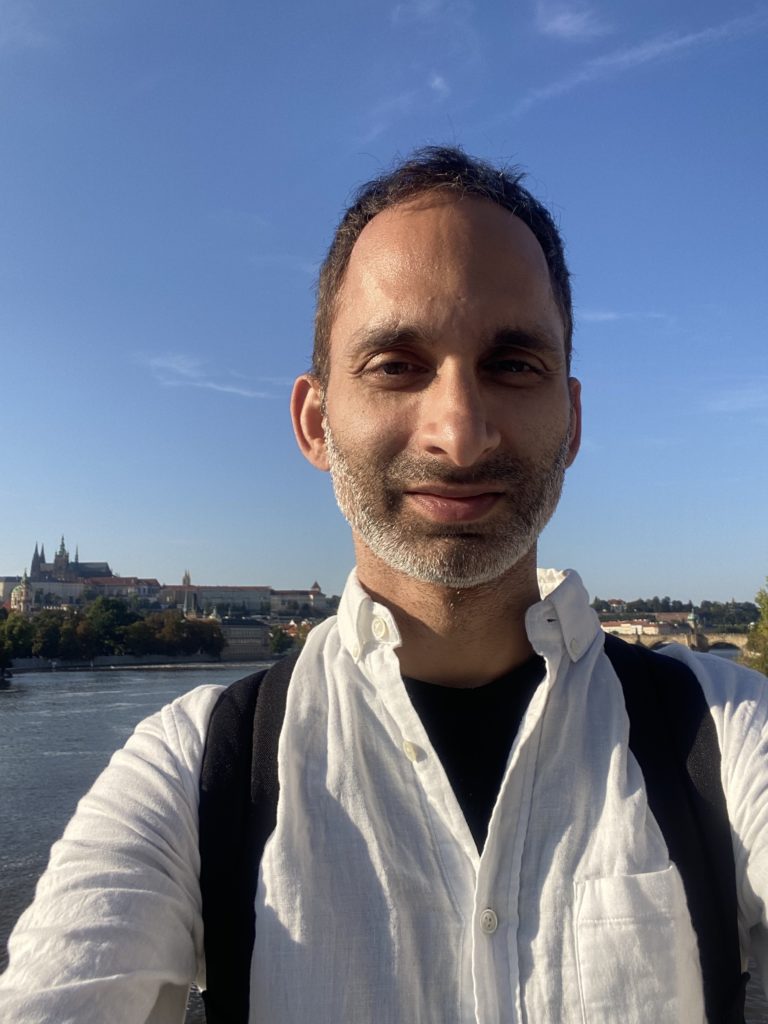
Dr. Adhip Rawal, Assistant Professor in Psychology
My work as an Assistant Professor in Psychology has focused on relationality and the connection between head and heart. I believe there is consciousness in the heart and this way of embodied knowing is important to the future. I would like to see a commitment in education to protect the inspiration of young people for their life paths, but we have constructed a reality opposed to this knowledge where we are pressured to suspend what deeply engages us and has the capacity to transform the world. I feel there are students who are no longer willing to accept these dilemmas of an education that fails to bring meaning to their lives. I would like to find people who are interested in the work of transparent communication and re-imagining the healing impulse of education. Stay in touch: Deep Callings: Liberation of the Heart. The project discussed below is an Education and Innovation Fund project, the fund aims to drive positive changes in how we deliver our teaching and learning experience by stimulating student and staff co-creation and rewarding innovation and teaching excellence.
Who is looking for you?
A North American television broadcaster commissioned a field study some years ago. They recruited 12 people who were strangers to each other from the greater New York area and split them into 6 pairs. Each pair approached Manhattan from a different direction and their challenge was to find the other 10 people, who were also somewhere in Manhattan, an area of 1.7 million people. They were given $100 for transportation and nothing else. It took them 3 hours to complete this task. We are equipped to finding each other and there is something powerful about an intention which is shared. In my time at the University of Sussex, almost every day came with an impulse to wander the campus, because of some deep and palpable longing. During those hours of meandering there would often come a moment where my path crossed that of another person who was also wandering and longing to know something about their lives. After several of these kind of experiences, I began to ask myself whether there was something about humans searching that was so attractive that a meeting could come about between these people to engage something essential. Does the heart know when another heart is in range for the possibility of deep and just conversation? Is that not possible, that people are looking for each other because their hearts have something to say?
There is an evolution that happens when a person can bring a deeply felt inner possibility into expression. It reveals a source of knowing that re-organises the will and protects the young person from being overshadowed by external influences and values. Suddenly there is the company of someone whose expression carries a seed of the future.
It is remarkable what possibilities can be recovered when we are freed from someone else’s aspirations and left to our heart’s reality, even if for a moment. That moment can be enough to intuit a deeper knowing that becomes a light in the mind and to what we conceptualise as reality. These intimate encounters, though they took place during the day, felt like they opened a window to the night sky where the heart is still pondering dreams of ‘What could be’’? There is an evolution that happens when a person can bring a deeply felt inner possibility into expression. It reveals a source of knowing that re-organises the will and protects the young person from being overshadowed by external influences and values. Suddenly there is the company of someone whose expression carries a seed of the future.
In psychological language, such moments are a relativisation of the ego: “There are higher things than the ego’s will, perhaps my unconscious is forming a personality that is not me, but which is insisting on coming through to expression’’ (Jung, 1963). It seems there is something within our nature that is not neutral and carries a predisposition to begin. Hannah Arendt (1993) once said: ‘with the creation of man, the principle of beginning came into the world…And this again is possible only because each man is unique, so that with each birth something uniquely new comes into the world which cannot be expected from whatever may have happened before’.
Will you help me read my heart?
My work centres on paying attention to the impulses that speak to the potential beginning that lies latent in the heart of the youth. Is it really such a strange idea that an open heart generates human development and yields awareness of deeper dimensions of existence? The poet Arthur Rimbaud once expressed this need to find oneself through someone else’s eyes, which I have seen in my students who are longing to be seen for who they could become, when he said: “We are in the month of love; I am nearly seventeen…I’ve got something in me, I don’t know what, what wants to soar”. Even muscles have memory and there can be a chain reaction in a young person’s heart that becomes their future when they are communicated with in a way that provides the vital impulse of love. My students have, sometimes with tears in their eyes, asked me to support their future: “Something you said in a lecture one or two years ago is the reason I am here. It touched me. Can we make this the semester of the heart?’. This relational agreement that sets free a person’s self-expression is not one mediated by knowledge but by the experience of resonance that comes about by the sharing of presence and the building of bridges over which the ontological signals that help us understand our gifts can travel between us.
Do you love the future?
There is something that consents to such a request of a young person to know their inner life for the process of self-discovery and the project ‘Stories of the Heart: Who We Are & What We Know’ is part of this human development initiative to understand and resource these people with their own resilience and gifts. It tells of the life paths of five students and is exploring their longings, hardships, turning points, and aspirations. It is based on an intention to create space for a way of sharing that allows deeper levels of a person’s biography, life meaning and potential to be present than tends to be possible in typical interactions where they are secluded behind layers of shame, defence and politeness.
Towards the end of his life Sigmund Freud confessed that his destiny necessitated him to remain a man of letters, while a doctor in appearance. The letter is a vehicle of affection and suggests there is more than function and physiology, the soul is reminiscing in the heart. It draws attention to the idea that we carry a capacity for deeper subjectivity, but this can remain latent if the rational mind does not give authority to other modes of knowing that express the meaning and beauty of a human life. Essential information that comes to us to create our sense of self necessitates a vicinity to the heart. Have you not heard the whisper that was in accord with your path? The story of the heart is your deep story, under the surface. It comes from abandoned places and re-cycles what the self has lost. Periods of isolation often take a person’s self-attentiveness to its farthest reaches and are ones when the young person must be able to communicate what they become aware of to ease their suffering. This awareness includes a space of the heart in which a stream is sourcing knowledge from the future. A Czech proverb says, there are people who are gazing at God’s window, and I have worked with students who know this place that receives consciousness of the spiritual world and its guidance for the youth. This inner space of the heart, or ‘Herzinnenraum’ as Rilke called it, gifts a person with a knowing of what is theirs to love in the world. This care is rooted in what Alfred Adler called ‘Gemeinschaftsgefühl’, the feeling for community, which connects self and world into an awareness that sustains life and completes someone else’s joy.
I believe these people are telling us what kind of discourse and sacrifices they need from us to mentor their intelligences. I also believe education needs to invoke a mode with heart so it can be a context that facilitates a person’s self-recovery and understanding of the world. It is not enough to have a heart; we need to trust it and there is a development that takes place when we engage with the heart’s curriculum.
There is a legend that lion’s cubs are stillborn. Another lion awakens them. The first participant of this project spoke for 6.5 hours. I believe these people are telling us what kind of discourse and sacrifices they need from us to mentor their intelligences. I also believe education needs to invoke a mode with heart so it can be a context that facilitates a person’s self-recovery and understanding of the world. It is not enough to have a heart; we need to trust it and there is a development that takes place when we engage with the heart’s curriculum. But my time in academia is ending. I made a commitment to develop this work to the limits of my understanding and then look for help. I no longer believe that this will come from the university. In all my years of wandering the campus, the people I met were always students. Maybe academics do not wander. But there is a feeling that I must follow deeper callings and that somewhere, someone is looking for me.
I often have to think of you, especially when I am thinking of the future. It is quite extreme, through our conversations, I have the feeling that a wholly new resource is with me, which I was not paying attention to before. I am using this resource now to better understand what my needs and longings are, but also my fears and things where I am stuck or hung up. I am so grateful I have found a new channel of experience and knowing, with your help. I wanted to thank you for this. It’s somehow funny isn’t it that one ignores natural resources the psyche gifts us.
Participant
References
Adler, A. (1998). What life should mean to you (A. Wolf, Ed. & Trans.). Hazelden. (Original work published 1931)
Arendt, H. (1993). The human condition (2nd ed.). University of Chicago Press. (Original work published 1958).
Freud, S. (1992). Letters of Sigmund Freud. (E.L. Freud, Ed). Dover Publications. (Original letters written between 1873-1939).
Hanson, E. (1960). My poor Arthur: A Biography of Arthur Rimbaud. Henry Holt. (Original letters written 1870–1891).
Jung, C. G. (1963). Memories, dreams, reflections (A. Jaffe, Ed.; R. & C. Winston, Trans.). Vintage Books. (Original work published 1961).
Rilke, R. M. (2005). The poetry of Rilke (E. Snow, Trans. & Ed.). North Point Press.