
Dr. René Moolenaar is an Associate Professor in the Strategy & Marketing department of the University of Sussex. He is also a Director of a Management Consultancy and Non-Executive Director.
Disconnect to Reconnect: Experiential Learning on the Sussex MBA
Innovative teaching and learning are at the heart of the Sussex MBA. In an environment where students spend so much of their time inside at their desks looking at screens, René is taking a new approach.
What I did
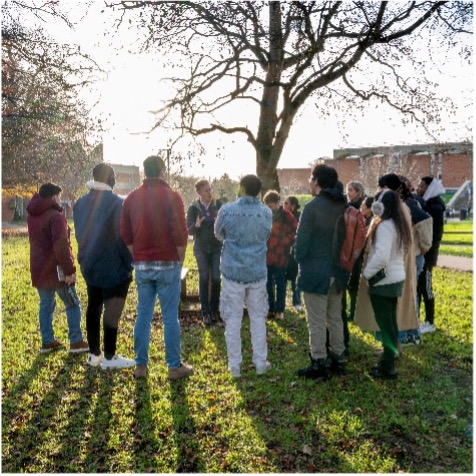
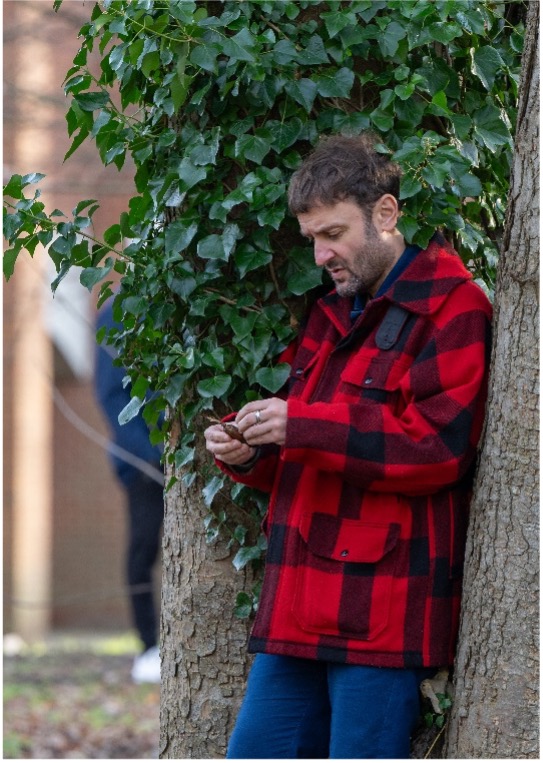
The ‘Digitally Disconnected and Mindfulness’ marketing task is a teaching session where MBA students are encouraged to ditch their laptops and phones, allowing them to focus entirely on feeling connected to the natural world around them.
Taking full advantage of the beautiful and leafy green campus, MBA students step into a new type of classroom. After finding a quiet space, students focus on their breathing and use four of their senses (sight, touch, smell, and hearing) to explore their surroundings and create an experiential marketing campaign inspired by nature.
“There is something about being in nature when having to complete a task. Particularly after practicing some basic mindfulness; it brings a level of calmness and a different perspective on the challenge to be resolved. I just love giving students this unique experience.”
Dr. René Moolenaar, Associate Professor in Strategy
Why I did it
The decision to develop a nature-based activity was first and foremost my own interest and experience of learning in nature. Having practiced mindfulness in nature, I experienced first-hand the inspirational and creative effects. This activity embodies experiential learning principles (Kolb and Kolb, 2005) by immersing students in an outdoor experience where they actively apply marketing concepts in an unfamiliar yet real-world setting. Research by Williams (2017) highlights the psychological and cognitive benefits of exposure to nature, suggesting that time spent outdoors can enhance mental well-being and creativity. Whilst listening to nature sounds restores attention (Gould van Praag et al., 2017) and Kerr and Maze (2019) promote looking up and out on nature has a range of neurological benefits. Therefore, in the context of marketing, where innovation and originality are highly valued, nature provides a conducive environment for students to think beyond conventional ideas and actively engage in more innovative problem-solving.
Impact and student feedback
Working in a practical, creative environment gives students a fresh perspective. One student commented: “It was truly a great experience. I may be implementing something similar at work, maybe ‘walking meetings’ or ‘walking 1:1s’ using the park next door to the office.”
Sustainability is central to teaching and learning at the University of Sussex Business School, and after the session one student reflected on how nature never lets anything go to waste. They observed: “Woodlice repurposed an empty snail shell. It was a beautiful lesson in sustainability and resourcefulness.”
“In marketing, just as in nature, when a product or strategy no longer performs as expected, it’s not necessarily useless. With creativity and adaptability, it can be transformed to meet new needs and provide fresh value. This reinforces the importance of creativity and innovation in our marketing approaches, ensuring that we can continuously create value, even from seemingly obsolete resources.”
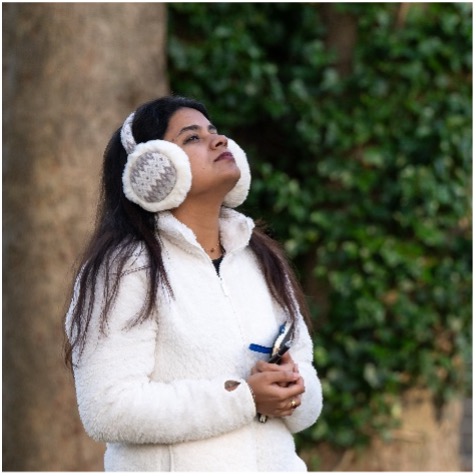
The Sussex MBA’s Mindful Marketing task exemplifies how breaking away from conventional methods and utilising our beautiful campus can lead to profound educational experiences. By fostering a deeper connection with nature and encouraging creative thinking, this activity prepares students to tackle real-world challenges with a fresh perspective and a commitment to sustainability – a highly valuable skill.
Future practice
Nature-based learning has strong potential for transferability across disciplines beyond marketing management. For example, psychology students could use a similar activity to study the cognitive benefits of nature-based mindfulness, while environmental science students could observe ecosystems firsthand and develop conservation ideas inspired by their findings. This interdisciplinary applicability aligns with Sobel’s advocacy for place-based education, which connects learning with real-world settings to make it more relevant and memorable (Sobel, 2004).
Place-based education fosters a deeper appreciation for the natural environment, making it an excellent approach for fostering sustainability-focused learning in various fields. Inclusivity was considered in developing this activity, offering students the option to stay closer to the Business School. Furthermore, pre-activity briefings were used to prepare students and ensure appropriate clothing for the anticipated weather conditions.
I am planning to develop this activity further by finding ways to facilitate even greater connection with nature for the students, explore the difference between different nature environments such as water and fields that have just been harvested. I am also interested in exploring how this activity could be applied to larger cohorts.
Top tips
- Break-away from the traditional teaching spaces and explore how campus can become your Mindful classroom.
- Prepare students with a detailed brief for the activity once you have settled on an activity (check for any anxieties or need to stay connected because of caring responsibilities).
- Just do it 😊 even if the weather isn’t quite kind, students are often less concerned than you might be.
- Enjoy!
References
Gould van Praag, C. D. et al, (2017). Mind-wandering and alterations to default mode network connectivity when listening to naturalistic versus artificial sounds. Scientific Reports, 7, Article 45273.
Kerr F. and Maze L. 2019. The art & Science of looking up: Transforming our brains, bodies, relationships and experience of the world by the simple act of looking up. www.lookup.org.au
Kolb, A. Y., & Kolb, D. A. (2005). Learning styles and learning spaces: Enhancing experiential learning in higher education. Academy of Management Learning & Education, 4(2), 193–212.
Sobel, D. (2004). Place-Based Education: Connecting Classrooms and Communities. The Orion Society, Great Barrington, MA
Williams, F. (2017). The Nature Fix: Why Nature Makes Us Happier, Healthier, and More Creative. United States, W.W. Norton