

Jeanette Ashton & Dr Verona Ní Drisceoil
Jeanette Ashton is an Associate Professor in Law (Education and Scholarship) and a non-practising solicitor. She is a Senior Fellow of the Higher Education Academy (SFHEA), leads on Employability for Sussex Law School, and was an Oxford University Press (OUP) Law Teacher of the Year finalist in 2025.
Dr Verona Ni Drisceoil is a Reader in Legal Education and a member of the Education Team at Sussex Law School. She is currently leading on Assessment Policy. She is a Senior Fellow of the Higher Education Academy (SFHEA), Co-Convenor of the International Connecting Legal Education Network and a Judge of the Oxford University Press (OUP) Law Teacher of the Year Award.
Introduction
In a higher education access and equity context, Thomas (2012; 2024) has long spoken about the importance of building an ‘enabling environment’ and a ‘whole provider’ approach for belonging, academic growth and retention. In this blog post, we draw on Thomas’ concept of building an enabling environment at modular level. Through deliberate design, thoughtful delivery and sustainable assessment we share how we have sought to build an enabling and empowering environment in a new Level 5 Professional Skills: Law in Action module (“the module”) at the University of Sussex. Informed by initial findings from a mixed methods study [C-REC Ref No: 2025-0205] exploring the impact of the module after a year, we consider three emerging themes: relationality, human flourishing, and sustainability. We do this to illustrate what can be achieved in a skills-based module of this kind specifically from a widening opportunity and employability standpoint but also to demonstrate what can be achieved in more traditional content focused modules. Ultimately, we argue that, in a world of generative AI, we must cultivate spaces and time for relationality, human flourishing, and more active and experiential learning. In essence, we must make the time we have with our students, in the classroom, count.
Why introduce a Professional Skills module?
Facilitating professional skills development in a legal education context is not new and has been a priority for some time. It was, for example, a key strand of the UK Legal Education and Training Review in 2013. At Sussex Law School, we run a suite of co-curricular activities including client interviewing, negotiation, mooting (arguing a case in a court-like setting), and mediation. These are all designed to give students exposure to a range of professional legal skills. Participating students benefit greatly, not only from the specific skills development aspect, but from the opportunity to network with local practitioners, who support the activities. Additionally, our final year Clinical Legal Education module (“CLE”) offers approximately 130 students the opportunity to work in an advisory capacity alongside practitioners in ‘Clinics’, providing free legal advice and public legal education to the local community. Again, the benefit to students is significant and includes gaining experience of practical legal work and the opportunity to work with practitioners, enhancing their employability.
However, with an average of 350 students per year group on the undergraduate law LLB programme, most students do not participate in either the co-curricular skills programmes or CLE. As Ashton and Basuita (in Millmore 2024; 262) note, a limitation of co-curricular skills programmes is that, unsurprisingly, it is often the most privileged students that put themselves forward. Those that already have significant social capital find it easier to navigate these opportunities. Students with caring responsibilities, those needing to work to support their studies, or commuting students may not be able to take part and therefore prioritise credit-bearing learning.
Our broad aim then was to develop a credit bearing module for students to develop a range of key professional and transferable skills, particularly those skills identified by our Employer Advisory Board. It was important for us to attract, and support, students unable to partake in our co-curricular offerings. In 2025/26, 55 students enrolled in this new second year optional module.
How did we design the module?
With skills development, active learning and widening opportunity as drivers, we took an innovative approach to the module design. Eschewing the traditional lecture/seminar format in law in favour of weekly two-hour workshops to allow for more experiential learning, the module included several innovative design features:
- students work in ‘law firms’ complete with mission statement;
- embedded oracy and presentation skills;
- critical AI literacy;
- Generative AI information literacy for the workplace;
- weekly independent reflection through workshop ‘exit tickets’; and
- career management.
For the generative AI information literacy for the workplace and career management workshops we worked in collaboration with colleagues from the Library and Careers and Entrepreneurship, Nick Heavey and Helen Gorman respectively.
The ‘consultancy work’ feature
Particularly unique to the module is a block of embedded consultancy work whereby the students, in their ‘law firms’, work on live briefs over three weeks to conduct legal research for local community organisations. This year the students engaged in issues such as law of the shore, copyright, GDPR, defamation and mental health legislation.

‘Work in progress interview’ assessment
The module culminates in a live in person assessment framed as a ‘work in progress’ interview, whereby the ‘trainee lawyers’ explain their process for a piece of authentic legal drafting (Letter before Action) and showcase their suitability for a fictional newly qualified (NQ) solicitor role. In this respect, the assessment can be described as process oriented and sustainable. (Boud et.al., 2000). Sustainable assessment, for Boud, is assessment that ‘encompasses the abilities required to undertake activities that necessarily accompany learning throughout life in formal and informal settings’ (2000; 151). One student participant spoke directly to that sustainable aspect. They wrote:
“The Work in Progress interview was incredibly useful, as I really felt like I was in an interview for a real job offer. Therefore, I could practice my interview skills before I even start applying for training contracts.”
Emerging themes from the preliminary findings
Given the nature of the module, particularly the consultancy co-created aspect, we were keen to fully understand how our ‘trainee lawyers’ found the module and potential impacts and benefits for the collaborative partners (library and careers) and the community organisations who set the live ‘briefs’ for our students. The findings from the study will be developed in a fuller paper, alongside a practical toolkit, but for now we touch on three key themes emerging from the data.
1. Community, belonging and relationality
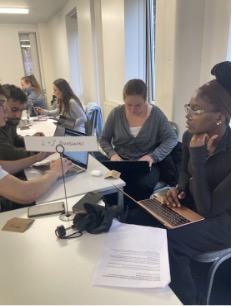
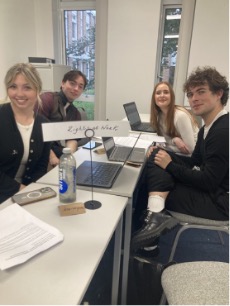
Drawing from previous research in this area (see further Ní Drisceoil 2025), Hodgson’s “let’s get back to basics on belonging”, and Gravett’s work on relationality and ‘mattering’ (2023), we took deliberate steps to try (there is no guarantee) to cultivate an inclusive space to ensure everyone could connect and feel they belonged, and mattered, in this module. From an environmental standpoint (the physical ‘matters’ Gravett speaks about), the first step we took, in week 1, was to set up the teaching spaces in café style table groupings. Students were then tasked with ‘Set up your own Law Firm’, with complete mission statement and objectives. This week one task set the tone for the module. Every week students would sit together and work together in their ‘Law Firms’. Not only was this focus key from a building community perspective, but we were also cognisant of the need for the ‘trainee lawyers’ to establish good working relationships with their ‘colleagues’, which we felt would be essential for the success of the consultancy project.
Throughout the module, it was clear that the students valued forming connections with each other, and with us. As the module progressed, we had the sense of a steady growing of friendships, collegiality, and confidence, particularly, around voice work. This growing confidence was borne out in the study findings, with one student commenting on being “excited to come to class and learn” and another speaking to the group aspect and the opportunity for growth:
“Working in these groups was a great opportunity to learn from those in my group, develop my team skills and also further improve my presenting skills. It was refreshing to work in a setting where I wasn’t alone in a project, I had people to rehearse with, to give feedback to and advice. This made the whole project a lot more comfortable and allowed me to work to my best.”
2. Human flourishing
Closely linked to investing in community and belonging, perhaps a consequence of it, is human flourishing and agency. Given the workshop design and focus of this module, we, as teachers, were not front and centre, but worked in a more facilitative role (see further Race, 2014). In active learning, as noted by Betts, rather than the teacher ‘transmitting’ knowledge through lectures or reading, learners engage in a series of activities which require them to produce observable evidence of their learning. Where possible, these individual, pair and group tasks should aim to develop higher order thinking skills, emotional connection with content and tactile or physical engagement with the environment’. Our role in essence was to guide, observe and nudge the ‘trainee lawyers’ working on tasks but in essence we deliberately allowed them to get on with it, make executive decisions together, disagree, discuss, and ultimately manage their own time. In this regard we drew on the work of Hall and Kerrigan who have argued persuasively for the need to “synthesise the doctrinal study of law with an exposure to the practical realities of the law”. A key feature of legal practice is working to a tight timeframe and getting a task ‘over the line’. Students told us they enjoyed how different the module was in this respect – where they had responsibility, and agency. This shift in power structures, focus and classroom dynamic was one they seemed to respond well to:
“This module was a great experience, and I learned a lot from it. It pushed me out of my comfort zone and helped me gain confidence through practical work and collaboration, which I found really valuable.”
3. Sustainability
Finally, sustainability. As per the work of Boud on (assessment) sustainability, the purpose of this module is to support students in developing transferable skills that they can use beyond university. We believe the skills and opportunities, and assessment, provided in this module are sustainable. The transferable skills focus is key here. Maranville argues that the ‘trade-off’ between traditional content, focusing on knowledge of substantive law, and increased experiential learning, is worth it. She suggests that the latter type of learning leads to better retention than that of content which is often lost after assessment. (Maranville, 2001). With this in mind, we felt that being a second-year module, this was ideally placed as a ‘bridge’ between first year and final year and beyond. In short, we wanted the ‘trainee lawyers’ to draw on the substantive law they had been taught in first year for the practical legal tasks we set, and to develop the skills which would help them with both their future studies and as they apply for internships and employment. An example of drawing on prior learning is the final assessment (the in person ‘work in progress’ interview), where students were required to produce and respond to questions on a ‘letter of claim’, situated in the legal arena of contract law, which they had all studied in first year. Looking forward, alongside the key transferable skills of teamwork, communication, presentation and project management, in the ‘Information literacy for the workplace’ workshop and in the consultancy project, they undertook legal research on unfamiliar areas of law, many of which feature in final year optional modules. Our hope, therefore, is that the module’s impact, and particularly the assessment, goes beyond the 15 credits awarded. Students recognised this ‘value after university’ aspect:
“This approach created such valuable unique opportunities which will apply to life after university. Instead of just learning content we could grow our skills and replicate real life experience that we might face in the future. It was challenging at times, but the hard work was worth it, and in the end, I feel it has prepared us for our future careers.”
Concluding thoughts
Our experience, and the student reflections shared here, point to the value in building an enabling and empowering environment to help students connect with each other, us as teachers, and with the community outside of the university. Connection and relationality matters. The research also points to the powerful impact of active and experiential learning and providing meaningful insights into the realities of professional life, particularly for students that might not have the same opportunities. Whilst designing and delivering the module certainly required more time than a standard module, the experience of this first iteration has been a joyous endeavour and a teaching highlight for both of us; one where we were able to bring different skills, strengths and passions to the fore – and build meaningful connections with our students. Ultimately, we argue that, in a world of generative AI, we must cultivate spaces and time for relationality, human flourishing, and more active and experiential learning. As we said at the outset, make the time you have in the classroom with students count.
References
Ashton, J. & Basuita, P. (2024) ‘Professional Legal Skills: Building in and feeding forward – a client interviewing skills programme’ in Millmore, A. (ed) How to Include Employability in the Law School: Elgar, 253 to 264.
Boud, D. (2000). Sustainable Assessment: Rethinking assessment for the learning society. Studies in Continuing Education, 22(2), 151–167.
Gravett, K. (2023). Relational Pedagogies: Connections and Mattering in Higher Education. Bloomsbury Academic.
Hall, J. & Kerrigan, K. (2011) ‘Clinic and the wider law curriculum’ International Journal of Clinical Legal Education (15) 25-37.
Hodgson, R. (2024). ‘Time to go back to basics on belonging’ (Wonkhe) available at https://wonkhe.com/blogs/time-to-go-back-to-basics-on- belonging/
Kolb, D. (1984). Experiential Learning: Experience as the Source of Learning and Development: PTR Prentice-Hall, New Jersey.
Maranville, DA. (2001). ‘Infusing Passion and Context into the Traditional Curriculum through Experiential Learning’, Journal of Legal Education, 51(1) 51-74.
McConlogue, T. (2020). Assessment and Feedback in Higher Education: UCL Press.
Ní Drisceoil, V. (2025). Critiquing commitments to community and belonging in today’s law school: who does the labour? The Law Teacher, 59(2), 181–199.
Race, P. (2014) Making Learning Happen: 3rd edition, London: Sage.
Thomas, L. Final Report: ‘What Works?’ Students Retention and Success Programme: Building student engagement and belonging in Higher Education at a time of change (Paul Hamlyn Foundation/HEFCE/Higher Education Academy/Action on Access, 2012).
Thomas, L. (2024) ‘What is a whole provider approach to widening access and student success?’ (Wonkhe, 5 June 2024).
Webb, J., Ching, J., Maharg, P. & Sherr, A. Setting Standards: The Future of Legal Services Education and Training Regulation in England and Wales (Legal Education and Training Review 2013) available at www.letr.org.uk/the-report/index.html