

In this case study, Dr Doug Haynes, Reader in American Literature and Visual Culture, discusses the creation of the interdisciplinary Liberal Arts BA at Sussex.
What we did
In collaboration with an Advisory Board that assembled specialists from museums, activist organisations, think-tanks, NGOs, journalism, broadcasting, PR and communications, we developed a degree that combines theory and practice across the arts, humanities, and social sciences. Working with experts in different academic fields, Liberal Arts students at Sussex use interdisciplinary thinking to tackle complex problems and global challenges as well as develop skills in a range of media and methods with which to articulate their knowledge. Students also work with our external partners to transform research into practice as they design campaigns and policy initiatives, or work with museums, writers, and activists. All students also undertake a substantial final year project in the community.
Why we did it
We wanted to show the importance and relevance of the humanities and social sciences at a time when they are being increasingly devalued. And we wanted students to experience the practical applications of these subjects in order to understand their capacity to make active contributions to the world.
Studying the humanities doesn’t have to be disconnected from real life. In fact, putting the discourses of the humanities and social sciences in conversation with one another, and with real-world issues, creates new kinds of knowledge and allows for degrees to be shaped in new ways. Approaching global problems from different perspectives cuts across disciplinary boundaries and encourages students to apply concepts creatively, addressing and reflecting on the most pressing issues that face us today. In this sense, the Liberal Arts degree recalls Sussex’s interdisciplinary roots to offer a disruptive and innovative contemporary learning experience. We developed this degree with Sussex’s employability initiatives specifically in mind: our pedagogical strategies were planned in direct dialogue with our Advisory Board members from a range of sectors. Interdisciplinary learning fosters critical thinking and innovation because it asks students to synthesise ideas and consider alternative ways of acquiring knowledge, but we also teach critical and life-skills that have direct application to a range of sectors.
Impact and student feedback
The Liberal Arts degree at Sussex asks students to think outside of the disciplinary confines that they are used to from studying A-levels. Thus, at first, they can feel a bit confused as they are challenged to think in more expansive and creative ways. Yet once students feel more comfortable with this new way of thinking, they find it empowering. Students are highly motivated because they can shape their degree based on their own interests. Furthermore, the Liberal Arts degree gives an authentic purpose for learning by connecting theory to the real world.
Challenges
My background in American Studies means that I naturally take an interdisciplinary approach, but in the initial stages of designing the degree, there was some inevitable push back because our approach challenges traditional disciplinary ways of thinking and traditional ways of assessing students’ work. With Curriculum Reimagined, we hope that the Liberal Arts will become a model for disruptive, innovative interdisciplinary learning at Sussex.
Future plans
The degree is very new so we want to continue to foster interest and increase enrollment. To stay innovative and up-to-date, we want to incorporate the use of portfolios as an assessment mode. Portfolios provide a more flexible approach as they will allow us to offer a wider range of assessment modes in the future and to ensure that frequent metacognitive reflection is central to our students’ learning experience.
Top 3 Tips
Interdisciplinary learning is often a new experience for students so it is important to provide a narrative that can help students to connect disparate approaches and topics.
Faculty collaboration is important. It is necessary to know the topics students are covering in different modules so that you can draw on this in your own discussions.
Consider using portfolios to allow for greater flexibility and adaptability.
In this case study, Dr Carli Rowell, Senior Lecturer in Sociology at Sussex, shares her experience of co-creating a Sociology module with first-generation, working-class students.
What I did
I worked with first-generation, working-class Sociology students to co-create the module ‘Class, Culture and Conflict: A View from the Inside’. Students were involved will also aspects to the module design, from helping to choose topics, selecting content material and crafting the assessment mode. Importantly, the students helped me to bring in material from outside the University in an attempt to better understand class inequalities within the UK from the perspectives of working-class people.
Why I did it
I wanted to co-create this module with students because class continues to be talked about within the discipline in an overly top-down way. Despite the inclusion of more working-class academics within Sociology, class as a conceptual tool central to sociological thought is taught through the gaze of the privileged academic in the ivory tower. I thought that co-collaborating with working class students studying Sociology at Sussex would be a great way to centre the working-class voice throughout the module, not just in terms of the issues and things that it looks at, but also in terms of the material that it engages with and draws upon.
Impact and student feedback
Designing this module with students made them feel that their experiences and life history are valid and worthy of academic, sociological enquiry. It allowed students to reflect on their own experiences and connect theories discussed in the module to their own lives.
Challenges
I was attuned to the ethical issues that can arise when seeking to draw upon subjective experiences of social class within HE teaching and assessment. To address these issues, I emphasised that although I was asking students to situate themselves in terms of the class landscape and how they have been affected by class, they did not need to share these insights with everyone. I also encouraged students to be mindful of the language that we use when it comes to class since there is a lot of derogatory language that surrounds class and class-based issues. I wanted to create a safe space, so I approached the subject of class as a potentially sensitive topic.
Future plans
I have recently been awarded funding from Education and Innovation Fund for the project ‘A View from Within: Pedagogy, Practice & Possibilities’. The project, drawing upon student conducted focus groups, and an end of project dissemination event project aims to have a positive impact on the learning experience of all students, by influencing the teaching practice and curriculum design of those working in higher education at Sussex and beyond. It aims to encourage others (beyond the discipline of sociology) to adopt the pedagogical practice of taking “a view from within” as a way of fostering HE curriculums that are inclusive of working-class knowledge(s) thus reflecting the larger society in which UKHE operates within and challenging the classed politics of knowledge production.
Top 3 tips
Collaborate with students to pool interests and resources that go beyond academic understandings such as works by activists, artists and comedians.
Assign auto-ethnographic pieces of reflective writings and diary entries that encourage students to connect their personal experiences with the content covered in the module. This helps to further centre the student voice.

Collaborate with students on the design of assessment. For example, in this module, we decided to include several formative activities that asked students to analyse non-academic material such as poems, song lyrics and documentaries. Thus, both content and assessment in the module were generated by students rather than decided upon solely by me.
The DARE to Transform blog has changed its name to Learning Matters. DARE, which stands for Development, Advancement and Recognition in Education, was a scholarship network established by Dr David Walker and Prof Susan Smith at Sussex in 2019. The DARE network was run by the Academic Development team between 2020-3. In the last three years, it has had many successes:
23 blog posts, with a grand total of over 7000 views
a great programme of guest speakers for the DARE seminar series, including Prof Celia Popovic, Prof Lisa Anderson, and Dr Dawne Irving-Bell
a lively community of practice, which regularly brought together academics from across the University to discuss scholarship ideas, issues and outputs.
A lot has changed in the last three years, David and Susan have sadly left Sussex, the Academic Development team is almost completely unrecognisable from its original 2020 composition, and nobody we’ve ever spoken to can remember what the acronym DARE stands for.
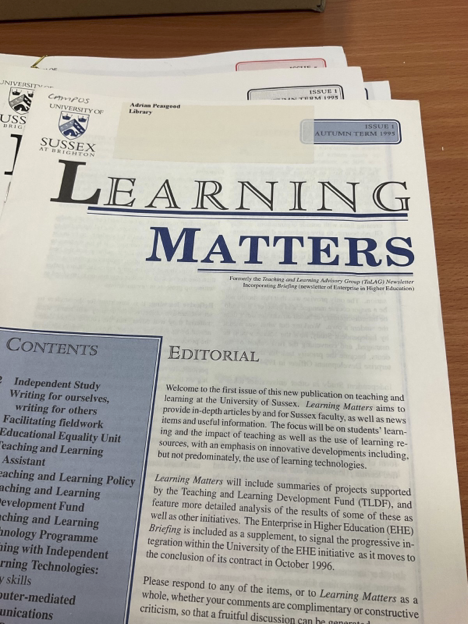
The Academic Developers wanted to create a scholarship forum that didn’t need to explain itself and were inspired by the University of Edinburgh’s brilliant, and self-explanatory, Teaching Matters blog. On a relatively recent trip to The Keep (to gather archival material for the University Pasts and Futures Symposium), we serendipitously stumbled upon the Learning Matters newsletter, set up at Sussex by the Teaching and Learning Advisory Group in 1995. The newsletter was published termly and ran for at least 5 years. Issue one (autumn 1995) stated that the newsletter focused on the impact of teaching on student learning and was predominantly comprised of ‘in-depth articles by and for Sussex faculty’ (Locke, 1995. p.1). Not only did the heritage of Learning Matters at Sussex legitimise our seeming appropriation of Edinburgh’s Teaching Matters blog, it also highlighted the synergy between our contemporary teaching and learning interests within the institution and those of a quarter of a century ago.
Issue 3 (summer 1996) of Learning Matters includes an article written by Mary Lea (Reader in Academic and Digital Literacies at the Open University) and Brian Street (Lecturer in Anthropology at the University of Sussex) on a research project they were currently undertaking into the complexities of different writing genres. Lea and Street argued that students’ writing skills weren’t necessarily getting worse (as was being claimed at the time), but that the academic writing requirements within specific genres or fields or writing weren’t being made explicit to students. Lea and Street used Learning Matters to present the progress of their research project and two years later, once the project was complete, they published their full research in Studies in Higher Education. This 1998 article established Lea and Street’s ‘academic literacies’ framework, which focused on successful writing as a complex and dynamic process, defined not merely through technical skill or subject acculturation, but rather through an understanding of a variety of linguistic practices (genre, fields, disciplines etc.,) within HE and the ability to ‘handle the social meanings and identities that each evokes’ (Lea and Street, 1998, p.159). This framework has been hugely influential across the sector and is still prevalent today, with the Journal of Learning Development in Higher Education dedicating a special issue to academic literacies in 2019.
Strangely enough, the academic literacies framework was at the forefront of our minds in June, when we visited the Keep, as we were in the process of publishing two DARE to Transform blog posts by Sue Robbins’ (Senior Lecturer in English Language at the University of Sussex). The first post focused on the importance of academic literacies in UK HE generally, and the second examined the need to develop students’ academic literacies as a defence against AI and personation in assessment. In both posts, Sue explicitly referred to Lea and Street’s research, unconsciously connecting the DARE to Transform blog with the 1990s Learning Matters newsletter, and providing us with further encouragement to adopt the name of our predecessor.
It was a joy sitting in the Keep and reading Learning Matters articles from former faculty at Sussex. These ‘in-depth articles’, which were around 2000-4000 words in length, allowed academics to delve into their subject (Locke, 1995. p.1). As with Lea and Street’s 1996 article, Learning Matters gave faculty an opportunity detail current research, providing a platform from which a journal article might quite naturally generate. These articles were very interesting to us, as they helped us to see that we need to create a space for multiple and diverse forms of writing about teaching and learning. For example, Sue Robbins’ text on academic literacies had to be split into two parts in order to fit the shorter blog post format, whereas her original submission (which was around 2000 words long) would have been perfectly suited to a longer article format. With this in mind, the original Learning Matters newsletter has also inspired us to expand beyond a blog. We now present a Learning Matters scholarship forum, which gives academics the opportunity to write in three different formats:
Learning Matters provides a space for multiple and diverse forms of writing about teaching and learning at Sussex. We welcome contributions from staff as well as external collaborators. All submissions are assigned to a reviewer who will get in touch to discuss next steps.
Post written by Dr Verona Ni Drisceoil, Senior Lecturer in Law (School of Law, Politics and Sociology)
Writing doesn’t just happen. It takes practice. To quote Wendy Belcher, good writers write. Short and steady sessions will, she says, win the race (Belcher, 2019: 18-9) … Belcher advocates for a deliberate and regular practice approach and suggests the 15 minutes writing a day approach over the cramming approach as ideal.
In April 2022, I wrote a blog post about the need to rethink formative assessment in higher education (HE). Building on the work of Crossouard and Pryor (2012, 253), I called for a questioning of the practice of formative assessment and specifically that we need to rethink our approach to formative assessment in relation to the preparation for written based summative assessments in HE. Specifically, I argued that we should spend more time supporting students, within the classroom environment, with writing through what I called formative opportunities. Drawing on the work of Ericsson and Pool (2016), I called for purposeful and deliberate practice; that is, embedding the deliberate practice of witing in the classroom environment.
This blog post is a follow up to the 2022 piece. What follows are insights of and reflections on the ‘Writing into Land Law Project’ where we (the Land Law Teaching Team – Bonnie Holligan (Convenor), Ashleigh Keall, Chloe Anthony, Millicent Ele and I) embedded writing opportunities into every seminar of Land Law I, an Autumn term module. Broadly speaking, my headline message remains the same: if you are assessing by way of written assessment, you should build in opportunities for your students to write, reflect and build confidence in, and with, writing. In addition, I encourage you, as teacher/tutor, to take part; to participate and write with your students. Share in the vulnerability of writing. Share in the conversation about writing, about what good writing looks like in different contexts for the discipline. Arguably, this practice, and conversation with students, will become even more important as we navigate the role of AI, in and for, writing in HE.
Writing as deliberate practice
The impetus for the Writing into Land Law Project, as discussed in the previous blog post, was inspired by the work of Christodoulou (2017) and William and Black (1998) on responsive teaching and practice. In their work, they tell us that formative assessment should intervene in the midst of a student’s learning process not at the end. In its ideal form then, formative assessment, or formative opportunities, should be comprised of frequent activities that help to identify learning and develop the skills required – with an opportunity for teachers to respond in real time. In essence, the approach is to purposefully build the blocks required for students to excel. Students, we know, need knowledge and skill in the subject area. However, in HE, they rarely practice writing in a deliberate way. Though students ‘write’ regularly, the writing form, it seems, is primarily note taking and not developed passages of writing that resemble what they will later be expected to produce by way of assessment output. Moreover, and as previously outlined, our current design and approach to formative assessment in HE is such that few students take up opportunities to receive feedback prior to the summative assessment. In addition, though we may design seminar questions so that they look like summative questions, we have no real indication if the way in which a student has prepared for that question is going to help them build a suitable response for the summative assessment. Students require the building blocks of skills required for the summative. We are pretty good at supporting students to break down and build up blocks of knowledge but less so with skills. Yet, we know writing doesn’t just happen. It takes practice. To quote Wendy Belcher, good writers write. Short and steady sessions will, she says, win the race (Belcher, 2019: 18-9). In guiding academics with writing, Belcher (2019) advocates for a deliberate and regular practice approach and suggests the 15 minutes writing a day approach over the cramming approach as ideal.
It is, I argue, rather curious that in the HE environment where there is now a greater emphasis placed on supporting academics to be able to write well and produce suitable REF outputs etc., that we don’t attach the same weight or understanding to the writing process for undergraduate study. Writing spaces, retreats, labs are growing in number and popularity across the higher education landscape to support academics. There is, it seems, a collective understanding amongst academics that writing is hard, writing takes time, writing needs support, that it can be isolating and that it needs to be deliberate. Why then, don’t we apply the same attention and focus to support our undergraduate students with writing? It is almost like we expect our students to be able to produce said assignment output by way of osmosis when we would never view our own writing work in the same light. There is a disconnect here and thus the effort to do otherwise in this project.
Building blocks: embedding writing into seminars as a deliberate and collective practice
The approach taken in the Writing into Land Law project was not radical. In fact, it was a simple albeit deliberate approach. We simply built-in space (5-10 minutes) for writing, or reflecting on writing, into every 50-minute seminar in the Autumn term. (Yes, it can be achieved!) By way of context, the substantive summative assessment for the Land Law I module is to write a coursework essay. The writing tasks we built in then were all purposefully geared towards the blocks of writing an essay and were roughly as follows:
Seminar one: free writing
In seminar one, we incorporated a 5-minutes free writing exercise at the end of the seminar. The prompt provided was simply to free write for 5 minutes in response to a short article on the right to roam or the impact of the pandemic on land use and space (this built on the class discussion). Following the free writing exercise, we then had 5 minutes to reflect on the practice and outlined our intentions moving forward.
Seminar two: introductions
Seminar two was all about essay introductions. We began the 10-minute slot by discussing, in pairs, what a good introduction looks like. We then had a go at writing an introduction to an essay question. Once the writing time was up, we shared some examples.
Seminar three: advancing an argument
Seminar three focused on advancing an argument. Here students were asked to consider what makes a good argument and to look at an abstract/draw on an academic article that had been set for reading to draw out arguments made by the author. For note, Wendy Belcher (2019: 68) provides some excellent ‘argument tests’ that can be used to help undergraduate students understand whether they have an argument or not. One example is the agree/disagree test that I use regularly with students. Provide students with a statement. If they can reply by saying ‘I agree/I disagree’, then it’s an argument. If not, then it’s not an argument.
Seminar four: conclusions
In seminar four, we focused on conclusions. Again, we allowed time for discussion on what makes a good conclusion, looked at an example and then allowed time to write a conclusion to a sample essay question.
Seminar five: brining it all together
Seminar five was specifically designed to replicate the summative assessment and was therefore about bringing it all together. Another headline message here is that formative essays or opportunities should link to the summative. It is often the case that formative essay assessments in higher education have no connection with the summative. They should. That’s the whole point.
Whilst there was some divergence in approach in different tutor groups, and that is to be expected, one key point to emphasise is that this approach works best if the tutor also takes part; that is, to share in the process and to connect through action.
What did the students think?
To glean some insights and any potential impact of the project, I asked students to complete a short survey at the end of the module. 55 students of 379 on the module responded to the survey. Not all students replied to every question so the limited scale of the project should be noted. I began by asking students about confidence in writing before and after the project and whether they felt differently about writing now. Of those that responded, there was a 16% increase in confidence about writing. In terms of affect and feeling, 84% (37 out of 44 students) said they viewed the writing process differently with 59% noting specifically that ‘they have a clearer idea of what is expected’. In response to the question, ‘what did you find most helpful about the in-seminar writing opportunities’, ‘demystifying the writing process’ was voted most highly at 30%. Thereafter, ‘regular practice’ at 27 % and ‘building confidence’ at 25.5%. Interestingly, only 9 students (16%) felt that ‘doing so in a community environment’ was the most helpful aspect.
It is unsurprising that ‘demystifying the writing process’ was voted most highly. As with academic writing, Belcher notes (2019:15) that ‘writing dysfunction is commonplace in academia’. There is a silence about writing. It is, she notes, something that is supposed to come naturally and should be performed in polite privacy (2019:15). The reality, of course, is much different. One student noted that the writing project provided a way ‘to break that fear you get from essay writing. It reminds you that it is possible, and you can do it’. Another student noted that it is ‘good way to build confidence and understand how to write/get thoughts onto the page in a better way’. Further still, another student recognised the building blocks nature of the process by noting that:
The seminar writing exercises in this module gives everyone a chance to process and break down their own thoughts about writing an essay. Hearing my tutor talk about ways of writing has been super insightful.
It was also clear that many of the students recognised the potential to further develop the project to include feedback and extend the writing time for example.
Concluding message
Though recognising that the survey conducted here is limited in terms of scale and thus only provides a snapshot of insights from the module cohort, the feedback was overwhelmingly positive and as a project is worth pursuing and developing further. Only one student said that the embedded writing opportunities were not worthwhile. The feedback from students about building confidence, overcoming fear, and knowing what to expect, are things that we know, intuitively, are important for student learning and growth. Moreover, the literature on skills has long advocated for embedding in, rather than bolt-on, and thus the headline message remains the same; if you are assessing your students by way of written based assessment, build in opportunities for deliberate writing practice in seminars, or even in the lecture theatre. Regular opportunities, even for 5 or 10 minutes, seems to work more favourably than one-off opportunities. This project clearly shows that this approach can be achieved even in a 50-minute seminar and in a large core module with multiple tutors. It’s a question of priorities and focus. If you have a 2-hour seminar with students in an optional module, then there is even greater scope to develop and embed writing as a deliberate and supportive practice – and indeed to be even more creative in approach.
References
Belcher, W (2019) Writing your journal article in twelve weeks: A guide to academic publishing success. Chicago: University of Chicago Press.
Black, P and William, D (1998) Assessment and classroom learning. Assessment in education: principles, policy & practice, 5:1, 7-74, http://dx.doi.org/10.1080/0969595980050102
Christodoulou, D (2017) The Future of Assessment for Learning. Oxford: Oxford University Press.
Crossouard, B and Pryor, J (2012) How Theory Matters: Formative Assessment Theory and Practices and their Different Relations to Education. Studies in Philosophy and Education, 31 (3). pp. 251-263 https://doi.org/10.1007/s11217-012-9296-5
Ericsson, A and Pool, R (2017) Peak: Secrets from the New Science of Expertise. London: Harper Collins.
If ‘write an essay’ is an instruction to students that follows a period of input on a particular topic, then students using artificial intelligence to complete or assist them in the task could easily disrupt that assessment mode. But if the process of researching and writing an essay is taught, the level of disruption is potentially lower and we could look for ways to incorporate the use of AI into the process in ways that are useful and ethical.
Academic writing and generative artificial intelligence (AI), such as Chat GPT
At the recent University Education Festival I took part in a discussion/solution room with the title ‘ChatGPT means the essay is dead’. AI has the potential to affect any mode of assessment, so why single out the essay? I suppose it depends very much on what we mean by ‘essay’ as to how disruptive ChatGPT may or may not be. If ‘write an essay’ is an instruction to students that follows a period of input on a particular topic, then students using AI to complete or assist them in the task could easily disrupt that assessment mode. But if the process of researching and writing an essay is taught, the level of disruption is potentially lower and we could look for ways to incorporate the use of AI into the process in ways that are useful and ethical.
Teaching academic writing using an academic socialisation approach
For several years I co-convened the core Academic Development module (AD) module on the Central Foundation Years programme (CFY) at the University of Sussex. This module was taken by up to 800+ students each year. The module was originally located in a ‘bolt-on’ position to the wider CFY programme, and opposition to this deficit model was evidenced by poor student evaluations. Focus groups and module evaluations showed that much of the students’ dissatisfaction centered around their perception of AD as ‘remedial’.
Due to the constraints relating to the way the CFY programme is structured, we were not able to adopt a full academic literacies approach (Lea & Street, 1998). Drawing on the Scholarship of Teaching and Learning literature, we decided that an approach akin to the academic socialisation branch of the academic literacies concept would allow us to avoid a generic skills approach and would be realistic in the context in which we found ourselves. To enable this ‘built-in’ approach we engaged with CFY faculty to identify and develop areas of overlap and integrate (to the extent that we were able) the subject modules and AD, with the aim of helping students understand the ways ‘things are done’ in their discipline.
The main aim of the module is to teach discursive writing/argumentation – the ability to recognise an author’s argument as you read, and construct arguments of your own in both written and spoken work in ways that reflect disciplinary norms – a core process central to university study. In our experience, argumentation is a threshold concept (i.e. a concept deemed to be central to the mastery of a subject, or a ‘conceptual gateway’ that opens up ‘previously inaccessible way[s] of thinking about something’ Meyer & Land, 2003) for students new to university study. On the module, the research and writing process is broken into clearly identifiable stages and practice opportunities are provided at each stage which encourage students to view the writing process as iterative, take risks in their work and try things out and make decisions about what does and doesn’t work at every stage, and if necessary to go back and re-do aspects that were less successful. This approach is new to students leaving the school system and the transition required is substantial as they are required to think, read and write in entirely new ways.
The use of a process approach
Having identified a theoretical base, we chose to design the syllabus using a process approach. This methodology is not a new or innovative one, as it was introduced in the 1980s in the discipline of English for Academic Purposes, but when students are expected to arrive with, or very quickly acquire, the necessary cultural capital and skills to succeed at university a process approach can make visible the things that are encouraged and rewarded in HE (see Haggis, 2006). It may not immediately be evident to students, for example, that staff assume they will:
read widely
find out how to make effective use of the library
be able to choose appropriate texts from the range on offer
know to/how to skim read over chunks of irrelevant texts to find what is relevant
be able to read and understand academic prose/journal articles
interpret the assessment task
have the confidence to work in ideas gleaned from their reading into their own writing
A process approach allows for explicit instruction in these academic skills.
In his introduction to the volume Academic Writing; Process and Product (1988), White noted that the process approach was prompted by the concern that ‘we should turn away from our preoccupation with the end product of a course of instruction and look instead at the psychological, social and intellectual processes that must be gone through on the way to that product’. It was overtaken by current genre approaches, but in this video (2021) Wingate argues for its return (alongside genre approaches). She talks about her examination of students’ research and writing practices and, like us, notes the success of those who adopted a process approach to writing to support their subject-specific assessment tasks. She also notes that while engagement with the process is key to developing successful academic writers, in encouraging a collaborative approach to teaching it can also move teaching interventions away from bolt-on, study-skill provision. David Munn, co-convenor of the AD module, elaborates (2022).
The AD module includes a bespoke online resource, the Academic Writing Guide (AWG) which structures the process. It is an interactive web-based resource designed for self-access and is embedded into the VLE, where a weekly narrative about the process is elaborated. It offers students guidance, exemplars and practice tasks in the skills of finding, evaluating and connecting source material to the arguments they intend to make in their essay. It is separated into 3 stages and students submit work-in-progress at the end of each stage in order to gain feedback. This independent work is supported in weekly AD seminars. All of the module assessment is linked to the work that students do with the AWG.
Following each of the submissions tutors hold feedback dialogues, the purpose of which is to give actionable feedback/feedforward that allows students to adjust what they have done, do some more thinking/research, and be fully prepared for the subsequent stage (2023). In this way we embed feedback-seeking opportunities and enactment within the curriculum to improve learning, develop learner autonomy and ensure quality standards are met. ‘Feedback needs to come before students submit their final task for assessment, so they have an opportunity to improve… Discussing qualities of work and how to produce it with students helps students develop a better understanding of what quality work looks like’ (Tai et al, 2018).
A focus on the human, emotional side of academic work is critical to students’ successful transition into HE. A process approach allows for conversations to develop in the classroom that give students an opportunity to voice ‘the struggle involved in writing at the intellectual and emotional levels as well as the struggle for recognition, “voice” and legitimacy’ (Burke, 2008). Students need time and repeated practice opportunities to make the transition to writing in ways required by their discipline. ‘Most students need three to four opportunities to learn something…but these learning opportunities are more effective if they are distributed over time, rather than delivered in one massed session’ (Donoghue & Hattie, 2021). The process approach allows for the gradual development of students’ writing ability. It familiarises them with elements of the writing process such as the importance of planning, drafting, re-drafting and editing their essays, and allows them time to ‘get it’ before a final draft is summatively assessed.
Student feedback on the module has become more positive and there has been an increase in student satisfaction scores from module evaluation questionnaires year on year. There is evidence that integrating academic writing provision as part of subject curriculum in AD has helped to reduce the concept of ‘remedial’. Use of the AWG on the module has allowed us to go some way towards synchronizing academic literacy development with subject content exploration. Students engage with the research, reading, writing and thinking skills required by this genre of writing while applying disciplinary knowledge with a good degree of success.
The process approach and ChatGPT
The impact of generative AI in education is still unfolding. Over the course of the last half a year, by the time we’d worked out a potential response to ChatGPT for our own teaching context, the world of generative AI had already progressed. Much of the initial discussions have focused on assessment and academic integrity, with the concern that students will use generative AI to write essays or other assessment types. These concerns have parallels with those previously associated with the use of essay mills/personation.
The current positioning of the AD module and the use of a process approach has allowed us to meet the QAA Guiding Principles for Assessment, including ‘assessment that encourages academic integrity’. We have been able to focus on sound academic practice in several ways. None of the regular low-stakes assessments, including the first draft of the essay, are submitted via Turnitin so that students do not have to fear being penalised (or humiliated) for plagiarism while they learn how to incorporate the work of others into their own. Feedback conversations about how well they are mastering skills and how to develop subsequent submissions support the continuing development of students’ writing and understanding of academic integrity. Students add a short reflective account at the end of each submission that outlines how they have taken feedback from previous submissions into account and prompts them to ask for specific feedback on the current submission – both reasonably resistant to personation attempts. Because the assessed elements form part of a portfolio and the final essay receives only 50% of the overall marks, students calculate that it is in their interests to submit all elements and are therefore in a position to receive regular feedback and support.
In his primer (2023) Michael Webb from Jisc UK’s National Centre for AI sees our main options with AI as avoiding it, trying to outrun it, or adapting to it. The next iteration of AI will likely involve A1 writing ‘co-pilots’ that will be directly embedded in Microsoft 365 – which we make available to all of our students – and be designed to assist writers in generating content (2023). It seems to me that we therefore have a duty to adapt and to support our students in developing an understanding of how to use these tools that will be available to them throughout their studies and later in the workplace. This will involve rethinking how we assess. As Lodge writes, adapting is a more effective, longer-term solution but also much harder than the other two options (2023).
Liu and Bridgeman (2023) note that a focus on a process approach has been foregrounded recently as a response to generative AI. It’s possible we may be able to identify ways to incorporate AI into the writing process in order to help students develop an understanding of how to use such writing support tools in ways that are ethical, and which don’t undermine the learning and skills that a graduate should master. Encouraging the development of students’ evaluative judgement or ‘the capability to make decisions about the quality of work of self and others’ (Tai, et al., 2018), may be even more important than it has been to date, as well as offering practice opportunities to evaluate AI generated text and model ways to engage critically with it.
Conclusion
Many of us have so far only a limited knowledge of generative AI. If we choose the ‘adapting to it’ option we’ll need to think about integrating the teaching of AI literacy into the curriculum, including teaching the practicalities of large language models and their ethical use, especially in assessments. If the essay is a useful assessment mode to teach threshold concepts such as argumentation, and if a process approach is employed to teach such concepts and to make visible the things that are prized in HE, it’s possible that the same pedagogic approach can accommodate a focus on the co-creation of text with AI.
We need to focus on the process of putting together an essay or other assessment, rather than on the end product. Students need to be taught how to manage the process and be given repeated practice opportunities in order to ‘get it’ before being summatively assessed. This shift in focus may create opportunities to move attention away from the use/misuse of AI and look again at the pedagogical underpinnings of how and why we assess students in our own context to see what role AI can play.
Reference list
Adler-Kassner, L. and Wardle, E. (2015) Naming what we know: Threshold concepts of writing studies. Logan, UT: Utah State University Press, an imprint of University Press of Colorado.
Borg, E. (2012) ‘Writing differently in Art and Design: Innovative approaches to writing tasks’, in Hardy, C. and Clughen, L. (eds.) Writing in the disciplines: Building supportive cultures for student writing in UK higher education. Bingley: Emerald Group Publishing, pp. 169–187.
Burke, P., J. (2008) ‘Writing, Power and Voice: Access to and Participation in Higher Education’, Changing English, 15:2, 199 210, DOI: 10.1080/13586840802052419
Cairns, J., Hervey, T. and Johnson, O. (2018) “Neither ‘bolt-on’ nor ‘built-in’: benefits and challenges of developing an integrated skills curriculum through a partnership model”, Journal of Learning Development in Higher Education, (13). doi: 10.47408/jldhe.v0i13.435.
Cousin, G. (2006) ‘An Introduction to Threshold Concepts’. Planet, 17, pp. 4-5.
Donoghue, G. M., and Hattie, J. A. C. (2021) ‘A Meta-Analysis of Ten Learning Techniques’, Frontiers in Education, Vol 6, DOI=10.3389/feduc.2021.581216
Haggis, T. (2006) Pedagogies for diversity: retaining critical challenge amidst fears of ‘dumbing down’ Studies in Higher Education 31, 5 pp.521-535.
Harris, A. and Ashton, J. (2011) ‘Embedding and integrating language and academic skills: An innovative approach’, Journal of Academic Language & Learning, 5(2), pp. 73–87.
Hendricks, M. and Quinn, L. (2000) ‘Teaching referencing as an introduction to epistemological empowerment’, Teaching in Higher Education, 5(4), pp. 447–457. doi:10.1080/713699175.
Land, R., Meyer, J. H. F. and Flanagan, M. T. (eds.) (2016) Threshold Concepts in Practice. Rotterdam: Sense Publishers.
Lea, M. R., & Street, B. V. (1998). Student writing in higher education: An academic literacies approach. Studies in Higher Education, 23(2), 157–172. https://doi.org/10.1080/03075079812331380364
Lea, M. R. (2016) ‘Looking Back in order to look forward’. Critical Studies in Teaching & Learning, 4:2, pp88-101. DOI: 10.14426/cristal.v4i2.91.
Lillis, T. and Curry, M. J. (2010) Academic writing in a global context. Abingdon: Routledge.
Maldoni, A. and Lear, E. (2016) ‘A decade of embedding: Where are we now?’, Journal of University Teaching & Learning Practice, 13(3). doi:10.53761/1.13.3.2. (Accessed: 9 June 2023).
Melles, G. and Lockheart, J. (2012) ‘Writing Purposefully in Art and Design.’ Arts and Humanities in Higher Education. Vol.11, No.4) pp.346–362. doi: 10.1177/1474022211432116. (Accessed: 9 June 2023).
Meyer, J.H.F. and Land, R. (2003) ‘Threshold concepts and troublesome knowledge: Linkages to ways of thinking and practising’, in Rust, C. (ed.) Improving student learning: Theory and practice ten years on. Oxford: Oxford Centre for Staff and Learning Development (OCSLD), pp. 412–424.
Pownall, M., Harris, R., & Blundell-Birtill, P. (2022) ‘Supporting students during the transition to university in COVID-19: Five key considerations and recommendations for educators’. Psychology Learning & Teaching, 21(1), 3-18. https://doi.org/10.1177/14757257211032486
Roberts, L. (2018) ‘Which way forward? The future of embedded learning development’, presented at ALDinHE Regional Symposium: Embedding Academic Skills.
Sloan, D. and Porter, E. (2021) ‘Contextualising, Embedding and Mapping (CEM): A model and framework for rethinking the design and delivery of an in-sessional academic literacy programme support’, EMERGE, 2009(Paper Issue 1), pp. 1–15. Available at: https://www.researchgate.net/publication/238510217 (Accessed: 9 June 2023).
Sloan, D. Porter, E. & Alexander, O. (2013) ‘Yes, you can teach an old dog new tricks. Contextualisation, embedding and mapping: the CEM model, a new way to define and engage staff and students in the delivery of an English language and study skills support programme’. Innovations in Education and Teaching International, 50 (3). pp. 284-296. DOI: 10.1080/14703297.2012.760779 (Accessed: 9 June 2023).
Swales, J. (1990) Genre Analysis: English in Academic and Research Settings. Cambridge University Press: Cambridge.
Tai, J., Ajjawi, R., Boud, D., Dawson, P. and Panadero, E. (2018) ‘Developing evaluative judgement: enabling students to make decisions about the quality of work’. Higher Education 76, 467–481. https://doi.org/10.1007/s10734-017-0220-3 (Accessed: 9 June 2023).
White, S., and Lay, E. (2019) ‘Built-in not bolted-on: embedding academic literacy skills in subject disciplines’. Creative Pedagogies, 12. pp33-37 (Accessed: 9 June 2023).
Wingate, U. (2016) ‘Academic literacy across the curriculum: Towards a collaborative instructional approach’, Language Teaching, 51(3), pp. 349–364. doi:10.1017/S0261444816000264. (Accessed: 9 June 2023).
Wingate, U. (2015) Academic literacy and student diversity: The case for inclusive practice. Bristol: Multilingual Matters.
Wingate, U. and Tribble, C. (2012) ‘The best of both worlds? Towards an English for Academic Purposes/Academic Literacies writing pedagogy’, Studies in Higher Education, 37(4), pp. 481–495. doi:10.1080/03075079.2010.525630.(Accessed: 9 June 2023).
Wingate, U., Andon, N. and Cogo, A. (2011) ‘Embedding academic writing instruction into subject teaching: A case study’, Active Learning in Higher Education, 12(1), pp. 69–81. https://doi.org/10.1177/146978741038781 (Accessed: 9 June 2023).
Post written by Susan Robbins: Senior Lecturer in English Language (Sussex Centre for Language Studies)
Embedding study skills, it is argued, helps students make the important link between the conventions of academic writing, the contested nature of knowledge, and the way writers use theory and evidence to argue.
What to do about study skills?
What do we mean when we talk about study skills? Current approaches position study skills as a ‘fix’ to a wide range of difficulties experienced by students, and study skills support is presented as a panacea for resolving the issues presented by educational expansion. Viewed this way, they are little more than ‘a remedy as a placebo, providing confidence and emotional “sticking plasters” to students without treating the much more complex cause of their difficulties’ (Bond, 2020). If we instead view skills as situated, contextualised and discipline specific socio-cultural practices which therefore cannot be decontextualised from the process of learning and the subject matter being taught (Wingate, 2006), then the way that we teach study skill’s has to shift.
Critical thinking, for example, is an essential part of any student’s mental equipment and is often positioned as a ‘21st century skill’. Critical thinking is not a skill, however (Willingham, 2008). There is not a set of critical thinking skills that can be acquired and deployed regardless of context. Without anchoring these skills in domain-specific contexts such an approach may have little value. Similarly, students can only ‘be critical’ in their writing in relation to the subject area they are studying, and with an understanding of the way knowledge is communicated in their discipline.
Researchers have attempted to capture the complexity of the skillset required to ‘communicate competently in an academic discourse community’ (Maldoni, 2017, p.104) using the term ‘academic literacies’. Rather than focussing on technical or generic skills and acculturated behaviour norms, an academic literacies approach looks at academic development as situated social practices at the level of epistemology and identity, and in particular at academic writing as having multiple, contested meanings, discourses, power relations and authority (Lea & Street, 1998). Students are making decisions about their writing in a context which is marked by hierarchies of power and authority (Webster, 2021).
The academic literacy support continuum: ‘bolt-on’ to embedded
At the generic end of this continuum are academic skills workshops and generic online materials, while activities at the embedded-literacy end include collaborations with departmental staff to offer targeted activities to improve students’ academic literacy skills. In between, discipline-specific online materials and individual 1:1 consultations bridge the gap by addressing the concerns of specific disciplines and specific assignments.
1. Generic
Skills module ‘bolted on’ to a programme
Students may not see the purpose, or the usefulness of the module to their wider programme/ future studies.
Students assess their own skills as better developed than they are.
2. Moving from generic to embedded
Overlap created between skills module and subject content modules/programme
Students may continue in the belief that the module has little relevance to their wider programme/future studies.
Subject modules build in formative & summative written work aligned to the ‘skills’ module so that students see value in harnessing ‘skills’ taught.
3. Embedded
Academic literacy support embedded within subject modules/programme
Writing specialists teach the writing syllabus as part of the subject module.
Embedded approaches help overcome poor student uptake/poor reception of strategies offered outside the curriculum.
Writing specialists provide tutorial support at subject module assessment points.
Students need effective support with their academic skills at all levels of study at university, particularly regarding academic writing (Ganobcsik-Williams, 2006). While generic resources and workshops have a place as part of a broad institutional offering, the bolt-on skills approach is a deficit-focused model which associates skills learning with failure. Often working as ‘third space’ practitioners, Department of Language Studies (DLS) faculty have in the past made efforts to teach generic skills modules which are credit-bearing and oblige attendance from all students, and are familiar with the resistance they engender.
The limitations of a bolt-on study skills approach
Universities need to support the academic skills development of a student cohort with diverse backgrounds and varying levels of educational experience. The Widening Participation agenda can create challenges when developing curriculum models that are able to accommodate a more heterogeneous student body. Many of the responses to the challenges of mass higher education are based on a deficit view of the students, where the problem is located within the student. A shift towards a social model, where we examine attitudes and practices as the cause of the deficit/difficulty can help students with the task of ‘becoming academic’. It’s interesting that in their report on the effects of embedded skills on first year UG attainment, Cook & Thompson (2019) conclude that although ‘the effect of socio-economic background of our students on their learning is largely excluded from our report… our research suggests it may have a significant effect on the [lack of] receptiveness to academic support’.
The need for an alternative approach to generic, bolt-on academic skills support is clear. ‘The literature is unequivocal that high impact student learning occurs when communication skills are integrated within disciplinary learning and assessment’ (Maldoni, 2017, p. 105). An alternative is found in the ‘embedded’ approach, which is defined as ‘explicit development of students’ academic language and literacies within the specific curriculum of the discipline’ (Chanock, 2012, in Maldoni, 2017, p.105). This approach recognises that academic literacy skills are complex and involve more than learning particular surface skills.
Embedding study skills
Embedding, it is argued, helps students make the important link between the conventions of academic writing, the contested nature of knowledge, and the way writers use theory and evidence to argue. Embedding provision within subject departments can be a more effective approach to the academic development of students in that it helps students link subject content with assessment requirements, and makes explicit the norms and conventions of particular disciplines (White and Lay, 2019).
I would point out that attempting to establish an embedded approach (wherever on the continuum you aim for) makes great demands of time, energy and resources. In the DLS we make efforts to take the principles of the academic literacies approach into account in our planning and teaching of academic skills, but the structural constraints we encounter make this impossible to achieve this by ourselves. Implementing embedded support requires institutional support, collaboration between departments and time (McWilliams and Allan, 2014).
The current curriculum review at the University of Sussex offers an opportunity to think more about embedding skills development across the curriculum, and resourcing subject-based support. This would help foster students’ understanding of disciplinary approaches by focusing on subject-specific skills that seek to broaden a student’s disciplinary knowledge and unlock the threshold concepts of each subject. A shift towards a social model that locates attitudes and practices as the cause of perceived skills deficit/difficulty can help all students with the task of ‘becoming academic’.
Ganobcsik-Williams, L. (2006) Teaching academic writing in UK higher education: Theories, practices and models. Basingstoke: Palgrave Macmillan.
Lea, M.R. and Street, B.V. (1998) ‘Student writing in Higher Education: An academic literacies approach’, Studies in Higher Education, 23(2), pp. 157–172. doi:10.1080/03075079812331380364.
McWilliams, R. and Allan, Q. (2014) ‘Embedding Academic Literacy Skills: Towards a best practice model’, Journal of University Teaching and Learning Practice, 11(3), pp. 94–114. doi:10.53761/1.11.3.8.
Maldoni, M. (2017) ‘A cross-disciplinary approach to embedding: A pedagogy for developing academic literacies’, Journal of Academic Language and Learning, 11(1). Available at: https://journal.aall.org.au/index.php/jall/article/view/422 (Accessed: 14 June 2023).
White, S. and Lay, E. (2019) ‘Built-in not bolted-on: embedding academic literacy skills in subject disciplines’, Creative Pedagogies Imprint, 1(2), pp. 33–38.
Willingham, D.T. (2008) ‘Critical thinking: Why is it so hard to teach?’, Arts Education Policy Review, 109(4), pp. 21–32. doi:10.3200/aepr.109.4.21-32.
Wingate, U. (2006) ‘Doing away with “study skills”’, Teaching in Higher Education, 11(4), pp. 457–469. doi:10.1080/13562510600874268.
On Wednesday the 19th April the School of Media Arts and Humanities (MAH), in collaboration with Educational Enhancement (EE), hosted an event celebrating the scholarship of teaching and learning (SoTL) from arts and humanities perspectives. The symposium established a space of resistance to the monopoly that the social sciences have over SoTL. We examined teaching and learning through cultural artefacts, archival research, punk music, film entrepreneurship, and community activism.
The presentations
When a dolphin is not a dolphin: Odi Oquosa, University of Sussex
Odi with an object he created in response to the colonial symbolism on the University of Sussex coat of arms.
Odi’s work examined the colonial symbolism of the dolphin: a key feature of the University of Sussex’s coat of arms and the Victoria Fountain in Brighton’s Old Steine and examined the effects that colonial symbolism has on collective wellbeing. Odi presented some of the objects he created in response to these symbols, and showed us how this type of awareness and artistic creativity can bring opportunities for the academic community to collectively heal from colonial oppression and support difficult, cross-cultural dialogue.
Learning to unlearn via postcolonial library legacies for decolonial educational futures: Alice Corble, University of Sussex
A slide taken from Alice’s presentation. The slides asks how important is the university library, as a centre for learning and a repository for institutional memory, to understand contemporary calls to decolonise the university.
Alice presented her AHRC-RLUK-funded research project, which explored the foundational role of Sussex Library and archives in the University’s postcolonial origins, institutional development, and what this can teach us about contemporary calls to decolonise the university and its curricula. Alice demonstrated the importance of critically engaging with the library as a learning space and as a site of institutional memory (and forgetting). Realising that the library is not an inert space but, through the diversity of both its collections and users, libraries become spaces where knowledge can be rethought.
Decolonising and praxis: Rachel Stenner and John Masterson, University of Sussex
An image of two texts that John and Rachel engage with in their teaching as they work towards a decolonial education: The Cosmography and Geography of Africa and Teaching Race in the European Renaissance
John and Rachel spoke about their experiences of teaching and trying to decolonise modules that treat colonisation in very different ways and in different periods. They discussed the need for a decolonial approach to teaching and learning at all cohort levels, but especially at levels three and four, when students first enter into the University. John and Rachel explained that the current tendency to leave decoloniality to final year modules fails to understand decolonisation as a continual political response.
Embracing authority – when punk pedagogy met the Hare Krishnas: Mike Dines, Middlesex University
A photograph of Mike presenting on the punk band Subhumans, and speaking about them as educators
Mike spoke about punk as a pedagogical tool, which in his youth taught him to interrogate authority, and become politically engaged in issues related to gender, race, animal rights, pacifism and anti-capitalism. Mike then asked the audience what happens when ‘rules’ are embraced and when punks turn to established institutions for guidance? Drawing specifically on his research on Krishnacore, this keynote looked at the complex interchange between punk pedagogy and the Hare Krishna Movement and opened up discussion about the tensions of bringing punk approaches to learning into Higher Education institutions.
Silverstone Productions: A fast, self-financing course ranking booster: Jeremy Sheldon, University of Sussex
Silverstone Productions logo
Jeremy spoke about his film production company Silverstone Productions which, among other things, develops, finances and produces work by Sussex University filmmakers and writers. Silverstone Productions has strong links to the film industry and the support of leading practitioners in the field. Jeremy is calling for Silverstone Productions to be positioned alongside the curriculum at Sussex, allowing students to develop and produce their own films to a level that is professionally credible and persuasive. The opportunities provided by Silverstone Productions will provide an invaluable learning experience for students wanting to enter into the film industry, as well as add to the profile of the university’s filmmakers more generally.
Learning by doing – innovative models for fostering community connection: Katherine Kruger, University of Sussex
Katherine and Jeremy answering questions from the audience
Katherine has been exploring community engagement as a tool for improving the experiences of students from groups which are under-represented at the University of Sussex. Katherine spoke about how her students have the opportunity to become involved in various forms of community engagement, such as charities supporting Gypsy, Roma and Traveller people in Brighton and Hove. Katherine spoke about the advantages community engagement brings to student confidence, belonging, satisfaction, and learning.
Find out more
We have started putting together a Padlet wall collating the scholarship of teaching and learning from arts and humanities perspectives. This is a growing resource. Please feel free to add to it.
What next?
This is the first of these types of MAH scholarship events. We hope this will be the first of many. The day established links between people who undertake teaching and learning through arts and humanities approaches. Collaborative ways of working were identified, and ideas and resources were shared. Please don’t hesitate to contact Viki Walden v.walden@sussex.ac.uk or Sarah Watson sarah.watson@sussex.ac.uk if you would like further information about the event or support with producing scholarship within an arts and humanities context.
Most people at the University of Sussex haven’t heard of Sylvia Crowe. Her legacy at the University is strong, but generally silent, existing in the spine of trees that cut across the centre of campus, the cloisters, courtyards, and pathways that give context to our teaching spaces. Crowe, the University’s landscape architect, still choreographs us through our campus, yet most of us are completely unaware that she is doing so.
At Sussex we like to talk about the beginnings of the University. When we do, we never fail to speak of the campus’ renowned architect, Basil Spence. It was Spence who commissioned Crowe as landscape architect, seeking her advice on how to make the University buildings (to use Spence’s words) ‘grow out of the soil of Sussex’ (1964, 204). Spence sought the expertise of Crowe, whose work changed the face of twentieth-century Britain as she acted as landscape consultant on the construction of towns, motorways, power stations. Despite these accomplishments, little has been written about her, and she remains absent from most publications about the creation of Sussex. Where she is included, it is only in passing.
In an article entitled “Why the Fame of Anonymity is the Greatest Fame of all”, Mathew Parris writes that it is wonderful to have created something enduringly famous while remaining anonymous (1998). Parris included Crowe in his list of unknown artists, and claimed that creators like her were happy with their anonymity. That somehow their invisibility brought them closer to God. I find it hard to share Parris’ view. Not that I’m claiming to know whether Crowe cared that her contributions to the University went relatively unrecognised. It seems presumptuous to associate anonymity with power, especially when we consider the women who have been silenced in a world that prioritises giving the platform to men.
In celebration of International Women’s Day, this blog post starts to unearth the impact of Crowe at Sussex. This task is made difficult because Crowe is missing from almost every publication about the University. I’ve had to look for her elsewhere, in her own writings and on the few writings about her. In these texts, Crowe comes across as commanding and loud, famous in her circles for fierce eye-contact and persuasive communication (British Forestry, 1998 and Collens and Powell, 1999). With this in mind, it seems strange that she has such a small presence at Sussex, prompting me to consider the legacy of her silence. Crowe is missing from the 1964 seminal publication on the founding of Sussex: David Daiches’ The Idea of a New University. This book is a key reference point upon which future discussions about the institution have developed. Because Crowe wasn’t included in conversations from the beginning, it has become very easy to neglect her as time has moved on.
Crowe’s legacy at Sussex, and in her landscape designs in general, can be defined as sympathetic to the natural context. In 1955 she wrote that ‘every landscape has its own character which reacts differently to the incursion of crowds and buildings.’ The architect must ‘design in sympathy with each particular landscape (Crowe, 1955, 250). Almost ten years later, in The Idea of a New University, Spence echoes Crowe in his chapter on the building of the Sussex campus. He writes: ‘Because of the lovely site I was against building high; the trees should top the buildings and continue to form the skyline. The materials should be sympathetic to the location – a Sussex brick, concrete, knapped flint, copper, timber and white paint’ (Spence, 1964, 205). Although Crowe’s influence underlies Spence’s chapter, he fails to mention her. Perhaps I’m reading too much into this oversight. But if it doesn’t seem strange that Crowe’s influence isn’t credited, then why isn’t it strange that Spence credits far more distant influences, like Robert Adam, Frank Lloyd Wright, Mies van der Rohe, and even Archimedes. The credit to Archimedes compounds the issue of Crowe’s omission. In 1961, the year the University of Sussex opened, Crowe gave a lecture called Civilisation and Landscape, which praised the geometry of Greek architecture. She describes=d how the Parthenon is ‘imperceptibly curved to acknowledge the land formation of its hill’ and reflected on how ‘the Greeks knew that geometry and natural form were two facets of a single truth’ (95). Once again, in echo of Crowe, Spence’s 1964 chapter heralds the architectural harmony of Athenian colonnades, describing their influence over the University’s physics building.
The main aim of this blog isn’t really to criticise Spence for his omission of Crowe, but rather to begin revealing more female aspects of our University heritage, which can be so easily buried beneath the weight of men. It was almost a hundred years ago that Virgina Woolf, in A Room of One’s Own, lamented the very heavy, and very male, foundations laid at Oxbridge. It was funding from men that laid the first stone and established the first scholarship. And, as a result of this patronage, Woolf describes how women at Oxbridge, even in 1928, weren’t allowed to walk on the grass. That privilege was still reserved for the male fellows and scholars, who were set to protect ‘their turf, which has been rolled for 300 years in succession’ (Woolf, 2000, 8). With the building of the 1960s plate glass universities, like Sussex, came new ways of doing things. The turf at our campus wasn’t rolled out by a man, but by a woman, and Crowe’s landscape should be celebrated.
As we begin to unearth Crowe, it becomes clear that there’s more to Sussex than first meets the eye. Our campus reveals itself as a complex organism—“of which man is only a part” (Crowe, 1961, 95). I suggest we delve deeper into Crowe’s presence at Sussex. Who knows what we might uncover?
References
British Forestry (1998) ‘A tribute to Dame Sylvia Crowe’s landscape work for British Forestry’, Forestry, 71(1), pp. 83–85. Available at: https://doi.org/10.1093/forestry/71.1.83 (Accessed: 10 May 2023).
Crowe, S. (1961) ‘Civilisation and landscape’, Journal of the Royal Society of Arts, 110(5066), pp. 93–102. Available at: http://www.jstor.org/stable/41367049 (Accessed: 10 May 2023).
Collens, G and Powell, W. (1999) Sylvia Crowe. Reigate, Surrey: LDT Monographs.
Dr Xuan Huy Nguyen (Lecturer in Marketing: University of Sussex Business School)
Dr Xuan Huy Nguyen
Dr. Xuan Huy Nguyen joined University of Sussex as a Lecturer in Marketing in October 2017. He has a PhD in Marketing from The University of New South Wales (Australia).His research interests include consumer choice behaviour, role of emotions in consumer decision-making, and services marketing. He is comfortable with analyzing and interpreting large volumes of data by numerous statistical packages. In terms of methodology, he is experienced in choice modelling, market response models, experimental design, and Bayesian statistics. He is also familiar with structural equation modelling (SEM).He is keen on collaborating with researchers and students who share the research interests.
Introduction
Educational technologies play a critical role in enhancing lecturers’ teaching and students’ learning experiences in higher education. As a result, educational technologies have attracted attention from many researchers and practitioners. From the students’ perspective, educational technology adoption and utilization are among the key aspects making up their holistic learning experiences in higher education. Unsurprisingly, educational technologies, represented as ‘learning resources’, is one of the nine dimensions of the National Student Survey (NSS) Questionnaire in 2022, measuring the overall students’ higher education experience (Canning,2015).
In recent years, universities in the UK have accelerated their investment in educational technologies to further enhance students’ learning experience and consequently improve their NSS results. One must ask questions about which educational technologies to invest and how to encourage lecturers to use educational technologies (Surry & Land, 2000). In this post, the author argues that only investing in educational technologies might not be enough to improve our students’ perception, e.g., the ‘learning resources’ aspect in the National Student Survey. It is also very important to improve the perceived usefulness of educational technologies, from both students and lecturers, to further improve the NSS results.
Perceived usefulness of educational technologies from a lecturers’ perspective
According to the Technology Acceptance Model, the perceived usefulness of educational technologies has a strong impact on the tendency that one would engage in the technologies and make the best use of them (Granić & Marangunić, 2019). In the context of higher education, the existing literature demonstrates that lecturer-perceived usefulness of technologies extend a significant effect on technology adoption under a wide range of circumstances (Salas, 2016). In addition, lecturer-perceived usefulness of educational technologies may even have the spillover effect, influencing the attitude of the same technologies of other people around them, e.g., other teaching staff (Abuhamdieh & Sehwail, 2008). As a result, to improve the educational technology adoption in higher education, enhancing the lecturer-perceived usefulness of the technologies may be as important as the decision to invest in the technologies.
Perceived usefulness of educational technologies from students’ perspective
Lecturer-perceived usefulness of educational technologies may not always be consistent with students’ perceived usefulness of the same educational technologies. In other words, module convenors and students may not always see an educational technology the same way. One educational technology considered as highly valuable by lecturers may be seen as low value by students.
The study
To improve students’ learning experience, I conducted a personal teaching evaluation in the middle of the semester in a postgraduate module in 2023. I asked students in two workshops to rate the usefulness of the types of tasks in PollEverywhere.com, which is a popular educational technology used to facilitate discussion in class (Laverick, 2015). Students could select one of the five options: multiple choice, word cloud, Q&A, clickable image, open-ended question, and competition. Based on my expertise and experience, I believed that clickable image would be the most useful option. Nonetheless, students’ perceptions in both workshops did not agree with my perception. Indeed, based on students’ perception, clickable image was the least popular. In Workshop 1, only 1 student out of 26 selected clickable image. The most popular were multiple choice (16 out of 26 students) and open-ended question (7 out of 26 students). In workshop 2, the same thing happened. Only 1 student out of 18 students selected clickable image. And the most popular option was still multiple choice (11 out of 18 students).
Future practice
To improve students’ learning experience, increasingly investing in educational technologies, and shifting to digital education, is a process that all higher education institutions must experience. Nonetheless, many other factors may also play important roles in the process, apart from the decisions on how much to invest and in which educational technologies to invest. In this blog, based on the findings in the existing literature and some exploratory empirical evidence, I demonstrate that universities should also pay attention to the perceived usefulness of educational technologies to improve the perception of technology adoption and subsequently improve their NSS results. Practical tips
Practical tips
Universities should pilot a technology in a number of schools or modules before rolling out the technology across the institution.
Early in the term, lecturers should explore their students’ perceived usefulness of a technology and how to best utilize it. Based on the results, lecturers can either adapt to their students’ perceptions or explain the benefits of their preferred learning technology to improve both teaching and learning experiences.
Canning, J. (2015). A new measurement and ranking system for the UK National Student Survey. Perspectives: Policy and Practice in Higher Education, 19(2), 56-65. https://doi.org/10.1080/13603108.2015.1021401
Granić, A., & Marangunić, N. (2019). Technology acceptance model in educational context: A systematic literature review. British Journal of Educational Technology, 50(5), 2572-2593. https://doi.org/10.1111/bjet.12864
Laverick, C. (2015). Using Poll Everywhere to Improve the Student Experience: Increasing Confidence and Encouraging. In G. Brewer & R. Hogarth (Eds.), Creative Education, Teaching and Learning: Creativity, Engagement and the Student Experience (pp. 40-50). Palgrave Macmillan UK. https://doi.org/10.1057/9781137402141_5
Salas, A. (2016). Literature review of faculty-perceived usefulness of instructional technology in classroom dynamics. Contemporary Educational Technology, 7(2), 174-186. https://doi.org/10.30935/cedtech/6170
Surry, D. W., & Land, S. M. (2000). Strategies for motivating higher education faculty to use technology. Innovations in Education and Training International, 37(2), 145-153. https://doi.org/10.1080/13558000050034501
Jeanette Ashton is a Senior Lecturer in Law (Education and Scholarship) and a non-practising solicitor, having joined the University of Sussex after 8 years at Brighton University. She convenes and teaches on the Bachelor of Law (LLB) degree programme in the Law School. She works on employability, is interested in the intersection between academic and professional skills, and is part of the Clinical Legal Education team.
Kieran Durcan is a Senior Lecturer in Law (Education and Scholarship). He convenes and teaches a number of core and optional modules on the LLB and MA programmes within the Law School. He is interested in module design and enhancement and is keen to embed practical skills across the law programmes having previously been the placement lead within the School.
Introduction and pedagogical context
This blog reflects on the process of working with students to develop a new Business Law and Practice module (BLP) for Sussex Law School, one of two options for law students at level 5. It is set within the broad pedagogical context of co-creation, knowledge exchange and students as ‘partners’ (Cook-Sather et al, 2014; Dollinger & Lodge, 2019), but, on a review of the literature, is more aligned with the ‘participatory design’ approach, explored in the medical education arena, with students having a key role in working towards the goal of improving the “quality of educational innovations by ensuring use, usability and utility of educational design for both teachers and students” (Di Salvo et al, 2017). Martens et al (2019) note the overlapping of terminology, but find that participatory design sits below co-creation in terms of student influence and involvement with design and decision-making. In summary, we wanted students to work with us to develop a pedagogically innovative module, but once we had their input, we would work on what that might look like in terms of implementation.
Why introduce a Business Law and Practice module?
In 2020, while relatively new in post, and both from a practice background, we led a project on the Law School’s response to a big shakeup in legal education, the introduction of the Solicitors Qualifying Exam (SQE). For students wishing to qualify as solicitors in England and Wales, there is no longer a requirement to undertake a Qualifying Law Degree before undertaking the professional stage of training, meaning that Law Schools were, and indeed still are, faced with the challenge of ensuring that students wishing to become solicitors can see the benefits of undertaking a law degree at undergraduate level prior to embarking on the professional stage, despite it not being mandated by the Solicitors Regulation Authority. To demonstrate the requisite legal knowledge, aspiring solicitors need to pass the SQE, with one of the Foundations of Legal Knowledge areas being BLP.
Sussex is a research-intensive Law School and there was understandable scepticism amongst some within the School as to whether change was necessary. Some colleagues expressed concern that this would undermine our critical approach, moving too far in line with the central government employability agenda (Department for Education, 2017). Our view was that wholescale redesign of the law curriculum would not be necessary, but that we should and could find a way to support students wishing to qualify via the SQE route without damaging the essence of Sussex as a Law School.
As part of our work on the Law School’s response to the introduction of the SQE, in April 2020 we conducted an employability survey of our then incoming second year students, the first cohort able to qualify via the new route, to ascertain the percentage wishing to become solicitors in England and Wales. Of the 77 respondents, approximately 59% indicated they wished to qualify as a solicitor after graduating, while 18% indicated that they did not, and 23% did not know. The challenge then was to develop a strategy suitable for the majority group, which would also accommodate students who wished to pursue other career paths, legal or otherwise, or those students who did not know. We identified a gap between level 4, where Contract Law is a core module, and level 6, where there are a range of specialist commercially focused electives, and felt that BLP could usefully bridge that gap. Alongside this, we were mindful of the continued focus on commercial awareness in legal practice and recruitment, and felt that a BLP module could be utilised to embed that, aligning with the ‘Sussex 2025 World Readiness and Employability Strategy’ (Huns, 2022).
What do we want to explore?
Our study is twofold and in two stages. The first purpose was to work with the students who had chosen the module, around 230, to design the first iteration, to find out why they had chosen BLP and to get their input on the content and key themes that they would like to see, alongside teaching and learning delivery, including assessment. The second purpose was to explore their experience, including prior to university, of participating in the design of modules and/or the wider curriculum. This is the first stage and, having completed this in October 2022, prior to embarking on the design of the module, this piece reflects on those findings and our experience of shaping the module. The second stage, with the same group of participants, will focus on whether, if at all, participating in the design of the module had any effect on their experience of the module.
To understand what content and key themes students wanted covered, we undertook a mixed-method sampling approach, utilising focus groups and a Qualtrics survey for those who did not wish to or were unable to attend, but wanted to participate (Denscombe, 2021). 30 students participated in either the focus groups or by completing the survey. We were aware that participants may not be familiar with key terminology, so took care to frame our questions thematically, over the life cycle of a business, rather than technically. Participants were given the opportunity to choose from a range of options and to put forward their own suggestions for content, wider themes and teaching and learning. Interestingly, and supporting our initial views that they might see BLP as an opportunity to gain commercial awareness and employability skills, many expressed a wish for links with professional practice and a chance to gain an insight into the intersection of law and business. As one participant put it, the expectation was that BLP would “kind of give us a pathway to think about our future.”
How did our students feel about participating in the design of the module?
The responses on this, both from the focus groups and Qualtrics survey, were unequivocal in thinking that students should be given more opportunities to participate in module design and a chance to shape the curriculum more broadly. The main reasons for this view were that students valued the opportunity to work closely with faculty, that student input would result in the module being more engaging and enjoyable: “knowing that they will be learning about something that they actually want to gain knowledge in”. They felt that this would increase attendance and achievement: “[I]f students are happy, they are more likely to do well and be engaged with the course.” Opportunities like this would enable students to have more “control”, to play a bigger role in their own learning and in doing so, would benefit future cohorts. One of the respondents took a consumer-driven approach, citing payment of tuition fees as a reason why students should be more in control of their learning.
What are the challenges of student participation?
To some extent, we found we needed to manage students’ expectations as to what we could feasibly achieve within a 15-credit module sitting within the university structures. The module had already gone through the necessary approval process and, aside from the short survey detailed above, we had not had the opportunity to work with the students, meaning that the teaching delivery structure was already fixed, though we made participants aware this can be changed for future cohorts. We also had to build in the requirements of the SQE detailed above, ensuring that BLP gives students wishing to pursue that route a good foundation, mindful of the other students who are taking the module for different reasons, with “because the module aligns with my future plan for study” and “to gain commercial awareness” scoring just below “aligns with my future career plans” in our survey.
Alongside this, we needed to navigate the level 6 commercially-focused electives, to avoid duplication and to ensure that we provide a ‘stepping-stone’ rather than replacement for those modules. As we are fortunate to have scholarship leave, alongside some traditional resources, we found that non-traditional resources, such as podcasts and TED-talks, better suited the module content and differentiated BLP from other modules on the course.
A significant finding from our work with the study participants, is that they wanted a more practical approach to teaching content, which they felt would help equip them with valuable skills and an insight into professional practice, echoing research undertaken by others, such as Nicholson and Johnston (2020, 431). With this in mind, we are creating authentic learning activities utilising the virtual internship programme Forage, but embedding selected activities within the teaching and learning delivery. In the 21/22 academic year, 546 students from across the university, 65.7% law students, enrolled in a total of 770 Forage programmes, however only 108 of those programmes were completed. We hope that by embedding some of the activities within the learning, the completion rate will increase, as the programmes provide valuable insights into key aspects of business law.
Alongside this, as well as practitioner input, we are working with the Careers and Entrepreneurship team to build in a ‘meet the start-ups’ session, scaling up the Law School’s co-curricular ‘Start-up Legal Connect’ project from 21/22, where Law students, start-ups, and legal practitioners work together on small business legal issues. Students, having had input on business structures and considerations, will be able to hear from students with start-ups from across the University, followed by an opportunity to network. We hope that by embedding this within BLP, greater numbers of students will benefit, the importance of which was a key finding in our previous study.
Concluding thoughts
Our BLP module began in Spring 2023 and was still a work in progress at time of writing this piece. We have been able to spend a considerable amount of time ensuring students participate in the design and have considered other stakeholders’ views on what a BLP module should encompass. Without a period of scholarship leave, we would not have been able to develop BLP in this way. Sussex University is, rightly so in our view, championing work with students, for example through the Connector Programme . In terms of module and wider curriculum design, if student involvement is to be more than module evaluation, which we know is minimal in terms of engagement, thought needs to be given as to resourcing the process, particularly where there are significant numbers of students.
We are interested to see how BLP is received; whether students are enthused by the departure from a traditional approach. We look forward to understanding whether student participation in the design had any impact on their experience. To be continued….
Cook-Sather, A. et al. (2014) Engaging students as partners in learning and teaching: A guide for faculty. San Francisco, CA: Jossey-Bass.
Department for Education (2017) Teaching Excellence and Student Outcomes Framework Specification. London: Department for Education.
Denscombe, M. (2021) The good research guide: For small-scale social research projects. London: McGraw-Hill Open University Press.
DiSalvo, B. et al. (2017) Participatory design for learning: Perspectives from practice and Research. New York: Routledge, Taylor & Francis Group.
Dollinger, M. and Lodge, J. (2019) “Understanding value in the student experience through student–staff partnerships,” Higher Education Research & Development, 39(5), pp. 940–952. Available at: https://doi.org/10.1080/07294360.2019.1695751.
Martens, S.E. et al. (2019) “Student participation in the design of learning and teaching: Disentangling the terminology and approaches,” Medical Teacher, 41(10), pp. 1203–1205. Available at: https://doi.org/10.1080/0142159x.2019.1615610.
Nicholson, A. and Johnston, P. (2020) “The value of a law degree – part 3: A student perspective,” The Law Teacher, 55(4), pp. 431–447. Available at: https://doi.org/10.1080/03069400.2020.1843900
Learning Matters provides a space for multiple and diverse forms of writing about teaching and learning at Sussex. We welcome contributions from staff as well as external collaborators. All submissions are assigned to a reviewer who will get in touch to discuss next steps. Find out more on our About page.
Please note that blog posts reflect the information and perspectives at the time of publication.