

Welcome to June 2026’s Spotlight on AI in Education bulletin. With how fast things are moving, this will help you cut through the noise and catch what’s important. The bulletin highlights on-the-ground practice, institutional perspectives and trends in generative AI use across the sector and beyond. We hope you find this useful.
If you have anything you’d like to contribute or see in this bulletin please email EE@sussex.ac.uk
On-the-ground at Sussex: The Sixth Meeting of the Teaching with AI Community of Practice
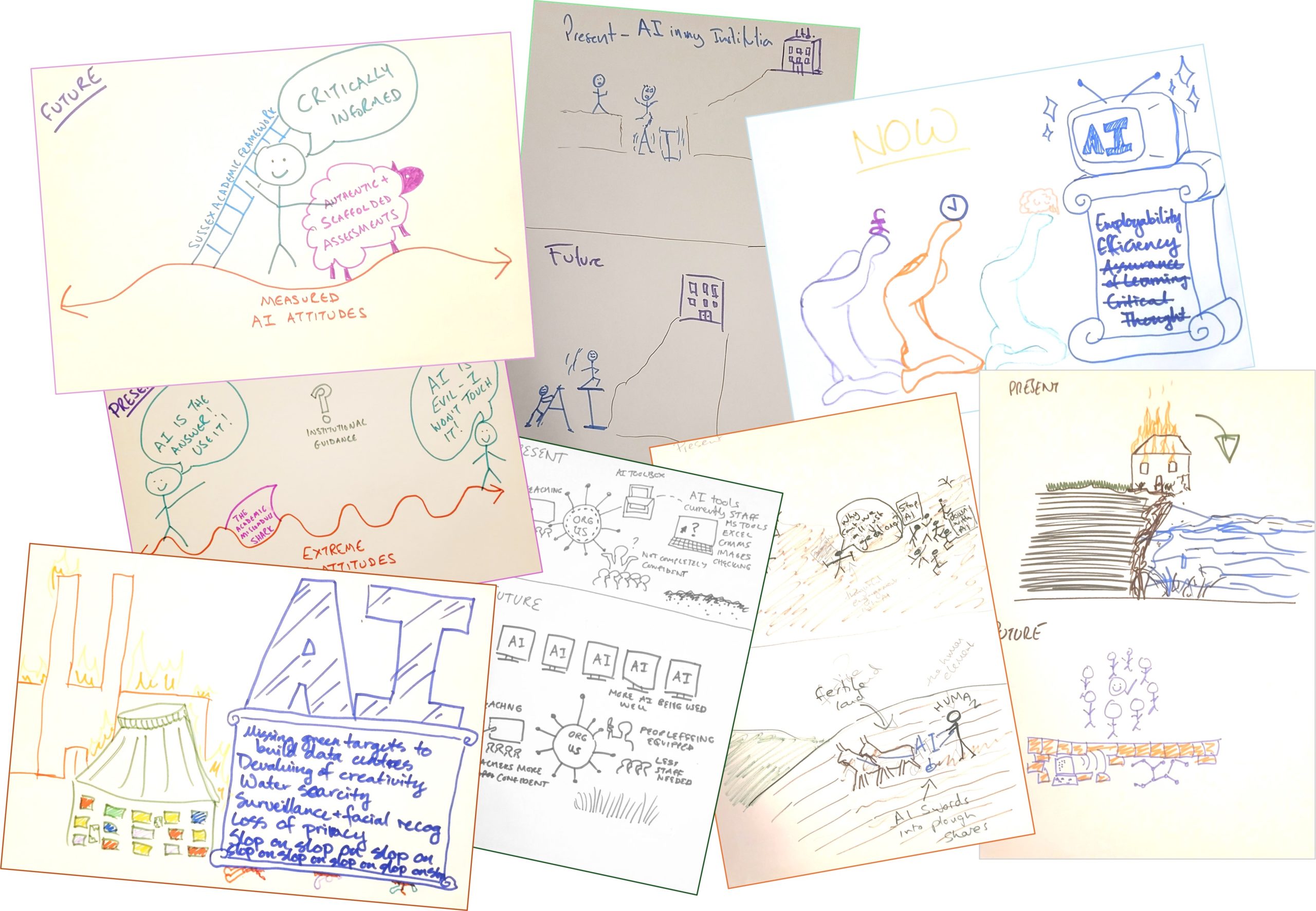
Illustrations produced at the sixth meeting of the AI CoP, depicting our perceptions of AI at Sussex now and in the future. Read more about these below.
On Monday 8th June Educational Enhancement hosted the sixth in-person meeting of the University of Sussex’ Teaching with AI Community of Practice. In a change to previous sessions, we focused on providing opportunities for all attendees to reflect on their professional use, understanding and perspectives of AI. The atmosphere was positively buzzing with conversation, creativity and collaboration as colleagues from across the university’s faculties and divisions shared their insights.
This report of the session runs quite long, but is not a challenging read. We hope you find it interesting. There are links below to where different activities are discussed.
Format of the Event
Tables were arranged with five separate activities with which members of the community were invited to engage. Colleagues were invited to move between the tables and activities as they liked, and were also given two time-checks to facilitate this. We heard from representatives of the groups during the time-checks which provided further information on the activities.
The activities were:
- Let’s talk about it – A space to share and ask questions with optional prompts provided.
- Read All About It! – Three articles were provided to spark conversation, along with some prompts.
- Be the Expert – Planning the perfect session to support a new colleague to make good use of AI.
- Practical Hands-on – George, EE’s Senior Learning Technologist, facilitated this opportunity to explore and build AI agents using Microsoft CoPilot.
- Visual and Artistic Expression – Borrowed and adapted from an activity Mark saw at a JISC event; colleagues illustrated how they perceive AI at Sussex now and in the future.
Click on the activity titles above to learn more about each one and the outcomes.
Let’s talk about it:
The conversation activity uncovered a lot of positive experience with AI, including task refinement and success with asking AI to follow formulaic instructions, and frustrations including AI output being too general and the challenge of knowing whether one can be confident in what is generated. One member of the group, Dr Leonardo Garcia Garcia, shared experience of using AI with students to create CAD images and the colleagues at the table took the opportunity to try this for themselves, comparing Gemini (Google) and CoPilot (Microsoft) and evaluating how the different platforms performed the same task of illustrating a gear. This was an excellent example of the value of having these tools at our fingertips while we’re discussing them, and how crucial it is to critically and experientially engage with generative AI by comparing output across platforms and to what an expert would expect, and adjusting our input – for instance by giving an example – to improve the result.
Two outputs from GenAI models, Microsoft CoPilot and Google Gemini, showing illustrations created by the platforms in response to the prompts to draw a CAD image of a gear. The Gemini example is more detailed, but both are inaccurate.

Microsoft CoPilot (left) and Google Gemini (right) CAD-style renderings of a gear. While the illustrations may look convincing, Dr Garcia Garcia was able to identify faults in the design and in the formatting.
Read All About It!:
The reading activity started quietly as the colleagues at that table took the time to study the article they chose to engage with. The structure was quite loose; colleagues were welcome to read and consider the texts on their own or to select a text they could discuss as a group. It seemed to develop quite naturally that colleagues who chose the same article were drawn to explore it together, while some were more inclined to work independently. The three publications were:
- Gen Z’s AI Adoption Steady, but Skepticism Climbs (Gallup)
- Why isn’t Durham University taking AI cheating seriously? | The Spectator (the author’s title and not a reflection of our view of decisions being taken at Durham)
- The Skinny on AI for Education #28 May 2026 | Professor Rose Luckin’s Educate Ventures Research | AI for Education (The Human Provenance Premium)
The colleagues at the reading table reported in their notes that it was reassuring to read in the Gallup poll that Gen Z (generally considered to be people born between 1997 and 2012) seem more aware of the contentious issues of using AI but that their concern that AI use risks replacing human skills rather than enhancing them must be taken seriously. Suggestions were made that Sussex must emphasise how AI can be used to enhance student experience and outcomes, if it is used at all, and that the university must ensure that suitable training is implemented across the institution.
Professor Luckin’s post, which was in response to Alex Imas’ Ghosts of Electricity article What will be scarce? was well-received, but didn’t generate much reaction as Luckin is essentially making the point that so many of us in Sussex’s Teaching with AI Community of Practice already understand – that while AI and automation has a place in education, the value that comes from the elements that only humans can deliver must be preserved. (Luckin cautions that the relational goods in education are devalued if AI is perceived to have “leaked” into them.) The hard task we should all be asking is where those distinctions lie: “where, in this institution, does human provenance matter?”
It was the article from The Spectator that generated the most discussion, probably because it is a polemic against the ills of AI and “lazy” students who use it. Sussex colleagues, as ever, identified the unfairness in the piece: that there are numerous reasons a student might be tempted to explore how generative AI could solve a problem for them in the moment, that not all students have equal access to such tools and this disadvantages students who cannot employ expensive or sophisticated systems, that actually the advent of AI only makes it more crucial that we develop assessments that are proportionate and relevant, and so on. Members of the CoP who are far from enthusiastic about adopting AI, rallied to the defence of the hypothetical students Hamilton labelled “lazy” and tore to shreds the points the author tried to make about in-person exams and removing anonymous marking. Reading the piece was useful though as the rhetoric about AI and universities published in a magazine that features in the Top 10 of current affairs titles in the UK (Press Gazette, 2026) is not something we can afford to ignore. Colleagues’ suggestions for Sussex are to ensure that information pages for staff and students, with a clear position on responsible use of AI and what this means, are made available and explicit, not hidden behind passwords and logins. Colleagues agreed that while the issue Hamilton writes about is sector-wide, we need a “cohesive, strategic approach…integrated into our policies” and that “some students will use AI; we [Sussex] need to adapt”.
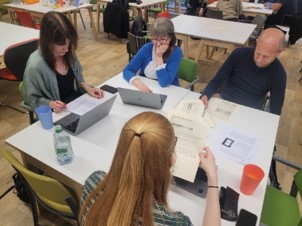
One of the iterations of the Reading Table group (colleagues moved between activities as the session went on)
Be the Expert:
The “Be The Expert” activity invited colleagues to position themselves as the expert expected to provide a 30 minute training or coaching session for a new colleague joining their team in September 2026, with a focus on how the new starter could use AI to directly support their work or to improve student experience. Prompts were provided, including variables such as what would change if the session were completely theoretical with no practical element, or if the session were extended to include multiple attendees.
We had two responses to this activity, one by a teaching colleague who worked independently and one by a group comprising colleagues from across specialisms. The teaching example included suggestions such as using AI to support initial subject research, future trends, fact-checking, lesson planning and giving students examples of poor AI output for them to critique and learn from. The group example included reference to our institutional resources such as Skills Hub, the Library, assessment and academic integrity guidance, Employability and Entrepreneurship and wider research on how students use AI. The two responses demonstrated how AI can be used well to support students and staff at Sussex, and how our response is developing across the university. Both responses made the point that details regarding permitted or prohibited use of AI must be transparent, and that while using AI is not automatically misconduct, we have a responsibility to set clear expectations.
My observation was that while this was initially a less popular activity, colleagues who approached it after completing the reading activity seemed more prepared to tackle it, which highlights how important it is that experts have the chance to engage with literature and data, developing their own scholarship, before being expected to deliver training or advice to others.
Practical Hands-on:
The Practical Hands-on activity was facilitated by George Robinson, EE’s Senior Learning Technologist, and provided the opportunity for members of the CoP to explore and build AI agents using Microsoft CoPilot. George’s encouragement, vast knowledge and enthusiasm were perfectly suited to this task as he put colleagues at ease and encouraged them to give it a go.
What started as a small one-on-one session soon grew as colleagues became more confident to join George and learn from him.
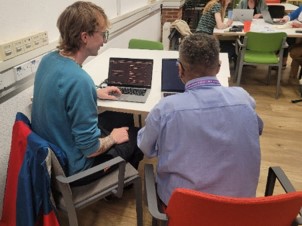
George Robinson, Senior LT, guided and supported colleagues to build AI agents using Microsoft CoPilot.
Colleagues were surprised how easy the process turned out to be, and recognised that while this is certainly a point in favour, such ease also calls for caution: we must be careful not to become mindless in our interaction with the technology.
Visual and Artistic Expression:
Finally, the Visual and Artistic Expression activity, which was borrowed and adapted by Mark Thomas from one he saw at a JISC event, invited colleagues to illustrate how they perceive AI at Sussex now and in the future. Mark provided useful prompts to include in the artwork and to guide reflection, which were:
- Draw the present – Sussex as it is today in terms of digital tools and its use of AI. Show how people experience AI: what works, what doesn’t and where challenges exist.
- Draw the future – Sussex 5-10 years from now where AI is working at its best. Show what has changed, how people experience it, and what makes it successful.
- Reflect – what are the key differences between the two drawings?
- Barriers – what is stopping us from moving from the current picture to the future one?
- Strategy Link – What would we need to prioritise to make the future picture a reality?
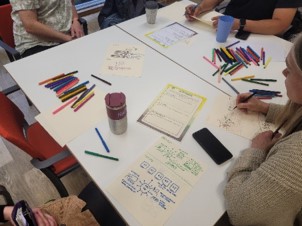
The visual/artistic activity proved very popular and generated a lot of conversation and reflection among attendees.
Perceptions of current AI use at Sussex were varied, but the common themes reflected the uncertainties and conflicts that we would expect so early in a paradigm shift. A desire for clearer institutional guidance was evident, as was concern that risks such as threats to academic integrity, critical thinking, environmental resources and equity are not being sufficiently addressed.
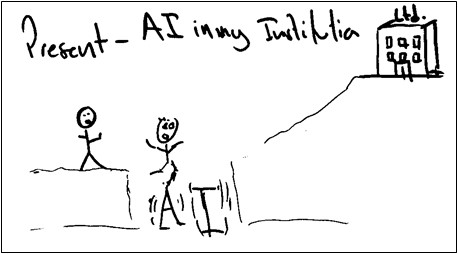
Illustration of the present showing a stick figure crossing a ravine where the only support is the letters A and I. The letters are shaky and the person is unsteady. It is necessary to cross the AI bridge to reach a building the other side of the ravine. Another stick figure stands on the side before the ravine and looks concerned.
In this thought-provoking example, AI is depicted as shaky ground separating people from reaching a destination. The building the person is trying to reach could represent employment (I read “Ltd.” on the roof) or another goal. It is clear that the artist views AI as a necessary but insecure part of the path to reaching the target. The person has to traverse the landscape without a guide who has gone before, but they do have a companion who might be encouraging them or urging caution.
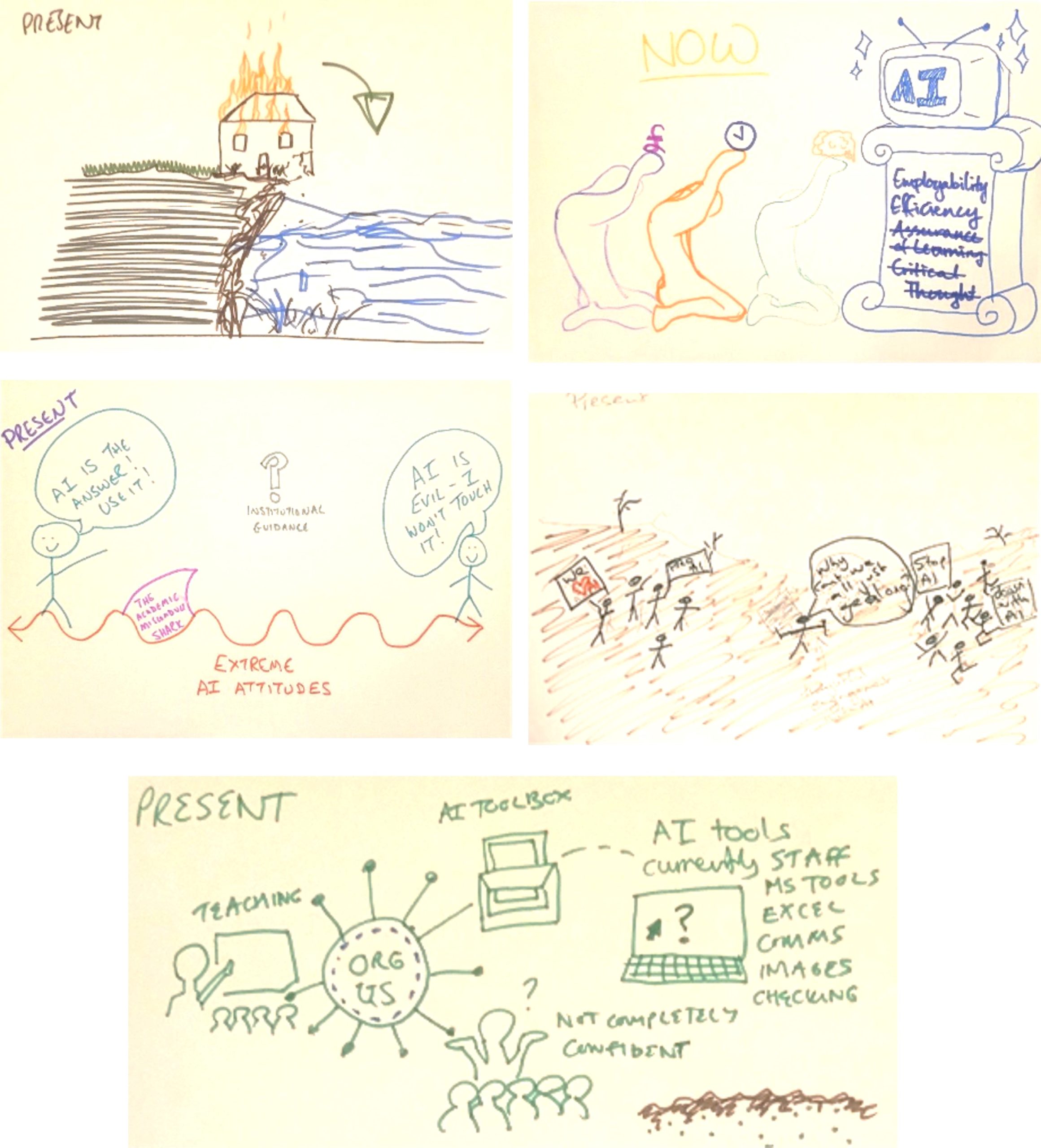
Illustrations of how members of the Teaching with AI Community of Practice perceive AI at Sussex in the present.
When asked to consider how AI at Sussex might look in the 2030s, the responses were mostly optimistic that the university will find a way to adopting informed and equitable use. A well-resourced and human-centred experience is envisioned, informed by initiatives such as the Sussex Academic Framework, with discernment and balance.
However, visions of the future did also include a stark warning about what we stand to lose if AI is allowed to overrun our values and our world: the threat to the natural environment is referenced, and the depiction of Sussex’s Arts A building alight drives home the risk to our creativity.
I was particularly struck by this illustration by Helen Todd, the Learning Technologist who supports Sussex’s Online Distance Learning provision, which shows AI as a tool used by skilled humans for the benefit of our community:
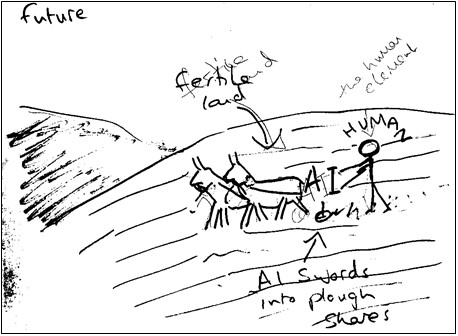
Illustration of the future
For reference, Helen’s vision of the present situation with AI is the illustration depicting conflict between opposing camps, while “thoughtful engagement” tries to achieve peace.
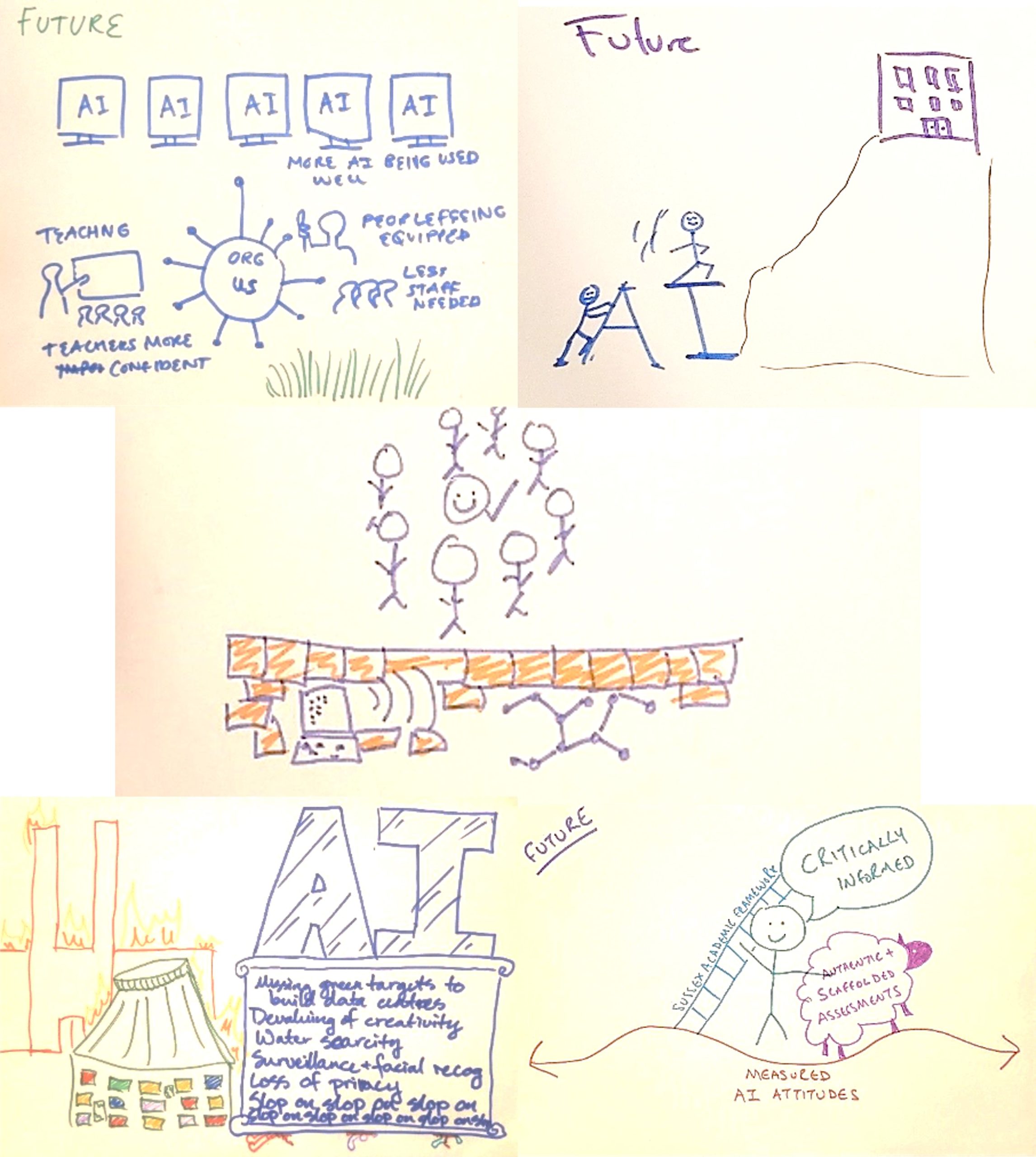
Illustrations of how members of the Teaching with AI Community of Practice perceive AI at Sussex in the coming decade.
In terms of the barriers we are facing, and what members of the CoP understand to be priorities for achieving confident and critically informed use of AI, the number one call was for support for colleagues and students to develop their AI Literacy and their wider Digital Skills, echoing the second of our Principles for AI in Education which were published in Summer 2025.
Summary and Next Steps for the CoP
The 6th meeting of the Teaching with AI Community of Practice was a success, generating much discussion and providing time and space for colleagues to reflect on how they have worked with AI throughout 25/26, and what they would like to try for 26/27. The activities and the structure was well-received and I really valued the chance to learn from everyone who came along.
Feedback on the session, and what colleagues would like to see from us in the future is invited on the MS Form here Teaching with AI Community of Practice – What’s Next for 26/27?.
You may view the resources we provided for the session here https://sussex.box.com/s/knm67qntxrt95l3bdfl6klrigr27lf14. If you would like to use them for your own event, we’d appreciate a credit.
Across the Sector
The University of Surrey have announced that AI is to be embedded in discipline-specific ways in every Surrey degree from September 2026. Read more here: Surrey embeds AI in every degree from 2026.
JISC’s HE AI Community Meetup took place on 11th June. Read more about the topics here June HE AI community meetup – Artificial intelligence where you’ll see a lot of the perspectives at Sussex are echoed across institutions.
Further Afield
Coming up on 5th July, the BBC podcast The Artificial University will feature Kathryn Claire Higgins, a working academic in the UK, who wants to raise an alarm and ask “can university education survive AI?” Tune in here: BBC Radio 4 – Currently, The Artificial University.
Announcements were made by the UK Government during London Tech Week, including details such as UK infrastructure, online safety and defence. The announcements were covered by The Guardian here: UK sets out AI infrastructure push at London Tech Week – how does it stack up? | AI (artificial intelligence) | The Guardian
- Join the Teaching and Learning with GenAI Community: If you’d like to join the community and be first to hear about events. Get in touch with us and we can add you to the list and dedicated MS Teams community. www.tinyurl.com/sussex-ai-cop
- Disclaimer on any tools not supported at Sussex. Please do not share Sussex, student, colleague, sensitive or personal data via these platforms. Not being supported means they have not passed stringent Data Protection assessments and could put you at breach of policy and legislation. For a list of supported platforms for teaching and learning please visit the Educational Enhancement website.
This was a Spotlight on AI in Education update from Educational Enhancement