Katherine Kruger (Associate Professor in Community Engagement)
What I did
In this Level 4 Leading Social Change module students work collaboratively on a real social change campaign and are assessed on their ability to critically analyse and reflect on their developing communication skills, their application of community engagement and social justice concepts, and their contribution to campaign activities. In the most recent iteration of the module, students contributed to a Young Workers’ Rights Campaign, taking on different campaign roles and responsibilities. The assessment is an individual 1,500-word reflective portfolio worth 75% of the module mark, alongside a group presentation worth 25%.
The portfolio combines a 1,500-word reflective and analytical commentary with supporting evidence gathered throughout the campaign. Students are expected to explain the role they played within the campaign, analyse the communication strategies they employed, draw on relevant research and concepts from the module, and reflect on what they did, why they approached it in that way and what they would do differently in the future. Alongside the written element, students curate an appendix that documents their contribution to the campaign. This may include campaign materials such as posters and banners, photographs of events and activities, records of campaign meetings, evidence of conversations with community members, and examples of strategic planning work. The portfolio therefore allows students not only to discuss their learning, but also to evidence it through examples drawn from their campaign work.
Throughout the semester, students build this evidence base through a series of workshop activities that support the development of their campaigning skills. These activities include exercises such as root cause analysis, power mapping, campaign strategy development and the identification of worthwhile and winnable campaign demands. Students can choose to include these activities within their final submission, enabling them to demonstrate how their thinking, decision-making and strategic understanding have evolved over time.
A key feature of the portfolio is the degree of scaffolding built into the module. Students complete a formative reflective task midway through the semester, providing an opportunity to test out their reflective writing and receive feedback before the final submission. They are also given detailed guidance about the portfolio requirements, including a suggested structure with indicative word counts and prompts to support their writing. The midterm presentation assessment asks students to design a direct action (any activity taken to build the campaign, for example a rally, strike etc) and to consider these different actions as part of a communications strategy. Students are encouraged to be theatrical, and previous students have done performances and come in costume, created podcasts, and spoken word poetry. This assessment supports them with the design of actions in their campaign. Students are marked individually for this assessment to encourage participation and recognise their different contributions. For the presentation, reasonable adjustments are in place, but students are encouraged and supported to present orally since communication is a key part of the module. However, I recognise that for campaigns to work we need people to play to their strengths and allow students to be graded, for example, on their contribution to the planning and research elements of the presentation.
Why I did it
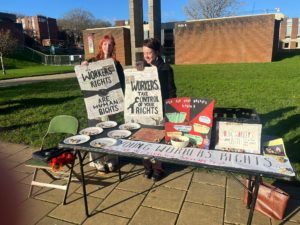
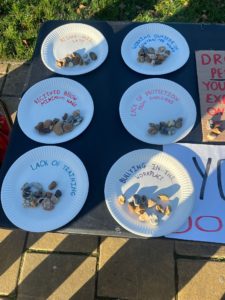
I wanted students to engage in an authentic learning experience rather than simply writing about social change. Instead of responding to a hypothetical brief, students are actively involved in designing and delivering a campaign in partnership with the local charity Brighton & Hove Citizens Alliance. Students apply theoretical ideas about community engagement, organising and social justice within a real-world context. This year they launched the Young Workers’ Rights campaign with an event in the Meeting House on campus; negotiated with management to get young workers’ rights included in the curriculum; listened to over 100 students from outside the module and collected their work horror stories; built a campaign database of student-worker experiences; designed and created the social media elements of the campaign.
The assessment is intentionally inclusive, enabling students to demonstrate their learning through a variety of campaign activities and forms of evidence, drawing on different strengths, experiences and communication skills. Learning is scaffolded throughout the module through workshop activities, campaign tasks, peer and tutor feedback, and formative opportunities, allowing students to build towards the final portfolio in stages rather than relying on a single end-point submission. The assessment also promotes sustainability by encouraging students to consider the social impact of collective action and critically reflect on contemporary social challenges and pathways for change. Finally, it has a strong employability focus. As graduates increasingly need to articulate their skills, present evidence of their achievements, communicate persuasively, work collaboratively, and adapt their messages for different audiences. The portfolio encourages students to build a narrative around their experiences, values and capabilities that will support both future study and professional practice.
What went well
Students often report that the portfolio feels more accessible than a traditional essay. Because much of the evidence is generated throughout the semester, students do not face a blank page at the end of term. The flexibility of the portfolio has also been beneficial. Students can include a range of evidence and demonstrate learning in different ways. One particularly successful aspect has been the ability to capture students’ development over time through workshop activities, campaign materials and reflective commentary. The assessment is also highly authentic. Students are not simply simulating campaign work, they are doing it.
What I would change
My main challenge is ensuring that the assessment appropriately captures and rewards students’ practical work. Some students make a substantial contribution to the campaign but struggle to articulate their learning in writing. In these cases, the final mark may not fully reflect the quality or quantity of work they have undertaken. This has led me to question whether the portfolio currently places too much emphasis on written reflection and not enough on the practical outputs themselves.
As a result, I’m beginning to think about whether the portfolio could be broken down differently in the future. For example, there may be scope to give more weight to particular elements of the work, rather than assessing everything through a single written submission. I’m also interested in experimenting with more oral and multimedia forms of reflection. Ahead of the midterm presentation, students write and perform a leadership speech – we go into the woods as a group to enable them to project their voices without worrying about who might overhear them. Students are asked to consider different modes of communication for different audiences, and currently they can reflect on that experience in their portfolios and include the written speech in their appendices. The written speech doesn’t, however, fully capture the different elements of communication we’re exploring (pacing, pronunciation and accent, intonation, rhythm and cadence, vocal dynamics and volume etc.); for this reason, I’m considering asking them to submit it as an audio recording. As this is fundamentally a communication module, it seems worth considering whether students could demonstrate some of their learning through spoken formats rather than writing alone.
I’m also considering asking students to submit a podcast-style reflection, or even a structured peer-to-peer conversation in which they discuss their role in the campaign and what they learned from it. I’m not sure exactly what this would look like yet, but I think there is potential for these approaches to surface learning that can sometimes get lost in the written portfolio.
Ultimately, the challenge is finding a way to assess such an authentic learning experience authentically. I’m increasingly interested in whether a broader range of assessment formats might help me recognise not only what students can write about their practice, but the practice itself.
Top tips for others
- Build evidence into teaching activities. Don’t treat portfolio work as something that happens outside class.
- Provide clear scaffolding. Templates, prompts and formative activities can reduce anxiety and help students get started.
- Distinguish between mandatory and optional elements. This gives students structure while retaining flexibility.
- Make the purpose of reflection explicit. Students often describe what they did rather than analysing what they learned. They need to know why analysis is important for their learning development.
- Use portfolios to support employability. Encourage students to see the portfolio as a way of evidencing skills, experiences and achievements for future opportunities.