Most people at the University of Sussex haven’t heard of Sylvia Crowe. Her legacy at the University is strong, but generally silent, existing in the spine of trees that cut across the centre of campus, the cloisters, courtyards, and pathways that give context to our teaching spaces. Crowe, the University’s landscape architect, still choreographs us through our campus, yet most of us are completely unaware that she is doing so.
At Sussex we like to talk about the beginnings of the University. When we do, we never fail to speak of the campus’ renowned architect, Basil Spence. It was Spence who commissioned Crowe as landscape architect, seeking her advice on how to make the University buildings (to use Spence’s words) ‘grow out of the soil of Sussex’ (1964, 204). Spence sought the expertise of Crowe, whose work changed the face of twentieth-century Britain as she acted as landscape consultant on the construction of towns, motorways, power stations. Despite these accomplishments, little has been written about her, and she remains absent from most publications about the creation of Sussex. Where she is included, it is only in passing.
In an article entitled “Why the Fame of Anonymity is the Greatest Fame of all”, Mathew Parris writes that it is wonderful to have created something enduringly famous while remaining anonymous (1998). Parris included Crowe in his list of unknown artists, and claimed that creators like her were happy with their anonymity. That somehow their invisibility brought them closer to God. I find it hard to share Parris’ view. Not that I’m claiming to know whether Crowe cared that her contributions to the University went relatively unrecognised. It seems presumptuous to associate anonymity with power, especially when we consider the women who have been silenced in a world that prioritises giving the platform to men.
In celebration of International Women’s Day, this blog post starts to unearth the impact of Crowe at Sussex. This task is made difficult because Crowe is missing from almost every publication about the University. I’ve had to look for her elsewhere, in her own writings and on the few writings about her. In these texts, Crowe comes across as commanding and loud, famous in her circles for fierce eye-contact and persuasive communication (British Forestry, 1998 and Collens and Powell, 1999). With this in mind, it seems strange that she has such a small presence at Sussex, prompting me to consider the legacy of her silence. Crowe is missing from the 1964 seminal publication on the founding of Sussex: David Daiches’ The Idea of a New University. This book is a key reference point upon which future discussions about the institution have developed. Because Crowe wasn’t included in conversations from the beginning, it has become very easy to neglect her as time has moved on.
Crowe’s legacy at Sussex, and in her landscape designs in general, can be defined as sympathetic to the natural context. In 1955 she wrote that ‘every landscape has its own character which reacts differently to the incursion of crowds and buildings.’ The architect must ‘design in sympathy with each particular landscape (Crowe, 1955, 250). Almost ten years later, in The Idea of a New University, Spence echoes Crowe in his chapter on the building of the Sussex campus. He writes: ‘Because of the lovely site I was against building high; the trees should top the buildings and continue to form the skyline. The materials should be sympathetic to the location – a Sussex brick, concrete, knapped flint, copper, timber and white paint’ (Spence, 1964, 205). Although Crowe’s influence underlies Spence’s chapter, he fails to mention her. Perhaps I’m reading too much into this oversight. But if it doesn’t seem strange that Crowe’s influence isn’t credited, then why isn’t it strange that Spence credits far more distant influences, like Robert Adam, Frank Lloyd Wright, Mies van der Rohe, and even Archimedes. The credit to Archimedes compounds the issue of Crowe’s omission. In 1961, the year the University of Sussex opened, Crowe gave a lecture called Civilisation and Landscape, which praised the geometry of Greek architecture. She describes=d how the Parthenon is ‘imperceptibly curved to acknowledge the land formation of its hill’ and reflected on how ‘the Greeks knew that geometry and natural form were two facets of a single truth’ (95). Once again, in echo of Crowe, Spence’s 1964 chapter heralds the architectural harmony of Athenian colonnades, describing their influence over the University’s physics building.
The main aim of this blog isn’t really to criticise Spence for his omission of Crowe, but rather to begin revealing more female aspects of our University heritage, which can be so easily buried beneath the weight of men. It was almost a hundred years ago that Virgina Woolf, in A Room of One’s Own, lamented the very heavy, and very male, foundations laid at Oxbridge. It was funding from men that laid the first stone and established the first scholarship. And, as a result of this patronage, Woolf describes how women at Oxbridge, even in 1928, weren’t allowed to walk on the grass. That privilege was still reserved for the male fellows and scholars, who were set to protect ‘their turf, which has been rolled for 300 years in succession’ (Woolf, 2000, 8). With the building of the 1960s plate glass universities, like Sussex, came new ways of doing things. The turf at our campus wasn’t rolled out by a man, but by a woman, and Crowe’s landscape should be celebrated.
As we begin to unearth Crowe, it becomes clear that there’s more to Sussex than first meets the eye. Our campus reveals itself as a complex organism—“of which man is only a part” (Crowe, 1961, 95). I suggest we delve deeper into Crowe’s presence at Sussex. Who knows what we might uncover?
References
British Forestry (1998) ‘A tribute to Dame Sylvia Crowe’s landscape work for British Forestry’, Forestry, 71(1), pp. 83–85. Available at: https://doi.org/10.1093/forestry/71.1.83 (Accessed: 10 May 2023).
Crowe, S. (1961) ‘Civilisation and landscape’, Journal of the Royal Society of Arts, 110(5066), pp. 93–102. Available at: http://www.jstor.org/stable/41367049 (Accessed: 10 May 2023).
Collens, G and Powell, W. (1999) Sylvia Crowe. Reigate, Surrey: LDT Monographs.
Dr Xuan Huy Nguyen (Lecturer in Marketing: University of Sussex Business School)
Dr Xuan Huy Nguyen
Dr. Xuan Huy Nguyen joined University of Sussex as a Lecturer in Marketing in October 2017. He has a PhD in Marketing from The University of New South Wales (Australia).His research interests include consumer choice behaviour, role of emotions in consumer decision-making, and services marketing. He is comfortable with analyzing and interpreting large volumes of data by numerous statistical packages. In terms of methodology, he is experienced in choice modelling, market response models, experimental design, and Bayesian statistics. He is also familiar with structural equation modelling (SEM).He is keen on collaborating with researchers and students who share the research interests.
Introduction
Educational technologies play a critical role in enhancing lecturers’ teaching and students’ learning experiences in higher education. As a result, educational technologies have attracted attention from many researchers and practitioners. From the students’ perspective, educational technology adoption and utilization are among the key aspects making up their holistic learning experiences in higher education. Unsurprisingly, educational technologies, represented as ‘learning resources’, is one of the nine dimensions of the National Student Survey (NSS) Questionnaire in 2022, measuring the overall students’ higher education experience (Canning,2015).
In recent years, universities in the UK have accelerated their investment in educational technologies to further enhance students’ learning experience and consequently improve their NSS results. One must ask questions about which educational technologies to invest and how to encourage lecturers to use educational technologies (Surry & Land, 2000). In this post, the author argues that only investing in educational technologies might not be enough to improve our students’ perception, e.g., the ‘learning resources’ aspect in the National Student Survey. It is also very important to improve the perceived usefulness of educational technologies, from both students and lecturers, to further improve the NSS results.
Perceived usefulness of educational technologies from a lecturers’ perspective
According to the Technology Acceptance Model, the perceived usefulness of educational technologies has a strong impact on the tendency that one would engage in the technologies and make the best use of them (Granić & Marangunić, 2019). In the context of higher education, the existing literature demonstrates that lecturer-perceived usefulness of technologies extend a significant effect on technology adoption under a wide range of circumstances (Salas, 2016). In addition, lecturer-perceived usefulness of educational technologies may even have the spillover effect, influencing the attitude of the same technologies of other people around them, e.g., other teaching staff (Abuhamdieh & Sehwail, 2008). As a result, to improve the educational technology adoption in higher education, enhancing the lecturer-perceived usefulness of the technologies may be as important as the decision to invest in the technologies.
Perceived usefulness of educational technologies from students’ perspective
Lecturer-perceived usefulness of educational technologies may not always be consistent with students’ perceived usefulness of the same educational technologies. In other words, module convenors and students may not always see an educational technology the same way. One educational technology considered as highly valuable by lecturers may be seen as low value by students.
The study
To improve students’ learning experience, I conducted a personal teaching evaluation in the middle of the semester in a postgraduate module in 2023. I asked students in two workshops to rate the usefulness of the types of tasks in PollEverywhere.com, which is a popular educational technology used to facilitate discussion in class (Laverick, 2015). Students could select one of the five options: multiple choice, word cloud, Q&A, clickable image, open-ended question, and competition. Based on my expertise and experience, I believed that clickable image would be the most useful option. Nonetheless, students’ perceptions in both workshops did not agree with my perception. Indeed, based on students’ perception, clickable image was the least popular. In Workshop 1, only 1 student out of 26 selected clickable image. The most popular were multiple choice (16 out of 26 students) and open-ended question (7 out of 26 students). In workshop 2, the same thing happened. Only 1 student out of 18 students selected clickable image. And the most popular option was still multiple choice (11 out of 18 students).
Future practice
To improve students’ learning experience, increasingly investing in educational technologies, and shifting to digital education, is a process that all higher education institutions must experience. Nonetheless, many other factors may also play important roles in the process, apart from the decisions on how much to invest and in which educational technologies to invest. In this blog, based on the findings in the existing literature and some exploratory empirical evidence, I demonstrate that universities should also pay attention to the perceived usefulness of educational technologies to improve the perception of technology adoption and subsequently improve their NSS results. Practical tips
Practical tips
Universities should pilot a technology in a number of schools or modules before rolling out the technology across the institution.
Early in the term, lecturers should explore their students’ perceived usefulness of a technology and how to best utilize it. Based on the results, lecturers can either adapt to their students’ perceptions or explain the benefits of their preferred learning technology to improve both teaching and learning experiences.
Canning, J. (2015). A new measurement and ranking system for the UK National Student Survey. Perspectives: Policy and Practice in Higher Education, 19(2), 56-65. https://doi.org/10.1080/13603108.2015.1021401
Granić, A., & Marangunić, N. (2019). Technology acceptance model in educational context: A systematic literature review. British Journal of Educational Technology, 50(5), 2572-2593. https://doi.org/10.1111/bjet.12864
Laverick, C. (2015). Using Poll Everywhere to Improve the Student Experience: Increasing Confidence and Encouraging. In G. Brewer & R. Hogarth (Eds.), Creative Education, Teaching and Learning: Creativity, Engagement and the Student Experience (pp. 40-50). Palgrave Macmillan UK. https://doi.org/10.1057/9781137402141_5
Salas, A. (2016). Literature review of faculty-perceived usefulness of instructional technology in classroom dynamics. Contemporary Educational Technology, 7(2), 174-186. https://doi.org/10.30935/cedtech/6170
Surry, D. W., & Land, S. M. (2000). Strategies for motivating higher education faculty to use technology. Innovations in Education and Training International, 37(2), 145-153. https://doi.org/10.1080/13558000050034501
Jeanette Ashton is a Senior Lecturer in Law (Education and Scholarship) and a non-practising solicitor, having joined the University of Sussex after 8 years at Brighton University. She convenes and teaches on the Bachelor of Law (LLB) degree programme in the Law School. She works on employability, is interested in the intersection between academic and professional skills, and is part of the Clinical Legal Education team.
Kieran Durcan is a Senior Lecturer in Law (Education and Scholarship). He convenes and teaches a number of core and optional modules on the LLB and MA programmes within the Law School. He is interested in module design and enhancement and is keen to embed practical skills across the law programmes having previously been the placement lead within the School.
Introduction and pedagogical context
This blog reflects on the process of working with students to develop a new Business Law and Practice module (BLP) for Sussex Law School, one of two options for law students at level 5. It is set within the broad pedagogical context of co-creation, knowledge exchange and students as ‘partners’ (Cook-Sather et al, 2014; Dollinger & Lodge, 2019), but, on a review of the literature, is more aligned with the ‘participatory design’ approach, explored in the medical education arena, with students having a key role in working towards the goal of improving the “quality of educational innovations by ensuring use, usability and utility of educational design for both teachers and students” (Di Salvo et al, 2017). Martens et al (2019) note the overlapping of terminology, but find that participatory design sits below co-creation in terms of student influence and involvement with design and decision-making. In summary, we wanted students to work with us to develop a pedagogically innovative module, but once we had their input, we would work on what that might look like in terms of implementation.
Why introduce a Business Law and Practice module?
In 2020, while relatively new in post, and both from a practice background, we led a project on the Law School’s response to a big shakeup in legal education, the introduction of the Solicitors Qualifying Exam (SQE). For students wishing to qualify as solicitors in England and Wales, there is no longer a requirement to undertake a Qualifying Law Degree before undertaking the professional stage of training, meaning that Law Schools were, and indeed still are, faced with the challenge of ensuring that students wishing to become solicitors can see the benefits of undertaking a law degree at undergraduate level prior to embarking on the professional stage, despite it not being mandated by the Solicitors Regulation Authority. To demonstrate the requisite legal knowledge, aspiring solicitors need to pass the SQE, with one of the Foundations of Legal Knowledge areas being BLP.
Sussex is a research-intensive Law School and there was understandable scepticism amongst some within the School as to whether change was necessary. Some colleagues expressed concern that this would undermine our critical approach, moving too far in line with the central government employability agenda (Department for Education, 2017). Our view was that wholescale redesign of the law curriculum would not be necessary, but that we should and could find a way to support students wishing to qualify via the SQE route without damaging the essence of Sussex as a Law School.
As part of our work on the Law School’s response to the introduction of the SQE, in April 2020 we conducted an employability survey of our then incoming second year students, the first cohort able to qualify via the new route, to ascertain the percentage wishing to become solicitors in England and Wales. Of the 77 respondents, approximately 59% indicated they wished to qualify as a solicitor after graduating, while 18% indicated that they did not, and 23% did not know. The challenge then was to develop a strategy suitable for the majority group, which would also accommodate students who wished to pursue other career paths, legal or otherwise, or those students who did not know. We identified a gap between level 4, where Contract Law is a core module, and level 6, where there are a range of specialist commercially focused electives, and felt that BLP could usefully bridge that gap. Alongside this, we were mindful of the continued focus on commercial awareness in legal practice and recruitment, and felt that a BLP module could be utilised to embed that, aligning with the ‘Sussex 2025 World Readiness and Employability Strategy’ (Huns, 2022).
What do we want to explore?
Our study is twofold and in two stages. The first purpose was to work with the students who had chosen the module, around 230, to design the first iteration, to find out why they had chosen BLP and to get their input on the content and key themes that they would like to see, alongside teaching and learning delivery, including assessment. The second purpose was to explore their experience, including prior to university, of participating in the design of modules and/or the wider curriculum. This is the first stage and, having completed this in October 2022, prior to embarking on the design of the module, this piece reflects on those findings and our experience of shaping the module. The second stage, with the same group of participants, will focus on whether, if at all, participating in the design of the module had any effect on their experience of the module.
To understand what content and key themes students wanted covered, we undertook a mixed-method sampling approach, utilising focus groups and a Qualtrics survey for those who did not wish to or were unable to attend, but wanted to participate (Denscombe, 2021). 30 students participated in either the focus groups or by completing the survey. We were aware that participants may not be familiar with key terminology, so took care to frame our questions thematically, over the life cycle of a business, rather than technically. Participants were given the opportunity to choose from a range of options and to put forward their own suggestions for content, wider themes and teaching and learning. Interestingly, and supporting our initial views that they might see BLP as an opportunity to gain commercial awareness and employability skills, many expressed a wish for links with professional practice and a chance to gain an insight into the intersection of law and business. As one participant put it, the expectation was that BLP would “kind of give us a pathway to think about our future.”
How did our students feel about participating in the design of the module?
The responses on this, both from the focus groups and Qualtrics survey, were unequivocal in thinking that students should be given more opportunities to participate in module design and a chance to shape the curriculum more broadly. The main reasons for this view were that students valued the opportunity to work closely with faculty, that student input would result in the module being more engaging and enjoyable: “knowing that they will be learning about something that they actually want to gain knowledge in”. They felt that this would increase attendance and achievement: “[I]f students are happy, they are more likely to do well and be engaged with the course.” Opportunities like this would enable students to have more “control”, to play a bigger role in their own learning and in doing so, would benefit future cohorts. One of the respondents took a consumer-driven approach, citing payment of tuition fees as a reason why students should be more in control of their learning.
What are the challenges of student participation?
To some extent, we found we needed to manage students’ expectations as to what we could feasibly achieve within a 15-credit module sitting within the university structures. The module had already gone through the necessary approval process and, aside from the short survey detailed above, we had not had the opportunity to work with the students, meaning that the teaching delivery structure was already fixed, though we made participants aware this can be changed for future cohorts. We also had to build in the requirements of the SQE detailed above, ensuring that BLP gives students wishing to pursue that route a good foundation, mindful of the other students who are taking the module for different reasons, with “because the module aligns with my future plan for study” and “to gain commercial awareness” scoring just below “aligns with my future career plans” in our survey.
Alongside this, we needed to navigate the level 6 commercially-focused electives, to avoid duplication and to ensure that we provide a ‘stepping-stone’ rather than replacement for those modules. As we are fortunate to have scholarship leave, alongside some traditional resources, we found that non-traditional resources, such as podcasts and TED-talks, better suited the module content and differentiated BLP from other modules on the course.
A significant finding from our work with the study participants, is that they wanted a more practical approach to teaching content, which they felt would help equip them with valuable skills and an insight into professional practice, echoing research undertaken by others, such as Nicholson and Johnston (2020, 431). With this in mind, we are creating authentic learning activities utilising the virtual internship programme Forage, but embedding selected activities within the teaching and learning delivery. In the 21/22 academic year, 546 students from across the university, 65.7% law students, enrolled in a total of 770 Forage programmes, however only 108 of those programmes were completed. We hope that by embedding some of the activities within the learning, the completion rate will increase, as the programmes provide valuable insights into key aspects of business law.
Alongside this, as well as practitioner input, we are working with the Careers and Entrepreneurship team to build in a ‘meet the start-ups’ session, scaling up the Law School’s co-curricular ‘Start-up Legal Connect’ project from 21/22, where Law students, start-ups, and legal practitioners work together on small business legal issues. Students, having had input on business structures and considerations, will be able to hear from students with start-ups from across the University, followed by an opportunity to network. We hope that by embedding this within BLP, greater numbers of students will benefit, the importance of which was a key finding in our previous study.
Concluding thoughts
Our BLP module began in Spring 2023 and was still a work in progress at time of writing this piece. We have been able to spend a considerable amount of time ensuring students participate in the design and have considered other stakeholders’ views on what a BLP module should encompass. Without a period of scholarship leave, we would not have been able to develop BLP in this way. Sussex University is, rightly so in our view, championing work with students, for example through the Connector Programme . In terms of module and wider curriculum design, if student involvement is to be more than module evaluation, which we know is minimal in terms of engagement, thought needs to be given as to resourcing the process, particularly where there are significant numbers of students.
We are interested to see how BLP is received; whether students are enthused by the departure from a traditional approach. We look forward to understanding whether student participation in the design had any impact on their experience. To be continued….
Cook-Sather, A. et al. (2014) Engaging students as partners in learning and teaching: A guide for faculty. San Francisco, CA: Jossey-Bass.
Department for Education (2017) Teaching Excellence and Student Outcomes Framework Specification. London: Department for Education.
Denscombe, M. (2021) The good research guide: For small-scale social research projects. London: McGraw-Hill Open University Press.
DiSalvo, B. et al. (2017) Participatory design for learning: Perspectives from practice and Research. New York: Routledge, Taylor & Francis Group.
Dollinger, M. and Lodge, J. (2019) “Understanding value in the student experience through student–staff partnerships,” Higher Education Research & Development, 39(5), pp. 940–952. Available at: https://doi.org/10.1080/07294360.2019.1695751.
Martens, S.E. et al. (2019) “Student participation in the design of learning and teaching: Disentangling the terminology and approaches,” Medical Teacher, 41(10), pp. 1203–1205. Available at: https://doi.org/10.1080/0142159x.2019.1615610.
Nicholson, A. and Johnston, P. (2020) “The value of a law degree – part 3: A student perspective,” The Law Teacher, 55(4), pp. 431–447. Available at: https://doi.org/10.1080/03069400.2020.1843900
By Dr John Parry (Senior Lecturer: Education) and Dr Sarah Watson (Academic Developer)
Walking away from campus towards Stanmer Park
The University of Sussex was founded, both literally and intellectually, on its downland surroundings. Basil Spence, the University architect, wanted the campus to ‘grow out of the soil of Sussex’ (Spence, 1964, 203). He situated the University in the fold of a valley, lined by woodland on both sides, to west at Richmond Hill and the east on Tenant Laine. By enclosing the campus within the landscape, Spence established a university that appeared to exist (in accordance with its own etymology) as a universe; a place where everything held together. To emphasise harmony between the built and natural landscape, Spence used local building materials of red brick and knapped flint. The pre-established trees, once part of an earlier farmland estate, were immovable and therefore dictated a more organic layout than that afforded by Spence’s angular, modernist design. Adding to the synthesis of natural and built forms, arched windows and vaulted arcades reflect the rounded hills and trees. Spence built the University by learning from the landscape, creating a balanced ecosystem where intellectual growth was just one aspect of the fauna. Sussex was founded upon reciprocal interchange between nature and intellect, with both making demands upon the other as mutual beneficiaries. This post argues that, in light of the University’s current sustainability strategy, and with it its drive to develop our students’ civic responsibility, such reciprocity needs to be revisited.
Aerial image of the University of Sussex campus taken from the University prospectus (1961-2)
Dr John Parry, who has passion and expertise in environmental education, integrates landscape and learning in his current teaching at Sussex. However, he recognises that to develop this pedagogic approach, the University needs more resources to support learning outdoors. In the second part of this blog, John introduces himself and proposes that the University requires a purpose-built teaching and learning space that is dynamic and flexible. John writes:
22 years ago, I was working with school groups on a regular basis in a local nature reserve in Lewes when a local benefactor said, ‘I see what you do with children without a building, John, but think what you could do with a building. Here is £100,000 – get building’ – or words to that effect! And that led to the Linklater Pavilion in Lewes and ‘the rest is history’ as they say. I only recount this because behind it is a serious point regarding learning and teaching outside, which is something the University is taking seriously, perhaps partly as a result of Covid with its consequence of distance and circulating air. The truth is that, however committed to the idea we may be, our great and changing British weather is capable of rendering such outdoor learning into miserably sodden students in winter or dehydrated ones in summer. And on a large campus with high demands to be in a lecture theatre on time, there is precious little scope for students to recover from deluge or extreme heat. Furthermore, the traffic noise of the A27 is difficult to ignore unless you are at the furthest northerly point on Campus at Northfields. And that is why I and colleagues have set up a forest food garden there and based much of our teaching and learning around it. However, to be a truly effective learning experience we need a modest structure to serve not only the forest food garden but Roots and Alan Stewart’s chalk grassland research project. Such a building designed and constructed by students using hempcrete with the help of professionals, with whom we are in touch, would not only teach useful skills to our students but would be a beacon of relatively cheap building techniques and sustainable materials. My vision is an interactive space with a modest kitchen that would allow informal exchanges between the generations with bifold doors opening out to open air teaching and learning spaces with direct access to Roots, the forest food garden and the chalk grassland research. It would not only provide badly needed storage space but would also serve as a base for outdoor drama, philosophy, music and life sciences to name but a few by supportive colleagues. The ability to dive into a well-designed and purpose-built shelter if the weather turns foul, as well as preparing properly before undertaking projects outside, will lead to richer outdoor learning experiences. These somewhat modest but regular interactions with the living world, often in time-limited slots framed by a degree of uncertainty, are so much better supported by the certain availability of reasonable shelter and flexible space. Such a facility will be in high demand and could serve summer courses, but more significantly will act as a secure catalyst for other outdoor interventions that will stand the test of time. Talking of which, this approach was being advocated and realised by John Dewey in his Chicago Laboratory school over a hundred years ago (Quay and Seaman, 2013).
John has spoken to colleagues across the institution about their interest and support for such a purpose-built learning space. Here are a couple of their responses:
As the impact of the climate and environmental emergencies becomes daily more evident, more than anything we need to explore practical and imaginative responses that draw on our creative resources from all disciplines. The proposed building will provide a unique campus focus and hub for such activities and exchanges.
Professor of Opera & Music Theatre
This sounds like a fantastic project. I can definitely envision using the space for teaching and project work on Games: Critical and Creative Writing … I have been thinking about how to expand the thinking on that course beyond screen-based play into locative media, site-specific artwork and interventions, ambient storytelling, placemaking, etc
Research Fellow in Arts, Climate & Tech
This purpose-built learning space will extend the scope of innovative teaching across a range of subjects at Sussex. If we want our lecturers to be sustainable educators, we must provide them with the appropriate sustainable environments in which to thrive.
References
Quay, J and Seaman, J (2013) John Dewey and Education Outdoors: Making Sense of the ‘Educational Situation’ through more than a Century of Progressive Reforms. Rotterdam: Sense Publishers. https://doi.org/10.1007/978-94-6209-215-0
Spence, B (1964) ‘Building a New University’ in David Daiches (ed) The Idea of a New University. London: Andre Deutsch.
Jeanette Ashton is a Senior Lecturer in Law (Education and Scholarship) and a non-practising solicitor, having joined the University of Sussex in 2019 after 8 years at Brighton University. Jeanette is Employability lead for the Law School, co-leads the Client Interviewing skills programme, CLOCK legal companion scheme, and peer mediation clinic.
Paven Basuita is a Lecturer in Law (Education and Scholarship) and a non-practising solicitor. She joined the University of Sussex in 2019 from BPP Law School. Paven runs the Client Interviewing Skills programme with Jeanette Ashton.
There is a wealth of literature on the importance of including employability skills in Higher Education (HE) (Tibby and Norton, 2020, Department for Education, 2017; Knight and Mantz, 2003). At the same time, there has been significant academic criticism of HE’s employability agenda (Morley, 2001; Rooney and Rawlinson, 2016; Tomlinson, 2012). At the University of Sussex, embedding employability is a strategic priority, set within the ‘Sussex 2025 World Readiness and Employability Strategy’ (Huns, 2022). Within Sussex Law School (SLS), there are many opportunities to develop practical legal skills, our employability focus for this piece, however these are largely co-curricular and those which are within the curriculum, primarily through our Clinical Legal Education module, are optional with limited numbers. This piece explores the findings from a follow-on study on a peer assisted learning project within SLS, and considers the possibility that a failure to embed practical legal skills into the curriculum from the outset of the student journey, may deepen existing inequalities between students, both during their time with us and post-graduation.
Our study
We organised two focus groups of students to evaluate our pilot of a client interviewing workshop, which we ran in Spring 2022. Client interviewing is an important practical legal skill with relevance beyond legal practice, and is a well-established co-curricular programme for second year students and finalists in SLS (skills competitions). The pilot project involved recruiting second and third-year students as facilitators to design and deliver a client interviewing skills workshop for first year students, to extend opportunities for the development of client interviewing skills. In evaluating the pilot, we spoke to five students who participated in the workshop and four of the student facilitators about their experiences, including their views on whether practical legal skills, such as client interviewing, should be embedded into the curriculum.
Findings from the participant focus group
To embed or not to embed:The participants (five first year law students) agreed that client interviewing should be embedded in the curriculum, for example by including it as a seminar activity, rather than only being offered as a co-curricular activity. Alluding to inclusivity, one noted “the type of people who go are just the type of people who would seek these types of things out anyway.” Expanding on this, they felt that students may not think they will benefit, and so do not sign up for co-curricular opportunities. However, they felt that students are likely to benefit, and that participating will help build confidence and encourage engagement with other opportunities. The participants also thought that client interviewing could be used to help students better understand and apply the legal content of a module.
To assess or not to assess:The participants were divided regarding whether client interviewing skills should be assessed. One argument in favour of assessing was that it was a way of evidencing competency in that skill, which would be beneficial for job applications. Concerns raised were that scoring poorly in such an assessment could be detrimental to a student’s confidence, both in terms of academic ability and professional pathways. Participants noted the value of receiving constructive feedback but not necessarily in an assessment context, with one feeling that skills competency is too subjective to assess fairly. This may be partly due to students being more familiar with traditional assessment methods.
Findings from the facilitator focus group
To embed or not to embed:The facilitators (four final year law students), all agreed that practical legal skills, such as client interviewing, should be embedded into the curriculum. They felt that client interviewing skills were essential for students wishing to become lawyers, but also useful for non-law careers. Another reason was that students need to start developing these skills before undertaking professional assessments such as the Solicitors Qualifying Exam.
Embedding was seen as fairer and more inclusive. The facilitators felt that embedding would give all students a chance to engage and would help them to build their confidence, particularly with work experience and job applications. As one noted, “you’re gonna have to use soft skills at some point and I think not having them is … setting students up for failure in a way.” They also felt that embedding skills would help give students an insight into whether a legal career was right for them, before they committed to expensive postgraduate vocational study.
To assess or not to assess:The facilitators were unequivocal that practical legal skills should be formally assessed and rejected suggestions that this should not be done because of ‘push back from students’. They suggested that including some practical skills assessments would increase the variety of assessment modes and ultimately be more inclusive. They stressed the importance of building this in from the outset. Unlike the participant group, the facilitators raised no concerns about the subjectivity of skills assessment and felt that skills could be taught and assessed in a fair way.
The broader context
The students were unanimous that employability skills should be embedded in the curriculum. Our findings reflect research undertaken by others, such as Nicholson and Johnston (2021) who found that students placed most emphasis on the instrumental value of their law degrees, particularly in terms of qualification as a lawyer and employability enhancement.
The responses of the facilitators demonstrate that they consider the responsibility for helping students to develop their employability skills lies with the law school. This arguably reflects the narrative promoted by universities, namely that the purpose of university education is primarily employability (Nicholson and Johnston, 2021). However, when it comes to students’ experiences of studying law there appears to be a disconnect between student expectations of what a law degree will offer and the reality. As one of our facilitators told us “when I did law, I thought I’d at least be doing some sort of legal practice stuff.”
Whilst the students who took part in our project undoubtedly benefitted, many more students did not take part and so did not benefit. The workshop was offered to all of our first-year students – a cohort of approximately 380 – but only around 20 students attended on the day. The workshop took place just before a period of industrial action, which may have been a factor. Research shows that lower-income and working-class students are more reticent to engage in extra-curricular activities and this may be due to paid work and responsibilities outside university including caring responsibilities (Bathmaker et al, 2013; Purcell et al, 2013; Hordósy and Clark, 2018). By offering these opportunities outside compulsory teaching activities, there is a danger that only those able to participate and/or those who are already sufficiently motivated, will benefit. This risks deepening inequalities between students, both at university and beyond, as students compete for jobs, in legal and other fields.
Concluding thoughts and challenges
Our study was small scale and whether the participating students’ views are representative more widely would need further research. Another limitation of our study was that the students participating had voluntarily signed up to take part in a client interviewing workshop and it is therefore unsurprising that they placed a high value on employability skills. That being said, we would suggest that embedding employability skills into the legal curriculum is the most equitable and inclusive approach and could go some way towards addressing the barriers to engaging with co-curricular activities for some students.
Including employability skills should not be at the expense of legal academic skills. Rather, the two can be combined. For example, a seminar activity could involve interviewing a ‘client’, defining their problem and giving them advice. This would help students understand and apply the law and demonstrate to them that there may be more than one solution to a legal problem.
In terms of assessing employability skills, whilst we acknowledge the concerns raised by a minority of the students in our focus groups, including employability skills without assessing them may mean that students don’t engage. We think that anxiety around assessing practical skills could be managed through careful scaffolding and formative opportunities. Alternatively, activities which help develop employability skills could be linked to an assessment, without being directly assessed, for example revision activities on a topic that will be examined.
Embedding practical legal skills should be, from what our students tell us, an important consideration in module/course design. Helping students to develop these key skills will provide them with, in the words of one of our student facilitators, a “stepping stone…before they enter the working world” and we suggest is a change worth making.
References
Bathmaker, AM, Ingram, N and Waller, R (2013) ‘Higher education, social class and the mobilisation of capitals: recognising and playing the game’ British Journal of Sociology of Education, 34, (5/6): 723-743 https://doi.org/10.1080/01425692.2013.816041
Hordósy, R and Clark, T (2018) ‘Beyond the compulsory: A critical exploration of the experiences of extracurricular activity and employability in a northern red brick university’, Research in Post-compulsory Education, 23 (3): 414-435 https://doi.org/10.1080/13596748.2018.1490094
Morley, L (2001) ‘Producing New Workers: Quality, equality and employability in higher education’, Quality in Higher Education, 7:2, 131-138, https://doi.org/10.1080/13538320120060024
Nicholson, A and Johnston, P (2021) ‘The value of a law degree – part 2: a perspective from UK providers’ The Law Teacher, 55:2, 241-257 https://doi.org/10.1080/03069400.2020.1781483
Rooney S and Rawlinson M (2016) ‘Narrowing Participation? Contesting the Dominant Discourse of Employability in Contemporary Higher Education’ Journal of the National Institute for Career Education and Counselling, 20 https://doi.org/10.20856
Tomlinson, M (2012) ‘Graduate Employability: A Review of Conceptual and Empirical Themes’ Higher Education Policy 25, 407–431 https://doi.org/10.1057/hep.2011.26
Verona Ní Drisceoil – Senior Lecturer in Law at the University of Sussex
Dr Verona Ní Drisceoil is a Senior Lecturer in Law at the University of Sussex. She is also a Senior Fellow of the Higher Education Academy (SFHEA). Her current research focuses on transition pedagogy, inequality in education and assessment for learning.
Introduction
Formative assessment is a familiar element in the Higher Education (HE) landscape but there has, as noted by Crossouard and Pryor (2012, 253), been ‘little questioning of the practices conducted in its name much less the theory that produces it’. In this blog post, I call for a questioning of the practice. Specifically, I argue that we need to rethink our approach to formative assessment in relation to the preparation for written based summative assessments, such as essays. In doing so, I argue for the incorporation of a more responsive and deliberate practice approach (Ericsson and Pool, 2016) – to build in, and embed, more formative written opportunities within the classroom environment as a better way to track progress, respond in real time, and ensure that all students benefit.
To begin, I will revisit some of the current challenges to, and for, formative assessment in HE before then moving on to outline what a rethinking looks like. I will conclude with some take away messages and suggestions on how to build in written based formative opportunities into your seminars and lectures.
What are the current challenges for formative assessment in HE?
The challenges to, and for, formative assessment in HE are well known and include workload capacity (providing feedback during term time), time frames and students not taking up the opportunities. Challenges also arise where the formative assessment has been marked and graded (formatives should not be graded!) by a faculty member or teaching assistant not marking the summative assessment. However, beyond these challenges, all of which are valid and important, I suggest that the primary reason that formative assessments do not work well in HE – for student or faculty – is due to the predominant approach we take. Standard formative assessments in HE in advance of traditional written based summative assessments (at least in law, my discipline) include:
Write a response to a problem question on X
Write an essay on X
Write a draft plan/outline to an essay on X
The problem with these types of formative assessments (all of which I have used myself, so no judgement), is that they are summative in nature and form. To use a sporting analogy as utilised by Christodoulou (2017) , the ‘write an essay on X’ as a formative equates with run a marathon to see if you can run a marathon. This is not a good approach, nor is it good advice. It seems then that we, in HE, have misunderstood what is meant by formative assessment.
What do we mean by formative assessment?
For Pryor, the aim of formative assessment is to improve education while summative assessments aim to measure education. Wiliam and Black (1998) note that formative assessment includes ‘activities that elicit evidence of student learning that can be used by teachers, students, or others, to make decisions about future teaching and learning’. In HE, I am not sure, we, as faculty members, are very good at making decisions about future learning based on the formative assessments we set – at least not for the cohort involved. In other words, we don’t respond in real time.
The basis for that premise is that the formative assessments we set are summative in nature (run a marathon to see if you can run a marathon) and arguably come much too late in the term. They have, in many instances, become a tick box exercise and let’s be honest in week 9/10 of an 11-week term (where they usually appear), students are not the only ones struggling with term fatigue and burn out. We are hoping, in part, that students don’t take up the opportunity. Surely then there is a better approach we can take – for student and faculty?
Responsive teaching and deliberate practice as a better approach
Wiliam and Christodolou tell us that formative assessment should intervene in the midst of a student’s learning process not at the end. In its ideal form then, formative assessment should be comprised of frequent, interactive assessments of student progress and understanding to identify learning and develop the skills required – with an opportunity for teachers to respond in real time. This is not to say, of course, that there are no examples of responsive and embedded formative practices being utilised in HE. There are many brilliant examples including the use of technology such as Poll Everywhere and Mentimeter. These tools are extremely useful for gauging knowledge and understanding of key principles in real time and, to a lesser degree, to test application. However, these more active, real time formative opportunities or approaches are more difficult to use when it comes to continuous written based tasks (without a significant need for response by the teacher) and thus there is a tendency to shy away from written based activities in the classroom in HE in favour of discussion-based seminars. This approach to literacy development lies in sharp contrast to teaching approaches adopted at primary and secondary level. This is deeply problematic particularly given our continued reliance on written based summative assessments in HE. Students need knowledge and skill in the subject area. To draw on Ericsson and Pool (2016), this requires identifying the building blocks, sequencing them carefully and ensuring students gain and retain them. This process is known as deliberate practice. Asking a student to write an essay for a formative assignment in week 8/9 is not going to guarantee that this will help the student to excel at writing essays in advance of the summative. In fact, it may be deflating and demotivating. As we all know, writing takes time and practice – it takes deliberate practice.
Concluding thoughts and take away messages
Written based tasks are more difficult to check and support within the contact time we have with students in HE but arguably what we should, and need to, spend more time on especially if we continue to assess by way of written based assessment.
As per the work of Teresa McConlogue (2020) we should think about backward design. If your summative assessment is written, think about how you can develop useful writing exercises (formative opportunities) into your lectures and seminars throughout the term. See further the work of Wendy Garnham (2021) on ‘active essay writing’.
Linked to point 1, respond in real time (where possible) thus reducing additional workload beyond allocation. This ‘respond in real time’ should be a shared and collective exercise with students. Peer review and peer feedback to written based exercises may take time to embed and develop but arguably worth the initial investment.
Examples of the 5-minute ‘write and reflect’ exercises I build into lectures, workshops and seminars include:
A free writing exercise: A response to X, or what have you learned today. This is inspired by the work of Tamsin Hinton-Smith, Rebecca Webb and Emily Danvers in Writing into Meaning
Write an introduction to a problem question on X. Give students a starting sentence to get started.
Summarise the position put forward by scholar X. Using the abstract from an academic article on your reading list works well here.
Write a response to the position put forward by scholar X.
Outline your argument/response to X or structure your argument/position to/on X.
Provide feedback on a form of writing. Be the teacher/peer.
Introduce students to the excellent academic phrasebank to support academic writing. With some of the exercises above, I encourage students ‘to use the academic phrasebank when you get stuck’.
For a seminar, ask students to read examples of former student work and give feedback, grades etc. This is not a novel idea but worth repeating and hugely important in terms of building feedback literacy as advocated by David Carless, Naomi Winstone (2018) and other leading scholars on feedback.
References
Black, P and Wiliam, D (1998) Assessment and classroom learning. Assessment in education: principles, policy & practice, 5:1, 7-74, http://dx.doi.org/10.1080/0969595980050102
Carless, D and Boud, D (2018) The development of student feedback literacy: enabling uptake of feedback. Assessment & Evaluation in Higher Education. 43:8, 1315-1325, doi: 10.1080/02602938.2018.1463354
Christodoulou, D (2017) The future of Assessment for Learning. Oxford: Oxford University Press
Crossouard, B and Pryor, J (2012) How Theory Matters: Formative Assessment Theory and Practices and their Different Relations to Education. Studies in Philosophy and Education, 31 (3). pp. 251-263 https://doi.org/10.1007/s11217-012-9296-5
Ericsson, A and Pool, R (2017) Peak: Secrets from the New Science of Expertise. London: Harper Collins
Winstone NE, Mathlin G and Nash RA (2019) Building feedback literacy: students’ perceptions of the developing engagement with feedback toolkit. Front. Educ. 4:39. doi: 10.3389/feduc.2019.00039
Since 2015, Mark has been based at the University of Sussex as a Senior lecturer in the Business School within the Management department. During this time, he has achieved Senior Fellowship of the Higher Education Academy and Certified Management & Business Educator status in recognition of the senior level and leadership contributions, has made an ongoing commitment to continuous professional development of teaching and learning practices and ever higher standards. Mark has been involved in leading research in the Business School to better understand the complex factors that lie behind what is referred to as the BAME awarding gap alongside other Equality Diversity and Inclusion initiatives aimed at tackling this issue.
The experience of feeling culturally isolated and anxious in seminars, feeling alienated in accommodation, having to explain why the unwanted touching hair is wrong, being unable to speak openly about how the daily issues people of colour experience affects mental health.
These are just a few of the many findings reported by students of colour in research undertaken by the Business School in 2020-21.
How did we get here?
The awarding gap of ‘good’ (First and 2:1) degrees between white students and students of colour (SoC) is longstanding and widespread in UK higher education (formally referred to as the BAME* awarding gap). The University of Sussex Business School’s (USBS) gap is 12.6% in the most recently available data. We are duty bound to rectify this and our research with our students of colour (SoC) in the school is a significant step.
The research
The research is a response to a call for action from leading higher education sector bodies to engage directly with their SoC communities, notably University UK’s, ‘Closing the gap’ report of 2019. The report highlighted a dearth of research of this type. Following the development of a research proposal, USBS’s Senior management team, agreed to a fund our research in November 2019. It was led by myself with Prof. Jacqueline O’Reilly and Dr. Ann McDonald, a specialist, independent researcher. We aimed to better understand the institutional, and other, factors affecting SoC and their sense of belonging, because belonging in turn affects attainment (EHRC 2019). The project commenced in March 2020 following ethics approval.
The research team included three SoC studying UG & PG courses in the school at the time. The student-researchers were paid and provided with training. Their insights proved invaluable, for example when contributing to the survey question design.
In all 76 surveys were completed by SoC in the School and 31 in-depth interviews via Skype because of the March 2020 lockdown. Each student-researcher conducted one interview and analysis with Ann’s supervision.
Key findings and outputs
One of the many key findings, also reported by the School’s excellent Race equity advocates, Arunima Singh, Gurbir Kaur Matharu and Ife Rotimi, is the urgent need for a trustworthy and transparent tool to report cases of discrimination, harassment and bullying. In the summer of 2021, the University introduced a Report and Support tool.
It demonstrates that through collaborative partnerships with SoC we can make meaningful progress towards a more inclusive school and university. This progress is set to continue with the Business school’s forthcoming Race Equity Plan led by the School’s Director of EDI and Associate Dean for Education and Students.
We have also developed the Race Equity Awareness site for all in the Business School. To instill inclusivity in to all that we do, we work closely with colleagues in the Student experience, Student Support and Careers and entrepreneurial teams and with students themselves of course.
What next?
If you want to be part of a more inclusive university there are plenty of ways to get involved. A good starting point is to read the full research report which is accessible via the Business school Race Equity Awareness site.
*BAME is Black, Asian, Minority Ethnic and is the official UK term for data classification purposes. However, use of the term is highly contested (Gabriel, 2020) In this research and accompanying report we use the designation Students of Colour (SoC).
References
Clark, M., McDonnell, A., Joy Valentine, S., Lui, Y., Trought, M., O’Reilly, J. and Hattersley Mitchell, C. (2021) Closing the Awarding Gap: Students of Colour Perceptions of Learning, Support and Cultural Environments at the University of Sussex Business School. University of Sussex Business School. Available at: Closing the Awarding Gap.pdf (accessed: 22/11/2021).
Universities UK (2019) Black, Asian and Minority Ethnic student attainment at UK universities: closing the gap. Universities UK. Available at: bame-student-attainment.pdf (universitiesuk.ac.uk) (accessed: 22/11/2021).
Paven Basuita is a Lecturer in Law (Education and Scholarship) and a Non-Practising solicitor. She joined the University of Sussex in 2019 from BPP Law School. Paven runs the Client Interviewing Skills programme with Jeanette Ashton.
Jeanette Ashton is a Lecturer in Law (Education and Scholarship) and a Non-Practising solicitor, having joined the University of Sussex after 8 years at Brighton University. She is Employability lead for the Law School, leads the Client Interviewing skills programme and co-leads the CLOCK legal companion scheme and peer mediation clinic.
Kieran Durcan is a Senior Lecturer in Law (Education and Scholarship). He is the Education Lead, LLB Convenor and Placement Convenor within the Law School.
Starting a new job is exciting – especially being recruited to join a well-established institution like the University of Sussex. This is the position in which we found ourselves in 2019 when we were recruited to join Sussex Law School on the, relatively new, Education and Scholarship (E&S) career pathway. We each had experience of teaching, enhancing the student experience and leadership from our previous institutions and had all worked in legal practice. We did not, however, come from research backgrounds or have a focus on disciplinary research (Locke et al, 2015). The new career pathway was appealing because it seemed to offer a way for people like us to succeed and be recognised.
On joining Sussex, we became aware that being on an E&S contract was not straightforward. There was a lack of clarity about what we were expected to do in order to meet the requirements of our roles, including what was expected to pass probation and to achieve promotion. It was not clear what ‘scholarship’ meant and what it included (and excluded). Despite being aware that teaching-focused lectureship roles were on the rise in UK Higher Education (UKHE) (UCEA Higher Education Workforce Report, 2019), we did sometimes wonder whether we really ‘belonged’ at a research-intensive institution like Sussex.
Our experience prompted us to design a research project to explore the following issues:
The prevalence of teaching–focused career pathways in Higher Education and how well-defined they are.
How the E&S pathway is perceived within Sussex Law School.
The role of staff on E&S contracts within the Law School and how they fit alongside those on Teaching and Research (T&R) contracts.
The scope and expectations of the E&S role and possibilities for progression.
The challenges and opportunities offered by the new pathway.
How the career pathway relates to academic identity and belonging.
We chose a mixed-method sampling approach, deciding to explore these issues by analysing the ‘law lecturer’ jobs advertised on jobs.ac.uk and by conducting empirical research through a focus group with colleagues at the Law School (Denscombe, 2007). Whereas a 2020 British Academy of Management paper had focused on these roles from the perspective of Deans of UK HE Business and Management schools, we wanted to focus on the picture in legal education, and to gain an ‘on the ground’ insight.
Survey of the UKHE job market
Our survey involved identifying and analysing all the ‘law lecturer’ roles advertised (below professor level) in the UKHE job market as at 20 February 2020. The survey covered 24 UK institutions including Russell group, non-Russell group pre-1992 institutions and post-1992 institutions, with several having more than one post available. We wanted to ascertain the clarity of the roles and whether the expectations would be clear to a prospective applicant, particularly in terms of research and scholarship requirements.
Lectureships with a professional focus, including the SQE and clinic roles, were clearly defined, requiring experienced practitioners (Bristol, Manchester Metropolitan) to support legal clinics and/or SQE focused modules. Similarly, more traditional ‘Teaching and Research’ roles, mostly, but not exclusively, at pre-1992 institutions, provided some clarity on research expectations, requiring “research excellence”, “leading research” in the specified area, with one requiring a minimum of two 3* publications for REF purposes as assessed by the School (Aberdeen). Here at Sussex, the roles were listed as on the ‘Teaching and Research academic pathway’, with Sussex being the only institution to indicate distinct pathways.
For many institutions, however, the roles were not clearly defined, particularly where scholarship and pedagogical research were mentioned. Through the lens of our project, we inferred that these roles, although not labelled as such, were essentially ‘Education and Scholarship’ roles, with more of a focus on teaching and pedagogy, than subject-specific research. However, from the perspective of an early career academic, particularly those who have recently completed their doctorate and are seeking a first academic post, this lack of clarity could be a barrier, both to applying and securing the role. Even if successful, they may find establishing their identity as an academic challenging if, for example, they had expected to develop their doctoral research, but were instead expected to focus on pedagogy. This issue was raised in our focus group and is one we are keen to explore further in the wider project.
Focus group within Sussex Law School
We invited all of the Law School faculty (65) and, unsurprisingly, given the challenges of the year, take up was low. Seven faculty members participated in the focus group, including two on research contracts, one of whom had moved from an E&S role, and two who had moved from research to E&S contracts. Two of the participants had recently completed PhDs and the implications of the scholarship requirement were particularly important to them.
Preliminary findings from the focus group
Variety of career backgrounds and stages of lecturers on E&S contracts
Even within our small group of participants we had a diverse group of people with different motivations for being on a particular pathway. For those on the E&S contract, some thought it meant more teaching and less research. For another it was a way to get their first academic job following their PhD – but this created a problem as they were not clear how or whether they could continue their disciplinary research. This raises an important question for those designing these contracts, which was raised by one of our participants – who are these contracts for?
Perceptions of the role
Participants had different views about what the role was for. For some, it was about a focus on pedagogy and students. Others saw it as being the same as a teaching fellow but with a change of title. Some participants also said their view of the role had changed over time.
Perceptions of scholarship
One of the findings which came through strongly was a lack of clarity about what scholarship means. This has been identified in earlier studies (Fanganel et al, 2015) and in other contexts, such as in Business schools (Smith & Walker, 2021). There was particular confusion over whether disciplinary research ‘counts’ for those on an E&S contract. Another example of the lack of shared understanding was whether writing or updating a textbook would count as scholarship, with participants reporting on receiving conflicting advice.
Moving between pathways
Transitioning between contracts emerged as a source of anxiety, with some participants worrying about the potential consequences on their careers and wrestling with the decision for a long time. One fear was how/whether the E&S role would be recognised by other institutions. This issue is made worse by the lack of consistency we identified in the job descriptions in our job market survey. Switching career track was therefore seen as taking a risk. The group identified a lack of support for those transitioning between contracts.
Career progression
There was a lack of consensus amongst our participants about whether it was easier or harder to get promoted on this route compared to a T&R route. Given that this is a new track within the University, it will be interesting to monitor this going forward.
Recognition/Parity of Esteem
Participants acknowledged and welcomed the intention at Sussex to better recognise the contribution of colleagues on E&S contracts. There was disagreement in the group about whether or not parity of esteem had been achieved compared to T&R contracts. One of those new to Sussex, and to academia, for example said they had not experienced any parity of esteem issues whilst another drew attention to disparity in terms of marking allocations.
Identity as an academic
This seemed to be a particular issue for those who have moved between pathways. One participant described ‘starting over’ and needing to ‘reinvent myself’. They also felt it was harder to have a clear identity as an E&S lecturer compared to a T&R lecturer. One participant talked about having to start from scratch and how the limitations on what they could research as an E&S lecturer meant they could not do ‘my…stuff’ anymore. This lack of control and purpose could have implications for law teachers’ wellbeing (Wilson & Strevens, 2018).
Analysis and recommendations
We will be developing our analysis and recommendations in our full paper but some initial observations were:
The background, motivations, needs and career stages of those on these contracts vary greatly and the E&S career pathway needs to be flexible enough to accommodate them all. A particular overlooked group are PhD students who are getting their first position at the University. If they are put on an E&S contract, where does that leave their disciplinary research?
There is a lack of shared understanding regarding the expectations of the role, and, in particular, what scholarship means. Sussex has adopted Boyer’s 1990 definition of scholarship: ‘knowledge acquired through research, through synthesis, through practice and through teaching’, but we suggest that more work needs to be done to embed this throughout the institution, including what this looks like in practice. Staff workshops are helpful for colleagues on E&S pathways, but it is particularly important that promotion panels, managers and mentors have a clear and consistent understanding of what is expected and that this understanding is shared by staff at all stages of their careers.
The concept of scholarship needs to be more flexible to accommodate the diversity of staff on these contracts, their different interests and strengths. For example, to recognise staff who wish to undertake disciplinary research or for other activities in the Law School, which are (wrongly, we feel) described as ‘Admin’, such as developing employability skills and opportunities. However, we also recognise that there is a tension between making the contracts flexible whilst also making sure they are clearly defined and distinct from the T&R pathway.
Transitioning between contracts emerged as a source of particular anxiety and greater support is needed in relation to this.
Progress has been made at Sussex in the establishment of these pathways and a clear attempt has been made to achieve parity of esteem, but we believe there is more work to do.
Being on an E&S contract raises identity questions about what it means to be an academic today and could have implications for wellbeing.
The lack of a sector-wide, clearly defined, E&S pathway is a problem, particularly for those entering academia and those wanting to move to an institution which may not recognise the E&S lecturer route. We believe that the poorly defined job descriptions may be a barrier to applying for lecturer positions which undermines access to academia and diversity in the profession.
As we continue our research, we look forward to proposing some formal recommendations to our university and to working with colleagues at other institutions to improve understanding of the issues and how they can be tackled. Our initial research indicates that addressing the challenges will benefit those on the pathway, their institutions and the HE sector more widely.
References
Anderson, L. & Mallanaphy, P. British Academy of Management, ‘Education-Focused Career Tracks in Business and Management Schools: Current practice and recommendations for progress’, 2020 White Paper (bam.ac.uk) [Accessed 6 Aug. 2021].
Boyer, E.L. 1990. Scholarship Reconsidered: Priorities of the Professoriate. Lawrenceville, NJ: Princeton University Press. https://eric.ed.gov/?id=ED326149
Denscombe, M. The Good Research Guide for small-scale social research projects(Oxford University Press, 2007).
Smith, S., & Walker, D. (2021) ‘Scholarship and academic capitals: the boundaried nature of education-focused career tracks’, Teaching in Higher Education, Critical Perspectives https://doi.org/10.1080/13562517.2021.1965570 [Accessed 6 Aug. 2021].
Wilson, J.C. and Strevens, C. (2018) ‘Perceptions of psychological well-being in UK law academics’, The Law Teacher, 52(3), pp. 335–349. 10.1080/03069400.2018.1468004
Lorraine Smith, Senior Lecturer within the School of Life Sciences
Guest post by Lorraine Smith
Lorraine Smith is a Senior Lecturer within the School of Life Sciences, and sits within the subject disciplines of biochemistry and biomedicine. Smith’s teaching responsibilities are varied and cover modules spanning foundation through to Masters level. Smith is the course convenor for BSc Life Sciences (which is essentially foundation year) and convenes and teaches three of the modules within the course. This post relates to the foundation year and some of the strategies for social inclusion and engagement used during the academic year 2020-21.
The Covid 19 pandemic posed many challenges to teaching within higher education, both for students and teaching staff. The isolation, lack of normal social interaction, and lockdowns contributed to a decline in students’ mental health, general well-being and feeling of belonging. A recent study reports that at the start of lockdown (in April 2020), students felt significantly more socially isolated, more worried about family and friends, more worried about the economy, more worried about their future career, and more affected by personal problems that were usually ignored(Elmer, Mepham & Stadtfeld, 2020). Given these factors, I devised strategies, and worked with colleagues and students, to develop interventions to foster interaction and community between students on the foundation cohort.
Practicals
The Life Sciences course prepares students in both subject specialism and practical skills development. Given the inability to run in-person practicals for most of the 20/21 academic year, I developed online provision for my Applied Skills in Biology module using Canvas, the University’s virtual learning environment, and integrated several other approaches that sought to foster social connections and engagement.
The online baseline
Alongside fostering social connection, another important challenge was to make the online experience interactive and require students to engage with, and process data, as well as to demonstrate understanding of the practical skill associated with the activity. For each practical, I created Canvas pages providing specific information about the practical, embedded videos demonstrating techniques co-created with the teaching technicians, and I embedded Learning Science interactive tutorials. For each practical, I created bespoke quizzes, which students were required to complete before attending a post-lab Zoom; where students were invited to discuss their results, the limitations of experimental techniques, and apply their understanding to application questions.
Face to face or online
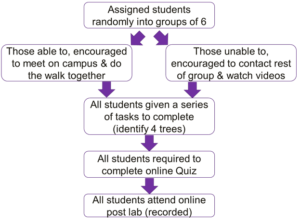
For the first practical, I developed an inclusive ecology-related experience that could be engaged with by students able to get to campus and meet others outside as well as catering for those who would only be able to engage online. At the beginning of October 2020, the UK had the rule of six meeting outdoors and many students were either isolating, at their home addresses or overseas, which led me to this flexible teaching approach. The primary objectives of this practical were to support students to settle in and to help students to make friends in week one . However the activity was also embedded within the subject discipline and was therefore relevant to the teaching and learning that took place during the subsequent ten weeks of the module. Figure one outlines the way that the practical experience worked.
Figure one. Flow Diagram to Illustrate Ecology Practical Scheme
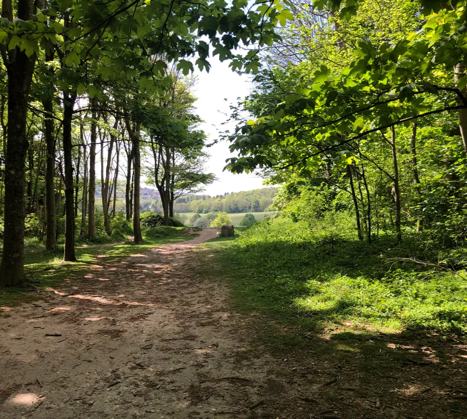
The videos I created for the online students were very easy to make and upload onto Canvas. I made them on my phone and they were essentially showing students particular trees within the woods bordering Stanmer park, an area of open countryside adjacent to the University campus. These videos had a dual purpose, firstly they helped distance learners feel physically connected to the University and secondly, by highlighting particular parts of different trees, they encouraged students to carry out discipline-specific investigative work as students were required to determine which species of trees I was showing them.
Students purposefully had free reign to use whichever resource(s) they wanted to identify the trees, and I used this as an opportunity to discuss the sources they had used and to introduce the importance of academic sources within the online post lab. Students discussed the reliability of the sources they had used and this strategy appears to have enabled students to gain a better understanding of academic and non-academic references, in comparison to students from previous years. Evidence for this is suggested in the summative essays students completed within this module, where they demonstrated better engagement with reliable sources than the previous year, suggesting that this simple exercise had impact within assessments.
When questioned in the post-lab, students said that they had found this experience useful as an introduction to the location of the university and also used this as an opportunity to get to know each other. Student engagement with this module was excellent: 77% students engaged with the ecology practical canvas pages and 94% attempted the quiz questions.
Although students understandably missed the in-person practicals, the results of the Applied Skills in Biology exam (mean 68.3%) demonstrates that the learning outcomes were achieved using these online practicals.
Post-it practicals
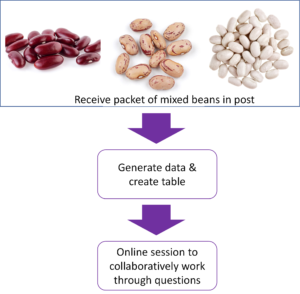
As lockdown continued into the second term, our teaching team wanted to provide students with some practical materials to physically interact with. We worked with our head teaching technician (Kristy Flowers) to develop packs that could be sent to students in the post. For my Genetics & Population Genetics module, we were able to send out packs containing specific numbers of three types of beans that students used to generate data to demonstrate the Hardy-Weinberg principle, Figure 2 illustrates the principle scheme of the Hardy-Weinberg practical that students would follow.
Figure two. Illustration of Hardy-Weinberg Practical Scheme.
In essence, students received a pack of mixed dried beans in the post , were encouraged to read the background Canvas page of the online practical, and then complete the data generation part of the experiment (which required pulling out 20 pairs of beans to represent ‘matings’). I scheduled a Zoom meeting to go through the next steps and to work through the questions together, and it seems that this mixture of independent work and collaborative engagement were particularly effective here. It has been well documented that collaborative learning can be achieved in an online environment and that there are a myriad of pitfalls to setting students group work within an asynchronous framework (Roberts, 2003), so the strategy used here was purposefully synchronous and supportive.
In summary, student engagement was fantastic, and in the end of module evaluation there was a comment that it was the best part of the module.
Lessons learnt
There have been many challenges associated with the move to online only teaching but also many rewards in terms of developing new approaches to teaching. I don’t believe I managed to overcome all of the specific challenges relating to practical experience by implementing the methods described here, since there are elements that can only be gained by physically interacting with equipment. However, I did develop students’ understanding about the techniques and support their understanding of fundamental principles thereby enabling their achievement of the learning objectives. Aside from the module objectives the strategies implemented also encouraged student interaction and collaborative learning, which I feel has been really important during these times. I would have liked to have provided more post it practicals for students and if we ever have to go into lockdown again I would develop more resources for this, but there are obvious limitations in what can be sent through the post so it is not always simple or possible to translate a lab practical to a home version.
There are aspects of the online experience that I will carry forward into next year. In particular, the resources created for the modules will be used to support students’ understanding of the skills and techniques they will be learning in the laboratory, and I will keep the online post lab sessions so that I can encourage synchronous collaboration in a supportive way. I have definitely learned the importance of social inclusion and will be encouraging students to interact with each other more than ever!
References
Elmer T,. Mepham K., Stadtfeld C. (2020) ‘Students under lockdown: Comparisons of students’ social networks and mental health before and during the COVID-19 crisis in Switzerland’. PLOS ONE 15(7): e0236337.https://doi.org/10.1371/journal.pone.0236337
Roberts, T.S. (ed.) (2004) Online collaborative learning: Theory and practice. Hershey, PA: Information Science Publishing.
Jeanette Ashton is a Lecturer in Law (Education and Scholarship) and a Non-Practising solicitor, having joined the University of Sussex after 8 years at Brighton University. She is Employability lead for the Law School, leads the Client Interviewing skills programme and co-leads the CLOCK legal companion scheme.
Introduction
This piece reflects on the experience of co-creating, with students, the 2021 Law Politics and Sociology (LPS) ‘Making a Difference’ employability showcase. It is set within the pedagogical context of a growing interest in, and body of literature on, co-creation, knowledge exchange and students as ‘partners’ (Cook-Sather et al, 2014, Dollinger & Lodge, 2020, Little, 2011). Whilst aware of ‘co-creation’ often being used to tick boxes in higher education spaces, as a team we genuinely felt we had co-created, and in doing so, had managed to ‘create’ something powerful and unique – and make a difference. Following the successful delivery of the showcase, I carried out a small study with the team, to explore themes including their motivation for participating, what they had learnt from the experience, any perceived employability and skills benefits, what co-creation means to them, and any learning points. This piece draws on those findings.
Origins of the project – the need for honest conversations and doing things differently and building the team
This project was born out of a vlog series by myself and two final year law students, with a local practitioner Jo O’Sullivan, where we discussed themes including the impact of the pandemic on them and their studies; their thoughts on the impact of AI on future employment; how the legal profession can become truly diverse, and their thoughts on the law generally. The students nominated me for a Sussex Education ‘teaching to disrupt’ award, for which I was shortlisted, writing about how they had valued the opportunity to speak frankly about their experiences as young women of colour, at the university and in wider society (O’Sullivan Family Law, 2021)
Whilst discussing meaningful diversity, the students said it was important to them that employability events had practitioners who “looked like” them i.e., who they could relate to, both in terms of ethnicity and background and how they wanted to hear from a range of perspectives in the employability context (Universities UK, 2021) New in post at Sussex, having joined in September 2020, in a challenging year with strikes and then Covid, I started thinking about what I could do as Employability Lead, to help students from all kinds of backgrounds explore the range of career opportunities available and hopefully inspire them at the end of a difficult year.
More traditional events such as our Law Fair and barrister/solicitor workshops were already in the calendar, so we wanted to do something different framed around the broad ideas of diversity and social justice. The three of us met to discuss what we could do, and from this the Employability Showcase idea came. We wanted to create a series of events around the theme of ‘making a difference’ and to hear from a diverse range of panelists, rather than having a ‘diversity event’. Moving beyond the buzzword of ‘diversity’ is a challenge not only for universities, but for wider society, and we wanted to explore this through our showcase. The aim was to explore difficult questions and open up honest and frank conversations.
From the outset, it was important to me that this event be truly co-created, not me leading and delegating particular tasks, but with the students involved in all stages of planning and implementation. The LPS Careers Connector and Race Equity Advocate (REA) joined our team, with all sharing the vision of wanting to open up some frank conversations on a range of themes from guests in a variety of roles. From this our showcase panels emerged: Women & allies in law; Disruptors in Law & beyond; Activism, Change-making & Policy-Influencers & NGOs and Human Rights.
Interestingly, the motivation for the students, was broadly similar to our own. One said they wanted to “make a little bit of a difference” and those in the paid Connector/REA roles were pleased to have a tangible task to work on alongside their exploratory work. With future career considerations being the second highest priority for students choosing a course in the 2021 UK Domestic Survey and a strategic priority for institutions including Sussex, it is perhaps surprising that when asked if they had thought about employability benefits/CV enhancement, the students all indicated this hadn’t been a motivation, although they appreciated the benefits subsequently. The common theme was doing something different, with one commenting that this project was “something different from our regular mundane law student life, where we just do the same things over and over again.”
So, what is co-creation?
I was interested to explore what co-creation meant to the students. Themes of working together, creating something and lack of hierarchy came through strongly. They felt it was “working together to develop an idea”, being “all in the same boat, relying on each other to get this thing out for the benefit of everyone to enjoy”, “an equal power dynamic” from the vlog series to the showcase, the ability to share experiences “without any boundaries” and “creating linkages” [with faculty, peers and professionals].
Control, trust and responsibility
Throughout my academic career I have considered myself as student-focused and enjoyed working with students on various projects. However, whilst I have given students responsibility for particular tasks, I have retained ownership and ultimately control, of the projects. Perhaps the biggest challenge of co-creation is the fear of losing control (Bovill et al., 2011), particularly in the context of high stakes projects relating to curriculum and assessment design. The showcase project was arguably less pressured, in that it was an extra-curricular event, but it felt high stakes in terms of the goals for the project, namely wanting to do something different, to open up conversations for our students, showcase diverse roles and routes and help students to feel optimistic about their future career paths, particularly important given the likely negative impact of the pandemic on graduate employability. Alongside this, we were hosting twenty guests, from a variety of sectors, and wanted them to feel that their time had been well spent with us.
I undoubtedly experienced a sense of discomfort at stepping back from having control of the process, but, a sense of what a talented group of students I was working with, alleviated that. The students reflected that they had relished not being micromanaged, that through our meetings they were clear as to what was required and the timeframes. As one said “when you’re given the trust, you can then reciprocate, because you know you have the responsibility.” One of the students created a Google doc, where we could check in, share resources and suggest contacts for each other and provide progress updates, another arranged panel moderator training for the group. Each of them had responsibility for one of the panels, with each, as one student noted, able to use their “unique skills” to put their stamp on the night. The value to students of being able to personalise the project has been highlighted elsewhere (Dollinger & Lodge, 2020). They reached out to their peers for support, with the Student Law Society designing the promotional material and sharing widely with the student body, and the Women in Law Society co-hosting the ‘Women and Allies in Law’ night.
Skills development
Reflecting on the project, the students felt that they had developed and enhanced a number of key skills. One of these, relating to trust and responsibility, was the experience of developing professional relationships through their communications with the guests on their respective nights, with one stating “the reaching out and emailing and talking to people is really good practice and I don’t think students are given enough opportunities” [to develop professional communication skills]. They all felt that the project had helped develop or enhance their public speaking skills, including the ability to “flex” on the night to move along the conversations, to manage time and attendees’ questions, alongside professional skills including organisation and project management, which one noted “you don’t really get to develop as a student”. Again, responsibility was a theme “holding myself accountable to get things done”.
Important to all of them was teamwork, they spoke of supporting each other, including in the design of a template for the night, which they could then adapt. One, a finalist, commented “I didn’t know what teamwork was before this year really and it’s strange because we haven’t been able to see each other in person”. This sense of teamwork extended to the guests and attendees at the events. The showcase coincided with the week of protests relating to the murder of Sarah Everard (Siddique, 2021) and the students felt this had perhaps added to what one termed a “community feel”, despite being an online event.
Concluding thoughts and future challenges
From my perspective, the showcase was a career highlight and the first truly co-created project I have worked on. Attendees who completed the post-event survey were overwhelmingly positive, commenting on the breadth of discussion, which included racism; sexual violence; ‘having it all’; the internship loop; following your passions; being authentic, and how to make a difference without burning out. They enjoyed the diversity of the guests and careers paths, with many noting it had helped them feel more optimistic about future options. One of the student attendees wrote a post for the Law School’s student blog and several offered to support future events (Currie, 2021).
In terms of learning points, whilst the showcase was undoubtedly successful, with around 200 students attending across the week, it is clear that those who benefitted most from the project were the small team working on it. A challenge for future co-created projects is how to scale up so that more students have the opportunity to benefit (Dollinger & Lodge, 2020). Perhaps, in thinking about employability strategy, institutions should consider investing in more co-created projects, in terms of curriculum development, assessment design and extra-curricular/work ready opportunities, which provide students with lifetime benefits and a chance to make a difference to their communities. As well as being beneficial for the students and staff involved, which was the experience of this project, this could, as Nicholson suggests, benefit the institution more broadly, in enabling differentiation in the HE market (Nicholson, 2020).
I would like to conclude with the thoughts of one of our “Disruptors in Law and beyond” guests Michael Herford, Sussex alumnus and co-founder of Legal Lifelines:
“It was really insightful and inspiring hearing from the other panellists and I hope the conversation put fire in the bellies of the participants to pro-actively pursue their chosen path, or trailblaze a path, if necessary. It was abundantly clear from the quality of questions from the students that there is a new wave of brave, motivated and talented change makers set to join the frontline shortly – an exciting prospect indeed!”
My key takeaway from the project is that co-creation provides dual benefits for students and faculty, that this should be an institution priority, and that continuing to develop such projects is “an exciting prospect indeed!”
References
Bovill, C., Cook-Sather, A., & Felten, P. (2011) ‘Students as co-creators of teaching approaches, course design and curricula: Implications for academic developers’, International Journal for Academic Development, 16, 133-145, doi:10.1080/1360144X.2011.568690.
Dollinger, M. & Lodge, J. (2020) ‘Understanding value in the student experience through student-staff partnerships’, Higher Education Research & Development, 39:5, 940-952, doi:10.1080/07294360.2019.1695751.
Little, S. (ed.) (2011) Staff–student partnerships in higher education. London: Bloomsbury Academic.
Nicholson, A. (2020) ‘The value of a law degree – part 2: a perspective from UK providers’, The Law Teacher doi: 10.1080/03069400.2020.1781483
O’Sullivan Family Law. (2021) Frank conversations about the law: Access to justice. YouTube video. Available at: https://www.youtube.com/watch?v=zd61rjWe1Eo [Accessed 7 Jul. 2021].
Learning Matters provides a space for multiple and diverse forms of writing about teaching and learning at Sussex. We welcome contributions from staff as well as external collaborators. All submissions are assigned to a reviewer who will get in touch to discuss next steps. Find out more on our About page.
Please note that blog posts reflect the information and perspectives at the time of publication.