

Dr Estelle Marks (Assistant Professor in Criminology) and Dr Jenny Chanfreau (Assistant Professor in Sociology)
Student attendance is one of the most discussed issues in higher education. While declining attendance is frequently noted anecdotally, there is less clarity about why students attend or don’t attend, and what attendance tells us about engagement.
In this article, we draw on recent research led by Dr Estelle Marks (Assistant Professor in Criminology) and Dr Jenny Chanfreau (Assistant Professor in Sociology) in the Faculty of Social Sciences at the University of Sussex. Their study offers a nuanced and evidence-informed understanding of student attendance, moving beyond common assumptions and highlighting implications for teaching, curriculum design, and institutional policy.
Impetus for the project
The project began in 2024 with a pilot study prompted by observations of highly inconsistent attendance. As Estelle explains, while there were many anecdotal explanations circulating across the University, there was a need to understand what was really going on. To gain a more evidence informed perspective, the team conducted a survey initially within criminology and sociology programmes, before expanding it in 2025 to include all undergraduate students across the Faculty of Social Sciences. This larger dataset enabled a more robust analysis of attendance patterns and student experience. The survey was sent to all undergraduate students in the Faculty of Social Sciences and received 746 responses. It is a strong sample size, although the response rate itself was relatively low – around 27%, which is typical for online surveys. It is also worth noting that students were being surveyed heavily at that time: final-year students had just completed the NSS, and other students were completing module evaluations, so survey fatigue likely played a role in the low response rate.
The survey asked students to reflect on a wide range of barriers to attendance, indicating how often these affected them. Importantly, the survey combined quantitative measures with open-ended responses, allowing students to describe their experiences in their own words.
Students responded to statements about barriers, indicating whether these affected their attendance “never”, “sometimes”, “often”, or “always”.
Barriers were grouped into three categories:
- university-related barriers
- individual barriers (e.g. health and wellbeing)
- external factors (e.g. work, caring responsibilities, home life)
A complex picture
One of the most important findings is that attendance cannot be explained by a single factor. Instead, students experience a cumulative set of barriers that interact with one another.
Individually, commonly cited barriers include:
- seminar anxiety
- timetabling challenges, particularly early morning and late evening sessions
- financial pressures, including the need to work
- travel costs
- physical and mental health, disability, and neurodivergence
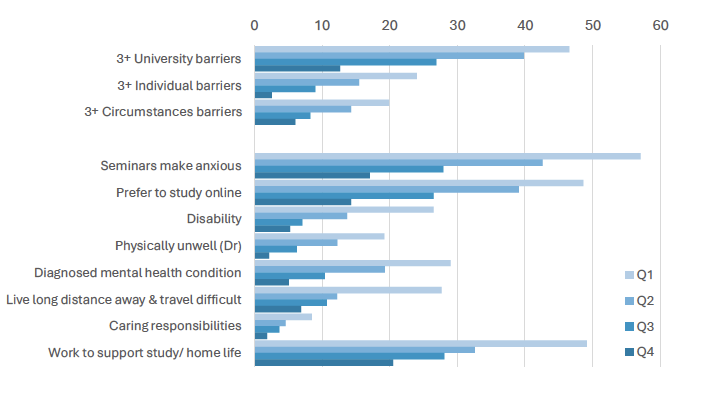
What emerges from the qualitative data is that these are not separate issues. Students experience them as interconnected and reinforcing. For example, a student working long hours may not have time to complete preparatory reading, which increases anxiety about participating in seminars, which then affects attendance.
Certain student groups are more likely to experience these cumulative pressures. Women, students of colour, mature students, and first-generation students reported higher levels of overlapping barriers. In particular, first-generation students were more likely to need to work alongside their studies, reflecting broader changes in the student population.
The changing realities of student life
Perhaps the most significant finding of the research relates to the changing financial context of higher education. As Estelle notes:
The student loan, even with the maximum maintenance allowance, barely covers basic expenses like rent and food… Only students who receive financial support from family are able to fully dedicate themselves to their studies.
This financial reality represents a fundamental shift in student experience. While widening participation initiatives have successfully increased access to university, many students now face a new barrier: the cost of living. The majority of students must balance study with paid work, significantly shaping how they engage with their education. Attendance, therefore, cannot be understood without recognising these broader structural pressures.
Rethinking what counts as a barrier
Another important insight from the study is that barriers are not objective measures, they are experienced realities. For example, simply living far from campus does not necessarily affect attendance. However, experiencing the commute as difficult or costly does. Similarly, having a disability or learning plan is not, in itself, linked to attendance but how those conditions are experienced, and whether appropriate support is in place, can have a significant impact.
This highlights the importance of moving beyond “observable characteristics” and engaging directly with students’ lived experiences. As Jenny explains, understanding attendance requires listening to how students themselves interpret and navigate their circumstances.
A strong theme emerging from the qualitative data is students’ frustration with transport costs. Many expressed palpable anger about rising bus fares and unreliable services, with this frustration sometimes directed towards the University, particularly where timetabling appears not to account for these constraints. Students described having to make difficult trade‑offs, for example, deciding whether to spend money on travel for a short teaching session or to prioritise work and other commitments. Timing further compounds the issue: several students noted that there are not enough buses to reliably get to early morning sessions, yet these sessions remain a fixed part of the timetable. The result is a clear sense of tension, with students feeling that structural factors beyond their control are shaping their ability to attend.
Attendance and engagement are not the same thing
A key finding that challenges common assumptions is that attendance is not a reliable proxy for engagement. The research found that reported study time does not differ significantly between attendance groups and students with lower attendance often still describe themselves as highly engaged, for example through reading or engaging with recorded materials. This finding raises important questions about how we define and measure engagement, particularly in a context where students are balancing multiple responsibilities. While there is longstanding evidence linking attendance and attainment, the authors suggest that this relationship needs to be revisited in light of current student realities. Attendance may no longer be an adequate stand alone measure of engagement in contemporary higher education.
What can teachers do to support attendance?
Address seminar anxiety
Seminar anxiety emerged as one of the most frequently reported barriers to attendance. Many students expressed concern about speaking in front of others or being called upon in class.
As a result, the researchers emphasise the importance of:
- creating supportive, low-stakes learning environments
- clearly communicating expectations
- framing seminars as learning spaces rather than testing spaces
Students need to feel comfortable making mistakes as part of the learning process and this requires teaching approaches that normalise uncertainty and exploration. As noted in discussion, students may attend but not participate verbally due to anxiety, which raises questions about how engagement is recognised.
Recognise competing demands
Many teaching staff are aware that students face increasing pressures outside their studies. However, this awareness needs to translate into practical adjustments and flexibility, where possible.
This might involve:
- reconsidering how preparatory work is structured
- acknowledging constraints on students’ time
- designing activities that remain meaningful even when preparation is limited
Make in-person teaching meaningful
A significant proportion of students reported a preference for online study. In a predominantly in-person institution, this raises an important question: what is the added value of attending in person?
Departments and teaching teams may benefit from working collaboratively to:
- identify what cannot be replicated through recordings
- design sessions that emphasise interaction, discussion, and active learning
- ensure that attendance feels worthwhile
- Think creatively about how to ensure that attending in person feels valuable to students, so that there is a clear added benefit over watching recorded lectures later.
Institutional implications
The research also highlights several areas where institutional action could have a significant impact.
Timetabling
Students consistently identified timetabling as a barrier, particularly early morning or evening sessions, uneven distribution of teaching across the week and having to travel in for a single short session. At the same time, preferences vary widely, suggesting that there is no simple solution. Instead, the findings point towards a need for clearer communication around timetabling and more predictable scheduling patterns.
Understanding engagement
The study suggests that institutions need to move beyond attendance as a primary measure of engagement. While attendance data is widely available, other forms of engagement are less systematically captured. This gap offers an opportunity for institutions to develop more holistic measures of engagement that can explore how engagement is experienced by different student groups.
Supporting teaching practice
Finally, the research highlights the value of creating space for staff to reflect on approaches to reducing seminar anxiety and inclusive pedagogies more generally. While support for early-career teachers is well established in the Fundamentals of Teaching and Learning and the PGCert, the findings suggest that these conversations should take place across all levels of experience.
Moving the conversation forward
The research provides a foundation for ongoing discussion about student attendance and engagement at Sussex and beyond. While the study focuses on the Faculty of Social Sciences, its findings resonate more broadly across disciplines and institutions. For colleagues interested in learning more the full report is available below and provides detailed analysis and recommendations. The hope is that it will be read, discussed, and used to inform practice at multiple levels, from individual modules to institutional strategy.