

Welcome to September 2026’s Spotlight on AI in Education bulletin. With how fast things are moving, this will help you cut through the noise and catch what’s important. The bulletin highlights on-the-ground practice, institutional perspectives and trends in generative AI use across the sector and beyond. We hope you find this useful.
If you have anything you’d like to contribute or see in this bulletin please email EE@sussex.ac.uk
We begin 2026/27 with a welcome to all readers, a wonderful story of Sussex success using AI to support learning, some prompts/reminders for colleagues at the University of Sussex, and a sweep of the Higher Education landscape.
On-the-ground at Sussex:
Sussex Economics professor wins European innovation award for teaching students to use AI critically
Members of the Teaching with AI CoP will be familiar with Professor Gabriella Cagliesi who has shared her work with us at our in-person events. Gabriella was recently awarded the 2026 European Economic Association Award for Innovation in Teaching with AI in recognition of her explorations into “how to design learning in the age of AI”. Educational Enhancement extends our congratulations to Gabriella and thanks her again for speaking to the community.
Read more about Gabriella’s award, her project and some of her reflections here Sussex Economics professor wins European innovation award for teaching students to use AI critically : Staff Hub : University of Sussex. Dr Sarah Watson, Academic Developer here in EE, interviewed Gabriella earlier in 2026 about this project: read her post here Making (class)room for AI: Integrating custom GPT into teaching and assessments | Learning Matters.
Reflections on the progress made at Sussex as we support our students to become AI-literate through a values-led, institution-wide approach
Dr Katie Piatt, Head of Educational Enhancement, has published this post Developing AI-literate graduates through a values-led, institution-wide approach | Learning Matters which explains the approach to AI in education that the University of Sussex has taken over the three years since Chat GPT-3 burst onto our screens, and reports on our progress. As the use of AI increases and the conversations around what is reasonable, practical and realistic continue, it is rewarding to reflect on how well-served the university has been by our initial commitment to engage critically with the tools and to include the wider university community in this.
“The University really listened to us, moving away from a blanket ban, which ignores the reality of where AI is right now, toward a strategy of teaching proper, responsible use.”
Lewis Wilson, former Education and Employability Officer at the University of Sussex Students’ Union, quoted in Katie’s post.
New Year Prompts
Staff at the University of Sussex have access to Microsoft CoPilot’s Teach app as part of our licence. To access this tool, make sure you are logged in with your Sussex account (you will see your staff profile details on the screen):
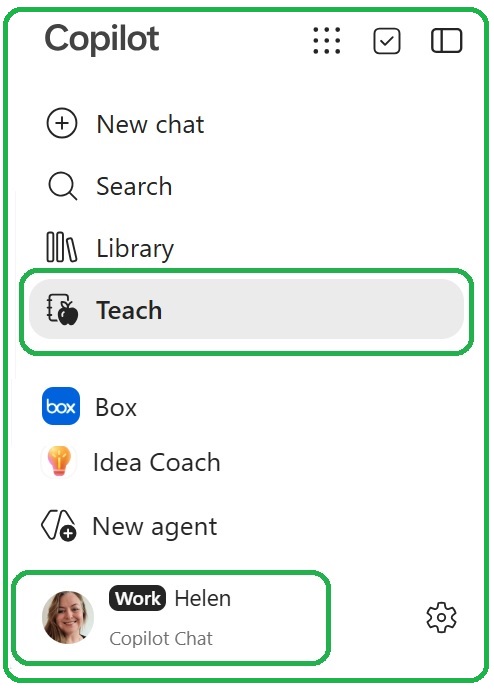
This AI powered tool can create session plans, quizzes, flash cards and other learning support materials using information you upload (remember to ensure you’re logged in with your Sussex account to enjoy the protections of our licence).
We’d love to learn about colleagues’ experience with the tool so please share your insights, successes and challenges in the Teams channel.
There are a number of resources available to colleagues at Sussex, so do take a look as the new year begins:
- The University of Sussex Principles for AI in Education are published here Our principles for Artificial Intelligence (AI) in education : About us : University of Sussex.
- The University of Sussex provides access to staff and students to JISC’s Building Digital Capabilities Toolkit, which includes support for developing your confidence with AI here https://jisc.potential.ly/.
- Educational Enhancement has published guidance and core statements for use in modules and assessments here AI in education hub : Guidance : Educational Enhancement : Staff Hub : University of Sussex.
Join the Community of Practice by adding yourself to the Teams channel here: www.tinyurl.com/sussex-ai-cop and please let us know if you have any projects you would like to share with us. If you’d like to liaise with the Academic Developer or Learning Technologist for your faculty about using AI in your teaching, contact us at ee@sussex.ac.uk.
Across the Sector:
The University of Florida’s AI2 Director, Hans van Oostrom, makes the point in the THE that ‘AI literacy is everyone’s responsibility’ and has shared some tips to achieve this. (I’ll plug our access to JISC’s Building Digital Capabilities Toolkit here again!). This article compliments others published in THE regarding AI Literacy, including this by Laura Duckett Boosting AI literacy across your institution.
Universities UK, of which Sussex is a member, have worked with support from Pearson and the British Chambers of Commerce to publish a Future Jobs Roadmap which includes the commitment to “Ensuring AI tools are accessible to every undergraduate student and every course has a lecturer who is an ‘AI trailblazer’ so that graduates have the skills to be AI pioneers in the workplace.”
Long Read – This article The Generative AI Learning Penalty: Evidence from Chinese Secondary Education by David Strömberg, Victor Lei, Yanhui Wu :: SSRN, which reports AI use by school-aged students in China suggests an increase in attainment for homework tasks but a decrease for exam performance makes interesting reading. See this previous blog post from EE How can a process approach to assessment help address the impacts of AI? | Learning Matters which addresses how we can adapt our approach to assessment when faced with these trends.
Listen – The Artificial University – BBC Sounds Dr Kathryn Claire Higgins spoke with students, academics and executive teams to explore current use of AI in university and its impact.
Further Afield:
Dr Phil Anthony is familiar to many people with an interest in AI in Education; he has built an online community and hosts regular webinars on the topic. Phil has moved from The University of Kent to BPP, so now hosts his platform on a Substack here A new home for the Digitally Enhanced Education webinars. The next event is 14th October.
This summer I noticed a sharp increase in discussion around smart glasses, and mostly for unsavoury reasons. However, technology like this has the potential to support inclusion and accessibility in education settings and beyond. Read Helen Nicholson-Benn’s study How useful are smart glasses in improving accessibility in higher education? where she explores how to balance the benefit of tools such as these against the concerns they raise.
- Join the Teaching and Learning with GenAI Community: If you’d like to join the community and be first to hear about events. Get in touch with us and we can add you to the list and dedicated MS Teams community. www.tinyurl.com/sussex-ai-cop
- Disclaimer on any tools not supported at Sussex. Please do not share Sussex, student, colleague, sensitive or personal data via these platforms. Not being supported means they have not passed stringent Data Protection assessments and could put you at breach of policy and legislation. For a list of supported platforms for teaching and learning please visit the Educational Enhancement website.
This was a Spotlight on AI in Education update from Educational Enhancement