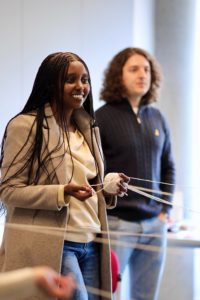
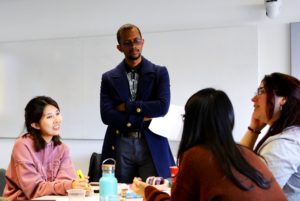
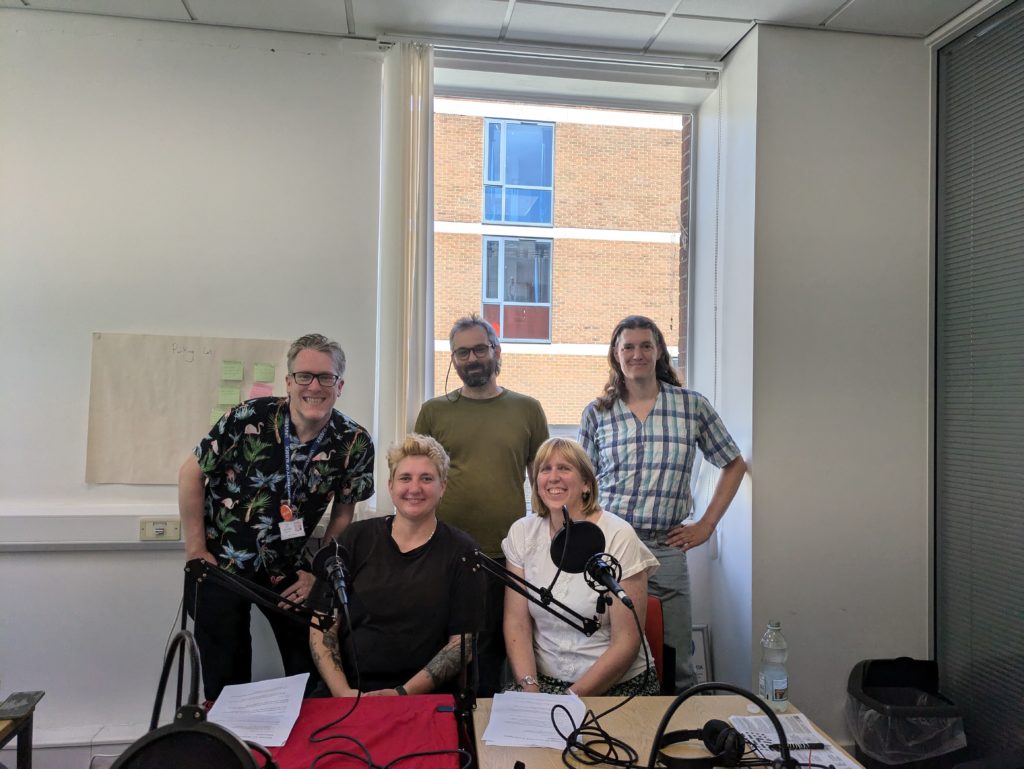
Students engaging in the Intercultural Reflection Series at the University of Sussex
In a 2022 plenary for the BALEAP (British Association of Lecturers in English for Academic Purposes) Professional Issues Meeting, applied linguist Adrian Holliday challenged the widespread framing of international students as ‘problematic newcomers.’ Instead, he offered a discourse which views international students as ‘intercultural experts,’ capable of negotiating their own learning narratives and sense of belonging within new cultural environments. As an institution, we have a duty to help students recognise the strengths they bring to the university. We also need to support them in reframing their positionality, not as outsiders, but as experts who can shape The University of Sussex for future generations.
The Intercultural Reflection Series (IRS) has been designed to work with our international students to develop this sense of intercultural expertise and belonging. It provides a novel, student-led, discursive space in which students can share their expertise with others. In this space students come together to engage in critical discussion concerning how they understand their positionality here at Sussex and how they make sense of their contribution to the wider academic culture. In addition to meeting in person, the Series also includes guided input from an interactive virtual learning environment (Canvas) set up to disseminate input on intercultural communication theory. This site hosts bitesize lectures and overviews of intercultural concepts that can be used to help students better understand their own intercultural expertise, doing so by introducing them to terms such as non-essentialism; intersectionality; othering; ethnorelativism; English as a Lingua Franca; native-speakerism; intercultural praxis; and Holliday’s ‘grammar of culture’ (1999, 2011, 2018).
Ultimately, the Intercultural Reflection Series offers our international students the chance to engage with other students from outside of their disciplines, and to think of their own intercultural resources in more empowering ways, for example, by realising how their own experiences, understandings, and worldviews can be used to initiate change at the university and to make its culture of learning safer and more representative for all. The Series has also helped students to form support networks across the wider international community at the University.
Read the zine created by our Intercultural Ambassadors, Précieux Rajaofera and Victoria Rodriguez and organisers Chris Stocking and Jo Osborne. It showcases the ideas, stories, creativity, and powerful reflections that emerged across the Intercultural Reflection Series. It’s absolutely worth exploring.
About the Intercultural Ambassadors
Précieux G. Rajaofer
Précieux G. Rajaofer
Précieux is a lawyer and youth leader with seven years of experience leading a youth leadership organisation that strengthens youth activism, expands socio‑economic opportunities, and supports young people to participate more fully in political life. Since 2019, he has supported 5,000 active citizens and influential young leaders, helping them to advocate for their rights, claim political spaces, and lead meaningful development initiatives. As a Master’s student in Development Studies at Sussex (2024–25), Précieux was drawn to the Intercultural Ambassador role as a way of expanding his global impact and deepening his intercultural leadership. Through the Intercultural Reflection Series, he helped build a culture of belonging and supported students from diverse cultural backgrounds in navigating the complexities of intercultural life and UK academic culture. The experience, he says, transformed him into “a global citizen with deep intercultural awareness.”
Précieux reflects on the series: Facilitating the Intercultural Reflection Series was both humbling and energising. I saw students move from hesitation to confidence, finding their voice while affirming others. What stood out was the vulnerability and strength they brought, from challenging stereotypes to reclaiming their English. As an Intercultural Ambassador, I also grew: learning to listen deeply, hold space without authority, and embrace facilitation as mutual learning. This series reshaped how I understand culture, community, and belonging in the university.
Victoria Rodriguez Denyer
Victoria Rodriguez Denyer
Victoria has a background in international relations and sustainable development. Before arriving at Sussex, she worked in Colombia’s environmental sector, collaborating with local communities and public and private stakeholders. She came to Sussex to pursue an MA in Development Studies at IDS, where the Intercultural Ambassador role helped her expand her skills in facilitation, data analysis, and participatory research. She is now working in London as an SDR, helping strengthen the resilience of organisational infrastructure across EMEA.
Victoria reflects on the series: We worked with such a diverse group of people who brought perspectives from different cultures and disciplines, making each session incredibly rich. For me, it was a chance to connect with fellow students and improve our university experience, while gaining skills in creating spaces that encourage creativity and diversity.
What students said about the series
The IRS gave me a space where I didn’t need to ‘perform’ a version of myself to fit in. As a Malagasy student, being able to speak from my positionality and have it validated in a collective setting helped me feel more rooted and visible at Sussex—not just present, but represented.
It invited me to locate myself within global systems of inequality and to reflect more intentionally on how I engage across difference. I’ve become more aware of how power and privilege shape every interaction, and more committed to practicing humility, curiosity, and care.
Enacting Sussex 2035
The Intercultural Reflection Series embodies the spirit of the University of Sussex 2035 Strategy, promoting Global and Civic Engagement, Human Flourishing, and Global Knowledge Equity. It empowers students to understand themselves not as passive participants in a global university, but as active contributors to a more equitable, connected, and culturally conscious academic community.
Watch a conversation about the Sussex University Intercultural Reflection Series, its design, delivery, and outcomes. Delivered by the two Intercultural Ambassadors, Précieux G. Rajaofera & Victoria Rodriguez Denyer.
Follow Intercultural Studies at Sussex’ on LinkedIn and YouTube.
Register now to attend the fourth Sussex Education Festival. The event will be held on Friday 8 May, 09:30-15:30, in the Woodland Rooms at the Student Centre. The Festival is for anyone involved in delivering education at Sussex and provides a supportive and collaborative space to celebrate and share experiences, research and reflections on teaching, learning and assessment.
We have an exciting programme, featuring speakers from all faculties and across Professional Services, with a range of sessions including lightning talks and panels, roundtables and showcases. Across the day we will explore how we can build student wellbeing, belonging and engagement, support student transitions, design playful and creative learning, and use anything from our green spaces to AI tools to help us do so.
The roundtable session at the start of the day will also provide a chance to learn more about plans for our new flagship elective modules which will embed the themes of environmental sustainability, human flourishing and digital and data futures from the very beginning of the student journey.
Lunch and refreshments will be provided.
We look forward to seeing you there to celebrate all the amazing work that goes into teaching, learning and assessment here at Sussex!
Matthew Easterbrook is a social psychologist interested in social class, socioeconomic status, and inequality. His research aims to use social psychology to increase our understanding of, and ability to reduce, educational, economic, and political inequalities.
What I did
Since 2014, I’ve been asking students to submit blog posts as part of a portfolio assessment on my final year undergraduate module, ‘The Psychology of Inequality: From Poverty to Power’.
The module assessment is a portfolio submission which comprises short blog posts and an ‘intervention summary’. Students submit three 750-word blog posts (one formative, two summative) at intervals through the semester, written for an educated lay audience. Each post should briefly describe an issue, such as a current event, a sociopolitical issue, a story, or even a personal experience of some kind. It should then draw on one academic reference exploring relevant research, a theory or a bit of a theory, covered in the previous 3 weeks’ lecturers or associated readings, to illuminate the psychological processes that might help the reader understand or explain that issue. Students post anonymously to the user-friendly messaging software Slack (I provide them with pseudonyms). I also provide a format for them to follow which breaks down the blog posts into four paragraphs plus some top tips and some 1st and 2nd class annotated exemplars.
The first blog post is formative and I provide everyone with feedback via comments on their post in Slack. In effect, therefore, all of my feedback is for every student on the module. I also encourage them to read each other’s posts, my feedback on them, and to add constructive comments of their own. The second and third posts (which are submitted as part of the portfolio assignment), follow the same formula, but without my feedback.
The other part of the portfolio, a 1000 word ‘intervention summary’, is more traditionally academic in style. It asks students, with citations, to describe a problem related to inequality, the psychological impacts and related socio-cultural factors, and provide an idea for an intervention that might mitigate those psychological impacts.
Why I did it
I really wanted to engage my students with the process of writing something accessible, fun to write, but still rooted in the discipline. The portfolio helps develop insights into how the topic can be applied outside the psychology lab and helps to build some transferrable skills along the way.
As I explain to my students in the Assessment Information section of the module Canvas page:
“I chose the assessments because they will help you develop your ability to apply psychological theory and research to real world problems, as well as helping you develop useful and transferable writing skills that many employers now value above writing academic essays or cramming for an exam. They also allow you more flexibility and freedom to write in engaging ways for a lay audience. However, they still require a lot of careful thinking so that you can effectively get across complex ideas in an engaging, succinct, and accessible way.”
I also wanted to encourage the formation of a writing and learning community with the students in each year group and to encourage peer-to-peer learning so that they can see how other people are using the studies to interpret things in the real world.
Changes I’ve made
A couple of years ago I introduced two three-hour workshops, to add support and make sure they were really reading each other’s blogs and feedback. I wasn’t entirely confident they were going to have the desired effect, but they worked well and I’m really pleased I started them.
In the workshops, which I run with up to 50 students at a time, I ask them to work in groups and read four or five of their peers’ blogs. In the first workshop, they read my feedback too. Then, following some discussion, students work in groups to provide a new feedback comment on each of the blogs they reviewed. This way we collaboratively tease out what makes a good blog. By the end of the session, students feel much more confident in what is, to most, a new form of writing, as well as my expectations as a marker. The workshops also facilitate students receiving lots of feedback (and not just from me) and they develop their own feedback literacy along the way. I think it also helps prepare them for the intervention summary.
How it’s going
There is always a bit of trepidation at the beginning of the module, as students navigate a new format and new marking criteria. However, by the end they do tend to really enjoy the process, and I think it frees them up to write in a more personal way as well.
Also, at the very end of their degree, I think my students find it refreshing and liberating to be able to write in this style. The blogs are short, snappy and engaging, personal and about something that they find interesting. Students also see lots of organisations and companies writing in this way too. They can see that it might have value in the future, and I think those things are really important for students to appreciate.
Also, the work is quite fun to mark. I’ve read blogs that have interpreted Marge Simpson’s behaviour from the perspective of a psychological theory we covered in a lecture, and another that interpreted the behaviour of haughty Harrods customers in light of the findings of a psychological study. And, I learn a bit more about the students that are taking my module, the kind of things that they’re interested in and what they find topical.
My top tips
Finding ways to allow students to express their own voice is really important. I really encourage them to find their own voice when they’re writing and to choose a topic that they find interesting. Both aspects seem to really keep up engagement among students.
If you are introducing a new type of assessment, you do need to provide a lot of information and support to students, especially if it’s in their final year. At that point they can be focused on grades so reassuring them that it’s going to be fine and they’ll be able to do it, and do it well, is important.
Student feedback
Learning Matters heard about Matthew’s approach and encouraged him to write this case study after meeting a couple of his former students, now doctoral candidates and tutors in the School of Psychology. Here’s what they have to say:
“The blogs assessment was my favourite assessment of my degree. It pushed me to think creatively about applying theory to everyday situations, while encouraging me to consider my audience and practice explaining ideas clearly without relying on jargon. Writing in a blog style was refreshing because it let me focus more on understanding, explaining and applying the theory, rather than worrying about overly formal language.” (Camaryn Monro)
“After nearly 3 years of undergraduate studies, you start to adopt the overly formal academic tone. However, writing blog posts taught me to write concise, accessible content, a skill that is essential for the post-university world. I also found that the blog post format gave insight into how reporting for different audiences, such as policymakers and the wider public, differs. I find I remember more of the module content (now over 2 years later) than others because the short 3 blog posts allowed the contextualisation of the module content across three different topics. Additionally, reading other people’s blog posts provided the module content in an easy-to-digest language across multiple perspectives” (Yasmin Richter)
I had the pleasure of joining the Life Sciences in mid-December for their teaching and learning away day (well, it was a morning, but there were biscuits!). I love attending these kinds of events. In my role as an Academic Developer, I have the privilege of working across disciplines and seeing colleagues’ hard work and innovative practice bear fruit. My magpie mind also gets the opportunity to pick up lots of sparkly insights and examples I can stockpile and share with colleagues from other Schools and Faculties as examples of great practice.
So, here are some recent gems from Life Sciences.
Embedding Employability – A student perspective
Greig Joilin and Valentina Scarponi shared insights into the impact of changes made to the Life Sciences curricula to embed employability skills and better enable students to identify and articulate those skills through their degree and beyond. These changes, which began roll out with the 2022/23 cohort, have included adding in dedicated skills modules through years 1 and 2, incorporating teaching and assessment tied to disciplinary areas, careers skills sessions, employer panels in each year, plus sessions on work experience.
Greig and Valentina surveyed students at the start and end of a skills module that includes CV writing and mock interviews (marked and feedback provided by AI tools, CV360 and BigInterview). At the end of the module, students reported recognising the importance of these career skills and that the new modules are helping them to develop them.
When asked what skills they still need to develop, communication and confidence remained high on the list. Therefore, the next steps under consideration are to do more to scaffold oracy skills through the curriculum.
Reflections from Portfolios for Biomedical Science Students
Lorraine Smith also talked about the impacts of encouraging students to evaluate their achievements and skills developed across their 2nd year via a reflective element in a portfolio assignment. Having provided students with lots of guidance on reflective writing from the start of the year, including YouTube videos of students talking about reflective writing, a workshop then took students through the process and provided safe space to have a go and engage in peer feedback. Importantly, using her own experience as an example, Lorraine started the workshop by talking to her students about her own experience of reflective writing (like Lorraine, I also find it uncomfortable!) and shared with them an example of her own writing and invited peer feedback from students.
The value of the reflections went beyond those for students themselves. Lorraine reported that the submissions gave her insights into the impact of the new Life Sciences curriculum on students’ development of, and ability to articulate, employability skills plus insights into how they had interpreted and acted on feedback they’d received along the way.
Embedding AI Literacy into the curriculum
At the end of the morning, Greig Joilin returned to the podium with a call to action to colleagues to plan how they will weave AI literacy into Life Sciences curricula. This need includes but goes beyond learning about the effective and responsible use of generative AI to helping students understand how all forms of AI are currently being used and will shape disciplinary practice in the future.
Investigating factors in large group teaching
Alex Stuart-Kelly shared the outcomes of an Education Innovation funded project, undertaken with Oli Steele from BSMS. Their work has provided some original and nuanced insights into the value of active learning in the classroom and into ways in which students prefer to participate, and those they would rather avoid. In short, they found that all active teaching approaches improved engagement, as did the use of clear narratives, sections (e.g. linked to specific session learning outcomes), recaps, and varied formats. Students also like low stakes opportunities to participate in the lecture, particularly when either social or anonymous (i.e. don’t require them to speak out individually) and integrated with feedback, which varied in difficulty.
Alex and Oli will be publishing their full study in due course. Until then, see Educational Enhancement teaching methods guidance and information about teaching tools that can be used to support student participation in the classroom.
Improving 3rd year project supervision and skills learning
Doran Amos shared insights from his investigation into student experiences and learning through their final year projects. Life Sciences students can choose to do an experimental project, a public outreach project or a critical literature review. Because of this, while all project supervisors work with a number of students, the nature of the work and how students and supervisors collaborate, varies.
Students identified pros and cons of individual and group supervision meetings. For example, while they value finding out how their peers are progressing and learning they aren’t alone in dealing with challenges or concerns, they also valued the opportunity in 1:1 session to ask questions they might feel less confident about voicing in front of others. Doran’s suggestion was to ensure that all students are offered a mix of group and 1:1 supervision meetings.
Accessibility and student experience in labs
Kristy Flowers, Life Sciences’ Senior Technical Manager for Teaching, shared the incredible work she and her team do to make lab work as accessible as possible for all of their students, including enabling a partially sighted student to engage in lab work by creating raised line and braille labelled diagrams and 3D printed slide preparation guides.
Perceptions of feedback: the use of self-reflection to improve student satisfaction
Jo Richardson shared outcomes from an Education Innovation funded research project led by Sue Sullivan from Psychology, in collaboration with Jo and colleagues from the Business School, Psychology and Sociology. The study found that students who were asked to complete a short reflective quiz on their engagement with a module (e.g. attendance, completing reading etc), who then received marks in the 50s were much more satisfied with their feedback than students who hadn’t done the reflective exercise. Learn more about the projects and the implications of its finding in their recently published research article.
Heroes in a half shell
Using the lovely example of a group of students who have adopted and developed a project investigating winkle populations (half shells – geddit!) on the Sussex coastline, Kevin Clark, talked about the importance of nurturing students’ curiosity and enthusiasm and the value of supporting them to just get on with projects that interest them.
Building the STEM ambassador network for students
Haruko Okomato talked about membership of the national STEM Ambassador Scheme, which is supported by UKRI, and how the scheme’s online community portal could be used to develop and support a staff and student network of volunteers at Sussex. Also – they provide free DBS checks!
If you would like to learn more about any of the examples of practice outlined above then look out for future case studies. In the interim, everyone who spoke at the event is happy to be contacted.
As part of a reciprocal mentoring project with colleagues at the University of Ghana we have a reflection on cross cultural experiences of AI in education.
Introduction
Generative AI has a longer history, but 2022 marked the popularisation of generative AI, when user interfaces were made widely available. Take up of generative AI has exponentially increased since then, the implications and impacts of which are still emerging. However, some things are clear. Like the web moment of the 1990s, the web 2.0 social media moment of the early 2000s, and the pandemic driven adoption of technology platforms across new areas, this is an exponential expansion that will continue to have major shaping effects, even when there is some fall off and retraction.
In the UK, public discussion about generative AI moved very quickly into education, particularly higher education. Media coverage of major news outlets in the UK in 2023 show a very high incidence of references to university students. Higher Education is not always mainstream news in the UK, but generative AI discussions in the news brought discussions of HE into mainstream coverage. These usually focused on assessment, and the debate was characterised by concerns about students cheating and assessment design and, less frequently, about AI marking. In Ghana, public discussion was triggered even earlier, particularly when Google AI opened in Accra in 2018. AI has been central to government and business discourse about innovation and economic growth, and generative AI has been central to debates about education in the same period.
In this context HE institutions, academic bodies, technology providers and advocates, in both Ghana and the UK, and internationally, have moved to look at approaches, principles and scenarios, to shape academic practice in a post generative AI context. They have also looked at new user interfaces, tools and technologies, exploring innovation and use through both boosterish and promotional discourses, and highly critical and resistant ones. This utopian/dystopian dynamic characterises discussions, imaginaries and implementation of new technologies and has been explored in the social studies of science literature. This is usually tempered through the language of challenges and opportunities.
In this broader context, we compare the conversations, policies and technologies in two different university contexts: Ghana and Sussex. The University of Ghana and the University of Sussex have a long history of connection, and an important strategic partnership. This has historically been focused on research collaborations in the sciences, education and international development. Through 2023-2025 this also included a project through CEGENSA (led by Professor Deborah Atobrah) at the University of Ghana, and the gender equality workstream in the EDI unit at the University of Sussex (led by Professor Sarah Guthrie). This project established a reciprocal cross-cultural mentoring scheme across the two universities, which is the context in which these reflections about AI have been developed.
More broadly Sussex and Ghana have had strong education relationships nationally, through students and alumni, and regional connections including the Fiankoma project in the 1990s (Pryor, 2008). This was another cross-cultural project which aimed to link the community of Fiankoma in Ghana with people and educational institutions in Sussex (in the UK) through digital technologies. Educators and students in both settings produced accounts of their lives using digital media that were turned into a web site for cultural exchange and development education.
The current Ghana-Sussex cross cultural, reciprocal mentoring project paired colleagues across both institutions, from different disciplines, and across different roles. When we first met, for the authors of this paper, we were coming from different disciplinary backgrounds. Otoo is a social psychologist in the Department of Distance Education and O’Riordan is a digital media scholar, from media and communications, and currently based in the Vice Chancellor’s Office. Our respective institutions were in very different places in relation to debates about generative AI, and at the same time there were very strong common themes. We outline and reflect on these differences and similarities here.
Post pandemic
The COVID-19 context informs what has happened with generative AI and this played out differently in relation to the two institutions in relation to educational delivery. At the University of Ghana, there was already a very strong online teaching offer (ODL) for the discipline of education. This meant that staff, and students were already used to using a learning management system (LMS) called Sakai as the educational context, and had been using this for over a decade. ODL at the University of Ghana is largely intended for Ghanian students, and aligned with teaching methods in the on campus offer in many ways. The Sakai support unit was based in their department. However, for the on campus offer in the rest of the university there was no use of a LMS, and there was very little experience of this. In the context of the pandemic and the shift to remote education for everyone, the rest of the university started using the same platform that had already been in use, but previously only for one area. As a consequence of this shift, Sakai became the university platform and the support unit is now based in the main campus Balm Library.
At the University of Sussex, conversely, a LMS called Canvas was already used throughout the university to support the on campus offer. There was also a pre-pandemic online distance learning (ODL) offer as part of the overall educational offer, which also used Canvas. ODL at Sussex is very distinct from the in-person campus offer, and is delivered to students in other parts of the world and is largely nonsynchronous. However, the on campus offer, which was the main educational offer, was already mediated through Canvas as standard, and LNS use had been in play for decades at this point. In the pandemic the same platform that everyone was already using, was used more intensely, and in a remote mode for all teaching. This was often a synchronous offer that replaced timetabled teaching with online sessions. Although there was some unevenness of experience and expertise, and additional platforms were also brought to bear, this story was more about intensification of the use of the LMS rather than a wholesale change of practice.
Therefore, there was a contrast between the Sussex and Ghana experiences in the pandemic technology adoption for education. At the University of Ghana, a smaller group of staff and students with specific expertise saw wholesale adoption of the previously ODL-only platform by the rest of the staff. At the University of Sussex, there was wholesale intensification of an existing platform and set of technologies that had already been in widespread use across the offer.
Building on the contrast between the wholesale adoption of the Sakai platform by the University of Ghana and the intensification of existing platforms at the University of Sussex, there was also an added implication for the colleagues at the University of Ghana, with existing expertise in use of the Sakai platform.
The distinction is that at the University of Ghana, the rapid, wholesale adoption of the platform placed an immense and sudden workload on the smaller group of staff and ITprofessionals with the existing expertise. They instantly transitioned from being expert users and platform managers to becoming the institution’s primary, often overburdened, trainers,first-line support staff, and technical consultants for the entire faculty and student body. Their expertise became a critical, non-negotiable bottleneck to the institution’s operational continuity.
Conversely, at the University of Sussex, where technologies were already in widespread use, the intensification meant (at least in theory) the existing experts could focus more on scaling, optimizing, andproviding advanced pedagogical support, rather than on fundamental adoption and crisis-level initial training. However, in practice, the pandemic revealed varying levels of expertise with the existing system, despite its ubiquity, and there was also an uneven impact, with some patterns of over burdening and bottlenecks of expertise.
In 2024 the University of Ghana celebrated the 10th Anniversary of the Sakai Learning Management System (LMS) with a two-day blended conference. Professor Yaw Oheneba-Sakyi pioneered the introduction of Sakai at the university. This Learning Management System proved to be a lifeline for the entire university community—including teaching staff and students—during the COVID-19 era, leading to its wholesale adoption by everyone.
One common theme ran through the submissions and speeches of presenters at the conference which was that the University should embrace and integrate new technologies in its teaching and learning. Prof. Ohene Sayki detailed the system’s success in advancing the University’s academic mission, specifically citing the establishment of the MA in Distance Education and E-Learning, its successful integration into PhD teaching, and the global leadership roles attained by its alumni. He outlined a strategic path forward focused on expanding mobile access, the responsible adoption of artificial intelligence and deepening in collaboration.
At the University of Sussex, Canvas was introduced as a VLE in 2018, replacing a previous system (StudyDirect). It was introduced and supported by the Technology Enhanced Learning group. Support for Canvas is delivered by the Educational Enhancement team and is reviewed in an ongoing way, with rolling workshops and resources. There are templates for use, and resources for good practice. When it is used for nonsynchronous ODL, there is a different approach to the creation of interactive learning materials, supported by a partner specialist (currently Boundless). Good practice in the use of Canvas is celebrated in teaching and learning workshops and conferences at Sussex, but the platform itself hasn’t been the focus of a university conference.
Post AI (student and staff discussions and practices after AI)
At the University of Ghana, in 2024 the university updated its approach to plagiarism by including the use of AI in its approach to misconduct. However, there has also been a paradigm shift in how AI is viewed in recent times. It has shifted from the perspective of AI as a tool for cheating to that of a tool used in the efficiency of knowledge production and an assistance to both staff and students in teaching and learning pedagogy. A recent study with 17 PhD students in the College of Education of the University of Ghana was conducted to explore the use of generative AI tools in their work. The students explored several Generative AI tools in their various capacities.
Findings from this demonstrate that students used a variety of GenAI tools across their academic tasks:
For brainstorming and generating initial written content. ChatGPT and Copilot were adopted.
For language improvement and editing academic writing, Grammarly and QuillBot come in handy and for clearer visual aids and presentations, the DALL.E was used.
The project also explored the pros and cons of using these Gen. AI tools in academic writing. There were positive impacts that translated into increased academic confidence, improved time efficiency, fostered self-directed learning and improved digital literacy. On the other hand there are emerging concerns about metacognitive laziness, diminished qualitative interpretation and risks to intellectual agency and overreliance and “Al-holic” phenomenon. The study concluded that GenAI can empower experiential learning only when integrated with pedagogical intent and ethical awareness.
At the University of Ghana, AI use has become normalised and is used in everyday operations. For example, the use of AI notetaker in remote meetings, and the use of AI add-ons in the LMS and other IT systems. However, the University has yet to adopt formal principles or policy beyond the updated plagiarism policy. At the same time, the University is a centre for research into AI in schools, and education more broadly. For example, the College of Education held a virtual panel discussion centred around the theme, “Generative AI: African Perspectives on its Challenges and Prospects.” at the 2024 Day of Scientific Renaissance of Africa (DSRA).
At the University of Sussex students and staff engaged with generative AI, but there was (and continues to be) a lot of uncertainty about the legitimacy of using AI. In the UK HE sector, a number of AI surveys, reports and policy notes, have been (and continue to be) produced, through actors such as the Higher Education Policy Institute (HEPI) and the Joint Information Systems Committee (JISC). A group of universities in the UK developed the Russell Group Principles and many institutions have signed up to these.
At the University of Sussex, a Community of Practice (CoP AI) was initiated by the Educational Enhancement team (EE). The first change to policy and guidance at Sussex was the amendment of academic misconduct to include generative AI in concepts of plagiarism, personation and fabrication (existing integrity concepts). Alongside this, guidance for staff and students, and a number of case studies were shared. In 2024 there was a university-wide engagement and an AI summit that culminated in the development of a set of institutional principles.
At Sussex, during the university-wide engagement, concerns and ideas were raised across integrity, the meaning of knowledge, automation, legitimacy and environmental impact. The principles themselves focused on seven key areas to:
build on Sussex’s world leading research in AI by investing in ongoing, interdisciplinary research on AI in education
develop strong digital capability and critical AI literacies for our students and staff
deepen ethical standards
protect our academic integrity and student experience
foreground accessibility and inclusion in our approach to the use of AI in education
safeguard our community against malicious or illegal use of AI
commit to clearly communicated and transparent governance
The last point, about transparency, has already become very difficult to deliver on, because the underpinning systems across the university now, increasingly, have AI functionality built in. This is not always visible, and software updates are included as an automatic default. For example, the lecture capture platform had an automated generative AI captioning function built into the latest upgrade. Our capacity as an institution to clearly communicate how and where AI is already in our systems, and to be transparent about the governance of this, is already significantly limited by the technical design.
Both universities are continuing to build up resources, guidance and training, both in-house and with external partners.
Conclusion
At the time of writing, the University of Sussex continues to build on the AI principles. This includes staff training, and resources, and continuing to identify opportunities to support staff and students to develop capability and critical literacies. There has been a return to in-person, invigilated exams, and many subject areas are rethinking their approach to assessment post-AI. This includes pilots for proctoring software and lockdown browsers. Responding to the challenges and opportunities through these technological disruptions is work that is ongoing and has to be made and remade. The AI landscape continues to change rapidly, and understanding, and access is uneven across the University. A broader set of principles that apply to the operational and research dimensions of the University is also necessary and is being led through the Digital and Data Task Force as part of the strategy, Sussex 2035.
The University of Ghana is developing an AI policy, and is actively researching the impact of AI in education. For example, Dr Freda Osei Sefa from the College of Education is leading research on the use of AI in basic (primary and lower secondary) schools. Recently, the Kwame Nkrumah University of Science and Technology (KNUST) has introduced a compulsory module for all students, and this is in the pipeline for the University of Ghana. This is largely focused on careers and future job prospects. A concern shared at the University of Sussex.
It is clear that generative AI particularly, and AI more generally, is an important feature globally and this plays out in both universities in different ways but with very strong common themes.
References
Acquah, R (2024) ‘University of Ghana revises plagiarism policy to include AI’
Pryor, J (2008) Analysing a Rural Community’s Reception of ICT in Ghana, in Van Slyke, C (ed) Information Communication Technologies: Concepts, Methodologies, Tools, and Applications.
Fiona Clements is an Assistant Professor in LPS and teaches Equity and Trusts and Law of Succession to UG and MA Law students. She is the academic lead for the Wills, Trusts and Estates clinic, offering pro-bono advice to the public on inheritance, trust and probate issues.
I think all students can do well in assessments if we give them the best opportunity to prepare for the type of assessment
1. What led you to use whiteboard exercises for teaching intestacy law?
If you’re thinking about the distribution of property on death, it’s useful to know what the shape of the family looks like. And drawing a family tree – and this happens even in practice – it’s not just an academic exercise. Drawing a family tree is really important because then you can see who the potential beneficiaries might be. It was a natural progression when we were thinking about the distribution of property to think about what the family tree might look like and have a go at drawing it out. And students didn’t bring with them a lot of experience of drawing a family tree. They might have done a family tree when they were at primary school and learning about the Tudors or whatever, but they hadn’t really had much opportunity or much need to draw one, and that’s really how it started.
2. How do you adapt your approach for students with different confidence levels?
I scaffold all my teaching, so I always come in with easy questions that get progressively harder and I always encourage the students who I know are less confident to answer a question early on before they start getting harder. I think I have a slight advantage in teaching Law of Succession because it’s a final year module. And the students, they know me because I taught them a core earlier down in their learning. And we build up a really nice group dynamic because we tend to be smaller groups and they’ve all chosen it. I think there are things that I do that help support students who lack confidence.
A lot of students support each other in a way that perhaps they might not earlier on in their education because they don’t know each other so well. But we have an opportunity to really become a cohesive group. And the students root for each other and say ‘oh, go on, you can do it.’ And if they’re writing something on the whiteboard and they miss something out, someone will say, ‘oh, have you thought about this, that and the other?’ in a non-confrontational, non-critical way.
3. What role do anxiety and mental health play in classroom participation?
That’s a really good question. Before we even get to the classroom participation, I would say that with mental health and anxiety issues the biggest barrier that I see them creating is actually stopping the students from coming to the sessions, because I think once the students have come into the session, there’s plenty that we can do to keep them engaged and feeling confident and well supported so that they’ll come back again. But I think it’s the fear of what might be going to happen and is a very real sort of barrier.
Also, I think it’s helpful for us to have an understanding of what mental health and anxiety issues students might be experiencing, because to have an understanding helps us to increase our empathy and our ways differently, maybe choosing different language to that’s a little bit more inclusive or more encouraging.
4. Why do confident students struggle with formal oracy assessments?
I think all students can do well in assessments if we give them the best opportunity to prepare for the type of assessment. Oracy assessments are assessments that they’ve not necessarily had much experience of taking before. I imagine students who’ve
done a language might have had an oral as part of their language GCSE or whatever. And if languages aren’t their thing, then that may or may not have been a happy experience for them.
There’s very little – even with lawyers who as a job, particularly the barristers, who are going to be standing on their feet and talking – I don’t think there are many opportunities for us to help the students to prepare for that sort of assessment. But I do believe that if we give students the best opportunity we can to prepare for that type of assessment, I don’t think there’s any reason why the confident and the less confident students
shouldn’t be able to do well. I also think it’s the way that we frame the type of assessment for them. Helping them to understand that we want them to do well and we’re giving them the best opportunity to do that.
An oral assessment that’s not a presentation gives them a really good opportunity to really explain and demonstrate what they do know in their own words because with an oral assessment, that’s more of a chat where the person who they’re talking to can give them prompts if they get stuck. This could be a really nice form of assessment for them to use and also a bit different to just having to write essays.
5. How do you gauge the success of interactive teaching methods?
Feedback from the students. Verbal feedback from the students, attendance of the seminars, they talk with their feet. If they’re enjoying it, then they come along and they want to get involved. Having a large number of students actively involved in seminars, I always think is a measure of success because they’re feeling confident enough to want to get involved and want to chat things through.
We also do a formative assessment in week 4 and week 9, so I can see how they’re getting on in terms of preparing for the exam and know that they’re on track with their learning. But mostly feedback from the students because they say they enjoy it. And the module recruits well. And I think that’s because students who’ve taken the module tell students in the year below that it was helpful and they enjoyed it and I like to think that’s the case.
6. Have you got any tips or advice for people who want to use this teaching method?
We know that the students tend to feel anxious when we put them on the spot and ask them a question about their prepared learning, so anything that gives them an opportunity to get involved in a less threatening way has to be good, whether it’s writing on the whiteboard as a way of not having to look at their peers, or using Lego. or using mini whiteboards and then holding up their answers, anything that takes away that pressure of putting a person on the spot, which is what students tell us they find so disconcerting. And it’s the prospect of being made to look foolish, I suppose, in front of their peers that discourages them from wanting to take part. And I think writing on the board works in my area.
But anything, any method that takes some of that pressure away is beneficial for students. If they keep coming to the sessions, then that feels as though it’s a win before anything else happens.
Our guests: Dr Paul Robert Gilbert and Dr Jacqueline De Beaudrap, with producer Simon Overton and hosts Dr Heather Taylor and Prof Wendy Garnham.
The Learning Matters Podcast captures insights into, experiences of, and conversations around education at the University of Sussex. The podcast is hosted by Prof Wendy Garnham and Dr Heather Taylor. It is recorded monthly, and each month is centred around a particular theme. The theme of our thirteenth episode is ‘generative AI and higher education’ and we hear from Dr Paul Robert Gilbert (Reader in Development, Justice and Inequality) and Dr Jacqueline De Beaudrap (Assistant Professor in Theoretical Computer Science).
Wendy Garnham: Welcome to the Learning Matters podcast from the University of Sussex, where we capture insights, experiences, and conversations around education at our institution and beyond. Our theme for this episode is Generative AI and Higher Education. Our guests are Dr Paul Gilbert, Reader in Development, Justice, and Inequality in Anthropology and Dr Jacqueline De Beaudrap, Assistant Professor in Theoretical Computer Science in Informatics. Our names are Wendy Garnham and Heather Taylor and we are your presenters today. Welcome everyone.
All: Hello.
Heather Taylor: Paul, could you start by telling us a little about what you teach and how you see generative AI changing the way students approach your teaching?
Paul Gilbert: So, I’m based in Anthropology, but I actually primarily teach in International Development. And my teaching is divided into three areas, which sort of reflects my research interests. I teach a secondyear module on Critical Approaches to Development Economics. I teach a thirdyear module called Education, Justice, and Liberation, and I’m the coconvener with Will Locke of the new BA Climate Justice, Sustainability and Development. I also do some teaching from first year on Climate Justice. So, honestly, in terms of how students are approaching the teaching, apart from a couple of cases where I suspect there may have been AI involvement in some assignments, I haven’t noticed a huge difference.
What is new, and maybe why I haven’t noticed that difference, is that, like a lot of my colleagues in International Development, we started engaging headon with AI and integrating it into what we teach about and how we talk to our students. For example, my secondyear development economics course is deliberately structured around global South perspectives on development economics and thinking that isn’t dominant. Economics is odd among the Social Sciences. There’s a lot of research on this. Sociologists like Marion Fourcade have looked at the relative closure of economics, the hierarchy of citations, its isolation from other disciplines, and the concentration of EuroAmerican scholarship. Professor Andy McKay in the Business School has also done work on the underrepresentation of African scholars in studies of African economic development, and on the tendency for scholars from the global South to be rejected disproportionately from global North journals. And so the reason that matters for thinking about teaching and AI is because AI, so large language models. Right? ChatGPT and Claude and everything, they’re basically fancy predictive text. Right? Emily Bender calls them synthetic text extruders. Right? You put some goop in and it sprays something out that sometimes looks like sensible language.
But it does that based on its training corpus, and its training corpus is scraped from somewhere on the Internet. And it also has various likelihood functions within the large language model that make sure the most probable next word in the sentence comes, right, so that it seems sensible. And what that does is reproduce the most probable answer to an economic question, which is the most dominant one, which happens to be not the only one, but one from a very, very narrow school of thought that has come to dominate economics and popular economics and so on. And so all the kind of, minoritised perspectives, the ones that don’t make it into these, like, extremely hierarchically structured top tier journals, the ones that aren’t produced by Euro American scholars, you’re not going to get AI answering questions about them. And if you use it to do literature searches, it’s not going to tell you about them.
So, that module is built around those perspectives. And so we kind of integrate that into the teaching as a way to highlight to students that large language models function in a way that effectively perpetuates epistemicide. Right? By making sure that it reproduces the most likely set of ideas and the most likely set is always the dominant set, right, from whoever is most networked and most online, then perspectives that have already been disproportionately not listened to get less and less visible. So structuring the course around precisely those not so visible but really important and really consequential approaches to economic development forces students not only to not use it to do to do their literature searches, but to think about the kind of the politics of AI knowledge production.
Heather Taylor (04:57): That’s fantastic. I mean, we have, so we both teach in psychology, and we’ve got a problem in psychology where it’s all very Western dominated. You know, we use the DSM 5 largely, which is American, as like the manual for diagnosing, you know, psychiatric disorders and so on. I teach clinical mainly, but, you know, it’s generally, there’s a Western dominance. And that would actually be a really interesting way to get them to think about where are these other perspectives and how like you’re saying, there’s sort of a moral question of using ChatGPT because it’s regurgitating stuff that’s overshadowing, you know, other important voices that aren’t being heard.
Paul Gilbert: Yeah. And it’s also an opportunity to get students to think more about data infrastructures. Right? Because whether you use ChatGPT or Claude or Lama or whatever or not, I think we all could do with understanding a bit better how search works, how data infrastructures are put together, where things are findable or not. Right?
So centring that means there’s a chance to reflect on that. And it’s not, you know, I’m not a big fan of AI for various reasons. We might go into it later. But rather than just standing up and going, this is awful, you can say, look, here are all these perspectives that are really important. We’re going to get to grips with them in this course, this is not what you will get if you ask ChatGPT for an answer. And it’s also part of a way of reminding students that they are smarter than ChatGPT, right? And I think that’s really important because there is some research, I think some people in Monash University in Australia and elsewhere looking at the kind of demoralising effects of people, so I think what’s the point of even trying? Right?
I can do this and it can spew out something as good as what I can do. And it can’t. Right? And it can’t if you structure your questions right and if you get your students to think about its limitations. I don’t want to talk too much, but, just one thing that’s worth saying, and, Simon knows about this as well because he did some videos for us, but one of the ways that I try and get this across to the students is that we have this big, special collection in the library, the British Library for Development Studies legacy collection, and it’s full of printed material produced by scholars from Africa, Asia, Latin America in the sixties, seventies, eighties. A lot of it doesn’t exist in digital form. Right? It hasn’t been published as an eBook. You might find a scan somewhere. Right? Some of that knowledge doesn’t even turn up in the Sussex Library Search. Right? But it’s there in the stacks or in the folders and, you know, there’s a huge amount of insight and history captured in there that the Internet doesn’t know about. Right? Which means ChatGPT will never know about. And, you know, yet that reminds us that there are limitations even to Google searches and Google Scholar and everything, but, you know, the problems of LLMs are that on steroids. Right? So using that as a chance to show people why offline materials and stuff that isn’t widely disseminated or available open online isn’t, you know, to be discounted, and there’s a lot of valuable knowledge in there.
Heather Taylor (08:07): So same question to you then,Jacqueline. Could you start by telling us a bit about what you teach and how, sorry, how you see generative AI changing the way students approach your teaching?
Jacqueline De Beaudrap: Alright. Well, I teach a couple of modules in informatics. And informatics, for those of you who don’t know this term, it’s another term for computer science. But, I end up teaching the introductory mathematics module for computer science where we try to introduce to them all the basic mathematical concepts. That’s the name of the module, Mathematical Concepts, that they might need throughout their career. And we’re not going to cover absolutely everything when we do that, but we try to cover a lot of ground with a lot of different ideas and how they connect to one another. And I also teach a master’s module in my own research specialty, which is quantum computation. And while these two things might seem a little bit different from one another, the fact that quantum computation, so setting aside sort of any excitement that might come with that, it’s something which you can only really come to grips with if you have a handle on a large collection of mathematical concepts. So, similarly to Paul, I don’t really know precisely how it would affect how they engage with either of these modules. I see some signs possibly for, what my modules were, the assessments that maybe, you know, the strange inconsistency sometimes with which the students, not only answer questions, but whether they are able to answer a question well or not, even if they’re very similar questions, sometimes has me scratching my head, but Idon’t try to infer anything about that.
But it’s sometimes signs about, you know, basically, when I wonder whether or not they have used a large language model in order to generate answers, it’s a question of basically how they are trying to engage with the subject in general. And, you know, if they’re relying on other tools to try to, basically learn about the subject matter. It’s very good if students try to use other materials, other sources from which to learn about a subject. But there’s the question of, you know, how will they can sort of judge the materials that they choose to learn from.
I try to curate the approach in which, as I, you know, all teachers do, all lecturers do, try to curate a particular perspective, a particular approach from which they can learn about a subject. And if they use alternative sources, this is good. You know, a very good student can do that or somebody who might happen to find my explanation a bit puzzling. It’s much better that they look for other solutions, other approaches to learn than just sort of struggle along with my strange way of looking at things. But, ultimately, it does require that they be able to sort of critically evaluate what it is that they’ve been shown. You know, if they do use AI, if they do use a large language model and its explanations, first of all, they’re going to come across basically the popular presentation, which not only might be biased, but for a complicated subject might simply be wrong. It might lean very heavily on very, very reductive, very simplified presentations that you might see, for instance, in a popular science magazine, which is the bane of quite a few of my colleagues and me in particular. The fact that these things get collapsed, the fact that they get just flattened down into something where you have something that sounds like a plausible sound of words, a plausible thing that somebody can say but actually has no explanatory power. Not only is it sort of not the full answer, it’s that you can’t use it in order to understand it, but the students, whether or not they can recognize something like that, is something that I worry about, for mathematical concepts of the more elementary stuff, the more elementary module that I teach. So it’s possible that they might use a large language model to try to generate examples of something or another, but there’s the question of how reliably the large language model is generating things. Like, I actually haven’t kept on track of just how good language models are doing arithmetic, but if they can’t reliably sort of do any mathematics, then how are they going to learn anything from the large language model, let alone anything which has got more complicated structure, from which, you know, they’re trying to learn this slightly nuanced thing, even if it’s at the most elementary levels. The only way that you really get to grips with these techniques is by encountering it yourself, and, you know, so a large language model maybe, is going to be a little bit more successful at generating elementary examples of things because there are certainly mathematics textbooks aplenty, many examples from which you can draw some sort of corpus of how you explain a basic concept, but if they’re being sort of chopped and changed, how do you know that you’re going to get some sort of a consistent answer? This is the thing that I’m concerned with. I don’t know precisely how often it comes up for my students, but I do hear them just sort of casually referring that they will look up something by asking ChatGPT. It makes me wonder what the quality of information that they’re getting out of it is.
Wendy Garnham (13:11): I suppose that’s similar to the Coding in R that we see in psychology students, so they will often resort to using ChatGPT, and quite often it gets it wrong.
Heather Taylor: And then they get flagged. They’re very good at flagging it in the research. The research methods team are very good at identifying when AI did it, basically. But, yeah, I’m assuming because it just does things a weird way. You know? Yeah.
Paul Gilbert: LLMs are astonishingly bad arithmetic. Like, almost amusingly bad. I think they can kind of cope up to, like, two, three figures and then you start, because it’s again, it’s predictive text. It can’t do maths. And I think one of the, like, really important things about bringing this into the classroom is, you know, part of what we mentioned earlier about, you know, students might lose confidence or lose motivation because they think, oh, ChatGPT can do it, I’ll just look it up on there. But there’s a lot of things that it’s super dumb at. Right? And I don’t think we should shy away from saying it’s really dumb at a lot of things, and we shouldn’t rely on it, and think about why that is. And it’s because something that is good at predicting the likely next word based on the specific set of words that it was trained on can’t do a novel mathematical problem, and there’s no reason why you would think it should. And there’s so much hype that equates large language models with human cognition that people seem willing to accept it can do a whole bunch of things that it can’t. Right? Even down to really trivial, sort of slips, like assuming it’s a search engine. Right? But it’s stuck in time. It can only answer things in relation to its training data. It’s not something that can actually search current affairs. Right? And that is something that is kind of surprising both how some students and some colleagues aren’t fully aware of that, which I think needs to be, like, the super basic minimal starting point is that people need to understand the data infrastructures that they’re messing with and what they can actually do and not do.
Heather Taylor (15:18): You know, it’s really agreeable as well. So it depends on how students phrase questions or if they phrase it almost, is this right? Or, you know, because if I told it, I asked it to tell me that -this shows my boredom. But I asked it to tell me what the date was. Let’s say, for example, it was the June 19, and it told me, and I said, no, it’s not, it’s the June 20. And it said, oh, I’m so sorry. You’re right, it’s the June 20. I said, no. It’s not. It’s the June 19. Why are you lying to me? And I asked it, why is it so agreeable? And it was like, this is not my intention. You know? And it’s like, it’s really, this is a thing. You can tell it. You can feed it nonsense, and then it will go, yes, that nonsense is perfect. Thank you. You know?
Paul Gilbert: Yeah. But this sorry. Like, to go back to I mentioned earlier Emily Bender, the linguist who writes a lot about large language models. And something that she says I think is really important is they don’t create meaning. If you impute meaning from what they create, that’s on you Right? But these are synthetic text extruders that produce statistically likely strings of words.
Heather Taylor: So if I’m saying something, you go, no, that’s probable then.
Jacqueline De Beaudrap: It doesn’t sound obviously wrong.
Paul Gilbert: But if you take that meaning as meaning that it can think, that’s on you. Right? It’s just a thing that responds to prompts and spews out words and it looks like it can think but it can’t.
Jacqueline De Beaudrap: That’s been going on for ages as well from the earliest chat bots and like back to the 1960s, Eliza, where a lot of people were convinced right from the very beginning that they were talking to somebody who was real or that something that was actually thinking, this might have been partly because of the mystique of computers in general. You know, the mystique of computers changes, but people still remain impressed by computers in a way which is slightly unfortunate, I think. Like, they’re very useful devices. Speaking as a computer scientist, I mean, I enjoy thinking about what a computer can help me to do, but it’s good to have an idea of what is realistic to expect from them. And people have often sort of been looking for it to be something with which they can talk and even something that was just responding a sort of to a formula, something that in the 1980s everybody could have on their personal computer, this is not something which is very deep.
People are looking constantly for something to be relating back to it as a person. So you always have that sort of risk, but yeah, if it’s not actually accessing any information, if it’s not using the information in any particular way that could actually produce novelty and for which you can have confidence, that that novelty might mean something because it’s in some quarters correspondence with a model informed by the actual world around it. You always have that risk of people imputing upon it a depth, a meaning, and a usefulness that is far beyond what it actually has.
Wendy Garnham (18:10): I think we’ve touched on this a little bit, but Paul, do you think generative AI is affecting how students value subject expertise? And if so, in what way and what impact does it have?
Paul Gilbert: It’s a really good question and it’s quite a hard one to answer. I think, you know, you can imagine a risk where people think, oh, what’s the point in having a specialist because I can just ask – it can tell me everything. Right? But we know it can’t, and I think a lot of students are pretty switched on to that. And, again, I think this is why it’s important to embed some of that, like, critical data literacy and critical AI literacy into the classroom. Just to pick up on something Jacqueline said about whether or not these large language models can produce novelty, produce new knowledge that is meaningful, I think it’s also worth thinking a bit more deeply about what we mean by subject expertise, which isn’t just having access to loads of references and being able to regurgitate stuff. Right? Leaving aside the fact that, large language models often get references wrong and make them up, right? Let’s just pretend they can do that.
That’s still not what subject expertise is. Right? And a lot of it is about developing certain styles of thinking, certain critical capacities, abilities to see connections, right, in the social sciences. In in one way or another, a lot of disciplines talk about the sociological imagination or the ethnographic imagination or the geographical imagination. And it’s about a certain way of thinking and making connections. And having a kind of imaginative capacity that comes along with subject expertise, I think, is really important. There’s a bunch of work that’s been done by some people in Brisbane, in Australia, where they have queried a whole bunch of different chatbots and different generations of the same chatbot and so on, to ask about ecological restoration and climate change. And aside from the stuff that by now, I think, hopefully, most of us know about these large language models, that it returns, like, 80% of the results are written by Americans and white Europeans, that it ignores results from a lot of countries in the global south that do have a lot of work on ecological restoration, all these kind of, things which we call biases, but I see sort of structural inequities in the way these models are trained. I think one of the most interesting things they found, and again, it makes sense based on what we know about these models, is that they never tell you about anything radical. Because again, it’s a backwards looking probabilistic thing. Right? What’s the best way to deal with this problem? Okay. Well, it’s going to give you something from its training corpus, which is probably based on the policies that have been done in the past. Except if we, you know, we are facing a world of, runaway climate change and things that have been done in the past are not the things we need to keep doing. Right? And it just would not answer about things like degrowth or agroforestry or anything that, you know, I wouldn’t even think of agroforestry as particularly radical, but, you know, it’s not mainstream. Right It’s not been done a lot before. And so they just don’t want to talk about it. Right? And having the capacity to look at a problem, know something about what happened in the past, think about what the world needs, and be creative, be innovative, and have an imagination is something that a lot of our students at Sussex really have that capacity, and that absolutely cannot be replaced by a large language model. Right? And I think, as well as, emphasizing that ourselves, we need to encourage them to become aware of that capacity in themselves. Right? That, you know, you might feel overwhelmed or demotivated or you like, you want to ask ChatGPT or Claude or whoever, but, like, both what we are trying to, get across as subject expertise and what we want them to leave with massively exceeds anything that this kind of very poor approximation of intelligence can offer.
Wendy Garnham: Yeah. It sounds as though there’s a big role to play for like active learning, innovation, creativity in terms of how we’re assessing students and how we’re getting them to engage with this subject material I guess. So that’s music to my ears.
Heather Taylor (22:22): Also in the same respect as that, we’re not meant to be information machines, you know? And I think if a student came to uni hoping to meet a bunch of information machines, well, they’d be wrong. Hopefully, not disappointed because it’s better than that. But, you know, I think also that, you know, teachers have the ability to say when they don’t know something and to present questions that can help them and the students try and start to figure out an answer to something. And, you know, I really love it actually when I’ll make a make a point or an argument in a workshop.
I had this last year with one of my well, last time, one of my foundation students, and I was very pleased with my argument I put forward. I was showing them about how you make a novel but evidence based argument, you know, so where you take pieces of information, evidence from all over the place to come up with a new conclusion. And I was very pleased with this. Anyway, the student of mine, she was brilliant. She rebutted my argument, and it was so much better than mine. Right? It really was, and it was great. And that’s sort of as a teacher, that’s what you want to see happen. And I think with things like ChatGPT and any of these AI things, they’re not going to do that. They’re not going to encourage that, and they’re not going to know how. You know? They’re not there for aren’t asking questions. They ask you questions to clarify what you’re asking them to do, but that’s it. And I think, yeah, I completely agree with you. Students can get so much more out of their education, you know, by recognising that they’re so much more than information holders. You know?
Wendy Garnham: So same question to you, Jacqueline. Do you think generative AI is affecting how students value subject expertise? And if so, in what way and what impact does it have?
Jacqueline De Beaudrap (24:15): I think it does affect how students value subject expertise. This is something that I see when assessing final year projects or even just seeing what sort of project students propose for their final year project, where in computer science, as you can imagine, a lot of students are proposing things that involve creating some sort of model, not a large language model, but, you know, something that’s going to use AI to solve this and that, where they seem to have a slightly unrealistic expectation of how far they’d be able to get using their own AI model, and in particular, where they’re contrasting this to the effort that’s required in order to solve things with subject expertise, where they seem to think that this is something which is easily going to at least be comparable to, if not match or surpass the things that can come from people who’ve spent a lot of time thinking about a particular situation, a particular subject matter. They think that a machine that’s just by crunching through numbers quickly enough is going to be able to surpass that. And, you know, they, of course, learn otherwise to a greater or lesser extent, basically to a greater or lesser extent that they notice that they have not actually met their objectives, that what they hoped to be able to achieve. The fact – it’s more the fact that they have that aspiration in the first place. Now I mean part of it of course again in computer science, there’s going to be a degree of neophilia. They’re enthusiastic about computers and why not. They’re enthusiastic about new things that are coming about computers and why not. It’ll be just a matter of the learning process itself that maybe some of these things aren’t quite all that they’re hyped up to be. But that’s sort of where they’re starting up from, this idea that just sheer technology can somehow surpass careful consideration. I find that a little bit worrying.
Heather Taylor: Do you think there are benefits of generative AI for student learning? If so, how can universities help students use these tools in ways that are ethical and supportive of their development as learners?
Jacqueline De Beaudrap: I’m not actually an education expert, so I can’t really say whether it’s likely that there are ways that generative AI can help, come up with ways, you know, to help student learning. I have seen examples where, a native Chinese speaker was trying to use this to translate my notes into Chinese. So, okay, there might be some application along those lines, just trying to find ways of, translating natural language whether we know, you know, a generative AI such as we’ve been thinking about them now to do that well, I’m not in a position to say. Conceivably, as I sort of thought about before, maybe they can be used to come up with, examples of toy problems or, simple examples. I guess you could say supplementing the course materials in order to try to come to grips with some particular subject.
That’s something that I can imagine one might try to use generative AI where it’s possible that things won’t go very badly wrong. Apart from that, I guess I’m sort of, viewing things through the framing of the subjects that I teach in my own particular interests, which basically involve the interconnectedness of a lot of technical ideas and ones that I find fascinating, so I’m going to be extra biased about that sort of thing. About, you know, learning about various ways that you can understand and measure things and structure them in order to get a idea of a bigger whole of how you can solve problems. And you can’t solve problems without being able to have the tools at hand to solve the problems. Okay. Some people might say, okay, maybe an AI can be such a tool, but before you can rely on a tool, you have to know how to use it well. You have to know how it’s working. You have to know what the tool is good at. So even if you want to say, shouldn’t this just be one tool among others, I don’t see a lot of evidence of, first of all, where it is a reliable tool. The thing that you absolutely have tohave of a tool is that you can rely on it to do the job that you would like it to do. Otherwise, I mean, you can use a piece of rope as a cane, but it’s not going to be very helpful to you. Maybe you just need to add enough starch or maybe you should look for something other than a piece of rope. And this just builds upon itself. The way that you build expertise, the way that you can become particularly good at something is by spending a lot of time thinking about the connections between things, by looking, asking yourself questions about, you know, what does this have to do with that? You know, is that thing that people often say really true? Only by sort of really engaging yourself in something like this can you really make progress on that and really become particularly good at something. And by sort of devolving a certain amount of that process okay. Again, there’s a reason why I’m in computer science. There are some things, like summing large columns of numbers. Is it possible that we have lost something by not asking people to systematically sum large columns of numbers?
Have we lost something important about the human experience or maybe just the management experience by devolving that to computers? Well, there will be some tasks, maybe, where it is useful to have a computer, not speaking of LLMs, but computers in general, having them solve problems rather than having us spending every waking moment doing lots of sums or doing something more or less tedious. There will be some point at which the trade off is no longer worth paying. And I believe that trade off, you know, happens well below the point where you are trying to really come to grips with a subject and with learning. So the only thing that one really wants to have a lot of for learning is a lot of different ways of trying to see something, a lot of different examples, a lot of ways of trying to approach a difficult topic. And beyond that, cooperating with others, that’s a different form of engagement. It’s a way of swapping information with somebody, ideally, people who are also similarly engaged with the subject. It doesn’t help, of course, for you to ask somebody who is the best in your class and then just take their answer. That’s the same sort of problem that one has with LLMs, is relying on something else without engaging on the subject yourself. The most important thing is to sort of try to draw the line at a point where the students are consistently engaging with the learning themselves with the difficult subjects. And if the things that we, if the resources that they usually have to hand aren’t quite enough, well that’s not necessarily something that you solve with LLMs. You can solve that problem by providing more resources generally, and that’s a larger structural problem in society, I think, that maybe can be drawn on, but that’s not quite about what LLMs are about.
Wendy Garnham (31:07): It sort of sounds a little bit like we’re saying that the purpose of education is changing so that it’s more about encouraging or supporting students to be creative problem solvers or innovative problem solvers. Would you say that is where we’re heading?
Jacqueline De Beaudrap: I don’t know if I can say where we are actually heading. I think, obviously, it’s good to be a good creative problem solver. And there has always been, I guess there’s the question of whether or not originally we spent more time doing things by rote. You know, you solve an integral and you don’t ask why you’re solving the integral. We’ve had tools to help people with things like, you know, complex calculations, a little, you know, slightly annoying picky fiddly details for a long time. Like so for example, a very, very miniature example of the same thing that we have with LLMs in mathematics is the graphing calculator, where you had something that was a miniature computer. It wasn’t wouldn’t break the bank, although it’s not as though everybody could afford it. But you could punch into it, ask it to solve a derivative, to solve an integral, to plot a graph. All sorts of things that, once upon a time were solely the domain of people, like before the 1950s and that, you know, particularly how to sketch a graph was something that was actually taught. Here are the skills, here are the ways that you can not precisely draw what the graph is like, but to have a good idea what it’s like, it would give you a good qualitative understanding. And even now, even though I do not draw very many graphs myself, the fact that I was taught that means that I have certain intuitions about functions that maybe somebody who hasn’t been taught how to do that, wouldn’t have. Now does that mean that I think that we should, you know, basically everybody should always be doing everything all the time with pencil and paper? No. There will be some sort of trade offs.
It’s a question, you know, with the creative problem solving. It’s good to have people spend more of their time and energy trying to solve problems creatively, to think about things, engage with them, rather than being constantly boiled down, you know, caught up in doing things by rote. Now as far as the creative part goes, well you know, if you put the students in a situation where they are tempted to put the creative part into basically the hands of something which or the digital hands, the metaphorical hands of a text generator, then it’s not going to teach them how to engage with their subject in a way that they could deal with it creatively. It’s like most things that you have to know what the rules of the game are before you can interpret them well or before you can know where you can break them. If true creation is coming up with something which hasn’t been seen before where you realize actually we can do things differently and, of course, in mathematics and computer science, you’re concerned also with whether it’s technically correct.
The rules that we have in place aren’t in place because it is the only correct way to do things. It is because the way that we can do things that we are confident will work out. That doesn’t mean that is the only way that things can be done. But you can only see these things if you know how the system was set up in the first place. If you know how to work with the existing tools that we have through the mastery of them, can you figure out how you can do things differently in a way that will work well? And if you always basically devolve all the hard stuff, the so called hard stuff, to a computer that’s not, of course, not going to tell you anything new, certainly not if it accidentally spits out something at random that, is sort of a novel random combination of symbols, it won’t be able to tell you why it should work in any way that you can be confident of. You need to be able to have the engagement with the subject itself in order to even recognize anything that could be an accidental novelty.
Heather Taylor (34:59): Same question to you then, Paul. Do you think there are benefits of generative AI for student learning? If so, how can universities help students use these tools in ways that are ethical and supportive of their development as learners?
Paul Gilbert: So my instinctive answer is, honestly, no. I don’t think there are benefits. Right? Maybe there are, but I haven’t been shown them yet. Right?
And I think the reason I want to say that is because there is so much hype and so much of a framing of inevitability about these discussions that frequently people are saying, well, if we haven’t figured out how they’re going to improve student learning, don’t worry, it’ll come. Right? And we’ll know. If you’re going to change pedagogy and change the curriculum and change how we teach, show us first how it’s better. Right? I think there’s a reasonable way around to do that. Tech journalists, I think it’s Edward and Waiso, or possibly another journalist, talks about the way people tend to treat LLMs as stillborn gods. In other words, these are like perfect all powerful things that just aren’t quite there yet, right? So if you just hang on, they’ll improve our learning. Right? And we saw this in the discussions we’ve had at the university that the Russell Group principles on AI make a whole series of claims about how AI can improve student learning without a single example or footnote or reference. Right? And yet we can find pedagogical research showing that it can actually undermine confidence, undermine motivation, all these kinds of things. Right? So, until people can show me that it’s good, my instinct is to say no.
And I know, you know, to dig into that a little bit deeper, I know there are claims made about how it can be important for assistive technologies. And it might be that that’s true in certain cases. But there’s equally evidence that it can be disabling. And there are some colleagues in Global, Lara Coleman and Stephanie Orman, working on this. And part of this is also about the what it means to learn.
So something I sometimes go through with my students when I’m trying to explain what we want from them, why giving example after example after example after example won’t get you a first. And I show them that Bloom’s Taxonomy Triangle. I don’t know if you come across that in teacher training and stuff, where it starts at the bottom, the bottom layer is like recall. You show you evidencethis learning by just reproducing something you’ve memorised, and it goes on to understanding. You show, you know, what it means, how it works, and then you kind of apply your knowledge to new situations, draw connections between it, evaluate it, create something new. Right? And so this is a useful tool to show, like, if you keep just building loads of the bottom layer with more examples, you’re going to not get higher than a 2:2. Right?
Heather Taylor: That’s very good to know, by the way.
Paul Gilbert: And equally, if you go straight to, like, I’m going to create something new at the top, but you haven’t built a foundation of knowledge, then you’ve got a rubbish pyramid that will fall over.
Heather Taylor: What’s that called again?
Paul Gilbert: Bloom’s Taxonomy. It’s now quite old, like, constructivist pedagogy example.
Heather Taylor: It’s very useful, though.
Wendy Garnham: Put it into ChatGPT.
Heather Taylor: Yeah. I like it – ‘You’re just at the bottom, mate’.
Paul Gilbert (38:16): But it kind of it’s also useful to show that just learning things and regurgitating them is not what we’re looking for. That’s not the kind of higher processes of learning. Right? And I think if I’ve been a bit disappointed to see people embrace the idea that, LLMs can be really useful in, creating study guides or creating summaries of articles and so on. So, well, because what you’redoing there is you’re outsourcing the process of creating the understanding, creating the knowledge object that moves you up the pyramid. And then if instead of understanding a text, you asked ChatGPT to summarise it for you, you’ve essentially just stuck yourself in the remember and regurgitate bit lower down because you’ve made it shorter, but you’ve not done that work to generate the understanding and the applications and make those connections with other readings you’ve had and the kind of things Jacqueline was talking about. And so I’m really cautious of a lot of the hype and inevitability framing around the idea these are going to be great for assistive technologies. They’re going to improve people’s learning and stuff. If that’s the case, evidence it before spending loads of money and reshaping higher education around it. And I think, you know, something else I wanted to add on to that is, you know, you were also talking a bit about, there are potentially maybe cases where LLMs could be useful. Right? You could create little problems or you know, okay. Sure. And there was an article recently in the Teaching and Learning Anthropology journal that sort of made this case. And superficially, when you start reading it, you think, okay, they’re talking about something similar to what we’re talking about here. Right? They’re saying, we want to reject this model of education that’s just regurgitating facts. Right? I think we’re all on that page. And ChatGPT is an opportunity to get students to interrogate ideas, to ask what’s wrong with things, to engage in dialogue. And they even use the language of, the Brazilian educator Paulo Freire to criticise the banking model, right, where you just pour ideas into the passive student’s head and they vomit it out. Right? None of us want to be doing that. But what kind of got me a bit frustrated with that paper is the other half of what Paulo Freire was talking about – banking education is bad. What you want is critical pedagogy, where people come to an understanding of their place in the world and the structures that create oppression and unfreedom so they can use that knowledge to make a better world to achieve liberation. Right? And it genuinely boggles my mind that people will invoke Freire in a discussion of ChatGPT and not mention the political economy of AI.
Right? It’s deeply frustrating that there’s this sort of sense that, oh, well, it’s incidental to this whole discussion about education that we’re talking about some of the greatest concentration of wealth and power in history. Right? That is also premised on an absolutely insane expansion of energy and water usage. And it’s hardwired into the model. Because of this understanding that these models are, you know, stillborn gods and they’re going to be perfect when we get them right, that’s the justification for Zuckerberg, Sam Altman, all of them. Their model is all about scale, more and more, bigger and bigger, more data centres, more, in video processing units. And that means more energy usage, and it means more water to cool those.
And so I think last year, there was a study that showed worldwide AI data centre usage emitted the same amount of carbon as Brazil, right, which is a big agro industry emitter. There have also been studies from UC Riverside suggesting that by 2 years’ time, the worldwide data centre freshwater usage, to call it, will be about half of UK water usage. Right? And that’s concentrated in certain areas, typically in low income areas. And all of those studies were done before over the last few weeks. Zuckerberg’s announced 23,000,000,000 investment to expand data centres. OpenAI is trying to spend 500,000,000,000 building data centres, mostly running off fossil fuels. Right? Mostly located in low income, often water stressed environments. Right? So if that is the pathway to finally getting it right so that this model works, right, and, oh, yeah, we’ll iron out those hallucinations and it won’t give you fake references anymore, genuinely, what is wrong with you that you think that is a good pathway to an educational future? Right? Like, I don’t understand it. And Sussex has these sort of ambitions to be one of the world’s most sustainable universities and everything, and you can’t bracket that and pretend like it’s not applicable to engagement with technologies that have this political economy, that have this political ecology.
And that political economy follows exactly from the claims about what they can do. Right? All of the claims about their magical power is based on scale. Right? These things are powerful because we’ve trained them on more data than you can possibly imagine. And we have more data centres, powering the models that are responding to more queries than ever that, you know, you couldn’t even imagine the scale of it. Right. Great. That pathway to refining these models is essentially ecocidal. Right? This is before you even get into the labour stuff and the fact that, you know, I really dislike the language of the Cloud because it implies a virtualism. Oh, The Cloud. Right? The Cloud is made of copper and plastic and lithium and silicon and stuff that is ripped out of the Earth.
Jacqueline De Beaudrap (44:02): So It invites you to think about it in an extremely vague way.
Paul Gilbert: Yeah. Right. Whereas, actually, what it is data centres largely in low income water stressed communities. Right? The same day that, last week, there was an FT leader, Zuckerberg, seeking 23,000,000,000 from private equity to expand his data centre. He’s just, there’s a story on a tech journalist web website 4 0 4 Media on the same day, but a community in Louisiana, one of the poorest towns in the state, that is going to have their utility bills go through the roof because a bunch of data centres are being built by OpenAI, which require construction new gas plants, and all those costs have to be paid for by someone, and it’s probably not going to be OpenAI. Right? Yeah. That is the sort of backstage on which these magical LLMs are unfolding. Right? And I think if you’re willing to have a discussion about the educational benefit of these tools without situating them in that political economy, that political ecology, you know, certainly, as someone who works in a kind of development studies department, that’s like a massive, you know, intellectual and moral failing.
Heather Taylor: So, essentially, even if so, I mean, like you were saying, it’s all hypotheticals about whether eventually they can get AI to be magic. And there’s also obviously lots of, even before you go thinking about the environmental implications, there’s lots of implications of if you could make AI that perfect, what’s going to happen to people’s jobs and, you know, there’s all that side of things as well. But so, essentially, even if, this is a question, even if AI were to be magic eventually, yeah, and do everything that they want it to do or that we theoretically want it to do, I have no idea what I want it to do, The cost would be the world burning.
Paul Gilbert: Yeah, some people don’t want to have serious discussions about that. That’s fine. But then just, you know, you’re not a serious person, I guess.
Heather Taylor: I didn’t – I knew that you had environmental – I honestly, this is like this shows my ignorance, really. But I knew that there was environmental consequences to AI. I did not know it was this deep or where the consequences were being worst felt, which is horrible.
Paul Gilbert: Yeah. And, you know, it’s utterly bizarre that a lot of data centres are being built in some of the most arid parts of The US, which are already water stressed. So aside from the massive ecological consequences of drawing down further freshwater, diverting it, I don’t know. What has happened historically in The US when you’ve had water diversion for industry, especially agro industry, is massive fire risk. Right? We’ve all seen what happens to California in the summer now. And now loads of data centres are being built across the arid parts of California, and they will not work. They will catch fire and shut down, and the models will stop working if they’re not cooled with vast quantities of fresh water. Right? So the guys building them have every intention of cooling them down with vast quantities of fresh water.
You don’t spend $500,000,000,000 on a data centre package if you are comfortable with it melting straight away. Right? So there is a genuinely huge ecological threat and the livelihood threat associated with that, which almost always lands on the most marginalised communities because, you know, when people dump massively polluting and water stress creating industries, they don’t usually do it in the most affluent neighbourhoods, right, because those people are well organised and well networked and everything. And, yeah, this is a serious part of it. And I think that the rush to scale that has seen this sort, of everyone’s just seems to have accepted that the only AI future is the one that we’re allowing Zuckerberg and Altman and people to lay out for us, which is 3 or 4 giant companies compete to buy up all of the world’s NVIDIA chips and create more and more data centres. Right? Maybe there are things that AI can do differently that don’t require this more and more bigger and bigger scale operation. But if that’s the path we’re going down, right,
Heather Taylor: And there’s already an energy use problem, though, isn’t there? There’s if there’s already an energy use problem, you know, so we’re kind of using energy for something we don’t need because we didn’t have it a little while ago. So it’s not something that we need. You know? Yeah. So even before we think about making it bigger, the fact that it’s even in existence now is a quite a concern.
Paul Gilbert: And this is also why I find this sort of inevitability frame that people use to talk about this so troubling. Right? Whenever someone uses the framing of inevitability to talk about a new technology, they’ve got an interest in it. Right? Because it hurries things up and it presents people who have questions as, you know, just getting in the way because this is going to happen, right? So get on board. And this is explicitly what we’re hearing from our local MP, our science technology administrator.
Heather Taylor: That’s what I thought, and I’ve not got any stakes in it.
Paul Gilbert: Things are made to be inevitable because powerful actors tell you they’re inevitable. There’s nothing inherently inevitable about this. Most people don’t even know what it can do when it works, and yet we’re accepting it’s inevitable. Right? I think that’s
Wendy Garnham: Is there another side to the inevitability, though, which is that it’ll eventually fold in on itself because eventually you’ll be feeding the machines with information that it itself has generated, I mean, is that a possibility?
Paul Gilbert: Possibly. I mean, the Internet is already so full of slop. Right? Just AI generated garbage. And there are examples of that.I think I can’t remember who it was earlier in the discussion. I was talking about translation. Right? And some of the folks at Distributed AI, research institution, Timnit Gebru and colleagues, looked at these claims that Meta and others have made about massive natural language processing models that could translate 200 languages. Right?
And they looked at a series subset of African languages, which the research team spoke, and they found that it was really bad. Right? But it was also bad because it had been trained on websites that were translated by Google Translate. Right? And then so when you gave it vernacular, or vernacular twee, it was just absolute rubbish came out. Right? So that’s already happening. And then you think, well, what was that? Like, what is it for? Just the kind of like you were talking about neophilia. Right? People want new things. People want to move fast and break things – but why? What benefit is this going to bring us and is it worth it?
Jacqueline De Beaudrap (50:40): Yeah. Yeah. It’s the slogan of a particular company to move fast and break things, and they had reasons for wanting to do that. It’s because it made them money.
Paul Gilbert: Yeah. Yeah. And speaking about those companies, you know, you’re saying this is a recent thing. A few years ago, the Silicon Valley giants were presenting themselves as green. Right? Go back a couple of decades. Google’s slogan was Don’t Be Evil, which I think just, you know, became funny after a while. But, like, you know, a few years ago, Microsoft was promising they weren’t only going to be, like, carbon neutral. They’re going to become a negative. Right? Really leaning into renewable energy, carbon capture and storage, which is a whole other story about how it may not actually work. But, you know, there was this sort of green vibe they were going for. After the kind of boom in , LLMs from the ChatGPT 3 launch, they’ve all just chucked their carbon neutral policies, right, straight out the window and back to coal, back to gas because we need those data centres. Right? Is this a good time to be doing that? When this is of unclear utility to us, and potentially poses a threat to jobs and can’t do half of the things
Heather Taylor: By the way, it’s boiling in here.
Paul Gilbert: Yeah. Yeah. So, you know, can we help students use these tools in ways that are ethical? Well, we’ve got to ask, are these good for our students? Right? Can we actually evidence that, not assume it because someone has told us it’s inevitable? And once we’ve figured that out, is it worth it? Right? There’s a whole bunch of things we can all do that make our lives easier. Are they all worth it?
Wendy Garnham (52:15): So that brings us to our last question. So, Jacqueline, I’m going to direct this to you first. Obviously, educators will have varying views on AI in higher education. But for now, it is something that we all must contend with. So with that in mind, what advice would you give to colleagues in terms of AI in higher education?
Jacqueline De Beaudrap: Apart from sort of acknowledging that it’s there and maybe sort of addressing students and encouraging colleagues to address the students to sort of talk about AI and the things that it purports to offer and how it might fall short, the main thing that I would do is basically to not use it yourself, to not feed into it. Like, the more that we try to use these tools in order to cut corners and things like this in our own work, not only is it providing a bad model for the students, like, I think that students can tell when you put in some efforts into anything from designing a script for your lectures or your slide deck or a diagram or something like this. If they see it modelled for them that it is quite normal to just ask a computer to spit something out according to some spec, they’re just going to think of it as a thing that one should do. It’s a thing that I systematically don’t do. I’ve never used any of these tools because I’m not interested in feeding the machine that I think is going to undermine the things that I care about. I would encourage colleagues to ask themselves if they actually want to be using a machine that’s going to have this sort of effect.
Wendy Garnham: Right. Same question to you, Paul. What advice would you give to colleagues in terms of AI in higher education?
Paul Gilbert: I think my answer is quite similar to Jacqueline’s. I fully agree. You know, don’t use it and then expect your students not to. Yeah. Come on. I have used it twice to show my second years how terrible the answer to one of the assignments would be if they asked ChatGPT and why they are better than it. Right? And I think what we can do, as well as kind of getting our students to think about the data infrastructures behind this, its limitations, what it can’t tell them, how not smart it is, how destructive it can be. We can also just, I think, put more work into highlighting for our students how much better they are than these models. Right? There’s all this discussion of, like, oh, you know, we’re going to replace, like, lawyers and radiologists and stuff. And, you know, I’m not sure how true that all is, you know, if you replace all the junior lawyers so no-one has to read through court documents who’s in five years going to be a senior lawyer. Right? You gotta have the foundations. Right?
So, again, there’s a lot of inevitability frame and hype, which I think we need to cut through. But, also, like, we have a lot to offer in higher education to our students, and they have a lot to offer us that cannot be replicated, reproduced, or displaced by ChatGPT and finding space in the classroom to emphasise that. Right? Even if that is explicitly saying, look, like, this is garbage. It’s powerful and it’s big and it’s fast and it looks shiny, but you guys are smarter than it. Right? And I’m not just saying that genuinely, like, my students produce better stuff than AI could, and I think that’s true for a lot of us, right? And we need to give them that, like, trust and meet them on that terrain rather than assuming they’re all, you know, just itching to fake their essays. Yeah. And then, you know, some people will, and that’s always been the case, and, you know, it will continue ever thus, right? There’s always been plagiarism and personation. We can’t stop it, right? But we can, highlight the things that AI can never do and encourage our students to value that in themselves.
Jacqueline De Beaudrap: There’s something that I could add, by the way. So there’s something that I’ve been thinking about that I – it feels a bit weird to ‘yes and’ what Paul was saying about the ecological and the sociological impact, which as far as I’m concerned, should be the sort of the conversation stopper in terms of the ethical use of AI, but about the notion that these are stillborn gods that we can just work to improve them. Well, I mean, this is a part of the technophilia, sort of the technophilic impulse in the computer industry generally. We can sort of look at the other things that happened at scale. For example, Moore’s Law, where computing power became larger and larger, computers became faster and faster. This didn’t always make our software better. In fact, it made it worse in a lot of respects because people stopped valuing writing code well. So even as things scale up, this isn’t going to be a guarantee of an improvement in quality. In fact, if the past is any indication, things will get worse. So even after burning the world, we may not have anything even particularly nice to show for it.
Wendy Garnham: Simon, as a learning technologist, do you want to add anything before we close our podcast? The role of AI in higher education.
Simon Overton (57:34): I think, the only thing that I would say that I feel is perhaps a little bit hopeful, and it’s not just limited to education, is that I believe that the use of AI and the proliferation of slop, great band name, by the way, is going to lead us to value things that are real a lot more. When I was at university, I really loved the essay, The Age of the Work of Art in the Age of Mechanical Reproduction, I think it’s Walter Benjamin, which was that people were worried that if we could produce posters of, you know, the Van Gogh Sunflowers that we wouldn’t value the original anymore. But that’s not what happened. It actually became more and more valuable. So I think and I hope and I believe that it’s all quite new and quite scary for us now, but I think that it will encourage us to value the things that Paul said just now that we can have and that can come out of the time and the relationships that we establish it in higher education. So and I think that ultimately that’s probably a good thing even though it looks kind of scary.
Heather Taylor: I would like to thank our guests, Jacqueline and Paul.
Jacqueline De Beaudrap: Thank you.
Paul Gilbert: Thank you.
Heather Taylor: And thank you for listening. Goodbye. This has been the Learning Matters podcast from the University of Sussex created by Sarah Watson, Wendy Garnham, and Heather Taylor, and produced by Simon Overton. For more episodes, as well as articles, blogs, case studies, and infographics, please visit blogs.sussex.ac.uk/learning-matters.
On Friday 8 May 2026, The Sussex Education Festival will return for its fourth year. The Festival provides a supportive and collaborative space to celebrate and share our experiences, research and reflections on teaching, learning and assessment here at Sussex.
We encourage all colleagues involved in education (in any capacity), to consider submitting a proposal. We also welcome co-presenting with students and have some student participation vouchers available.
This year’s festival has three themes and a variety of ways you can participate.
Themes
The three themes for this year’s festival can be interpreted broadly. We’ve suggested some topics below to get you started, but please see these as suggestions rather than limitations:
Education for Progressive Futures
Interdisciplinary teaching and learning
Reimagining the ways we teach in changing educational landscapes
Equipping students to make a difference
Lifelong learning, employability and citizenship
Digital literacy and skills
Impacting Student Experience
Building engaged learning communities
Encouraging and listening to student voice
Belonging and community building for diverse student populations
Student mental health and wellbeing
Designing and implementing impactful scholarship projects
Transforming Assessment at Sussex
Authentic assessment and assessment for learning
Involving students in curriculum and assessment design
Responding to, and evaluating generative AI
Inclusive and accessible assessment for all learners
Supporting students to develop agency in assessments and feedback
Presentation formats
There are two presentation formats to choose from:
1: Work-in-progress lightning talks (7 minutes) providing short reflections on current practice or projects.
2: Longer presentations reflecting on outcomes of pedagogic developments, scholarship or research in your chosen area (15 minutes).
No plans to present? Keep an eye on Learning Matters for details of our innovation showcase- there may be other ways for you to get involved in Sussex Education Festival 2026.
The deadline for submitting is 17:00 on Friday 6th March.
You should receive a response from the Education Festival Steering Group by 20th March.
If we haven’t convinced you to submit a proposal yet, here is some feedback from presenters in previous years:
‘I wanted to write to say what a brilliant day I had on Friday! So many of the talks were inspiring, and the general atmosphere was great all day.’
‘It was a really rich and stimulating day of ideas and fascinating discussions. It has helped to spur several ideas of things to try to improve my own teaching.’
‘I just wanted to say how much I enjoyed the whole day – such a rich and fabulous programme, sparking so much fascinating discussion… and helped to launch a few new collaborations and friendships with colleagues across Sussex.’
by Dr Sarah Watson and Kamila Bateman, Academic Developers in Educational Enhancement
A process approach in teaching is not a new concept. It was first introduced by Stenhouse in 1975 as an alternative to the product model. It concentrates on teacher activities, learner activities and the conditions in which learning takes place. In focusing on the nature of learning experiences, rather than specific learning outcomes, the process model emphasises means rather than ends.
Although it predates the age of artificial intelligence, can Stenhouse’s approach offer a fresh perspective on AI in education?
This post highlights how academics at the University of Sussex and beyond are adopting process-oriented approaches to assessment, not only to reduce over-reliance on AI, but, more importantly, to strengthen the pedagogical purpose and value of assessment for students.
Shifting from ‘product’ to ‘process’
Shifting the focus from product to process allows us to foreground thinking, development, and learning. It also provides room to explore how AI might support students during this process, rather than replace it.
One effective approach is embedding writing practice directly into teaching. At Sussex Law School, Verona Ní Drisceoil (2023) describes dedicating ten minutes of each seminar to structured writing activities. This helped students develop their writing skills incrementally and prepare for end-of-term essays. Student feedback was overwhelmingly positive, with many reporting that the practice demystified academic writing.
Teaching on the foundation year at the University of Sussex, Sue Robbins (2023) similarly argues that when students understand the writing process, the perceived threat of generative AI diminishes significantly. Embedding academic skills into teaching therefore acts as a powerful deterrent to academic misconduct. As Robbins notes, our choices in response to AI are to avoid it, outrun it, or adapt to it. Given the rapid development of generative AI, we have a responsibility to support students in learning how to use these tools responsibly, both during their studies and beyond.
Another productive strategy is encouraging students to treat AI as a writing coach rather than a content generator. Alicja Syska (2025) suggests using AI as a tutor that prompts critical thinking and supports students in producing their best work, without doing the work for them. She advocates collaborative writing in the classroom and rethinking assessment criteria to emphasise original thinking, writing development, and opportunities for peer review.
Fostering engagement with the learning and assessment process
One approach to help students engage with process is to design marking rubrics that explicitly reward idea development and provide opportunities for peer review. Bianca A. Simonsmeier et al (2020) note that such approaches support active, self-directed learning and encourage social interaction and reciprocal teaching, whether through online discussion forums or structured peer assessment.
We can also diversify assessment formats beyond the traditional essay. Introducing reflective components, small-group critical evaluation, collaborative planning, or playful elements can increase engagement and ownership. Denise Wilkinson (2024) suggests using “flipped assignment” techniques, interactive engagement tasks, and collaborative reflection to help students feel more invested in their work. This emphasis on ownership is echoed by Helen Foster (2024), who highlights the role of formative assessment in supporting self-regulated learning and creating more inclusive learning environments.
Another opportunity lies in building on what students already know about AI and how they use it. Tim Requarth (2025) advocates assignment-specific guidance that supports a balanced approach to AI use, neither punitive nor overly permissive.
In the Economics department at the University of Sussex, Gabriella Cagliesi (2025) and Carol Alexander (2025) have taken this further by developing customised ChatGPT tools that store module content and are fully integrated into the learning process. These tools function as trusted study aids, enabling students to engage critically with course material.
Cagliesi and Alexander found that their custom GPTs allowed students to explore, question, and critique content outside of class, creating more space during teaching sessions for relationship-building, personalised support, and meaningful discussion.
The rise of generative AI reinforces something we often overlook: Meaningful learning happens through human connection and collaboration. As Syska suggests, thoughtfully integrating AI may allow us to reclaim time and space for deeper engagement with learning and for valuing what we bring as human educators and learners in a digitally dominant world.
Gabriella Cagliesi is a Professor in the Department of Economics and Teaching and Learning Lead at the University of Sussex Business School. Since joining Sussex in 2019, she has championed innovative and inclusive teaching, earning recognition for initiatives that close attainment gaps and enhance student experience.
With a PhD in Economics from the University of Pennsylvania and over thirty years of teaching experience, Gabriella is research-active in applied international macro-finance, applied behavioural economics, and empirical studies on labour markets and educational choices and policies. She also collaborates on projects that support widening participation and enhance student outcomes.
This case study illustrates how Gabriella integrates generative AI into her teaching, encouraging students to use AI as a study tool and engage with it critically and creatively.
1. How do you bring generative AI into your teaching?
I integrate generative AI through a customised Chat GPT environment, rather than students using open platforms. This involves creating a closed system where I upload teaching materials, define the AI’s role, and set clear boundaries on what it can and cannot do. In seminars, students work in groups using this custom AI tool, and I emphasize ethical use and the risk of hallucinations of even a closed and bespoke AI platform. AI plays different roles across the teaching sessions, such as a teammate (acting as a devil’s advocate), tutor, Socratic teacher, simulator, or podcasting assistant. After each activity, students reflect on AI’s role and submit their interaction logs, which I review and provide feedback on.
2. What approaches do you use to integrate AI into your teaching, and why have you chosen them?
I use three main approaches:
Interactive learning design: AI is embedded in classroom activities to encourage experimentation, scenario testing, and critical thinking.
Teaching material development: AI helps create study guides and summaries of teaching, accelerating routine tasks while maintaining transparency with students.
Assessment integration: AI is incorporated into assessments through synthetic datasets and reflective tasks, requiring students to critique prompts and evaluate AI’s limitations.
These approaches were chosen because they align with my discipline (economics), promote higher-order thinking skills, and prepare students for real-world applications of AI.
3. What impact has AI had on student learning, curriculum design, or academic practice?
AI has significantly enhanced student engagement and understanding. Students report that simulations and visualizations help them grasp complex concepts better than formulas alone. It has improved critical thinking, as students learn to question assumptions and evaluate AI outputs. Curriculum-wise, I redesigned assessments to include AI-enabled tasks and reflection components, shifting focus toward interpretation, reasoning, and AI literacy. For me professionally, this work has led to invitations to present at conferences and collaborate across departments, fostering broader pedagogical discussions.
4. Looking back, what would you do differently?
Initially, I introduced AI only during seminars, but I now realise the value of pre-class integration. Allowing students to explore AI before sessions would have deepened engagement. I would also have focused earlier on student learning through AI, rather than policing its use. Designing prompts that encourage reflection, and reasoning has proven more effective than simply controlling access.
5. Three practical tips for fellow academics:
Build your own AI literacy and confidence: Experiment with tools to understand their capabilities and limitations. Confidence in using AI translates into better student experiences.
Shift from content delivery to challenge design: Create tasks where AI supports but does not replace human judgment. Clearly define acceptable uses and disclosure requirements.
Use AI to deepen reflection, not replace it: Incorporate reflective activities where students critique their own reasoning and AI’s output. This fosters metacognition and critical engagement.
Learning Matters provides a space for multiple and diverse forms of writing about teaching and learning at Sussex. We welcome contributions from staff as well as external collaborators. All submissions are assigned to a reviewer who will get in touch to discuss next steps. Find out more on our About page.
Please note that blog posts reflect the information and perspectives at the time of publication.