

Student Experience and Outcome Plans (SEOPs) are fundamental to understanding our students’ academic experience at Sussex, and the outcomes of this experience. They enable us to make meaningful interventions to improve these experiences and outcomes at the subject, Faculty and University level.
In striving to improve student experience and outcomes (see below for definitions of experience and outcomes), it is important to understand precisely where improvements and continuing efforts are needed. Deciding how to prioritise where we take action, and what is most likely to make a positive difference for our students, requires us to interrogate all the available evidence, take on board our students’ perspectives and to apply our own professional judgement. SEOPs provide the key framework to do this. Now in their second full year of operation, they are designed to help subjects/departments and Faculties identify their most pressing priorities, develop focused actions and evaluate whether those actions are having the intended effects on our students’ experience and outcomes.
Bringing together student experience and outcomes
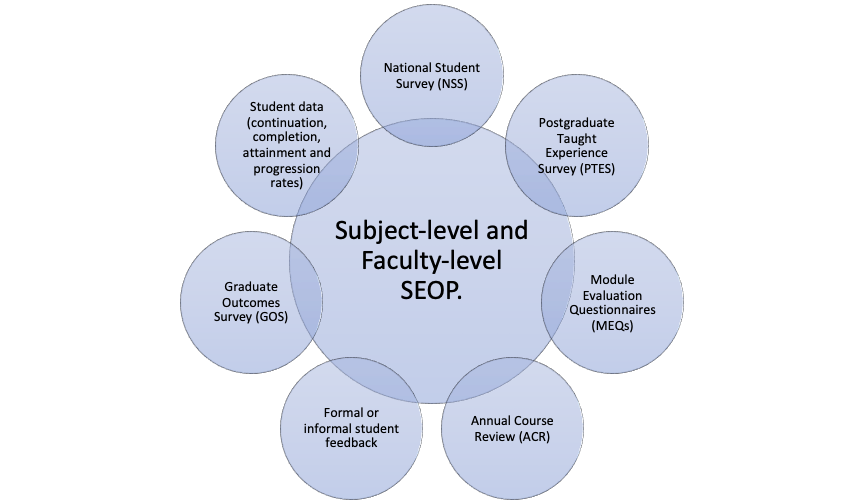
It is a strength of the SEOPs that they encourage us to consider the student journey in a holistic way. As student experience and outcomes are so closely connected, our planning must embrace and bring together both. SEOPs cover National Student Survey (NSS) planning, but go beyond this to look also at the context of outcomes. Compiling evidence from a range of sources and looking at trends in this evidence enables a much richer understanding of what our students experience, the differences in experience and outcomes for different student groups and what might be contributing to those gaps and inconsistencies.
The evidence on student experience includes the NSS, but also the Postgraduate Taught Experience Survey (PTES), Module Evaluation Questionnaires (MEQs) and formal or informal feedback from our student reps and the wider student voice.
Evidence for student outcomes includes continuation rates into second year, degree completion, awarding gaps in attainment and progression rates into graduate employment or further study. This includes race equity dimensions (attainment and awarding gaps). With progression informed by data from the Graduate Outcomes Survey (GOS), many colleagues will have helped this summer with work overseen by Emily Huns in Careers, Entrepreneurship and Employability (CEE) designed to connect to, and support, our recent graduates.
For academic colleagues (Heads of Department/School, subject leads and Faculty Leads) working closely with the SEOPs, the Power BI dashboards developed by the Planning Team make much of this information significantly easier to access and interpret. The Research & Evaluation Team have supported the Faculties through planned or bespoke sessions.
At the subject level
Subject/departmental SEOPs ensure that detailed analysis of data and the development of actions take place close to the relevant students and courses. This is important as experiences and challenges vary between disciplines. Priorities and gaps will vary across the University.
Each SEOP identifies a focused set of priorities based on the available evidence. These priorities might relate to all students or particular student cohorts, such as postgraduate taught students (PGT) or international students or student groups identified in our Access and Participation Plan.
For each priority, the SEOP sets out an objective, the actions intended to achieve it and details of the expected impact. Evaluation is also a part of the SEOP process. For colleagues developing their plans, key considerations include the proposed actions, why they will work, and the indicators that will ensure that progress can be monitored. Subject-level SEOPs inform (and are informed by) the Faculty SEOP, to ensure clear lines of sight and connection between local and Faculty priorities. SEOPs also inform, and are informed by University-level priorities, and are an important part of our whole institution approach to the Teaching Excellence Framework (TEF).
SEOPs as living documents
The SEOPs are designed to be ongoing living documents. They are monitored, stress-tested and updated throughout the academic year, not merely completed and set aside. The focus is on forward planning and enhancement, responding to trends in the data, and not merely a reaction to a single year of data.
Subject-level SEOPs feature on the agenda at every Board of Study, with plans available for note and/or discussion at Faculty Education Committee. There are two formal review points: January/February, when Higher Education Statistics Agency (HESA) data becomes available and this triggers Annual Course Review (ACR), and July/August, when NSS and PTES results are released. The Faculty SEOP captures actions at a Faculty level, is presented at Faculty Education Committee, and then tabled for discussion at University Education Committee. These arrangements ensure visibility and oversight, but also provide opportunities for continuous development, the sharing of best practice across the institution and evaluation of findings.
Integrating processes
It is important that the SEOPs process is efficient and effective, avoiding duplication and leading to meaningful enhancement of student experience and outcomes. To this end, it is crucial that SEOPs and Annual Course Review (ACR) are integrated effectively and are part of the same process. The ACR gives us an annual snapshot across the ongoing experience and outcomes data and an opportunity to reflect on the SEOPs. Once a year, we ask Course Convenors to analyse and respond to the evidence relating to their courses. This data-led exercise is needed to ensure we meet the regulatory requirements for the quality of our courses. It produces reviews of individual and cognate courses within disciplines and it leads to an ACR Overview Report, which feeds back into the SEOP. This Faculty-level report allows for the sharing of good practice and the escalation of issues (as appropriate) to FEC or UEC. For Course Convenors, the exercise is inherently reflective, looking back at the available data. The action-planning that was formally a part of the ACR process, is now incorporated within the Student Experience and Outcome Plans (SEOP) for each subject.
As the processes develop, we will look to move increasingly to a single planning process, wherever possible. Achieving the smooth alignment of ACR and SEOPs requires that HoDs/subject leads work closely with Course Convenors to ensure that actions relevant at a Course level are incorporated appropriately in the subject SEOP. At a Faculty level, the priority is that there be minimal duplication of work or tasks. The value of the SEOPs lies not in the production of another action plan or document, but in the continuing process of bringing evidence and student voice together, agreeing meaningful priorities, taking targeted action and evaluating impact. Used in this way, SEOPs at Sussex provide us with a shared and sustainable framework for improving the experience and outcomes of all our students.
New for 2026/27 – what to expect
This year we are focusing on communicating about the SEOPs to raise awareness of what they are, how they work and what they are intended to deliver. We are also working on SEOPS and ACR integration with the Education and Students Leadership Team and Educational Enhancement (EE). This is led by Professor Lara McMurtry and the Associate Deans for Education and Students (see contact links below), working with Educational Enhancement and the Deputy Director of Academic Services, Denise Cooper.
Further resources
Metrics that the SEOPs draw upon
Contact links
Faculty-Level SEOPs for 2025-2026 (for access to current SEOPs please contact your Associate Dean for Education and Students):
- Faculty of Science, Engineering and Medicine: Professor Zahid Pranjol
- Faculty of Media, Arts and Humanities: Dr Jason Price
- Faculty of the University of Sussex Business School: Dr C. Rashaad Shabab
- Faculty of Social Sciences: Dr Elizabeth Mills
This post was written by Professor Lara McMurtry in collaboration with Professor Kate O'Riordan, Professor Graeme Pedlingham and Educational Enhancement.